Branded Caller ID: What It Is and Whether It Protects You
By Josh C.
Branded caller ID is a vetted business name, logo and short call reason that appear on the recipient's phone before the call is answered.
But if your phone shows a familiar company's name, does that mean you should trust what the caller asks you to do? That's the gap a recognizable display can't close by itself. Business identity, number authentication and safe behavior are different signals, and understanding the difference helps you answer useful calls without handing a stranger your trust.
Branded Caller ID Explained in Plain Terms
Ordinary caller ID may give you only a number, a basic name or an unknown-caller notice when identifying information isn't available. Branded caller ID adds context that a string of digits can't provide: which business is calling and what the conversation is supposed to concern.
Think of ordinary caller ID as a handwritten name tag and branded caller ID as a badge issued after an identity check. The badge is more informative, but it isn't a promise about everything its holder might say.
What appears on screen with and without branding
| Element | What the recipient sees | Who verifies it | Example |
|---|---|---|---|
| Business name | Registered brand or doing-business-as name | Carrier vetting under the CTIA Branded Calling framework | Home Depot |
| Logo | Brand image on supported phones | Vetted together with the business name | Retailer brand mark |
| Call reason | Short purpose line shown before pickup | Validated through the business submission | Order Ready for Pickup |
| Verification indicator | Signal that the number passed authentication | STIR/SHAKEN attestation | A verification checkmark |
| Ordinary caller ID | Bare number, or unknown or hidden | No brand verification | 555-0123 |
A checkmark and a logo aren't interchangeable. The checkmark concerns authentication, while the logo and business name provide recognizable identity information. A phone may show some of these elements without showing all of them.
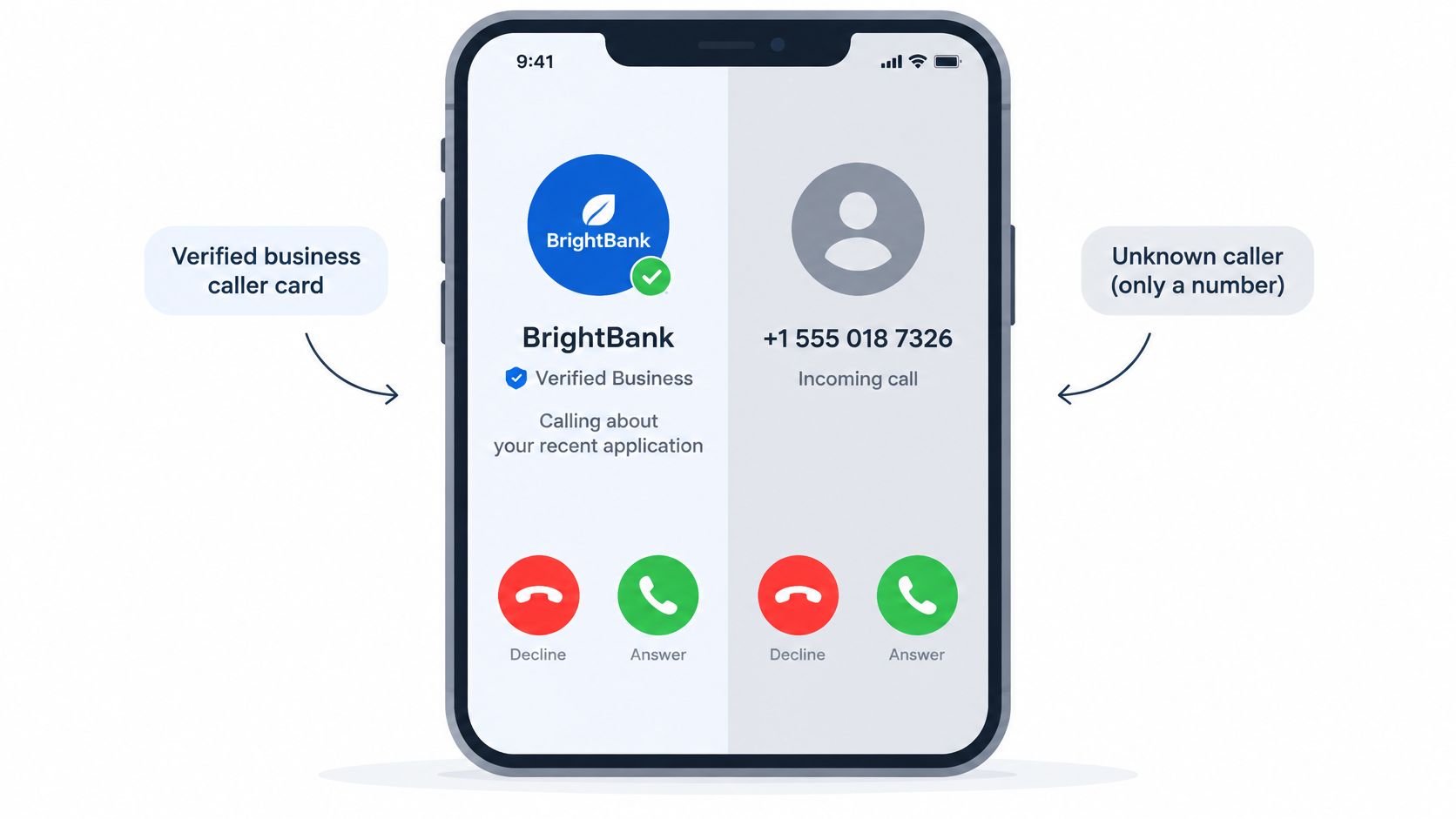
The contrast is easiest to recognize on an incoming-call screen.
Read the display as context
Say you've ordered supplies from a retailer. Its name and logo appear with the reason Order Ready for Pickup, giving you something concrete to compare with your actual purchase.
The displayed identity should represent the business's legal, brand or doing-business-as name, not a vague label chosen to sound reassuring. A generic customer-service label tells you less than the specific retailer you're expecting.
Practical rule: A name, logo and reason show that branding is being displayed. A bare number means you haven't received that context, not that you've received evidence of a scam.
How a Branded Call Travels to Your Phone
A branded call involves more than looking up a name in a telephone directory. The business supplies identity information, intermediaries validate it, and participating networks deliver the information to a compatible phone.
The CTIA Branded Calling Best Practices describes a framework in which submitted names, logos and call reasons undergo vetting before distribution. Its name rules require a legal, brand or doing-business-as identity registered in at least one U.S. jurisdiction, without deceptive wording, misleading information or hyperlinks.
Follow the identity information
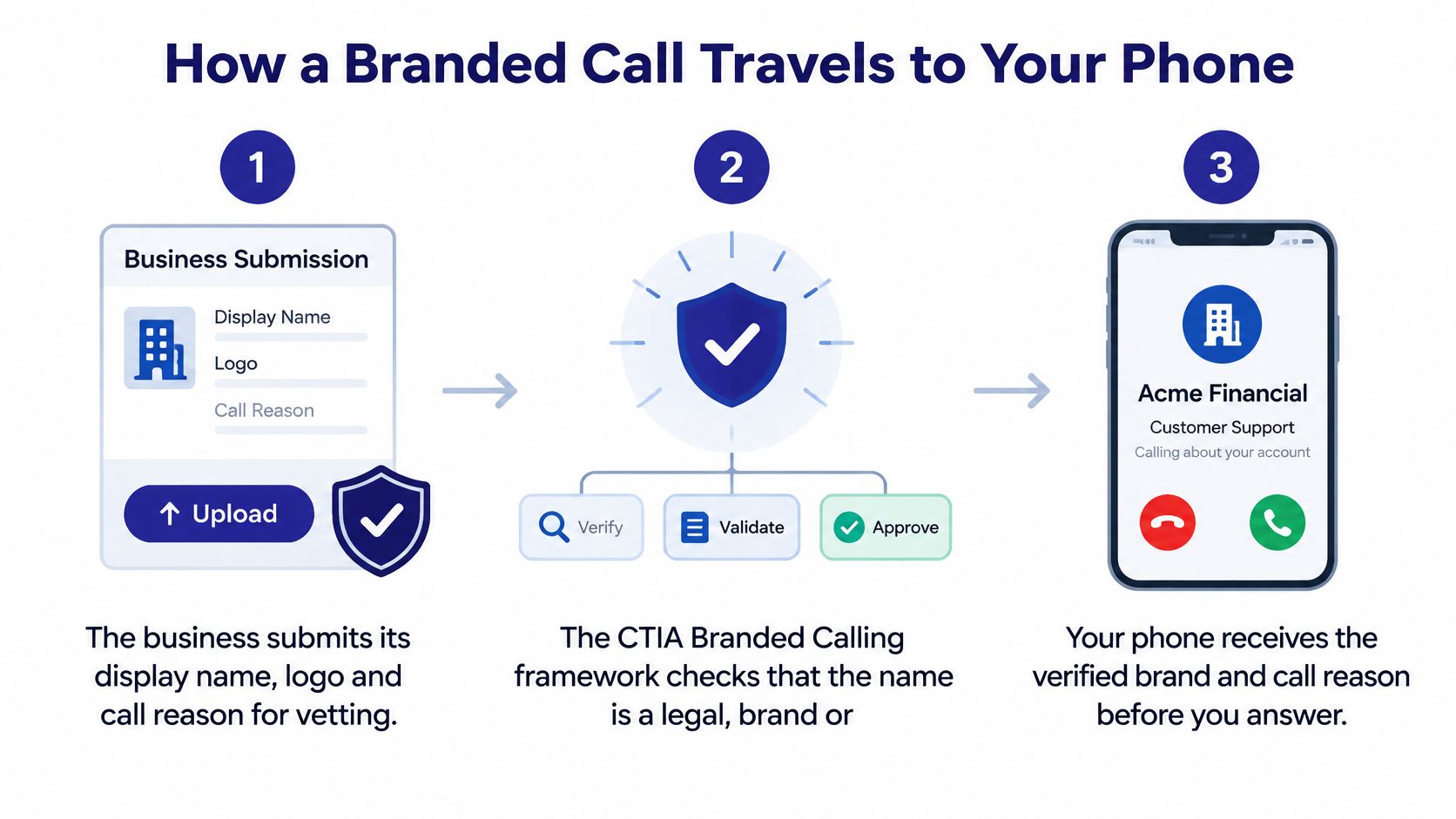
The business submits its identity. It provides its display name, logo and intended call reason for vetting. This gives the service specific information to check rather than accepting whatever text a caller wants to display.
The framework checks the submission. The business name must meet the identity rules, and the branding must accurately represent the caller. Specificity matters: a retailer's actual name is more useful than a broad label such as Customer Service.
Participating networks receive the validated branding. Rich Call Data supplies the visual fields, including the business name, logo and short purpose line. Those fields explain the claimed business context before you answer.
The originating provider authenticates the number relationship. STIR/SHAKEN digitally signs calling information to establish the provider's attestation about the caller's authorization to use the number. That authentication isn't an assessment of the conversation's honesty.
The receiving network and phone handle presentation. The receiving carrier processes the authentication and associated information, and the handset displays supported branding. Network participation and device support determine which elements reach the screen.
The process can be summarized visually, although the underlying checks involve separate systems.
Authentication and context do different jobs
A useful analogy is a passport and a travel-purpose entry. One concerns the document's authenticated origin; the other explains why someone says they're traveling. Neither predicts how that person will behave after arrival.
Likewise, STIR/SHAKEN concerns number authorization, while Rich Call Data supplies business context. Don't interpret an authentication indicator as proof that every displayed word or spoken request has been independently approved.
These components can succeed or fail separately. You might receive a business name without its logo, or an authenticated call without a branded presentation. For help distinguishing a saved contact name from information delivered by the network, our guide to caller ID on your phone explains the basic display differences.
Why Branded Calls Get Answered More Often
An unfamiliar number gives you little reason to interrupt your day. Hiya's findings below illustrate the problem: 86% of unknown calls go unanswered, even though some will concern appointments, deliveries or support requests the recipient wants.
Research on branding and answer behavior
| Finding | Figure | Source |
|---|---|---|
| Unknown calls left unanswered; consumers who want businesses to identify themselves through caller ID | 86%; 73%, respectively | Hiya 2026 State of the Call |
| Answer rate for branded calls versus unbranded calls | 62% versus 20%, in an analysis of approximately 720,000 calls | Industry analysis reported by Aloware |
| Surveyed U.S. adults who would answer with enterprise name, logo and reason shown | 78% | Transaction Network Services and Kantar, 2025, summarized by TransNexus |
| Respondents influenced by pre-answer indicators; respondents often or sometimes missing unexpected legitimate or expected business calls | 74%; 51%, respectively, among 2,201 U.S. registered voters surveyed in August 2024 | Morning Consult branded-calling survey |
Recognition makes the decision easier
The answer-rate comparison is striking, but its scope matters. It describes calls in an industry-reported analysis, not a guaranteed result for every business or recipient.
The practical explanation is straightforward. Say you're waiting for a clinic to confirm an appointment, but you don't have its outbound number saved. A recognizable clinic name and appointment-related reason make it easier to connect the call with something you already know.
The consumer surveys measure something different: what people say would influence their decision. They help explain why businesses adopt branding, but stated willingness to answer isn't the same as observed pickup behavior.
For someone who frequently misses important calls, useful context can reduce the need to choose between answering every stranger and ignoring everyone unfamiliar. For a caregiver, it can also make it easier to explain why a particular call might be worth answering without teaching a loved one to trust every polished display.
Greater willingness to answer is an engagement result. It isn't, by itself, evidence that fewer people will be defrauded.
Businesses still need responsible calling practices. Accurate reasons, stable number ownership, manageable outbound volume and attention to complaints help avoid confusing recipients or triggering unwanted-call classifications.
A deceptive or compromised call that appears convincing could also benefit from a recipient's increased willingness to answer. That's why answer rates and fraud reduction must be evaluated separately, rather than treating improved recognition as a complete security outcome.
What Branded Caller ID Cannot Prove
A verified name does not mean a safe request. Someone can establish a business identity or an authorized relationship with a telephone number without earning permission to collect your password, move your money or control your computer.
Separate the questions in your mind: Is the number authorized? Which business identity has been validated? Is the caller asking me to do something safe and appropriate?
Common claims about branded calls, checked
| Common belief | What is actually true | Why it matters |
|---|---|---|
| A verified name proves the call is safe | Branding identifies who claims to be calling, not whether their request is safe | Number authorization doesn't establish intent |
| Branding follows the call everywhere | Authentication information can be lost on non-IP portions of a call path | A familiar route can deliver incomplete identity signals |
| Every phone shows the same branding | Support differs by network, carrier and country | Recipients may see different displays for the same business |
| Spoofed calls cannot show a brand | Offenders can fake displayed names or numbers; a familiar label alone isn't proof of vetted branding | Appearance and verified provenance aren't the same |
| An unbranded call is probably a scam | A legitimate caller may use a route or service without branding support | Missing branding isn't evidence of fraud |
Missing information isn't a verdict
The FCC's December 2025 caller-ID proposal addressed authentication information being lost when calls traverse non-IP network segments. A proposal identifies a regulatory issue and potential response; it shouldn't be mistaken for proof that every network has already fixed the problem.
Coverage creates another limitation. The FCC proceedings on caller-ID improvements discuss incomplete delivery, interoperability questions and overseas-originated calls. International routing and legacy infrastructure can complicate the information a recipient sees.
If an expected business calls without its usual logo or reason, treat it as unbranded, not automatically fraudulent. Let it leave a message, then use a number you already trust to confirm the matter.
Judge the request separately
A legitimate business's display can also change when carriers reassess its traffic. Calling patterns, high volume or complaints may contribute to unwanted-call labels, so yesterday's clean presentation doesn't guarantee today's display.
Our explanation of caller verification helps distinguish identity checks from decisions about whether to act. The useful habit is to evaluate the request on its own merits: an unexpected demand for sensitive information deserves scrutiny even when the screen looks familiar.
Privacy and Accountability Questions to Ask
A trustworthy calling system needs an accountable provider behind the authentication. A business logo doesn't tell you which company made that decision or which organization handles the associated information.
The FCC's 2025 caller-ID authentication rules, effective September 18, 2025, allow providers to outsource technical signing while retaining responsibility for the attestation decision. Calls must use the certificate of the provider with the legal implementation obligation, and covered providers must obtain a Service Provider Code token from the STIR/SHAKEN Policy Administrator before obtaining a certificate.
Ask about responsibility and information
Turn those mechanics into practical questions:
- Which company signs the calls? Identify the responsible voice provider, not just the vendor supplying a logo or dashboard. Outsourcing the technical work shouldn't obscure accountability.
- Who validated the business name and reason? Look for a clear explanation of identity checks, correction procedures and responsibility for misleading submissions.
- What information is stored, shared or displayed? Distinguish public business branding from telephone numbers, screening transcripts, recordings and call histories.
Check what screening requires
A business identity is public by design. Your personal call history shouldn't be public by default. Screening services that answer calls necessarily process what callers say during screening; services that analyze conversations after pickup also process content during those calls.
Before enrolling, review whether the service retains audio or transcripts, who can access them, how deletion works and which permissions you're granting. Don't assume that call screening, call recording and ongoing conversation analysis all have identical privacy implications.
Our screening process answers unknown callers and asks who they are and why they're calling. People already saved in your contacts ring normally. Those operational details help you understand when screening happens, but they don't replace reviewing a service's privacy terms and your own settings.
Choose protection you understand well enough to explain to the person whose phone you're helping manage.
Spot the Scam and Confirm Before You Act
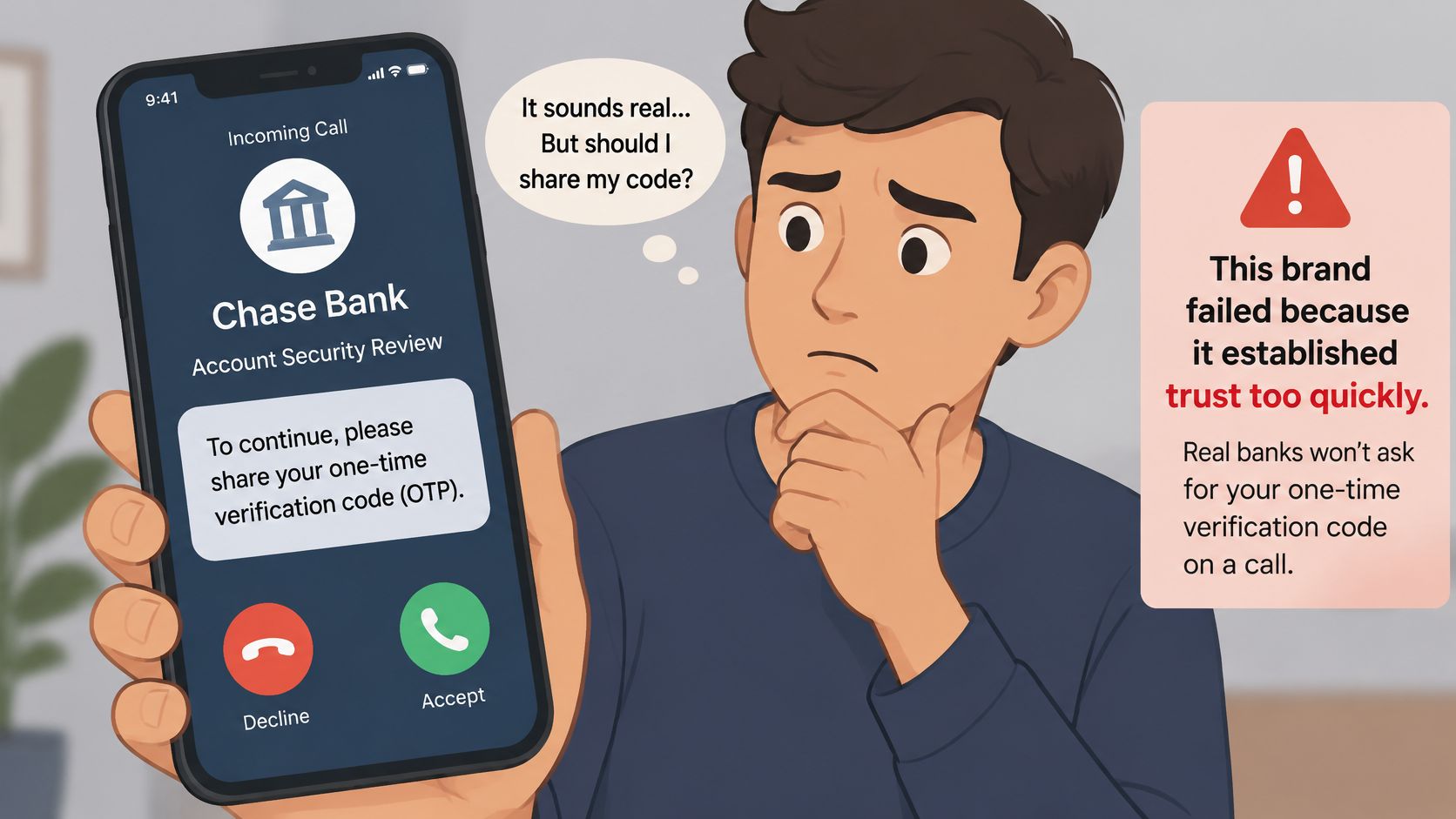
Say your phone displays your bank's familiar name and the reason Account Security Review. After you answer, the caller says someone is draining your account and asks you to read out a one-time verification code.
The danger is the request. A reassuring display hasn't established that this person should receive a code that could authorize access or a transaction.
The following illustration shows how a familiar banking identity can make an alarming call look credible.
Notice what the caller wants
Unwanted calls remain a substantial problem: the FTC's Fiscal Year 2025 National Do Not Call Registry Data Book reported more than 2.6 million consumer complaints and over 258 million active registrations. Caller-ID spoofing lets offenders fake the name or number shown on a recipient's phone, making a familiar-looking display insufficient on its own.
Watch for requests that transfer control from you to the caller:
- Verification codes or passwords. An inbound caller shouldn't receive a code that grants access to your account, even if they describe it as a cancellation or security check.
- Account details or immediate payment. Don't disclose account numbers or move money because someone claims your funds need protection.
- Remote access. Decline requests to install software, share your screen or let a stranger operate your device.
- Urgency and secrecy. Pressure to act immediately, stay on the line or avoid discussing the call with family is a reason to stop.
A claimed support role can be especially confusing when the caller mentions technology you own. If someone offers unsolicited help connecting home devices, end the call and consult documentation independently. For example, Tech Today's guide to using Siri with a Nest thermostat lets you investigate compatibility without giving an unexpected caller access to your home accounts.
Use a pause-and-confirm checklist
Treat the name, logo and reason as a claim, not permission. Ask whether the call fits something you initiated. A polished presentation shouldn't change your rules for protecting money or account access.
Hang up and call through a trusted channel. Use the number on your bank card, an official statement or a website you access independently. Don't use a callback number supplied during the suspicious conversation, and don't assume returning the number in your recent-call list reaches the organization you intended to contact.
Never read out a code, password or account number to an inbound caller. If someone says a code is needed to stop fraud, stop the conversation instead. Open the organization's app yourself or contact its published support channel to check for a real alert.
Decline when the reason matches no transaction you recognize. An unexpected delivery, refund or account review deserves independent confirmation. You don't have to prove the caller is a criminal before refusing to continue.
Report the call to the FTC or your carrier. Save the displayed number, approximate call time and what the caller requested, without engaging again to gather more evidence. If you already shared information, contact the affected organization through a trusted channel and explain exactly what happened.
A caller may use impressive titles, security terminology or a department name to discourage questions. Our guide to official-sounding names explains why authoritative wording shouldn't override your normal verification habits.
You're allowed to end a call before you know whether it's genuine. Independent confirmation is a precaution, not an accusation.
For a closer look at call protection, watch this demonstration.
Add screening without giving up judgment
Different safeguards address different parts of a call. Branding helps you recognize the claimed business, authentication helps carriers assess number authorization, and conversational screening evaluates what the caller says.
Gini Help is one optional layer. Unlike blockers that only check databases of known spam numbers, we answer unknown calls ourselves, ask who's calling and why, and ring you through when the call is real, according to your setup. Screening happens before your phone rings, but it can't identify every scam or guarantee that every caller is safe.
Our Help plan suits readers whose main concern is unwanted calls and scams. Plus plans add Live Scam Detection, which keeps listening after an unknown call is answered and warns during the conversation if it turns dangerous, including requests for verification codes or account numbers and pressure to act immediately. You can download the app from Google Play or the App Store.
For a family member, agree on a simple response before an alarming call arrives: end the conversation, contact the organization independently and discuss any unusual request with someone trusted. Keep important callback numbers somewhere easy to find. Preparation makes it easier to pause when a caller tries to rush the decision.
Gini Help screens unknown callers before your phone rings and helps you understand who's calling and why, adding a conversational check beyond branded caller ID. Visit Gini Help to explore call screening and choose protection that fits how you use your phone.