What Is a Spam Risk? a Plain-English Guide for 2026
By Josh C.
A spam risk is the estimated chance that an unsolicited call, text or email will lead to harm such as lost money, stolen codes, malware or exposed personal data, and the score ranks that chance before you act. It rests on three inputs, who is contacting you, what they want, and how hard they push.
That distinction matters because a flagged contact can still be real. Your job isn't to block everything on reflex. It's to judge how much caution a contact deserves, then verify it through a channel you trust.
What a Spam Risk Score Actually Measures
What is a spam risk? It's the estimated chance that an unsolicited call, text or email will cause harm, such as lost money, stolen one-time codes, malware or exposed personal data.
Think of a good doorman. He doesn't keep a list of every bad person in the city. He checks who's asking, what they want, and whether their story holds up before he opens the door.
A score works the same way. It asks three questions. Who's contacting you, and how certain is that identity? What does the contact want you to do? How hard does it push for a fast response?
Volume Isn't the Same as Risk
Don't confuse spam volume with spam risk. A hundred promotional emails can be harmless. One quiet message can be dangerous.
That's why scoring combines likelihood and impact. A low-volume message asking you to reset a password can deserve a higher score than a pile of sales offers. The first one is built to take something valuable from you, so the possible damage is bigger even if it arrives only once.
Practical rule: Treat the score as a warning level, not a verdict on the sender.
The score tells you how careful to be before you click, answer, reply or pay. It doesn't prove the sender is a criminal, and a low score doesn't prove a request is safe. If you remember that one point, the rest of the labels on your phone get easier to read.
Why Spam Risk Is a Money Problem, Not a Nuisance
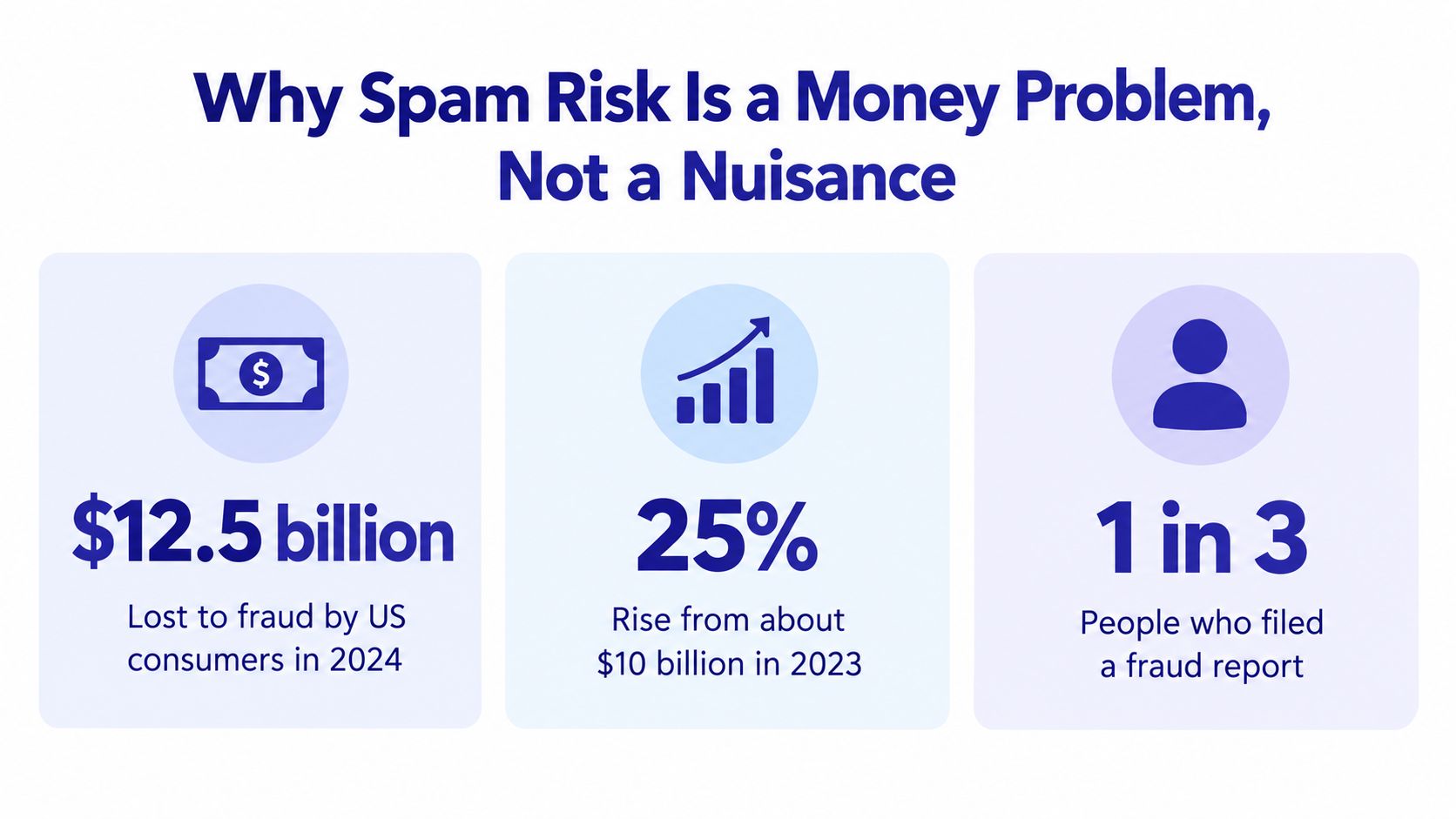
Consumers in the United States reported losing $12.5 billion to fraud in 2024, a 25% increase from approximately $10 billion in 2023, according to the FTC's 2024 consumer data book. One in three people who filed a fraud report said they lost money, compared with one in four the previous year, in that same FTC reporting.
The scale helps explain why an unwanted contact deserves more than an eye roll.
Phone contact carries particular weight. People who interacted with scammers by phone reported a median loss of $1,500, according to the FTC's summary of top scams in 2024. A live voice can answer your doubts, adjust the story, and keep pressure on you in real time.
Older Adults Lose More When a Scam Succeeds
People aged 60 and older filed 421,031 fraud reports that included age information in 2024, and 109,580 indicated a monetary loss, according to the FTC report on protecting older consumers. Their reported losses totaled nearly $2.4 billion, up from about $1.9 billion in 2023 and roughly $600 million in 2020, in that FTC report. Adults aged 80 and over reported a median individual loss of $1,650 in the same FTC age breakdown.
This short video adds useful context on how these contacts unfold.
The FBI recorded 859,532 complaints and more than $16 billion in reported internet crime losses in 2024, with phishing and spoofing among the three most frequently reported categories, according to the FBI's 2024 Internet Crime Report announcement.
The chain is simple. A contact exploits trust or urgency, sends you to a fake site or payment channel, then takes credentials, money or personal data. Impersonators often pose as banks, government agencies, businesses or tech support providers, so a familiar name shouldn't lower your guard.
How Spam Risk Changes Across Phone, Email and Text
Each channel gives a scammer a different lever, so the same story doesn't carry the same risk everywhere. The table below compares the three main routes.
| Channel | Share of 2025 Loss Reports | Typical Harm Pattern | Reported Median Loss |
|---|---|---|---|
| Phone call | 11% | Live pressure, caller-ID spoofing, requests for codes or payment | $1,500 for people who interacted with scammers by phone in 2024 |
| 10% | Lookalike senders, fake invoices, links that harvest logins | No median for this channel in the cited data | |
| Text message (SMS) | 7% | Urgent alerts with links about deliveries, bank accounts or account locks | No median for this channel in the cited data |
Those shares come from fraud reports indicating a financial loss in 2025, where 11% identified a phone call, 10% identified email, and 7% identified text messages, according to the FTC data spotlight on reported scam losses.
Phone Risk Is About Live Pressure
A caller can spoof caller ID, impersonate an organization, and respond when you hesitate. A static list of bad numbers can't capture that conversation.
Severity shows up in older adults' losses. Median individual losses were $2,210.77 when fraud began by phone, compared with $650 when it began on social media, according to the FTC's annual report to Congress on protecting older adults.
Email risk looks different. It's built on lookalike senders and links that harvest logins. Email was the most common reported contact method for fraud in 2024, followed by phone calls and text messages, according to the FTC press release on 2024 fraud losses. Text risk is shorter and faster, often an urgent alert with one link and little time to think.
Contacts also cross channels. A text can lead to a call, and an impersonator can claim to represent several organizations in one sequence. That's why real-time fraud detection that follows context across contacts matters when you judge the next message. The earlier contact may explain why this one feels convincing.
The Signals Behind Every Spam Risk Score
One odd feature rarely makes a contact dangerous on its own. A score rises when several signals stack together.
| Signal | Where It Appears | Why It Raises the Score |
|---|---|---|
| Caller ID not verified under STIR/SHAKEN | Phone calls | Shows the number wasn't authenticated; verified IDs can still be scams |
| Urgency, secrecy or a deadline | Phone, email, text | Pushes you to act before you can check |
| Request for a one-time code or password | Phone, text, email | Hands over access to an account |
| Request to install remote-access software | Phone | Gives the caller control of your screen and device |
| Request for payment by gift card, wire or crypto | Phone, text, email | Moves money to a channel that's hard to recover |
| Reply-to address differs from the sender | Sends your reply to a different party | |
| Link redirects or uses a lookalike domain | Email, text | Leads to a fake login or payment page |
| Claims to be a bank, agency or delivery firm | All channels | Borrows trust to lower your guard |
Identity Signals Only Answer One Question
STIR/SHAKEN is the framework providers use to authenticate caller-ID information on Internet Protocol networks, and rules adopted in 2020 required implementation on IP portions of voice networks by June 30, 2021, according to the FCC guide to call authentication. That check helps show whether caller-ID information matches the transmitting number.
It doesn't show whether the speaker's story is true. A verified number can still belong to a scam operation or a compromised account, so you still need to judge the request itself.
Pressure and Request Signals Carry More Weight
Pressure signals try to remove your time to think. Watch for artificial deadlines, demands for secrecy, and a story that suddenly moves from one impersonated organization to another.
Request signals matter most because they turn contact into loss. A one-time code gives away account access. Remote-access software gives away your screen. A payment request moves money before you've had time to check.
For email and text, look at details you can verify. Does the reply-to address differ from the sender? Does the link redirect, or use a domain that looks slightly different from a trusted brand? Does the message match a transaction you really expected?
A score can change during a call, because the risk changes when a friendly conversation turns into a request for a code or payment.
That's why checking only the number before the call connects isn't enough. The most important signal may appear two minutes into the conversation.
What a High Risk Label Means and What It Does Not
A label answers how careful should I be, not who is this. Confusing those two questions causes most false alarm frustration.
| Label | What It Tells You | What It Does Not Tell You |
|---|---|---|
| Spam or unwanted | Likely marketing or a robocall | Whether the contact is fraud or safe to trust with information |
| Elevated or caution | Some signals present, not enough to confirm fraud | Whether the caller is who they claim to be |
| High risk | Several strong fraud signals stacked together | That the caller is definitely a scammer or that the organization is fake |
| Verified or known | Caller ID authenticated or contact saved on your phone | That the request itself is legitimate or safe to act on |
| Held or quarantined | Contact kept from reaching you until reviewed | That the message was deleted or lost; you can check it later |
A False Alarm Can Still Be Useful
Say a caller claims to be your doctor's office with a lab result. The call uses urgent language and asks for a one-time code to open your patient portal, so your phone flags it as high risk. You hang up and call the office number from your appointment card. The office is real, and the result is real.
The label wasn't proof of fraud. It correctly spotted a pattern scammers also use, and it pushed you toward a safer route. You lost a minute, not access to care.
That caution matters because impersonation is common in severe cases. Among older adults who reported losing at least $10,000 to a business or government impersonation scam in 2024, 41% said the initial contact was a phone call and 13% said it began with email, according to the FTC spotlight on false alarm scams targeting older adults. The same FTC spotlight notes reported losses of $100,000 or more rose nearly sevenfold from 2020 to 2024, with combined reported losses rising eightfold to $445 million.
A familiar number, local area code or legitimate sounding name doesn't establish trust. Reading the difference between a scam and ordinary spam helps, because unwanted marketing and live social engineering call for different responses.
A high risk label doesn't confirm an organization is fake. A verified label doesn't confirm a request is safe. Use the label as a reason to verify, not as a reason to ignore the contact or comply with it.
Quick Actions When a Contact Is Marked High Risk
When a label appears, slow the moment down. These steps work for a call, text or email, and each one protects a different part of the process.
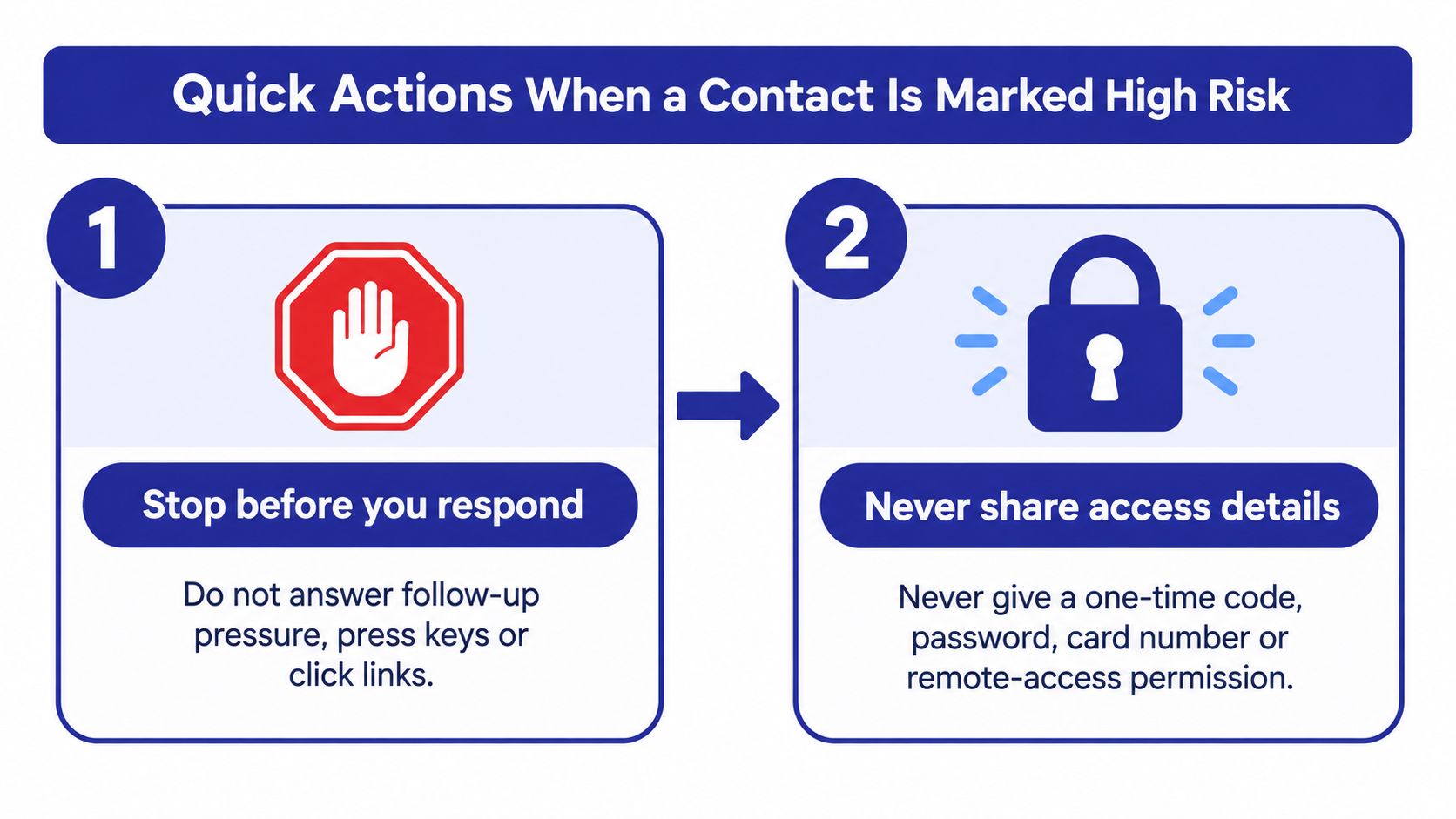
- Stop before you respond. Don't press keys, click links or answer follow-up pressure. Pausing breaks the urgency the contact depends on.
- Never share access details. Don't give a one-time code, password, card number or remote-access permission to an inbound caller or message. This is the error that causes the most damage during a live call.
- Verify through a separate channel. Hang up and call the number on your bank card, the agency's official website, or your account page with the company. Don't use a number the contact gave you, because it can lead back to the same person.
- Refuse hard-to-recover payment methods. Don't pay by gift card, wire transfer or cryptocurrency because a contact demands it. Once that money moves, you have fewer ways to get it back.
- Act fast if you already clicked or shared something. Change the password, turn on multi-factor authentication, ask your bank to freeze affected cards, and review recent statements. Early action can stop a stolen code or login from being reused.
- Report the contact. In the US, forward suspicious texts to 7726 (SPAM), report fraud through the FTC's ReportFraud site, and report internet crime through the FBI's ic3 site. Keep a note of the time and what was said, since details fade quickly.
- Block and keep evidence. Block the number or sender, but keep the message until any dispute is closed. You may need the wording, number or link for your bank or a report.
The Step People Skip Most Often
Step 3 feels awkward, especially if the caller sounds polite or the office turns out to be real. Do it anyway. A legitimate organization can be reached again through its official number, and it shouldn't need you to stay on an inbound call to prove who you are.
Check first: If you do only one thing, call back on a number you found yourself.
A protection app that screens or holds flagged contacts for review can reduce how often you face this sequence under pressure. It doesn't remove the need for verification, but it gives you time to use it.
Set Up Spam Risk Protection Before the Next Call
The steps above work best when screening happens before a risky contact reaches you. You get time to think instead of reacting to a ringing phone.
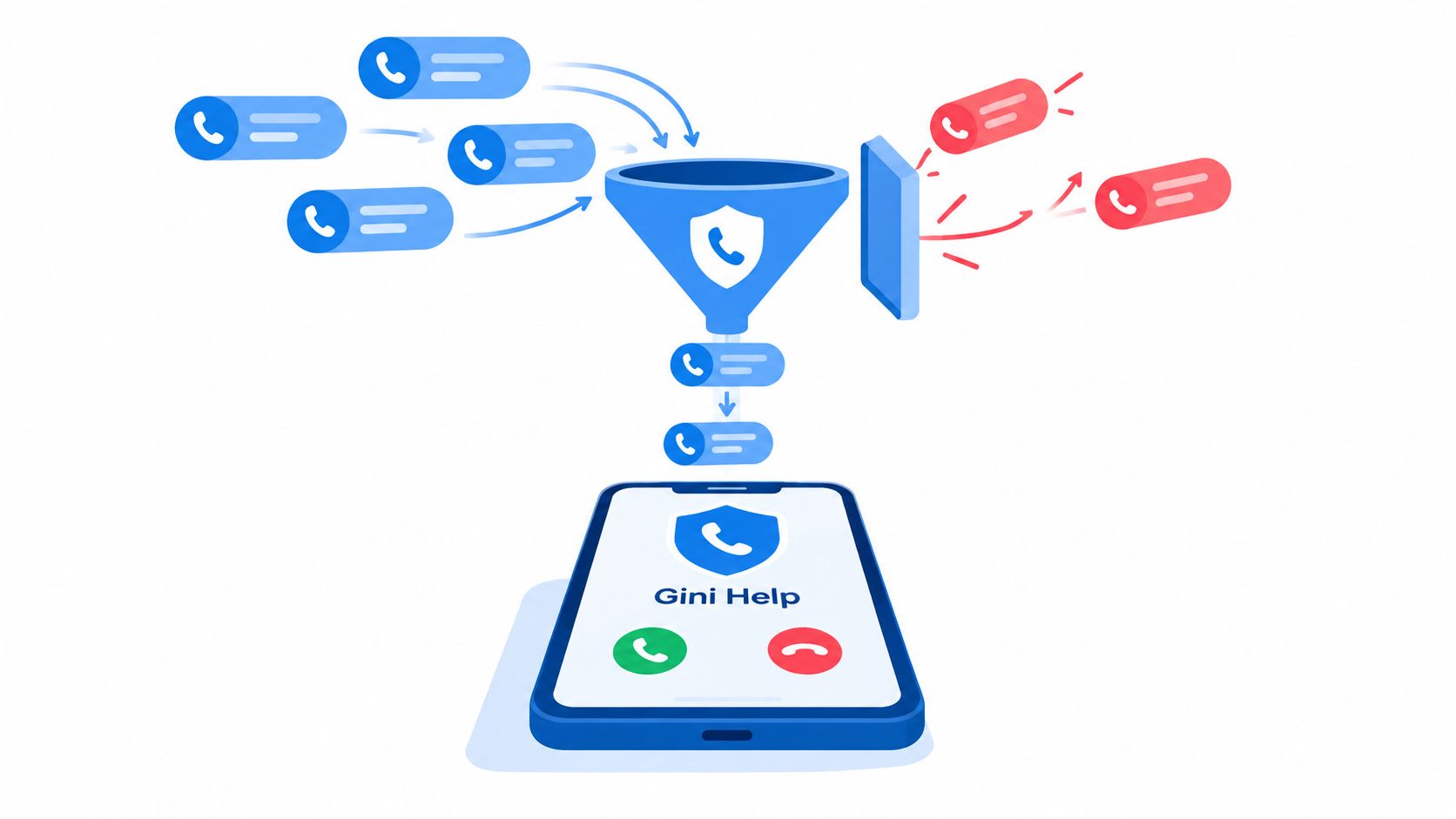
The Gini Help app screens calls, texts and emails in one place for $5.99 per month, with family plans that share threat intelligence across members. Its AI answers unknown calls first, judges whether the caller is legitimate, and connects only calls worth your time. For calls you answer, Live Call Analysis gives a risk score and haptic warnings when threats appear.
You can download it on Google Play or the App Store, and learn more about Gini Help's main site for scam protection. If you're setting up screening for the first time, how spam blockers work in practice explains the mechanics. Keep one rule either way, verify before you trust, every time a high risk label appears.
If flagged calls keep putting you or a parent on the spot, set up screening that answers unknown callers first and warns you during live calls when risk signals appear. Visit Gini Help to see how call, text and email protection can give you time to verify before you trust.