Online Caller ID Spoof: How Scammers Fake Numbers
By Josh C.
Your phone rings while you're preparing dinner. The screen shows your bank's familiar number, or a local area code you recognize from your neighborhood. You answer because the caller ID looks trustworthy. Within moments, the caller says there's suspicious activity on your account and asks you to confirm a code, move money, or stay on the line while a “fraud alert” arrives.
The number may look real, but it can be completely false. An online caller ID spoof changes the identity displayed on your screen without changing the attacker's actual phone connection. Your phone isn't broken, and you haven't necessarily been hacked. Someone is manipulating the information presented to you. You can learn more about how caller identification appears on your device in this guide to caller ID on your phone.
Understanding the Reality of Online Caller ID Spoof
Caller ID was built to help people decide whether to answer. It was never designed to prove who is calling. That distinction matters because scammers now use trusted-looking numbers as the opening move in conversations designed to make you react before you think.
A spoofed call might display your bank, a government office, a doctor's office, or a number with the same local area code as yours. The caller may know your name, mention a genuine company, or refer to a transaction that sounds plausible. Those details can make the conversation feel familiar even when the person behind it has no legitimate connection to the displayed number.
Caller ID spoofing has existed for decades. It became broadly accessible to the public in 2004, when the first mainstream U.S.-wide spoofing service launched online. Before that, access was largely limited to people with specialized telephone-company connections, including ISDN PRI circuits. Collection agencies, law enforcement, and private investigators were already using the practice before web-based services made it easier to scale. The United States later made malicious spoofing illegal through the Truth in Caller ID Act in 2010, reflecting the shift from niche telecom capability to consumer-protection problem. (Background on caller ID spoofing)
Why the screen feels convincing
People naturally treat a familiar number as a shortcut for trust. That shortcut works for ordinary calls, but it fails when the displayed identity can be forged. A local number doesn't prove local origin, and a bank's published number doesn't prove that the bank is calling.
Older adults, caregivers, busy professionals, and small-business teams can all be targeted because the scammer's advantage comes from urgency and distraction. The safest mindset is simple: caller ID is a clue, not authentication.
This article follows the threat from the network mechanics to the legal boundaries, the warning signs, the limits of number blocking, and the role of real-time screening when the caller's voice and conversation may also be synthetic.
How Scammers Manipulate Caller ID Networks
Think of a phone call like a letter. The envelope has a return address, but the sender can write an address that belongs to someone else. The address helps the recipient decide whether to open the letter, yet it doesn't prove who placed it in the mailbox.
A calling number works similarly. The actual calling party and the caller ID shown to the recipient are related, but the displayed identity can be falsified before the call reaches the phone. The Federal Communications Commission explains that caller ID spoofing works when the calling party number or caller ID is falsified at the signaling layer on PSTN or SIP-originated calls, allowing an attacker to present a false, trusted-looking number or name. (FCC explanation of call authentication)
The signaling layer in plain English
The signaling layer carries instructions that help telephone networks route and present a call. It isn't the voice conversation itself. When an attacker inserts a misleading caller identity into those instructions, downstream systems may pass that information along and the recipient's device displays it.
That can happen on traditional PSTN networks or on internet-based SIP calls. SIP, short for Session Initiation Protocol, helps establish and manage voice sessions over IP networks. In practical terms, the caller's voice may travel through several systems, and each system has to interpret the call information consistently.
A newer line of research describes a more complicated weakness. A 2026 paper on SIP semantic ambiguities concluded that ambiguity-based spoofing is widespread in real-world SIP services. Different SIP components can interpret the same crafted message differently, creating a gap that can help an attacker forge the caller identity displayed to the recipient. (Research on SIP semantic ambiguities)
Where authentication helps
The main technical response is STIR/SHAKEN. It uses digital certificates and signed caller ID assertions so participating carriers can verify whether the originating network was authorized to use the number presented in the call. That creates a stronger signal than an unauthenticated display name or number.
Authentication still isn't the same as a guarantee that the caller is honest. A legitimate customer account, compromised provider, or authorized number can still be used in a harmful conversation. Authentication helps answer, “Was this number authorized by the originating network?” It doesn't fully answer, “Is this person's request safe?”
That's why a trustworthy-looking number should never override the caller's behavior. A payment demand, request for a security code, or instruction to ignore an official alert remains dangerous even when the display appears familiar.
The Legal Landscape and Global Impact of Spoofing
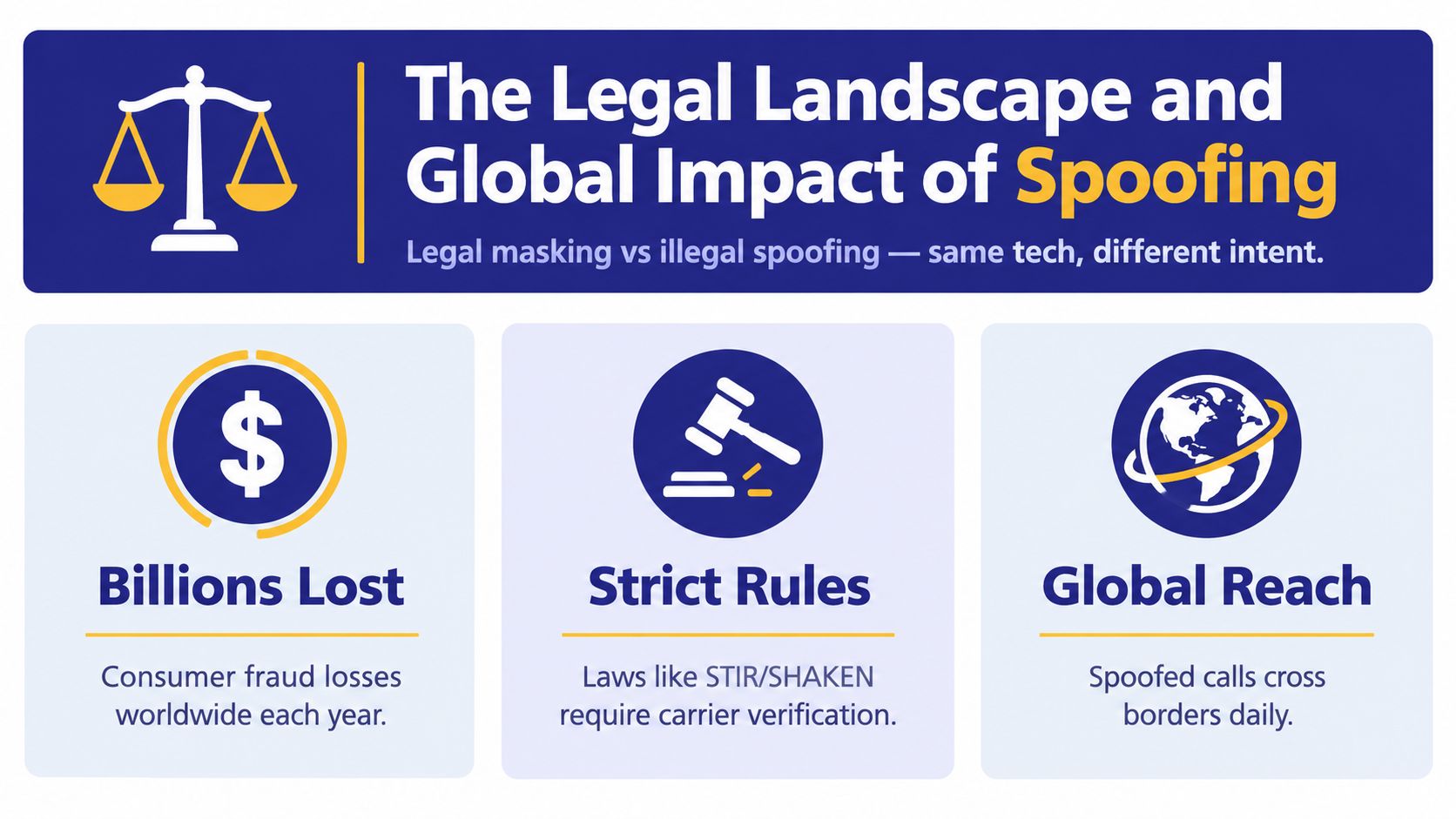
Not every altered caller ID is automatically unlawful. A doctor might use a personal phone while displaying a clinic number, or a business might present a main office number when employees call from different lines. The legal question often turns on intent and harm, not just on whether the displayed number differs from the physical device used to place the call.
The FCC states that malicious spoofing is illegal under the Truth in Caller ID Act when someone causes false or misleading caller ID information to appear with the intent to defraud, cause harm, or wrongfully obtain something of value. Violators can face penalties of up to $10,000 per violation. (FCC enforcement guidance on unwanted communications)
That rule explains why a scam call is more than an annoying technical trick. The false identity helps create authority, and the conversation turns that authority into a request for money, credentials, access, or another valuable action. The FCC also notes that spoofing can be used to trick people into revealing voicemail access or account credentials.
A problem that crosses borders
Europol estimates that spoofing-driven financial fraud and social-engineering scams cause about EUR 850 million in losses worldwide each year. Europol also reports that phone calls and text messages are the primary attack vectors, accounting for roughly 64% of reported cases. (Europol position paper on caller ID spoofing)
The same Europol paper says a survey across 23 countries found significant implementation challenges for anti-spoofing measures, leaving a combined population of approximately 400 million people susceptible to these attacks. That uneven protection makes enforcement difficult. A scammer can place a call through one network, present a number associated with another country, and target a person somewhere else.
The U.S. problem remains large even when some categories improve. AARP reports that 4.3 billion robocalls reached U.S. consumers in July 2026, equal to about 5.8 million calls per hour. AARP also cites YouMail data showing scam calls fell from a peak of 58.5 billion in 2019 to 52.5 billion in 2025, which still represents a substantial volume. (AARP reporting on robocalls)
Reporting a spoofed number can help carriers and regulators identify patterns, but it may not stop the infrastructure behind the campaign. Blocking one displayed number often leaves the attacker free to use another. The legal framework matters, yet personal protection still depends on how you respond during the call.
Recognizing the Warning Signs of a Spoofed Call
A familiar number is not a reason to relax your judgment. Treat an unexpected call as unverified until the caller proves the request through a channel you choose, not through a link, number, or instruction supplied during the conversation.
Start with the first 10 seconds. Ask yourself whether you expected the call, whether the person identifies themselves clearly, and whether they immediately introduce a financial, account, or security problem. You don't need to diagnose the telecom route. You need to notice whether the caller is trying to control your next action.
Behavioral clues matter more than the voice
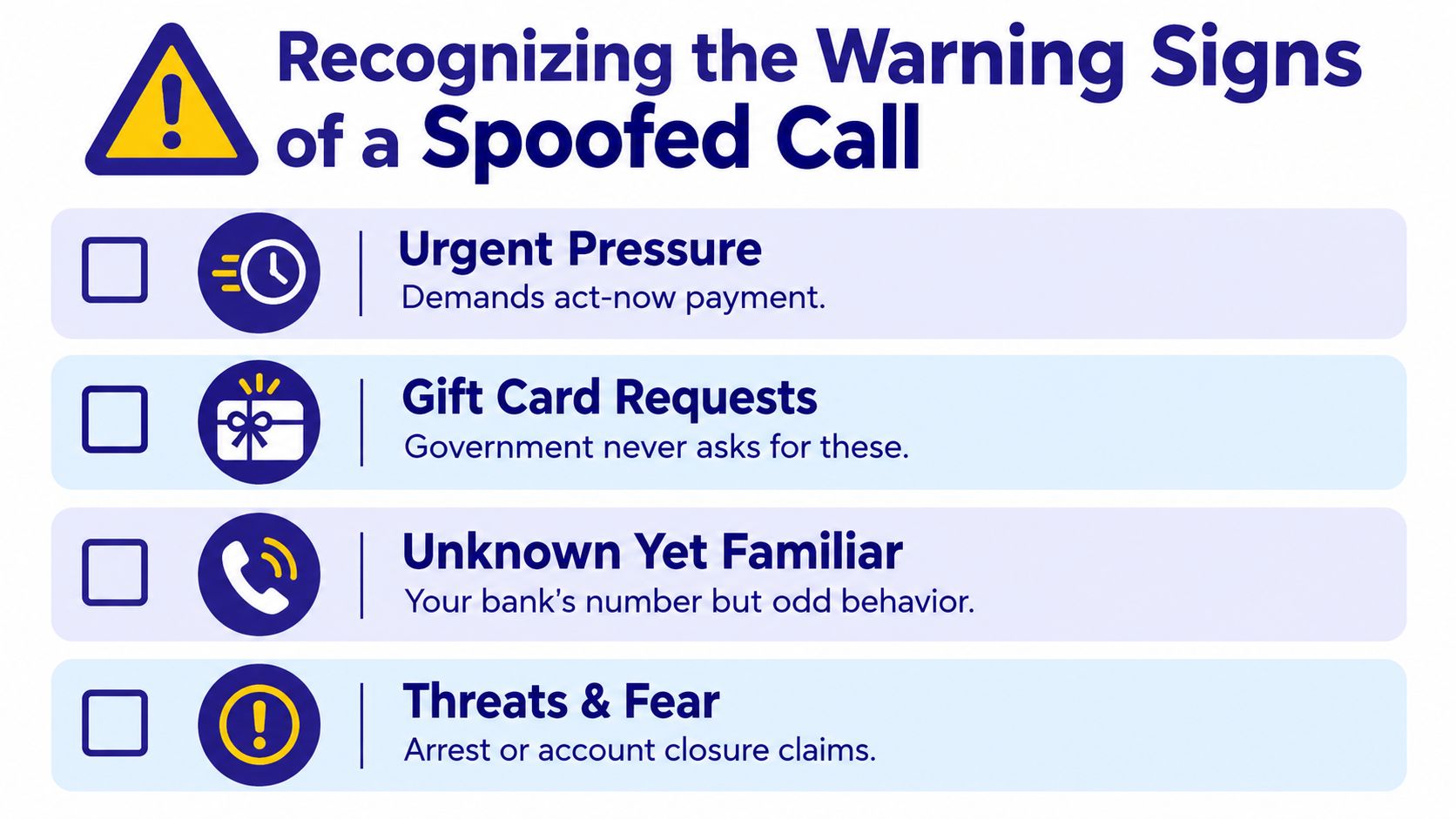
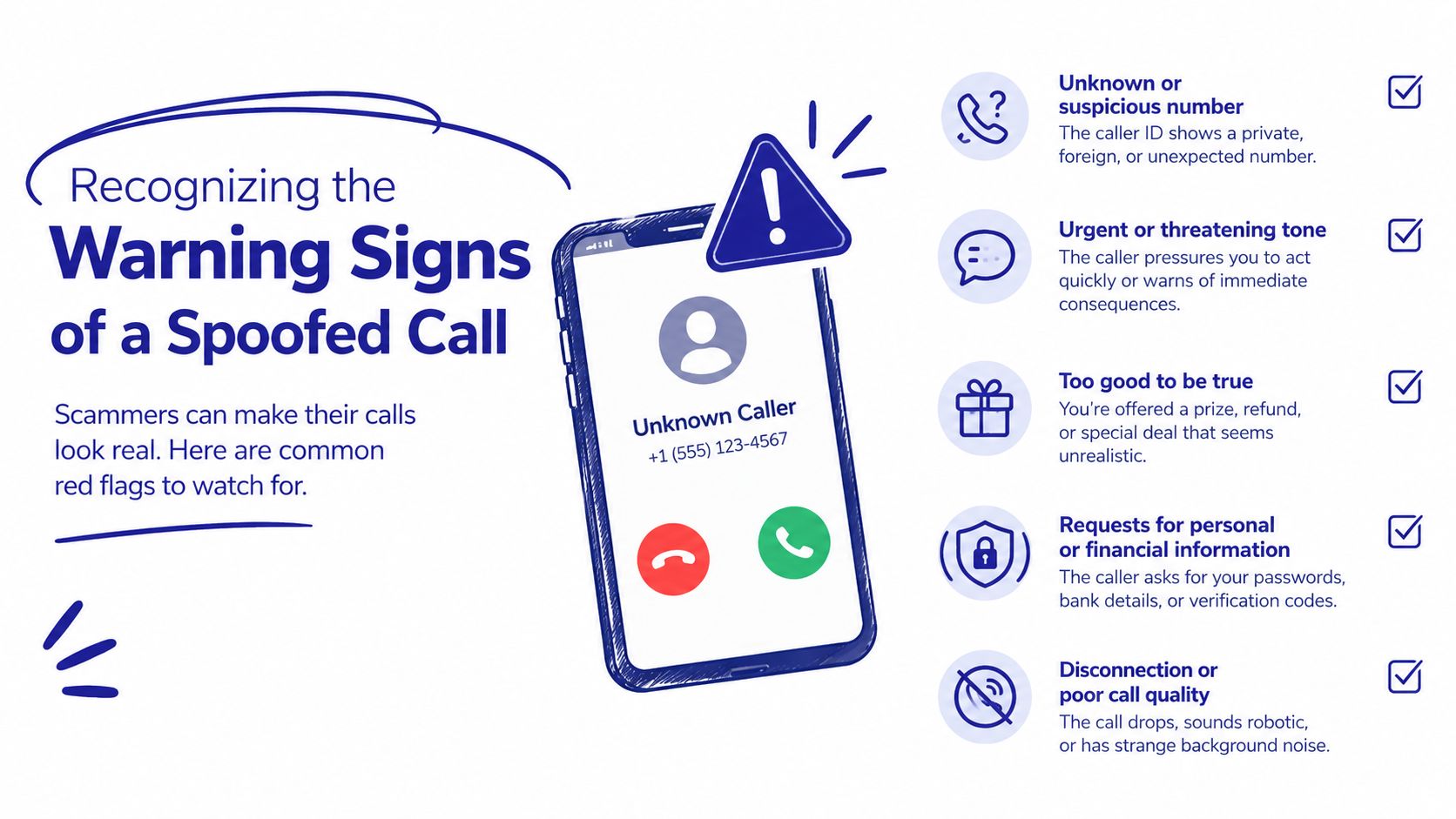
Classic warning signs include:
- Urgent payment demands: The caller insists that you pay immediately to prevent arrest, account closure, service cancellation, or financial loss.
- Gift card instructions: The caller asks you to buy gift cards, read the numbers aloud, or send photographs of the cards.
- Requests for secrets: The caller asks for a password, card security code, Social Security number, one-time code, or online banking credentials.
- Pressure to stay connected: The caller tells you not to hang up, not to speak with family, or not to contact the institution independently.
- Instructions to approve an alert: The caller asks you to confirm a transaction by replying to a text or email while they remain on the line.
- Threats and fear: The person uses an alleged warrant, investigation, frozen account, or compromised device to force immediate compliance.
A bank may contact you about unusual activity, but you can end the call and contact the bank through the number on your card or its official website. A legitimate organization won't lose its ability to help you because you verify the call independently.
AI changes the conversation
Recent reporting says Truecaller identified 17.47 billion spam calls in the first half of 2026, up 25.2% year over year, and noted that scammers increasingly used spoofed local numbers and AI-generated scripts designed to sound human. (Reporting on Truecaller's 2026 spam-call findings)
A synthetic or AI-assisted caller may respond smoothly, change direction when you hesitate, and use a script that sounds less robotic than older robocalls. Unnatural pauses can be a clue, but a natural-sounding voice isn't proof of legitimacy. The stronger signal is the combination of identity uncertainty, emotional pressure, and a request for an irreversible action.
Practical rule: If the caller creates urgency, asks for a secret, and discourages independent verification, hang up. Call the organization using a trusted number you found yourself.
Why Traditional Blocking Fails Against Modern Scams
Number blocking solves a narrow problem. It can stop calls from a known number, but an attacker can change the displayed identity on the next call. A blacklist sees separate numbers. The victim experiences one continuous campaign.
Silencing unknown callers has a different limitation. It reduces interruptions, but it can also hide legitimate calls from a school, medical office, delivery service, or new professional contact. Spam labels can be useful warnings, yet a call that isn't labeled is not automatically safe.
Authentication improves trust signals, not judgment
STIR/SHAKEN gives carriers a way to sign and validate caller identity. Malwarebytes reports that TNS found about 85% of voice traffic between Tier 1 networks in 2025 was signed using STIR/SHAKEN, and 93% of those signed calls received the highest A attestation. The same report says many smaller providers used the required cryptographic signatures only about 20% of the time, meaning roughly four out of five calls through those providers went unsigned. (Malwarebytes analysis of AI robocalls and caller authentication)
That uneven coverage leaves gaps across provider boundaries and international gateways. A signed call can carry stronger evidence about number authorization, but it doesn't understand what the caller is asking you to do. A scammer can still use a convincing conversation, and an unsigned call isn't necessarily malicious.
Static defenses miss changing behavior
Reputation-based filtering can identify known patterns, but it struggles when criminals rotate numbers, alter scripts, or move from a call to a text message. A conversation may begin with a spoofed bank number, continue with an SMS containing a link, and end with an email that asks for payment or documents.
This is why a reputation-based filtering approach works best as one layer rather than the entire defense. The useful question isn't only whether a number appeared in a database. It's whether the caller's identity, language, timing, request, and follow-up behavior form a coherent and safe pattern.
A blocked number is gone. A changing scam strategy is not.
Protection must therefore examine more than the number on the screen. It should help you evaluate the interaction while it's happening and recognize when separate messages belong to the same fraud attempt.
Defending Your Phone with AI-Powered Protection
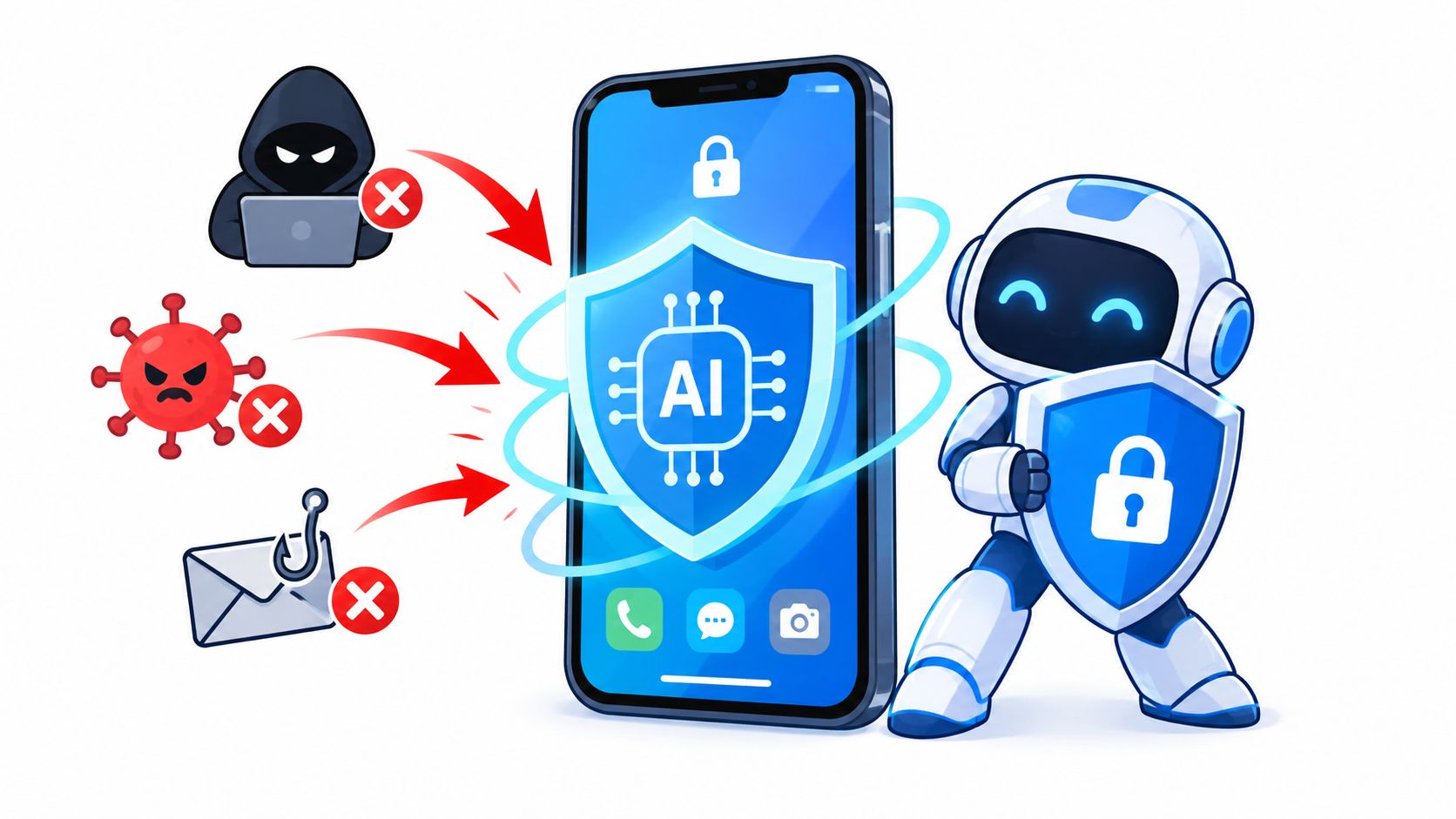
Real-time screening addresses the weakness static lists can't solve. Instead of asking only whether a number has been reported before, an AI screening service can answer an unknown call, examine the conversation, and assess whether the caller's stated purpose and behavior appear legitimate before connecting you.
Gini Help is one example of this approach. It uses fine-tuned large language models to handle unknown calls first, analyze the caller's conversation dynamically, and decide whether the call should reach you. Its design treats the service as a digital receptionist, not merely a database of suspicious numbers.
Why live analysis fits spoofed calls
A spoofed number can change before a static database catches up. A conversation also provides information that a number alone cannot:
- Intent: Is the caller discussing a normal appointment, or trying to obtain money and credentials?
- Pressure: Does the person demand immediate action or discourage verification?
- Adaptation: Does the caller change the story when you challenge an unusual request?
- Channel movement: Does the call lead to an SMS or email containing a link, code, or payment instruction?
Live Call Analysis can provide real-time scam detection during calls you answer, including a risk score and haptic warnings when suspicious behavior appears. Multi-channel protection can also examine phone calls, SMS, and email accounts such as Gmail, Outlook, Yahoo, and iCloud, helping identify a campaign that moves between channels.
For a small business, a related resource on a voice AI assistant for service businesses can help explain how conversational automation handles incoming callers. The security requirement is different, but the underlying lesson is similar: voice systems need to understand what a caller says, not just display a number.
Protection for families and caregivers
Older adults can face particular pressure when a caller claims to be from a bank, a government agency, or a relative in trouble. Family members may also struggle to intervene if they only learn about the call after money or credentials have been shared.
A screening service can reduce exposure by answering unknown calls before the phone rings, while live analysis can warn someone who does answer. Family-oriented threat intelligence can help members recognize related patterns rather than treating every incident as an isolated number.
A smart call blocker can still be useful for known nuisance calls, but dynamic analysis adds a layer for the calls that evade simple blocking. No automated system replaces independent verification. It gives people more time and better context before they act.
Taking Control of Your Digital Security
Caller ID should help you identify a call, not decide whether you trust it. A local area code, a bank's published number, or a familiar name can all appear in a spoofed call.
Use this short response plan:
- Pause: Don't let urgency choose your next action.
- Protect secrets: Never share passwords, one-time codes, card security details, or account credentials with an unexpected caller.
- End the call: Hang up when the caller pressures you or tells you not to verify.
- Verify independently: Use the number on your card, an official statement, or the organization's genuine website.
- Check other channels: Don't approve a text or email alert while a suspicious caller directs you.
- Add screening: Consider real-time analysis for calls that number blocking and caller-ID labels can't identify safely.
Download the Gini Help app from Google Play or the Apple App Store, then review its call, SMS, and email protection options. The aim isn't to fear every call. It's to make sure an unfamiliar person can't use a familiar-looking number and a persuasive conversation to rush you into a harmful decision.
Gini Help screens calls, texts, and emails with AI-powered analysis designed to identify suspicious conversations before they reach you or while you're speaking with a caller. Visit Gini Help to set up protection and make independent verification part of your everyday call routine.