What Is Caller ID Spoofing and How to Stop It
By Josh C.
Caller ID spoofing is the deliberate falsification of the phone number or name shown on your caller ID, and illegal spoofing can carry penalties of up to $10,000 per violation in the United States. The technology has legitimate uses, but scammers primarily weaponize it to disguise their identity and start fraud.
Your phone rings with a familiar local number. The caller ID even appears to show your bank, a government office, or a company you recognize. The person says there's suspicious activity and asks you to confirm a code, move money, or click a link sent by text. Because the display looks reassuring, you may focus on the request instead of questioning who's calling.
That's the central danger. Caller ID is a label, not proof of identity. A spoofed call can be the first step in a coordinated attack that continues through SMS and email, where the criminal tries to capture passwords, payment details, or one-time verification codes.
Understanding What Caller ID Spoofing Actually Is
Your phone shows a familiar local number, yet the caller claims to represent your bank, a government office, or a delivery company. The request may sound routine at first, then shift toward a verification code, payment, or link sent by text. That sequence matters because spoofing often serves as the opening move in a larger, multi-channel fraud attempt.
Caller ID spoofing changes the phone number or name sent to your display, hiding the caller's real identity. The display works like a return address on an envelope: it can look familiar without proving who placed the message inside. The Federal Trade Commission's guidance on impersonation scams explains that a fraudulent call may show a government agency or business name and can appear to come from anywhere in the world.
The technology isn't automatically illegal
Spoofing can have legitimate purposes. A doctor may call from a personal mobile phone while showing the office number, giving patients a reliable number to call back. A company may display a shared toll-free number instead of an employee's direct line.
The dividing line is intent. In the United States, the Truth in Caller ID Act of 2010 addresses misleading caller ID information used to defraud, cause harm, or wrongfully obtain something of value. The FCC says illegal spoofing may lead to penalties of up to $10,000 per violation, as described in its consumer guide to spoofing.
| What appears on your screen | What it actually tells you |
|---|---|
| A local number | The displayed number resembles a local contact |
| A bank name | The caller ID label has been set to resemble that institution |
| “Verified” information | Network authentication may have occurred, but the speaker still needs independent verification |
| A familiar contact | The number or name has been copied, not necessarily the caller's identity |
A phone display can help you recognize a caller, but it cannot verify the person behind the conversation. Gini Help's guide to caller ID on your phone explains how caller information is presented. Treat an unexpected call as one clue in a possible fraud sequence, especially if a later text or email repeats the same urgent request. Never use the incoming display as your only reason to trust a request for money or sensitive information.
How Scammers Manipulate Your Phone Display
Caller ID manipulation became easier to access during the early internet era. An industry summary identifies 2004 as the year Star38.com launched the first mainstream web-based caller ID spoofing service, with similar sites appearing the following year, as described in this background on phone number spoofing. That shift helped move spoofing from a specialized telecom technique to an online service available for both privacy-related uses and criminal schemes.
The scammer doesn't need your phone to be hacked. Instead, the caller sends signaling information that tells the receiving network or device what number or name to display. The forged return-address analogy fits here: the envelope reaches you through a real postal route, but the address printed on it can still mislead you.
Why local and institutional numbers work
A nearby number feels plausible because people recognize the area code and may assume the caller lives or works nearby. A bank or law-enforcement number creates a different pressure. It encourages you to treat the conversation as an official matter before you've checked the caller's identity.
That's why a familiar display can be more dangerous than an obviously random number. You may answer faster, share information sooner, and resist ending the call because the screen appears to confirm the story.
Modern networks use STIR/SHAKEN, a framework that digitally signs caller ID information at the originating carrier and allows downstream carriers to check whether the asserted number was authenticated. The FCC explanation of call authentication makes the important distinction clear: authentication improves confidence in the network information, but it doesn't independently prove that the human caller is the legitimate bank employee, investigator, or agency representative they claim to be.
For privacy-conscious users researching temporary phone services, a temporary number for SMS can serve legitimate testing or privacy purposes, but it shouldn't be used to impersonate another person or organization. The same underlying flexibility that supports privacy can also be abused when criminals use it to create a false identity.
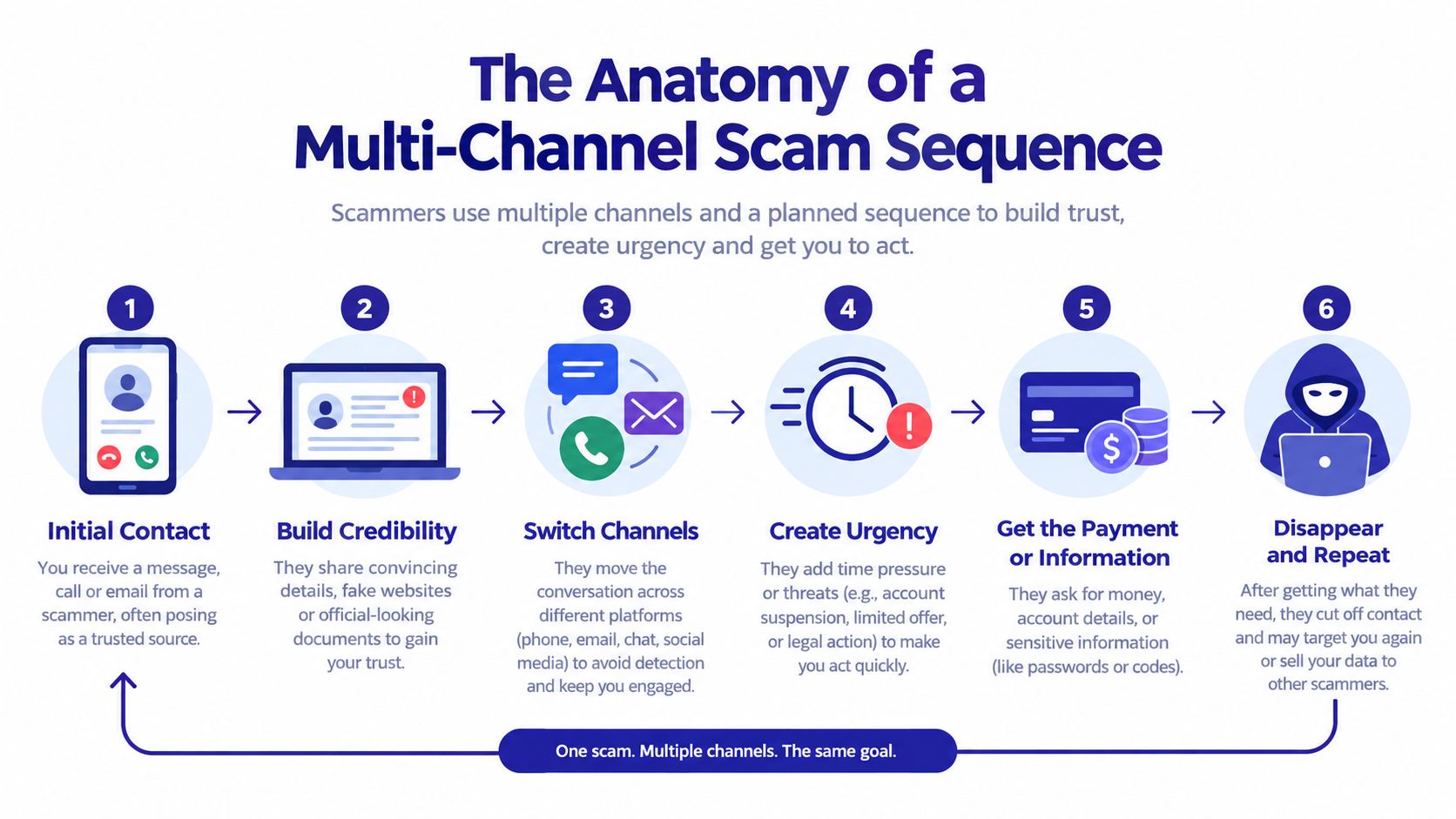
The Anatomy of a Multi-Channel Scam Sequence
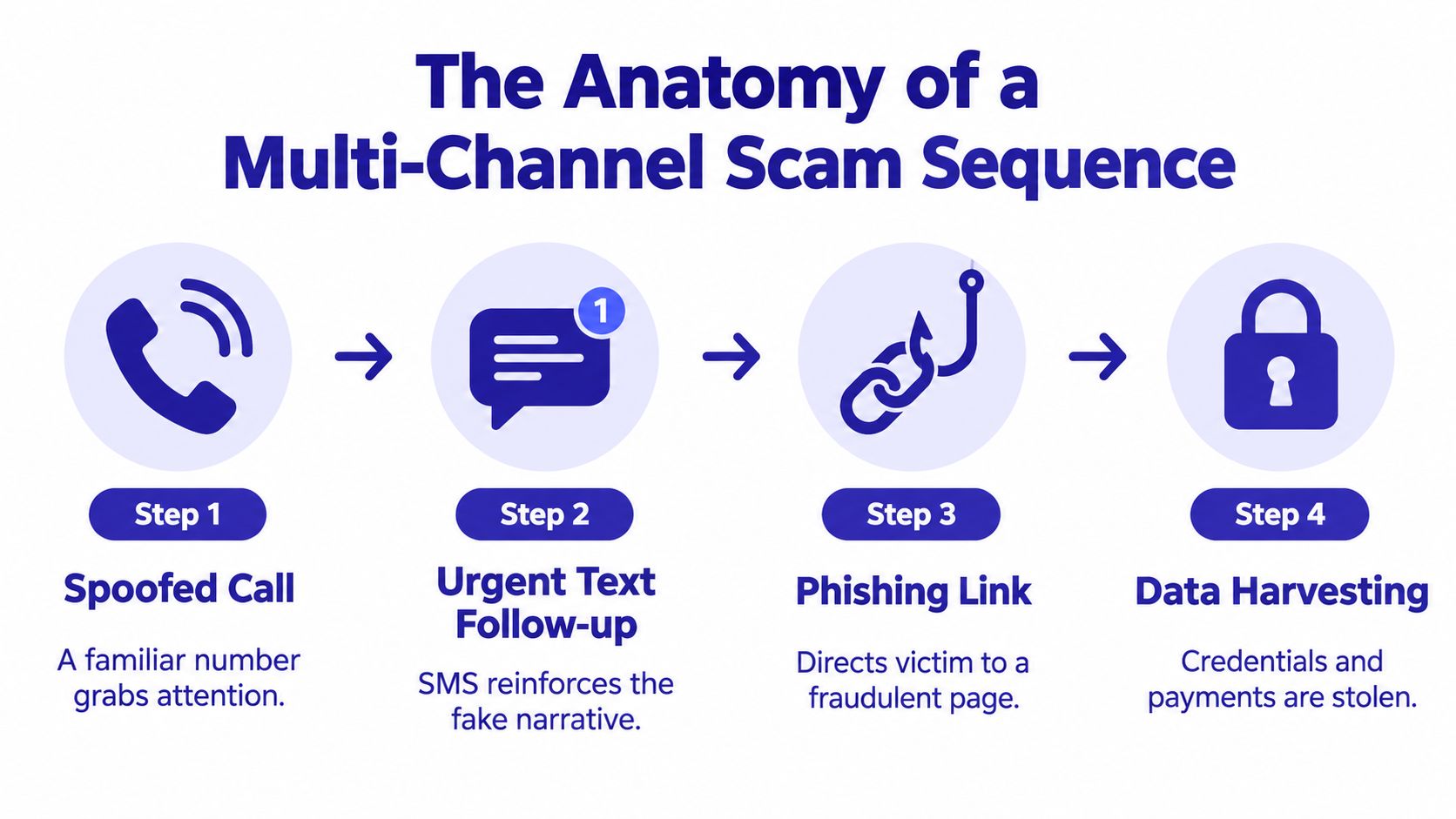
A spoofed call often works as an opening move rather than the complete scam. The criminal wants the voice conversation to establish a believable story, then uses another channel to make the request feel documented and urgent.
Consider a call that appears to come from your bank. The caller says a payment has been flagged and asks whether you received a security text. While you're still on the line, an SMS arrives with a link that supposedly lets you review or cancel the transaction. The caller tells you to open it immediately, claiming the link will expire.
The text message reinforces the voice story. The website may copy the bank's colors and logos, then ask for a username, password, card details, or a one-time code. An email can follow with the same case number and warning, making three separate messages seem to confirm one another even though the criminal controls the sequence.
The signals that reveal coordination
Look for the combination, not just one suspicious call:
- Unexpected voice contact: The caller introduces a problem you weren't expecting and discourages you from ending the call.
- Urgent SMS: A text arrives during or immediately after the conversation, often with a link or request for a reply.
- Matching email: The email repeats the same story, name, or supposed reference number.
- Pressure to stay connected: The caller may tell you not to contact the bank directly because that would supposedly interfere with the investigation.
- Requests for secrets: Passwords, PINs, one-time codes, remote access, and payment transfers are treated as routine steps.
Recent reporting highlights the growing importance of this pattern. Multi-channel phishing campaigns combining voice, SMS, and email increased by 97% in 2025, according to reporting on coordinated phone spoofing scams. That source also describes phishing and spoofing as the most reported IC3 complaint category in 2025, with more than 191,000 complaints and over $215 million in reported losses.
Practical rule: Treat a call, text, and email that repeat the same urgent demand as one campaign, not three independent confirmations.
Hang up, open your bank's official app or statement yourself, and contact the institution through a trusted number. Don't click the link sent during the call, even if the caller already knows some personal details.
Why Traditional Call Blocking Falls Short
Traditional blocking tools usually make decisions from signals such as the displayed number, a reputation database, calling patterns, or carrier analytics. Those tools can reduce nuisance traffic, but a spoofing campaign exploits the gap between who appears to be calling and what the caller says.
STIR/SHAKEN improves the trust model at call setup by digitally signing caller ID information and letting carriers verify that information as a call moves through the network. That's valuable because it can make large-scale number impersonation more difficult. It still doesn't evaluate the conversation's intent, authenticate a caller's claimed role, or determine whether a person asking for a transfer is running a fraud script.
The scale makes simple blocking reactive
The problem remains widespread. The FTC reported more than 2.6 million Do Not Call complaints in fiscal year 2025, with consumers mostly identifying robocalls rather than live telemarketing as the source of violations in its biennial report on the National Do Not Call Registry.
Enforcement records also show that spoofed caller ID remains a compliance concern. The FTC says it has brought 151 enforcement actions connected to Do Not Call, robocall, spoofed caller ID, and assisting or facilitating violations. It reports that 147 resolved actions recovered more than $178 million in civil penalties and $112 million in restitution or disgorgement, as detailed in its Do Not Call enforcement information.
A blocker can recognize a known bad number. It may struggle when the attacker changes the displayed number, imitates a trusted institution, or uses a newly created route. It also can't reliably judge a legitimate-looking number that becomes dangerous only after the caller asks for credentials or money.
That's why “verified” shouldn't mean “safe.” It may indicate something about how the call traveled across the network. It doesn't answer the question that matters most to you, which is whether the person speaking has a legitimate reason to request sensitive action.
Stopping Fraud Before Your Phone Rings
A stronger defense examines the conversation and the request, not only the number displayed on the screen. Proactive conversation analysis can identify pressure tactics, impersonation, requests for secrets, and attempts to move you into another channel.
Gini Help is one example of this approach. Its service can answer unknown calls first, analyze whether the caller appears legitimate or threatening, and decide whether to connect the call. Its caller ID spoofing detection guide explains the difference between trusting a displayed number and evaluating the caller's behavior.
What conversation analysis adds
Instead of waiting for a number to appear in a spam database, an AI screening layer can focus on the interaction:
- An unknown call arrives. The screening system handles the initial contact rather than immediately sending the call to you.
- The caller explains the purpose. The system examines the language and conversational context.
- Risk indicators are identified. Urgency, impersonation, payment demands, and requests for verification codes can change the assessment.
- The call is routed accordingly. A potentially legitimate call can be connected, while a suspicious call can be held back.
Gini Help also offers Live Call Analysis for calls you do answer. The feature provides real-time scam detection, a risk score, and haptic warnings when the conversation presents threat signals. That can help when a caller uses a new number, a familiar number, or a display label that ordinary blocking tools have no reason to reject.
No automated tool should replace judgment. If a caller pressures you, asks for a password or one-time code, or tells you to move money to “protect” it, end the conversation and verify through an official channel you locate independently.
Actionable Steps to Secure Your Family's Devices
Protecting a household works better when everyone follows the same simple rules. Older relatives, children, caregivers, and busy professionals should know what to do before a suspicious call creates pressure.
Set up protection on each device
Start with the screening layer your family will use. Download the Gini Help app on Google Play or get it from the Apple App Store. The service is designed to screen calls, texts, and emails in one app, so a scammer can't rely on switching channels after a blocked call.
Then review the phone's own controls. Enable carrier or device spam warnings where available, but explain that these features are a supplement, not proof that every permitted call is safe.
Create a family verification routine
Use a private family safe word for genuine emergencies. Agree that a relative who calls unexpectedly for money, account access, or urgent travel help must confirm the safe word, and that nobody should disclose the word during an unsolicited call.
Teach everyone to follow this sequence:
- Stop the conversation: Don't argue with the caller or follow instructions while under pressure.
- End the call: A legitimate organization can tolerate a callback.
- Find the official route: Use the number on a bank card, statement, official app, or independently typed website.
- Check every channel: Review texts and emails without opening their links.
- Protect access codes: Never share passwords, PINs, or one-time verification codes with an incoming caller.
Report suspicious calls to the impersonated organization and the relevant authorities. Save the displayed number, the time, the caller's claims, and any related text or email, but don't call the displayed number back. If someone has already shared credentials or payment information, contact the financial institution through its official channel immediately and change affected passwords from a trusted device.
Common Questions About Caller ID Spoofing
Can I trace a spoofed call myself
Usually, the number on your screen cannot confirm who called. Carriers may investigate routing records, while law enforcement and regulators can request information through formal processes. A consumer generally cannot identify the person behind a spoofed call by examining the displayed number.
Record the date, time, displayed number, claimed organization, requests made, and any follow-up texts or emails. These details can help a carrier, bank, regulator, or police department connect your report with a wider campaign. They also show how one call may fit into a larger sequence that moves from voice to text or email.
What should I do if my own number is being spoofed
Strangers may call you back because your number appeared on their screens, even though you never contacted them. Do not return those calls to confront anyone. Contact your carrier, explain that your number appears to be spoofed, and ask which reporting or filtering options are available.
Warn friends and family that your number alone does not prove a call came from you. Set a separate voicemail password if you do not already have one. Some services use the incoming number as part of access checks, so a spoofed number can create an extra risk.
Is caller ID spoofing legal
Legitimate display-name or number customization can be allowed. For example, a doctor may display an office number when calling from a personal phone, or a business may show a toll-free callback number. Using that display to impersonate a bank or government agency in order to obtain money, account access, or personal data is prohibited under U.S. law, as described in the FCC's spoofing guidance.
If a caller claims to represent an organization, hang up and use the official number on your card, statement, or independently opened app.
Should I trust a verified or familiar call
No. Network authentication can help carriers assess whether caller ID information appears consistent, but it does not establish the caller's identity or intentions. Unexpected requests about money, passwords, or account access require independent verification.
What if the call is followed by a text or email
Treat the call, text, and email as one possible fraud sequence until you verify it separately. Do not use links, numbers, or instructions supplied during the interaction. Open the organization's official app or type its known web address yourself, then contact support through its published channel. Network blocking may stop one number, while conversation analysis can identify the changing story across channels.
Gini Help screens calls, texts, and emails for suspicious activity before they reach you. Its Live Call Analysis can provide risk scoring and haptic warnings during calls you answer. Visit Gini Help to review its protection options, then install the app and help each family member use the same verification routine.