Small Business Fraud Prevention Guide That Saves Money
By Josh C.
Fraud is no longer just a back-office headache. In a 2026 survey, 72% of small businesses said they experienced fraud, scams, or ransomware in the prior year, and owners described the damage as a drag on payments, customer acquisition, and even new product development, not just a one-time loss (PPSI fraud, scams, and ransomware report). That's the part many guides miss, because one bad payment or email compromise can slow hiring, stall sales, and tie up cash you needed for the next move.
A café owner, a contractor, and a small agency all face the same problem in different clothes. The inbox fills up, the phone rings, a vendor wants a payment change, and a customer asks for an urgent refund. In the middle of that noise, fraud slips through because it looks like ordinary business.
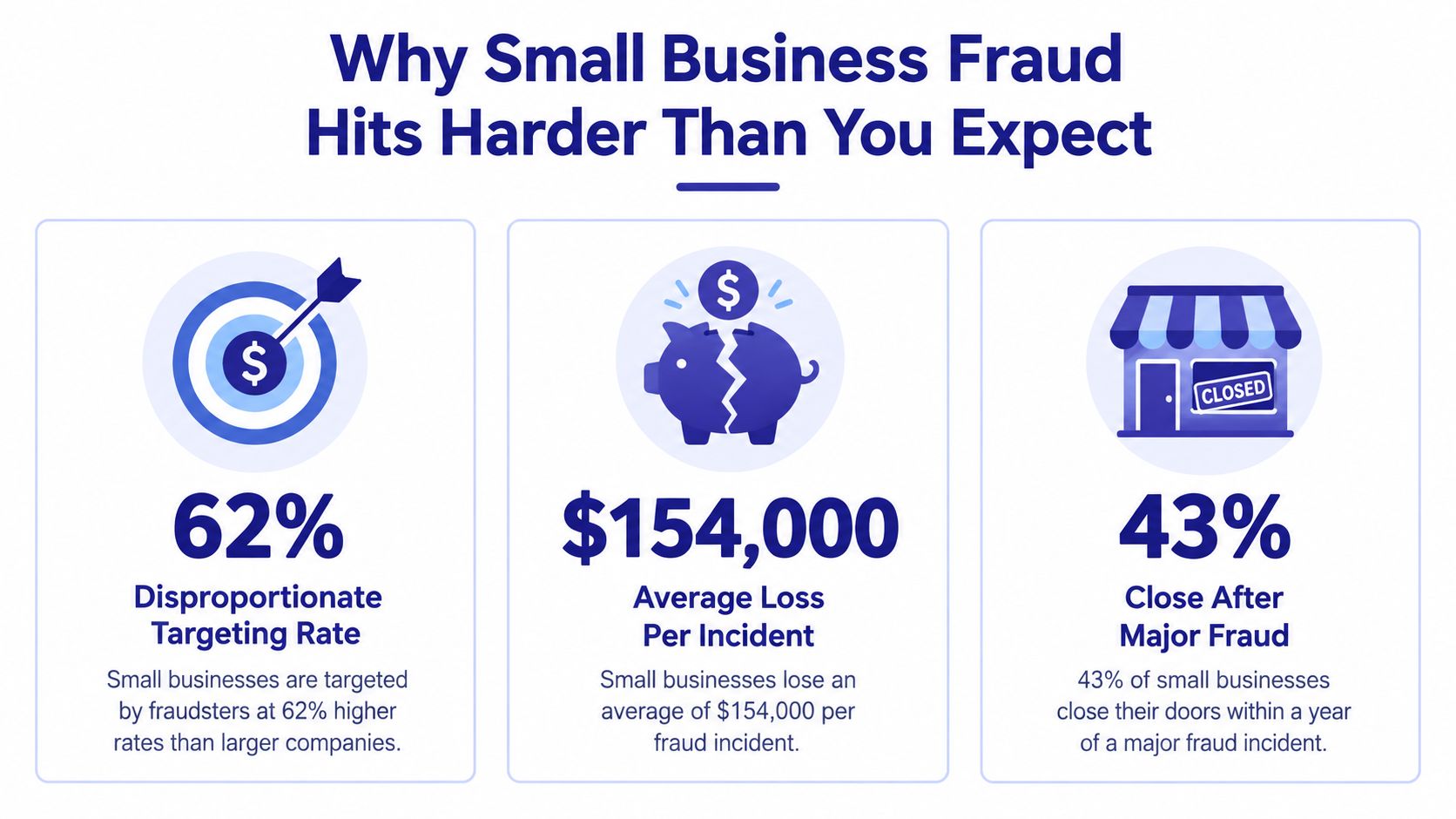
Why Small Business Fraud Hits Harder Than You Expect
A small business usually doesn't fail because of one dramatic mistake. It gets squeezed by a series of interruptions, a frozen payment here, a delayed vendor there, a customer who starts doubting your professionalism after a billing mix-up. That's why small business fraud is so damaging, it's not just money leaving the account, it's momentum getting interrupted.
The pressure is worse because fraud attempts are persistent and recovery is weak. The 2025 AFP survey found that 79% of organizations experienced attempted or actual payment fraud in 2024, checks were the most targeted rail at 63%, ACH debits followed at 38%, and only 22% of organizations recovered 75% or more of losses (First Business Bank summary of the AFP survey). Once money leaves, the window to fix it gets small fast.
That's why a fraud event is rarely “just fraud.” It can become a cash-flow problem, a staffing problem, and a sales problem all at once. If a vendor payment is delayed or a customer refund gets disputed, the owner spends time on damage control instead of running the business.
Practical rule: treat every payment request like it matters to operations, because it does.
A useful way to think about it is this. Fraud doesn't just steal dollars, it steals attention, trust, and time. Those are the things small businesses can least afford to lose.
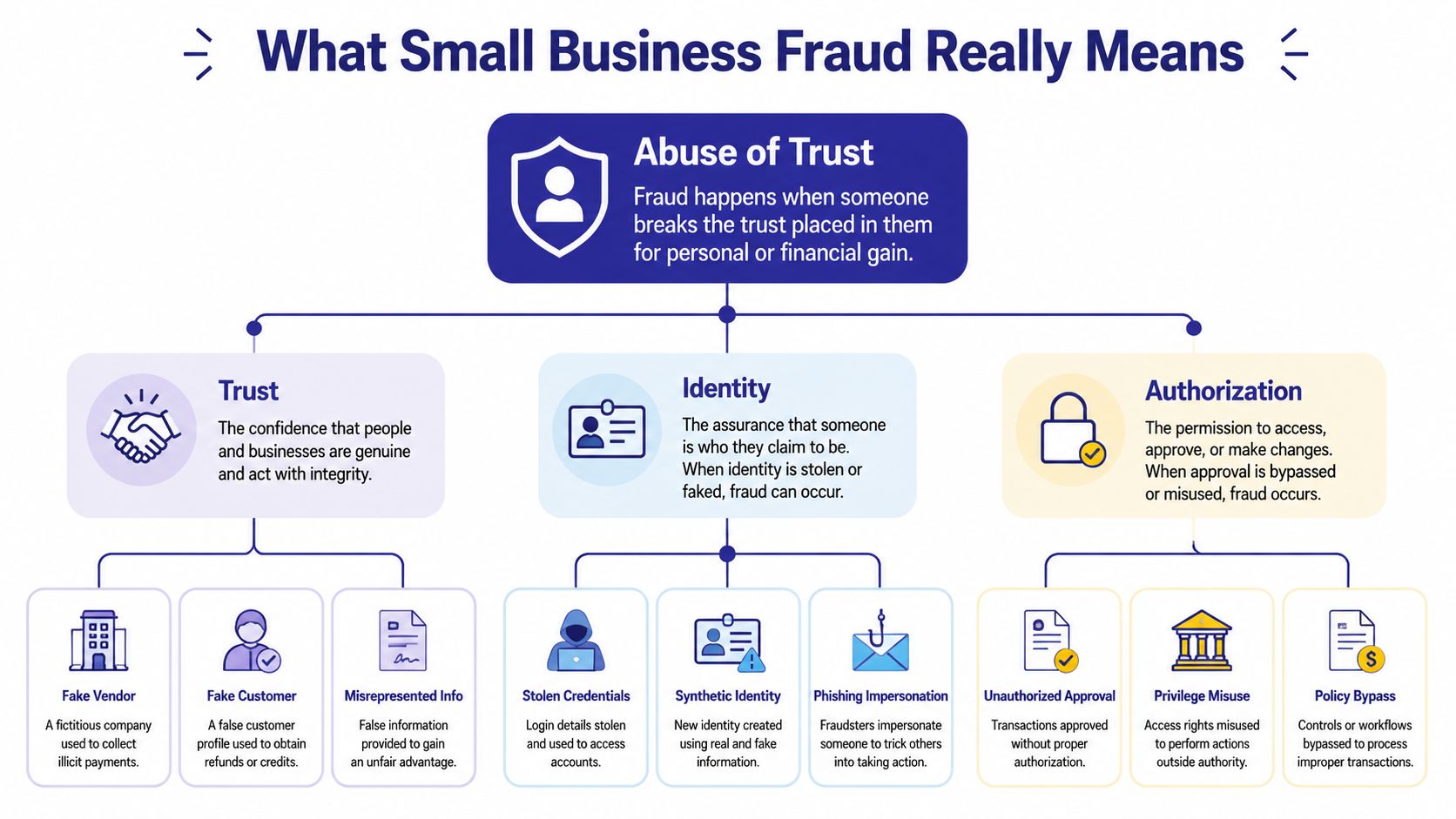
What Small Business Fraud Really Means
Fraud is easiest to understand when you stop thinking about it as “hackers breaking in.” A better analogy is a store with a few doors that should be locked, but one back door gets left open, a fake badge gets accepted, or someone talks their way past the counter. The problem is not only the thief, it's the moment the business trusts the wrong signal.
Fraud depends on three things, trust, identity, and authorization. If an attacker can sound like a vendor, appear like a manager, or pressure an employee into skipping a check, the process fails before anyone realizes it. That's why fraud often shows up as a business process problem, not just a security problem.
This is also where people get confused about the difference between theft, error, and fraud. Theft is straightforward taking. Error is a mistake without intent. Fraud is deception used to make a legitimate-looking action happen, such as an invoice that seems real, a payment request that looks routine, or a login prompt that appears normal.
The risk gets bigger when work is remote or digital. More approvals happen by email, more vendors are onboarded without face-to-face contact, and more payment decisions happen fast. That gives attackers more places to imitate normal business behavior.
Key concept: fraud is a process failure first, and a people failure only after the process has already been bypassed.
For a practical overview of how businesses can frame that risk, the Paylithix fraud risk guide is a useful companion resource. It fits well with the idea that fraud prevention works best when trust checks are built into everyday workflows, not added after a loss.
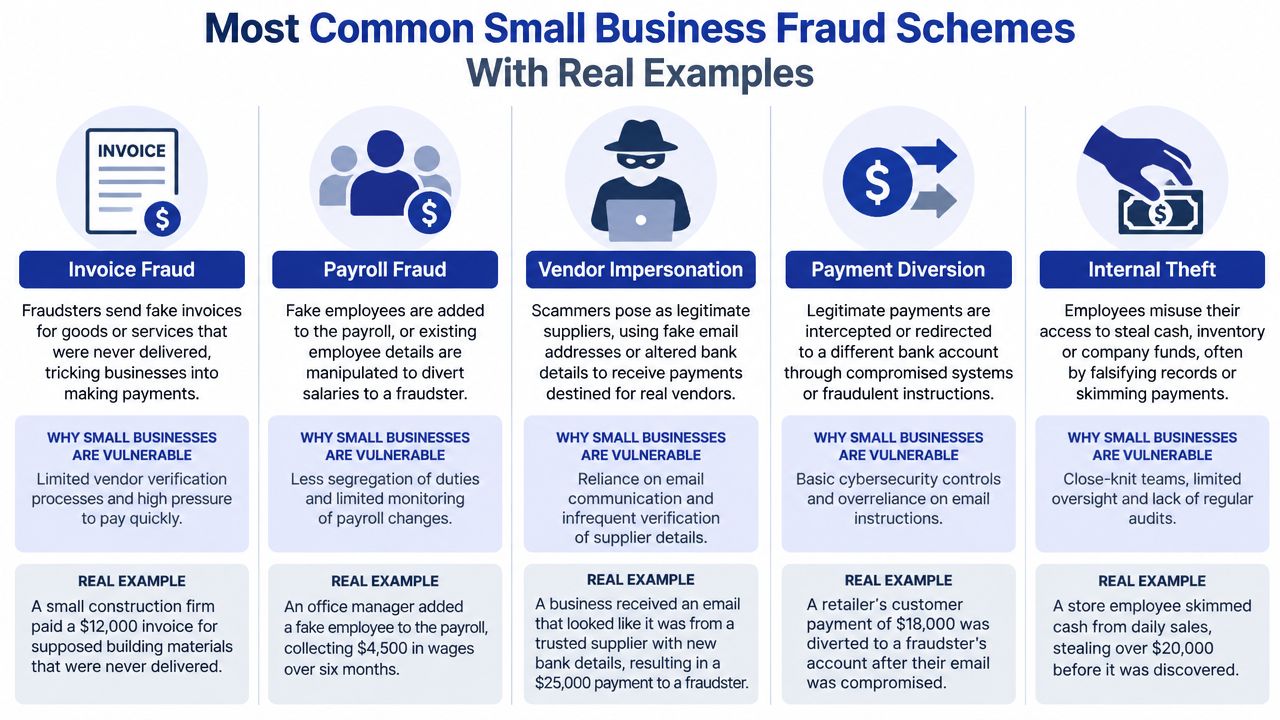
Most Common Small Business Fraud Schemes With Real Examples
Small-business fraud can block growth as quickly as it drains a bank account. One diverted payment may delay payroll or inventory, while one compromised email account can interrupt sales, hiring, and new projects. The schemes look different on the surface, but they usually follow the same pattern: a believable request persuades someone to approve an action they would question with more time.
Email, invoice, and payment diversion schemes
Business email compromise often appears as invoice redirection. A fraudster impersonates a vendor and sends revised banking details shortly before payment is due. The owner or bookkeeper believes the change is routine, but the payment moves to the attacker's account.
Canadian SME research found that email scams and phishing were the most common attack methods reported, followed by text and phone scams (CFIB fraud report). Attackers switch channels because a follow-up text or call can make a false email seem genuine. A stolen email thread may also reveal invoice dates, supplier names, and approval habits, giving the request the right details.
Checks, ACH, and payment rail abuse
Payment fraud can target the payment method itself. Checks may be altered, copied, or deposited by someone who changes the payee or account information. ACH transactions can also be manipulated through unauthorized debits or changes to account details.
A bookkeeper receives a check image from a customer with a slightly altered routing number. The deposit appears successful, so the funds are treated as available. Days later, the bank reverses the deposit, leaving the business to investigate the difference while the related order or expense has already moved ahead.
The same disruption can affect cash flow even when the amount is recoverable. A delayed reversal may leave less money for stock, wages, or a planned investment. Confirm unusual payment details through a trusted channel, rather than relying on the message that requested the change.
Vendor impersonation and onboarding fraud
A fake vendor or lender may arrive with polished documents, a professional website, and quick replies. Financial-services reporting describes risks including first-party fraud in loan applications and fraudulent lenders, showing that deception can begin before a business relationship is established (Experian business fraud article).
A merchant receives a supplier application that looks complete. The contact answers questions promptly, and the first order moves quickly. Later, the phone numbers stop working and the bank account cannot be verified. The business may then face unpaid goods, disputed transactions, or time-consuming recovery work.
AI-disguised tools and fake apps
AI is adding a newer disguise to familiar scams. Kaspersky reported that, during the first four months of 2026, it detected over 33,300 cyberattacks on SMBs disguised as popular AI tools, nearly five times the 2025 level, along with almost 415,000 attacks involving fake messenger apps and video-conferencing software (Kaspersky SMB threat report). A fake tool can capture credentials or payment information while appearing to support ordinary work.
Treat any request involving money, credentials, or payment changes as a verification task, even when it arrives through a familiar app. Businesses handling card payments or recurring billing can also review chargeback fraud detection for small businesses for payment-side controls.
Warning Signs Every Owner and Employee Should Know
Fraud usually leaves a trace before it leaves a loss. The trick is knowing which signals matter enough to stop the workflow. Teams often ignore the first warning because each sign looks harmless on its own.
Financial red flags
Watch for payment requests that don't fit the normal pattern. A vendor who suddenly wants a new bank account, a manager who wants to bypass approval, or an invoice that appears twice with a slightly different amount should all trigger a pause. Payment fraud often succeeds because the request feels urgent, not because it's clever.
Behavioral red flags
People also give themselves away in how they behave. If someone avoids leaving a paper trail, refuses to share duties, or never wants to take vacation, the issue may not be loyalty, it may be concealment. That's one reason internal fraud can stay hidden, the person who controls the process may also control the story.
Digital red flags
Urgent language is one of the most common manipulation tools in digital fraud. Watch for spoofed domains, strange login prompts, unexpected password resets, and messages that ask you to confirm a credential you didn't try to use. Those details matter because legitimate systems don't usually create panic.
A quick mental checklist helps:
- Unusual invoice details: The payee, amount, or timing doesn't match the norm.
- Pressure to act now: Someone asks you to skip review or keep it confidential.
- Odd communication habits: The message arrives from a slightly wrong domain or a new number.
- Unexpected access prompts: You get asked to log in or verify something you didn't request.
For owners who want a cleaner way to review suspicious account activity, bank statement conversion explained can be useful background on how organized records support detection and reconciliation.
**Pause-and-verify works because fraud depends on speed. Slow the transaction down, and the scam often falls apart.
How to Prevent and Detect Fraud With Practical Controls
Fraud controls work like locks on several doors. One control can fail, but layered checks make a scam harder to complete and limit the chance that one bad payment blocks cash flow, hiring, or product investment. Protect the points where money changes hands, vendors are added, and credentials are reset.
| Control Area | What It Stops | Effort Level | Impact |
|---|---|---|---|
| Dual approval for payments | One employee approving a bad transfer | Medium | High |
| Callback verification for vendor changes | Invoice redirection and fake banking updates | Low | High |
| MFA on email and banking | Credential theft and account takeover | Low | High |
| Email authentication checks | Spoofed sender domains | Medium | Medium |
| Reconciliation alerts | Duplicate or unusual transactions | Medium | High |
Separate duties wherever possible. The person who enters a payment should not approve it. A vendor change should also be confirmed outside the message thread that requested it. These are examples of auditable controls for finance, because fraud should require more than one compromised step.
Verify vendor changes by calling the number already on file, not the number in the email. A legitimate vendor can wait while your team confirms the request. That short delay can protect working cash and prevent a payment problem from interrupting sales or payroll.
Training works when it changes a routine. Repeat one clear rule, such as “do not trust new payment details without a callback,” during team meetings and onboarding. As AI-generated messages become more convincing in 2026, employees need practice checking the request, not just judging its spelling or tone.
Use a written checklist for new payees, unusual transfers, and urgent requests. Record who checked the request, which trusted contact method they used, and who approved the payment. This creates a trail for reconciliation and makes unusual activity easier to spot before it becomes a larger cash-flow problem.
For teams seeking app-based protection across calls, texts, and email, Gini Help screens unknown contacts and analyzes live calls in real time through its business scam protection tools. It's one option among others, and the practical value is that it helps surface suspicious communication before a team member acts on it.
What to Do When Fraud Happens Response and Recovery Steps
The first hour matters because fraud recovery gets harder as time passes. If you suspect a bad transfer, stop the process immediately, preserve the message trail, and keep everyone from making the problem bigger. Don't delete emails, don't edit screenshots, and don't try to “clean up” the evidence.
First hour
Call your bank and payment providers right away. Ask them to freeze or recall the transfer if possible, and tell them exactly what happened, in order, using the original transaction details. If an account may be compromised, lock access and change credentials from a safe device.
First day
Document everything in one place. Save emails, call logs, texts, invoice copies, payment confirmations, and any notes from staff who handled the request. Then report the incident through the channels your bank, insurer, or local authorities require, because fast reporting can improve the odds of containment.
First week
Bring in legal and insurance support if the loss is material. Review where the workflow failed, not just who clicked what, and close the gap that let the fraud in. If the scam came through a vendor, customer, or lender relationship, notify the affected parties quickly and professionally so they can protect themselves too.
A calm internal response helps more than blame. The owner, bookkeeper, and bank all need the same clean facts, so keep the story short, factual, and consistent.
**Recovery depends on speed, but prevention depends on process. If the same gap stays open, the next scam will look different and land the same way.
One practical post-incident read is what to do after being scammed, which can help staff stay organized when the situation is moving fast.
Staying Protected and Where to Get Help Next
Fraud protection works best when it becomes part of the way you run the business. The right mindset is simple, verify before paying, slow down when pressure rises, and assume every channel can be imitated. That matters even more now that 2026 research is showing more attacks disguised as AI tools and fake messenger apps, which means scammers are borrowing trust from the software people already use.
The next step is to tighten the places where your business moves money and information. That means payment approvals, vendor changes, staff training, and recovery planning, not just password resets. It also means making fraud awareness a shared habit for your team and your family, because scammers don't care who answers the call.
If you want a tool that screens calls, texts, and email in one place, Gini Help is designed for that kind of ongoing protection. It can help flag suspicious contact before someone on your team acts on it, and it's available on Google Play and the App Store.
Start with the basics this week, verify vendor changes by callback, turn on MFA everywhere you can, and write down who has approval authority. Then keep the process visible, because fraud thrives when nobody is sure who should stop it.
If you're ready to add a layer of real-time screening to your calls, texts, and emails, visit Gini Help. It helps small businesses spot suspicious contact before it becomes a payment problem. For owners who want less guesswork and faster decisions, it's a practical place to start.