One Ring Scams Explained and How to Stop Them
By Josh C.
Your phone vibrates once while you're making coffee. A strange area code flashes on the screen, then the call disappears before you can answer. No voicemail arrives. A few minutes later, curiosity starts working on you: Was it a doctor's office, a delivery driver, a relative traveling abroad, or an important business call?
That missed call may be the entire trap. One ring scams use a brief call to create a callback, then turn that callback into an opportunity for toll fraud, information gathering, or a later impersonation attempt. The modern version is more than an annoying wrong number. It's an adaptable, cross-border fraud pattern that uses spoofed caller ID, automated dialing, and changing phone infrastructure.
What Happens When Your Phone Rings Once
The call ends so quickly that it feels accidental. You see a number that may look familiar, perhaps with a U.S.-style area code or an international code you don't recognize. Before you can decide whether to answer, the screen returns to normal and leaves behind only a missed-call notification.
That moment is carefully useful to the scammer. A missed call creates an unanswered question, and people often call back because they want to resolve uncertainty. The caller doesn't need to persuade you with a speech or a fake emergency. The notification itself creates the opening.
The Federal Communications Commission recognizes the one-ring scam as a scheme in which a caller rings briefly to trigger a missed-call alert and encourage a callback that can create charges. The agency received approximately 2,600 consumer complaints in 2019 about this tactic, according to its consumer-protection order on one-ring scams.
Why the missed call feels harmless
A normal wrong number usually creates a conversation. The caller realizes the mistake, says little, and hangs up. A one-ring scam avoids that interaction completely. The person behind it wants you to make the next move.
The number on your screen may also appear domestic even when the call originated internationally. Caller-ID manipulation can make an offshore number resemble a local one, which lowers your suspicion and makes the callback feel safer than it is.
Practical rule: A missed call from an unknown number isn't a request for your attention. It's an unanswered call. Treat it that way unless you can verify the caller through a separate, trusted channel.
So who profits from a missed call, and why can a ringtone cost money? The answer lies in what happens after you press the callback button. The scammer may have spent almost nothing to place the brief call, while your return call connects to a billing system designed to keep the line open.
How the Call-Back Trap Actually Works
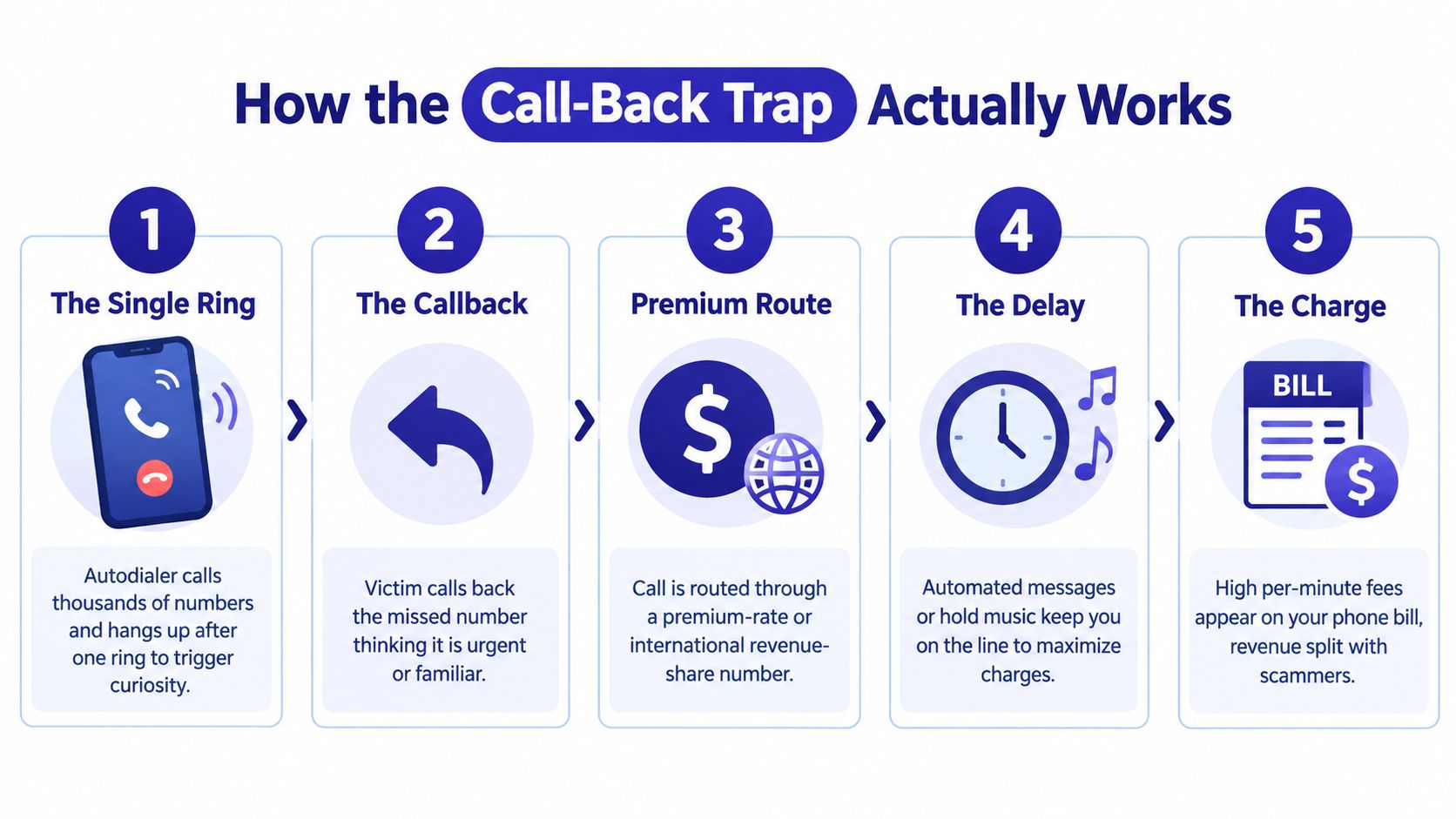
The scam follows a simple sequence, even when the underlying telecom equipment is complex.
An autodialer places a short call. Automated systems dial large batches of numbers and disconnect after one ring. The purpose isn't to speak with you. It's to create a missed call that looks unfinished.
You return the call. You may assume the caller made a mistake, needs you urgently, or could be someone you know. The callback tells the scammer that your number is active and that you're willing to respond.
The line routes to a charge-generating destination. The FCC describes this as a toll-fraud model. A returned call may connect to an international or premium-rate number, with resulting charges shared through the telecom revenue chain. The FCC's technical explanation of the one-ring scam explains how the scammer can earn from the returned call.
The connection is kept open. Hold music, recorded announcements, silence, or a delayed response can make you wait. Call-forwarding equipment may hide the final destination and route you through additional services. The longer you remain connected, the greater the potential charge.
The bill arrives later. The charge may appear as an international call, a premium service, or another unfamiliar billing entry. You might not realize the missed call caused it until you review the statement.
Newer versions use the callback differently
The classic scheme aims to generate billable minutes. Other versions may use a callback to confirm that your number is live, redirect you to text messaging, or lead you into a callback phishing conversation. A text might ask you to continue the interaction through a link or another number. A live person may claim to represent a bank, delivery service, government office, or technical-support team.
The specific route changes, but the conversion process stays similar: a missed call becomes a response, and the response becomes a tool. That's why the silence after one ring isn't reassuring. Silence may be the mechanism that pushes you to fill in the missing information yourself.
You can watch the process visually here:
Where These Calls Come From
A missed call can look local while beginning in another country. The FCC warns that scammers may spoof U.S.-style area codes and use international codes such as 232 for Sierra Leone, 809 for the Dominican Republic, and 649 for Turks and Caicos. Its FCC's consumer guide to one-ring phone scams explains why the number shown on your phone may not identify the caller's real location.
FTC warning materials have listed Caribbean area codes including 268, 284, 473, 664, 649, 767, 809, 829, 849, and 876. An unfamiliar missed call from one of these codes does not prove fraud, but it gives you a reason to avoid calling back. The number is often only the visible entry point to a wider, cross-border operation.
Automated dialing makes that operation easy to scale. Europol describes telecom-fraud systems that use tools such as botnets to dial random numbers in large volumes. The caller may have no personal information about you. Your number can be one entry in a campaign designed to turn curiosity into a response.
Area codes associated with warnings
| Area Code | Region | Typical Caller-ID Spoof |
|---|---|---|
| 268 | Antigua and Barbuda | May appear as an unfamiliar U.S.-style missed call |
| 809 | Dominican Republic | May resemble a domestic callback opportunity |
| 876 | Jamaica | May be displayed without making the international context obvious |
| 473 | Grenada | May look like a local or familiar regional number |
| 664 | Montserrat | May appear as a normal missed call rather than an overseas contact |
Caller ID is a display feature, not proof of identity. The number can be altered before it reaches your phone, much like a return address printed on an envelope. For a clearer explanation, read this guide to how caller ID works on your phone.
That shifting appearance is why blocking one familiar code does not solve the whole problem. Scammers can change the displayed origin, use different country codes, or place calls through new infrastructure. Treat the unexpected ring as a warning signal, not as evidence that the caller is nearby.
The FCC connected one-ring scams with a 2020 policy milestone after Section 12 of the TRACED Act prompted consideration of additional call-blocking measures. The agency later said it had authority to let voice providers block calls associated with these scams. Related consumer-policy changes have continued, including an effective-date postponement to January 26, 2026, described in the FCC's consumer policy materials.
The Long History of Wangiri Scams
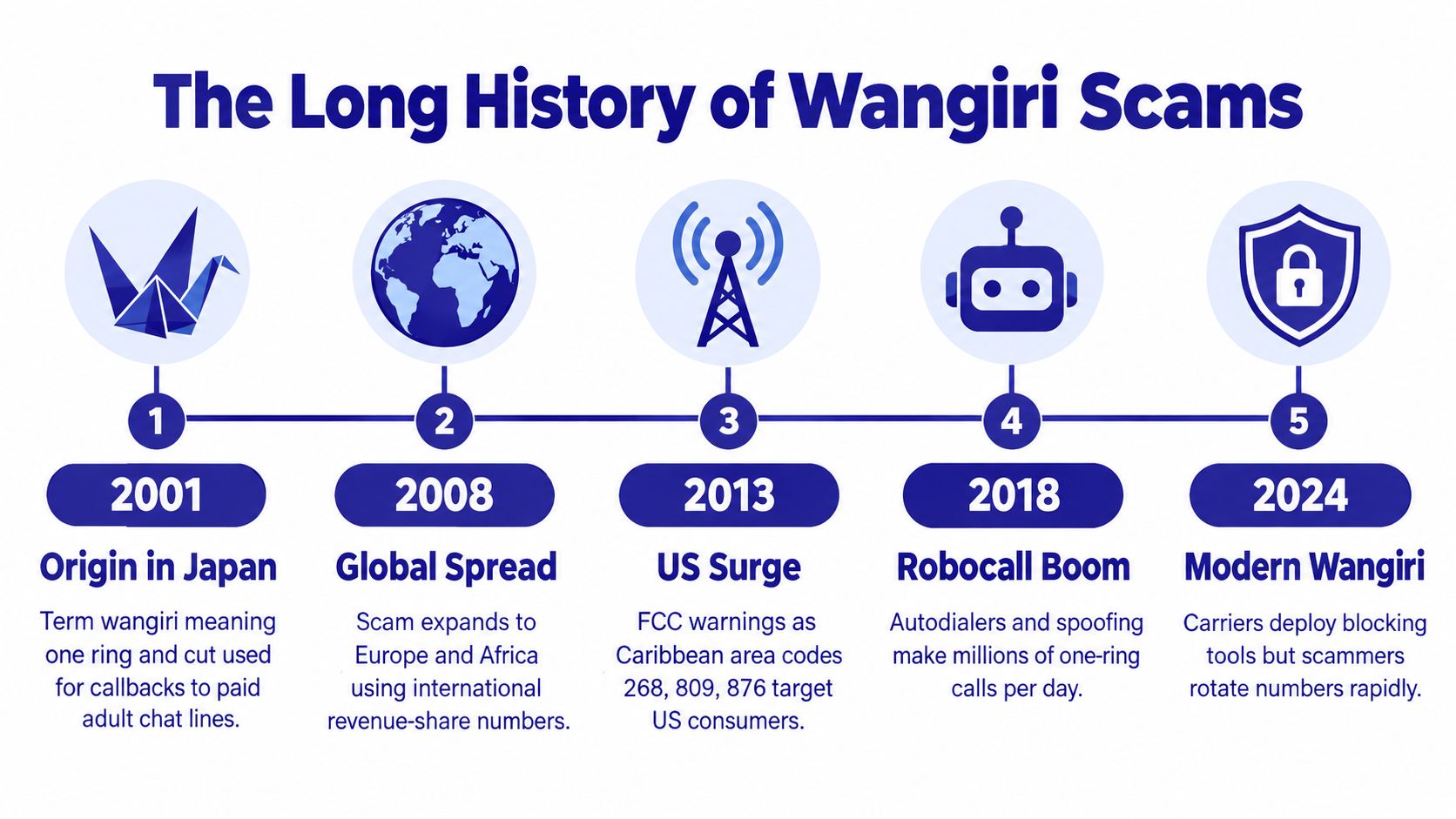
A phone rings once, stops, and leaves an unfamiliar missed call. That small event is the opening move in a wider cross-border fraud pattern, not merely a forgotten callback. Wangiri, a Japanese term meaning “one ring and drop,” describes a brief call that ends before the recipient answers. Australia's communications regulator defines it as a callback scam aimed at mobile users, often using international numbers to encourage expensive returns, as described in the ACMA scams report.
The tactic travels easily because it needs no shared language, brand, or elaborate story. A missed call can prompt the same curiosity in Japan, Europe, the Caribbean, or North America. International numbering systems, voice-over-IP services, and automated dialing let criminals alter the apparent source when providers block known routes. The number on your screen is therefore part of the disguise, not reliable evidence of who called.
A tactic that keeps changing shape
According to Hiya's Q1 2020 scam report, U.S. one-ring scam activity rose 98% in the first quarter of 2020 compared with the fourth quarter of 2019. The report also recorded a 2,527% single-day increase in calls originating from Sierra Leone between May 2 and May 3, while Hiya analyzed more than 13 billion calls globally per month.
These figures show the scale of the calling system, not a fixed script that every criminal follows. When traditional blockers identify one route, scammers can change the displayed number, calling pattern, or destination. One ring may become several. A foreign-looking number may be spoofed to look domestic. A toll charge may be replaced or supplemented by data collection and follow-up impersonation. Blocking one code stops one version of the opening move, while the broader fraud operation keeps changing around it.
Why Older Adults Are the Primary Target
Your phone rings once while you are waiting for a medical office, checking on family, or expecting a local service call. The missed call looks ordinary, yet returning it can confirm that your number is active and that you respond to unfamiliar callers. That response may place you into a wider cross-border fraud operation, not a one-time callback trick.
Older adults encounter scams through many channels, and phone calls remain effective because they resemble normal personal or service communications. A University of Michigan poll found that 75% of adults ages 50 to 80 experienced a scam attempt during the prior two years. The finding appears in the university's National Poll on Healthy Aging scams report.
The risk does not come from carelessness. An unfamiliar call may seem worth answering when it could involve a doctor, a relative, a household provider, or a number that appears local. A missed call with no explanation can create pressure to resolve the uncertainty quickly.
The first callback may not be the final objective
A returned call can tell criminals that the number is in use and that its owner answers unknown callers. They can then shift channels, using voice calls, text messages, or email. The next contact may impersonate a bank, government office, technical-support provider, or family member. Blocking one suspicious number does not stop that progression because the operation can change numbers and communication methods.
The FBI's 2023 Elder Fraud Report stated that complainants over 60 represented 40% of reports and 58% of losses, totaling almost $770 million. Those figures cover elder fraud broadly, not one-ring scams alone, but they show why older adults may be valuable targets in a larger fraud pipeline. The figures are reported on the FBI's 2023 Elder Fraud Report page.
| Group | Statistic | Source of Statistic |
|---|---|---|
| Adults ages 50 to 80 | 75% experienced a scam attempt during the prior two years | University of Michigan poll |
| Complainants over 60 | 40% of reports and 58% of losses, totaling almost $770 million | FBI 2023 Elder Fraud Report |
A household rule can reduce the pressure: do not return an unfamiliar missed call until another person or an official contact method verifies it. The routine protects both money and dignity by replacing a rushed decision with a check that scammers cannot control.
Warning Signs You Should Never Ignore
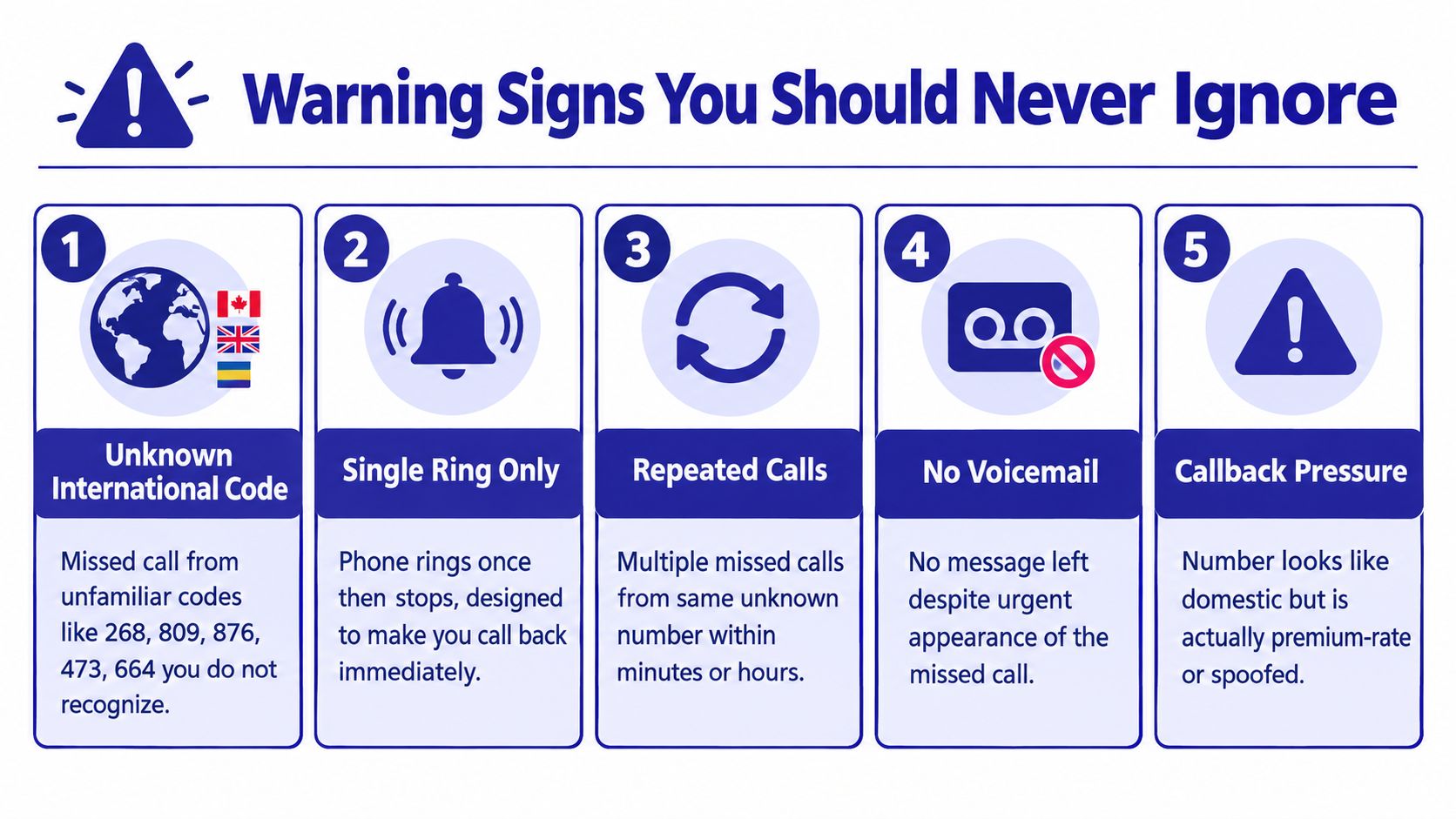
The strongest warning sign is often the combination of the caller-ID pattern and what happens next. One clue alone may not prove fraud, but several clues together should end the interaction.
- Unknown international code: Treat an unexpected missed call from codes such as 268, 809, 876, 473, or 664 as suspicious, especially when you have no reason to expect an overseas call.
- Single ring only: A phone that rings once and stops may be receiving a deliberate callback prompt rather than a genuine attempt to speak with you.
- Repeated calls: Several missed calls from the same unfamiliar prefix within a short period can indicate an automated dialing cycle. Don't assume repetition makes the caller more legitimate.
- No voicemail: A caller who appears urgent but leaves no clear message hasn't given you a reason to return the call.
- Domestic-looking number: A familiar-looking area code can be spoofed. The number displayed on your phone may not be the number that placed the call.
Escalation signs after a callback
If you already called back, don't panic. Hang up if the line plays unexplained hold music, keeps you waiting through recordings, or connects you to someone who immediately requests personal, banking, or account information.
End the call when the person demands payment by gift card or wire transfer, threatens immediate consequences, or asks you to install remote-access software. Those requests turn a suspicious callback into a broader fraud attempt.
For more examples of suspicious phone-number behavior, review this guide to what spam numbers are. Legitimate agencies and reputable businesses generally provide a verifiable way to contact them independently. They don't need you to trust an unexplained missed call, and you shouldn't use the number in a suspicious voicemail to verify the caller.
How to Protect Yourself Step by Step
Protection works best as layers. Traditional blockers can stop known numbers, but scammers can rotate numbers and spoof caller ID, so your habits and settings still matter.
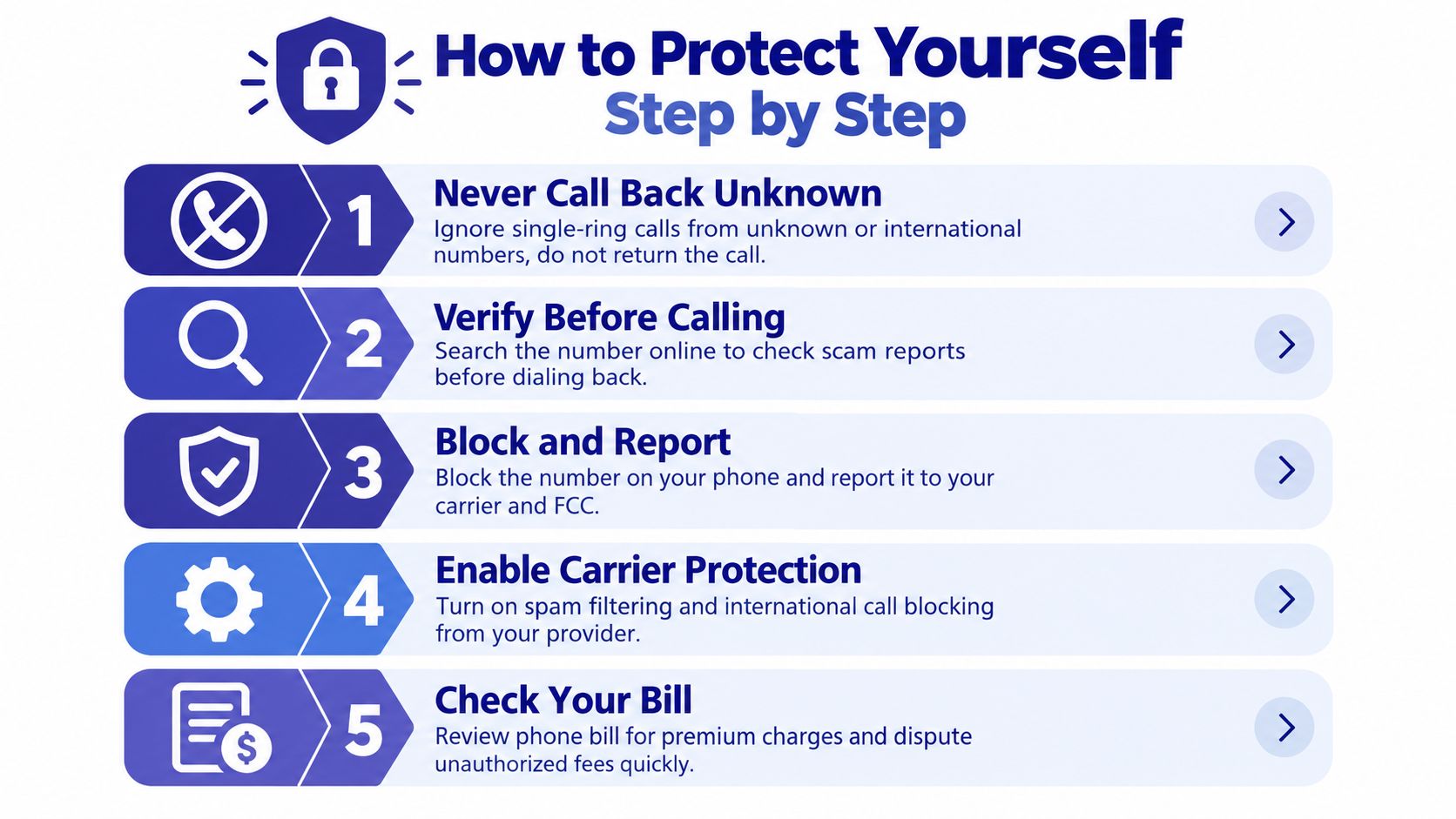
Don't return the call. Ignore a single-ring call from an unknown number, particularly an unfamiliar international or premium-rate destination. If you're concerned about a hospital, delivery, employer, or relative, find that organization's number independently through its official website, statement, or saved contact.
Verify before dialing. Search the complete number using a reputable search engine and compare any result with information you already trust. Don't treat a search result, caller-ID label, or online comment as absolute proof. Verification means using a separate route.
Block and report. Block the number on your device, then report the attempted scam to your carrier and the FCC. Keep the date, displayed number, voicemail, and any billing entry. That record can help your provider investigate or dispute an unauthorized charge.
Turn on carrier protections. Enable your provider's scam filtering and call-labeling tools. Ask whether international outbound dialing can be restricted or whether spending controls are available for your account. These settings are particularly useful for shared family plans and phones used by older relatives.
Add conversation-level screening. Static databases may miss newly rotated numbers. An AI screening service can answer unknown callers first, examine the interaction, and route only a verified call to you. Gini Help screens calls, texts, and emails, and its live call analysis can provide scam detection during calls you answer. You can download it from Google Play or the App Store.
You can also use a call-screening approach that keeps unknown callers from reaching your regular conversation flow. This guide to screening phone calls explains the idea in practical terms.
Finally, check your phone bill instead of assuming the problem ended when you hung up. Look for unfamiliar international or premium charges, contact the carrier promptly, and dispute unauthorized fees through the provider's documented process.
The Bigger Picture and What to Do Today
A one-ring scam can be the first contact in a wider fraud ecosystem. The same basic infrastructure can support impersonation attempts involving tax agencies, technical support, financial services, or romantic relationships. Spoofed numbers help establish trust, automated dialing finds responsive people, and callbacks provide a way to continue the conversation.
That makes number blocking useful but incomplete. Blocking one displayed number may stop one route while the operator switches to another number, area code, or message channel. The more durable defense combines skepticism, carrier controls, device settings, and screening that evaluates the conversation itself.
Take these actions today:
- Ignore unknown international callbacks, especially when the phone rings once and no clear voicemail arrives.
- Enable device and carrier scam filters and ask about international dialing restrictions.
- Use an AI screener for unknown calls if static blocking isn't enough.
- Review your bill for unfamiliar premium or international charges.
- Report confirmed attempts to the FCC and FTC.
- Tell older relatives and caregivers that a missed call doesn't need an immediate response.
Vigilance isn't a one-time fix. Make “verify before returning an unfamiliar call” a household habit, and the ringtone loses much of its power.
Gini Help screens unknown calls before they reach you and can analyze live conversations for pressure, urgency, or requests for money and personal information. Visit Gini Help to add a conversation-level layer of protection against one-ring scams and related phone fraud.