Caller ID Spoofing Scams: How They Work and How to Stop Them
By Josh C.
Your phone rings while you're making dinner. The number looks local, or the screen displays the name of your bank, doctor's office, utility company, or a government agency. Answering feels reasonable because the phone appears to have already identified the caller.
That appearance can be manufactured. Caller ID is a label carried through the phone network, not a verified identity card. A scammer may alter the number or name shown on your screen, then use that familiar signal to make a demand for money, personal information, passwords, or one-time codes seem credible.
That's why caller ID spoofing scams deserve more than a simple “don't answer unknown numbers” warning. You need to understand what the display does and doesn't prove, how scammers combine spoofing with social engineering, and what to do when a convincing call reaches you.
The Moment Your Phone Rings and the Number Looks Familiar
Caller ID creates a fast decision. You see a familiar area code, a recognizable business name, or a number stored in your contacts, and your brain treats it as supporting evidence. The problem is that the displayed information can be deliberately falsified. The Federal Trade Commission's explanation of phone scams warns that scammers can make any name or number appear on caller ID, including the identity of a government agency or trusted organization.
Think of the number as a digital return address. Someone mailing a letter can write a different sender's name on the envelope, even though that name doesn't prove who placed the letter in the mailbox. A spoofed call uses a similar trust shortcut. The caller supplies a number or name that makes the call look familiar before the conversation begins.
Why the display feels more trustworthy than it is
Your phone screen appears objective. It's generated by technology, presented in a clean format, and often paired with a business name. That presentation encourages you to ask, “Why would my bank call me?” rather than, “How do I independently verify this person?”
Scammers take advantage of that pause. They might copy a real customer-service number, use a local-looking number through neighbor spoofing, or imitate an institution you already recognize. The displayed number lowers suspicion, but it doesn't authenticate the voice on the other end.
Practical rule: Treat every unexpected incoming call as unverified, even when the number looks familiar.
A legitimate caller may still reach you through an unfamiliar number, and a criminal may present a number that looks official. The safe response is the same in both cases: don't provide sensitive information during an unsolicited call, end the conversation, and contact the organization through a trusted channel.
The gap between perceived trust and actual verification is the doorway caller ID spoofing scams use. Once you understand that gap, the technical process becomes easier to recognize.
How Caller ID Spoofing Actually Works
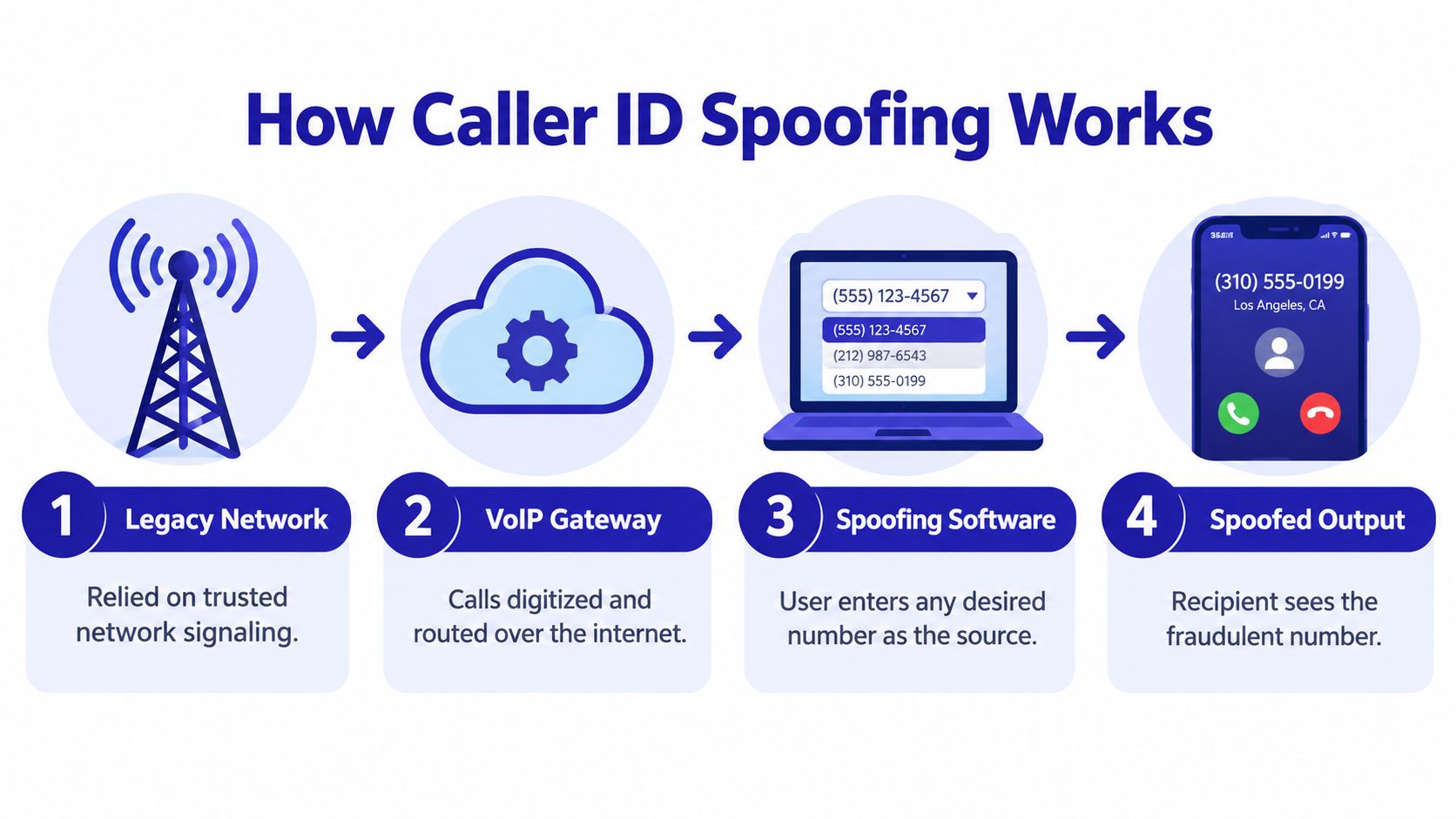
Traditional telephone systems used network signaling to pass information about a call from the originating carrier to the receiving carrier. Modern internet-based calling adds more flexibility. Voice over Internet Protocol, or VoIP, routes calls through internet-connected systems, and some services allow the caller to choose the number presented to the recipient.
The process resembles a forwarded letter whose cover sheet can be rewritten before delivery. The call still travels through communication providers, but the identifying field attached to it may not accurately describe the person or organization that initiated the conversation.
Two common forms of manipulation
Direct caller ID manipulation happens when a caller uses a VoIP platform, calling application, or other system that permits a selected number or name to appear on the recipient's device. The number might belong to a bank, a public agency, a business, or another person.
Neighbor spoofing uses a number that shares the recipient's area code and sometimes the same local prefix. The goal is simpler: a nearby-looking call may seem more likely to be a neighbor, local business, medical office, or community organization than an obvious overseas or unfamiliar number.
The FCC's guidance on stopping unwanted robocalls and texts explains that spoofing can help callers obtain money, personal information, or telemarketing leads. That distinction matters. Spoofing is the delivery mechanism, not the entire scam. The harm usually occurs after you answer, when the caller applies pressure or impersonates someone you trust.
A business evaluating legitimate internet calling can learn about VoIP solutions for London businesses to understand how lawful VoIP systems support communications. The technology itself isn't fraudulent. The danger comes from abusing flexible caller-identification fields and pairing them with deception.
You can also review this explanation of how caller ID works on a phone, but keep its central lesson in mind: the screen can tell you what identity was presented, not whether that identity is genuine.
Here's a short visual explanation of the process:
Common Spoofed Caller ID Scams in the Wild
A spoofed number usually appears at the beginning of a longer social-engineering sequence. The caller wants you to accept the identity first, then accept the request that follows.
The fake bank fraud alert
Your screen shows your bank's customer-service number. A recorded message or live representative says a suspicious transaction needs immediate review. The caller may ask you to confirm an account detail, read back a security code, or move money to a supposedly safe account.
The displayed bank number makes the opening feel routine. The request reveals the problem. Your bank may ask you to contact it through secure channels, but an unexpected caller shouldn't pressure you to disclose passwords, PINs, full Social Security numbers, or authentication codes.
The tax authority threat
The caller ID appears to belong to the IRS or another government office. The caller claims you owe money and warns of arrest, legal action, or an immediate penalty unless you pay during the call.
The fake official number supplies authority, while the threat suppresses careful thinking. Don't debate the caller. End the call and contact the relevant agency using contact details you find independently, not a number supplied during the conversation.
The technical-support emergency
A number associated with Apple, Microsoft, or your internet provider appears on the screen. The caller says your computer, account, or connection has been compromised and asks you to install remote-access software, disclose a password, or pay for urgent repairs.
Remote access creates a direct path to files, accounts, and saved credentials. A real support request should be verified through the company's official application or website. You don't need to let an incoming caller control your device to investigate an alert.
The family emergency
The caller claims to be your grandchild, a relative, or a lawyer helping that person. The number may look like a family member's phone or another trusted contact. The caller says there's an emergency and asks for secrecy, a wire transfer, gift cards, or cryptocurrency.
The emotional pressure does the work that technical detail can't. Call your relative through a number you already trust, or ask a separate family member to confirm the situation. Never treat a familiar caller ID as confirmation of a family emergency.
Warning Signs That the Caller Is Not Who They Claim
The phone rings, and the displayed number resembles your bank, employer, doctor, or a family member. The caller sounds confident, yet asks for something unexpected. Treat that mismatch as a reason to pause, not as a detail to explain away.
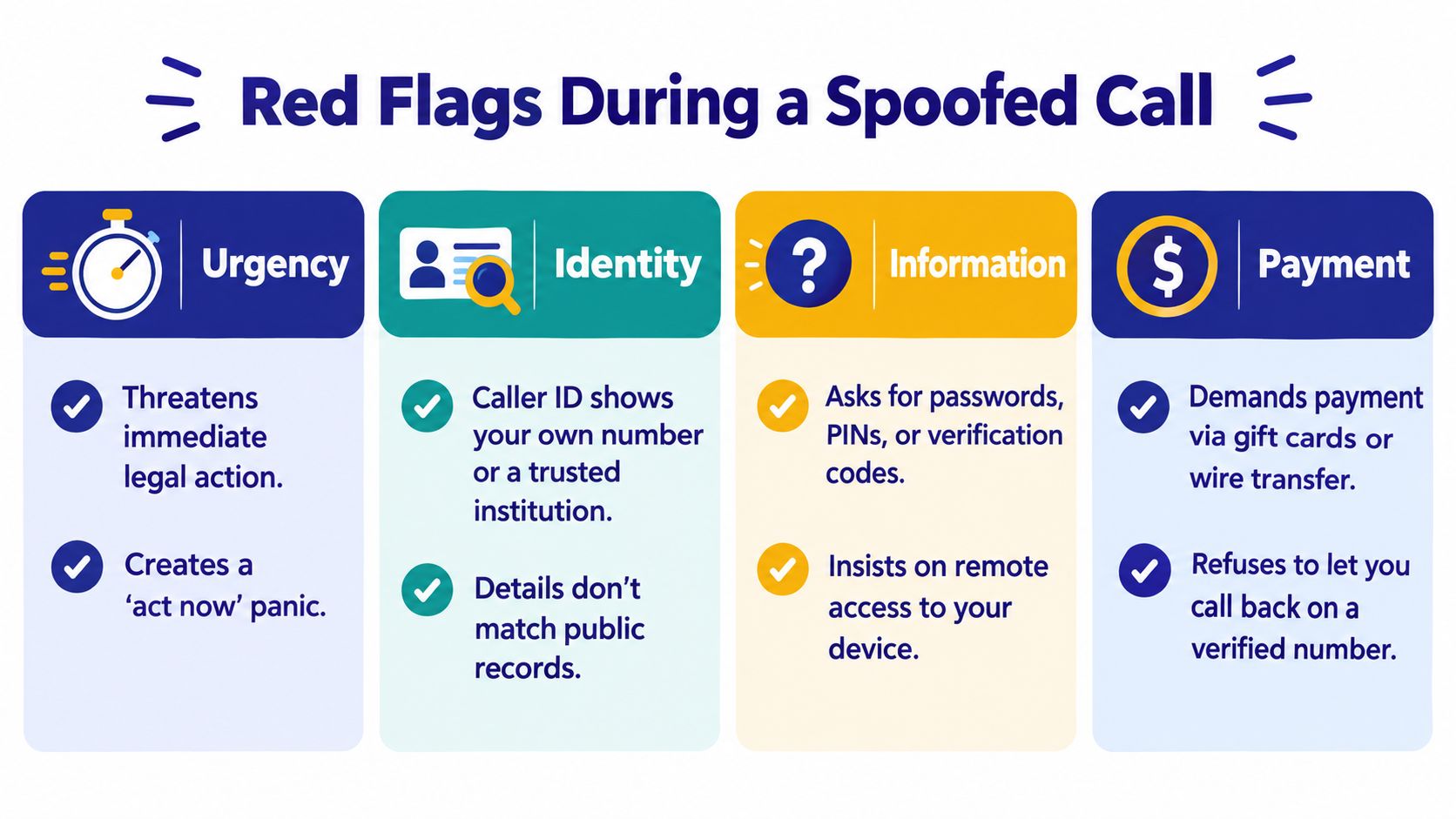
Use the checklist while the call continues. You do not need to prove fraud before protecting yourself. One strong warning sign, especially an unexpected request for money or credentials, is enough to end the call and verify through a channel you choose.
Pressure and urgency
Scammers try to keep you reacting instead of checking.
- Immediate consequences: The caller threatens arrest, account closure, service termination, or legal action unless you act immediately.
- Secrecy: You are told not to speak with your spouse, bank, family, accountant, or police.
- Panic language: The caller describes an emergency and refuses to give you time to think.
A legitimate organization can tolerate a callback and independent verification. An impersonator needs to keep you on the line, where the familiar caller ID and emotional pressure work together.
Identity inconsistencies
Listen for details that do not fit the claimed organization. The caller may know your name but fail to answer basic account questions, give only a vague department name, or refuse to provide a case number you can verify.
Caller ID is like a label placed on an envelope. It can look official without proving who sent it. A displayed number may be deliberately falsified, so a familiar number is not confirmation of identity. FCC's spoofing guidance explains this limitation.
Requests that legitimate organizations should not make
Be especially cautious if an unexpected caller asks you to:
- Reveal credentials: Do not read out passwords, banking passwords, PINs, full Social Security numbers, or two-factor authentication codes.
- Move money: A request to transfer funds to a “safe” account is a major warning sign.
- Use unusual payment methods: Gift cards, wire transfers, and cryptocurrency can make recovery difficult.
- Install software: Do not grant remote access because an unsolicited caller says your device is infected.
End the call if the person will not let you hang up and contact the organization through its verified website, application, or number. Traditional blocklists can block known numbers, but they cannot assess the caller's story or pressure in the moment. Independent verification remains your practical safety layer.
The Legal and Regulatory Fight Against Spoofing
In the United States, caller ID spoofing can violate the Truth in Caller ID Act of 2009 when someone transmits false or misleading caller ID information to defraud, cause harm, or obtain something improperly. The rule addresses the identity shown on your screen, the same label that can make a suspicious call appear familiar. The FCC's consumer guidance explains why that display alone does not establish who is calling.
Enforcement actions also show how spoofing can operate at scale. One forfeiture order involved $225 million, eight entities, and more than 21 million robocalls over about three months in late 2016 and early 2017. Those figures describe an organized calling operation, not a single scammer making occasional calls. Legal action can impose consequences after investigators connect the calls to the people behind them.
Authentication changes the network response
STIR/SHAKEN is an FCC-backed framework for authenticating caller ID information. Participating providers can attest to the relationship between a caller and the number being presented. That gives carriers and consumers more context than an unauthenticated number alone, much like adding a verification mark to the label on an envelope.
Authentication has limits. Calls may cross providers, begin outside a participating network, or travel through a route where verification data is incomplete. Industry analysis has estimated a 20% to 40% reduction in U.S. robocall volume since 2021, but that estimate represents fewer calls, not a guarantee that an incoming call is legitimate. The framework improves the network's information without settling the caller's story.
| Region | Key rule or framework | Enforcement body | Current practical effect |
|---|---|---|---|
| United States | Truth in Caller ID Act and STIR/SHAKEN authentication | FCC and FTC | Raises the cost of spoofing, but spoofed calls still reach consumers |
| European markets | Cross-border tracing and inbound verification recommendations | National authorities with Europol coordination | Encourages providers to examine call provenance across networks |
| United Kingdom | Ofcom telecom and nuisance-call oversight | Ofcom | Supports provider controls and consumer complaints |
| Canada | Unsolicited Telecommunications Rules | CRTC | Restricts unlawful telemarketing and supports enforcement against abusive calling |
| Australia | Reducing Scam Calls code | Australian Communications and Media Authority | Pushes carriers toward scam detection and call management |
The FCC's robocall-blocking guidance describes the consumer-facing controls that carriers can provide. Those controls can filter patterns and known problem numbers, while AI call screening can examine the conversation itself, including claims, requests, and pressure, before you decide whether to continue. That distinction matters at the ringing-phone moment, when a familiar number may still be a carefully constructed disguise.
What to Do If You Suspect or Fell for a Spoofed Call
Your next action depends on whether the call is still connected or information has already been shared. In either case, act quickly. Trying to prove the caller is lying gives them more time to pressure you.
If the caller is still on the line
- Hang up. You do not owe the caller an explanation. Staying on the line gives a scammer more opportunities to create urgency or learn what makes you hesitate.
- Do not call the displayed number back. Caller ID may show the exact number the scammer forged.
- Find a trusted contact route. Use the number printed on your bank card, an official statement, a verified website, or the organization's official app.
- Check the account independently. Open your banking application yourself. Do not follow a link or transfer instructions supplied during the call.
- Do not share codes or approve prompts. Reading a one-time code aloud may help an attacker pass a login protection step.
The FTC's bank impersonation scam advice also recommends ending the call and contacting the institution through a trusted number.
If you already responded
Contact your bank or payment provider immediately if you sent money or disclosed financial details. Ask whether a transaction can be stopped. Change compromised passwords from a device you trust, and enable stronger account protection where available.
If personal information was exposed, consider placing a fraud alert or credit freeze with the relevant credit bureaus. Report the incident through the FTC's ReportFraud service, submit an FCC complaint, and contact the FBI's Internet Crime Complaint Center if money was sent or the incident involved internet-enabled fraud.
Write down the date, time, displayed number, claimed organization, exact request, payment instructions, and any messages or receipts. Gift-card and wire-transfer payments can be difficult to recover, so report the incident promptly rather than waiting out of embarrassment.
A convincing script can deceive careful people. Reporting the call helps protect your accounts and gives investigators details they can use to identify patterns.
For a practical scam-call reporting checklist, record the caller's claims and the action they requested before submitting your report.
How AI Call Screening Changes the Equation
Traditional blocklists remember known bad numbers. That approach can stop repeat offenders when the number stays the same, but spoofing undermines the assumption. A scammer can present a new number, a local-looking number, or a number associated with a legitimate organization, leaving the blocklist with little history to use.
AI call screening evaluates the conversation as well as the number. It can look for scripted urgency, requests for passwords or verification codes, payment instructions, impersonation language, unusual behavioral patterns, and other signals associated with scam playbooks. That shifts protection from “Has this exact number been reported?” to “Does this interaction behave like a scam?”
What screening can add
A service such as Gini Help can answer unknown callers first, transcribe the conversation in real time, assess suspicious intent, and forward only calls that pass its legitimacy checks. Its live call analysis can also provide scam detection during calls you do answer, including a risk score and warnings when the conversation becomes concerning.
That makes AI screening a missing layer rather than a replacement for carrier controls, blocklists, reporting, or careful verification. Number reputation remains useful. It isn't sufficient when the presented number can change from call to call.
Organizations designing broader defenses can also study approaches to scalable fraud detection systems that combine signals across communication and transaction activity. For an individual, the principle is straightforward: analyze behavior at the moment of contact instead of relying only on a historical list.
What AI screening can't guarantee
AI tools can misinterpret poor audio, accents, background noise, unusual conversations, or a caller who uses a new script. A scammer may leave a voicemail, shift the conversation to text or email, or use an account that looks legitimate on another channel. Screening reduces exposure, but it doesn't remove the need to verify financial requests and protect authentication codes.
Use it as a buffer between an unknown caller and your attention. The strongest setup combines carrier-level authentication, device controls, independent verification, and real-time analysis when a suspicious conversation gets through.
Your Protection Plan and What Comes Next
Build your protection around one rule: the caller must prove the request through a separate trusted channel. Caller ID can support a decision, but it shouldn't make the decision for you.
Start with these actions today
- Enable carrier protections: Turn on your provider's scam-blocking and caller-authentication features, including available STIR/SHAKEN indicators.
- Add conversation-level screening: Consider an AI screener that can assess unknown callers before you speak with them.
- Register for call controls: Add your number to the U.S. Do Not Call Registry, while remembering that registration won't stop criminals who ignore the law.
- Protect verification codes: Never read a one-time code to an unexpected caller or approve a login prompt you didn't initiate.
- Verify by dialing out: Hang up, locate the official number independently, and place the call yourself.
- Limit exposed contact details: A practical phone number privacy guide can help you reduce where your number appears publicly.
Expect the impersonation layer to evolve
Spoofing is increasingly useful as the first trust signal in a larger fraud sequence. A caller may begin with a forged number, continue through SMS or email, and use AI-generated voices or other impersonation techniques to make an emergency sound convincing. Recent reporting cited in the CNBC coverage of AI-powered scam calls describes this shift toward more convincing AI-assisted impersonation.
Europol describes phone calls and texts as the entry point for roughly 64% of reported fraud cases and estimates about EUR 850 billion in annual worldwide losses in its position paper on caller ID spoofing. Those figures reinforce why network authentication alone can't close every route. Europol recommends tracing call paths and verifying inbound traffic, while consumers still need a simple habit: pause, hang up, and verify.
If a call causes harm, report it through the FTC's ReportFraud service, the FCC consumer complaint portal, or IC3. Preserve the number displayed and the conversation details, even if the call seemed too brief to matter.
Download Gini Help on Google Play or Gini Help on the App Store to add a real-time screening layer for unknown calls, texts, and emails.
Gini Help can screen unknown callers before they reach you and analyze suspicious conversations while you're on a call. Visit Gini Help to add a practical first line of defense against caller ID spoofing scams.