Phone Call Interception Explained: Stay Safe in 2026
By Josh C.
In the United States, people received 4.2 billion robocalls in April 2026, or nearly 140 million calls per day and 1,600 calls per second, according to the Congressional Research Service report on unwanted calls. That scale changes what phone call interception means. It isn't only a spy-movie scenario involving someone secretly tapping a line. It can also involve a fake tower, a compromised signaling system, a stolen phone identity, or an AI-generated voice trying to guide you through a dangerous conversation.
The practical question is no longer just, “Is this number on a spam list?” A caller can rotate numbers, imitate a trusted contact, or use a legitimate-looking authenticated route while the conversation itself remains fraudulent. This guide explains how interception works, where lawful monitoring ends and criminal access begins, which warning signs you can spot during a call, and how layered defenses can reduce the risk.
What Phone Call Interception Actually Means Today
Phone call interception means an unauthorized person or system listens to, records, changes, redirects, or impersonates a live phone conversation. The word “interception” can sound technical, but the basic idea is simple: someone other than the intended participants gains influence over the call.
That influence can take several forms. An attacker might listen, capture audio for later use, redirect a call to another destination, manipulate signaling information, or place a conversation using a cloned voice. A scammer doesn't always need to hear the entire call. In some attacks, controlling the route, the caller identity, or the first moments of the conversation is enough to create trust.
Spam is related, but it isn't identical. A spam call is unwanted. Caller-ID spoofing means the displayed number has been falsified. Interception concerns what happens to the call or the conversation itself. One call can involve all three: a spoofed number delivers a spam call, and the caller uses social engineering or technical access to collect information.
Why number screening isn't enough
Traditional call filters often ask a narrow question: Has this number appeared in a database of suspicious numbers? That works against known campaigns, but it struggles when criminals use new numbers, imitate local numbers, or call from an account that appears familiar.
A compromised account or phone number can still deliver a harmful conversation. Likewise, a legitimate caller's number doesn't prove that the person speaking is the person you intended to reach. For readers trying to understand the connection between phone identity and account theft, this guide to SIM-swap fraud provides useful background.
Practical rule: Treat caller identity as a clue, not as proof.
The consumer problem has grown large enough to change behavior. The FCC Consumer Help Center received more than 2 million complaints over eight years, and at least 55% concerned unwanted calls, including telemarketing and robocalls, as reported by USA Today's FCC complaint analysis. The same reporting identified 808,342 reports of unsolicited calls in the FCC searchable database. These figures show why phone call interception now belongs in everyday consumer safety discussions, not only in telecommunications engineering.
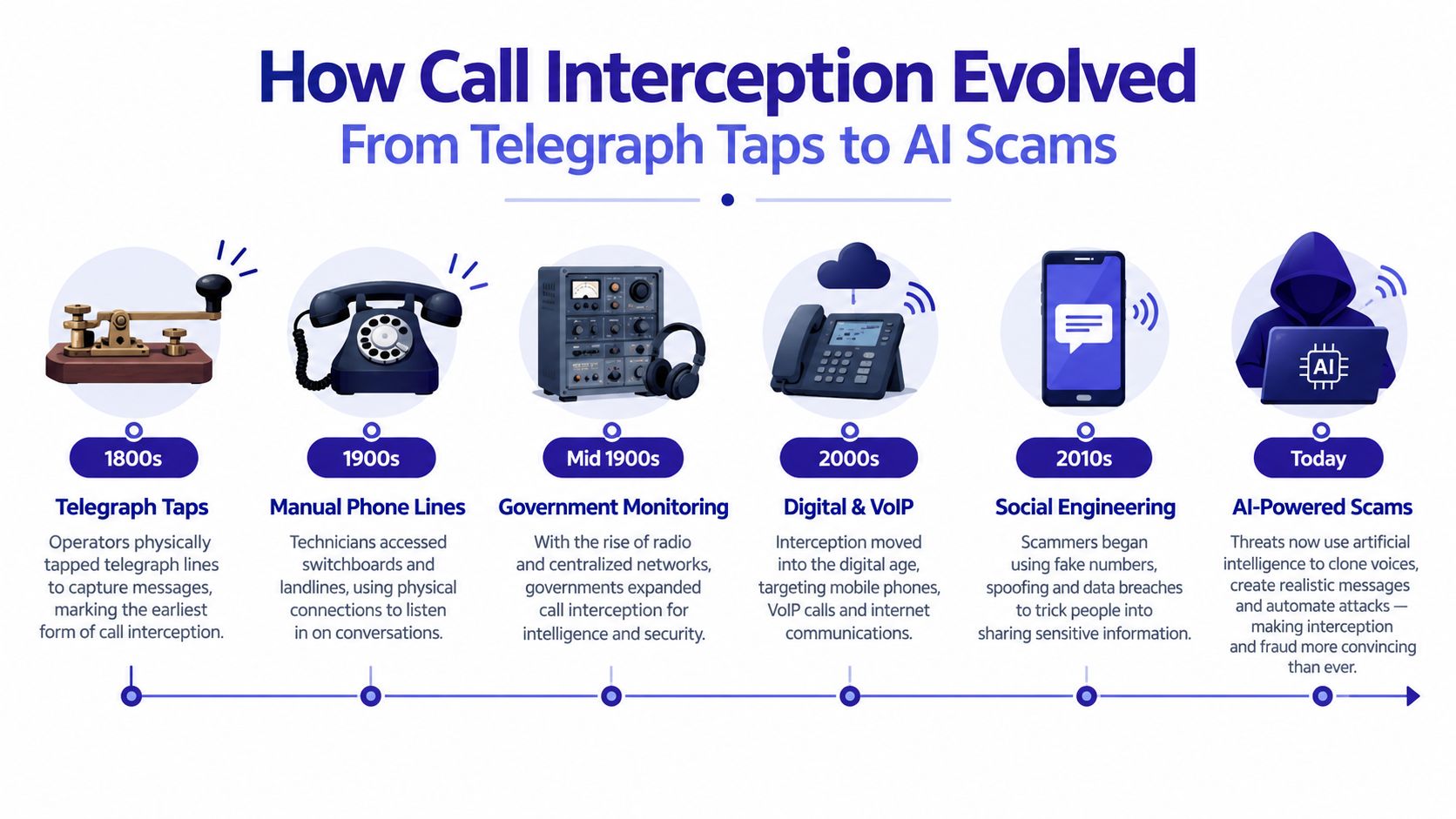
How Call Interception Evolved From Telegraph Taps to AI Scams
Interception began before mobile phones existed. Telecommunications technologies were first created around 1840, and the International Telecommunication Union's historical material describes an early reported case from 1867. A Wall Street stockbroker worked with Western Union operators to intercept telegraph dispatches intended for Eastern newspapers.
The technology was primitive by modern standards, but the motive was familiar. Information moving over a long-distance communication network had value, so someone found a way to access it before it reached the intended recipient. The episode also shows that interception didn't begin with smartphones. It appeared as soon as electronic communication became important enough to target.
From physical wires to network instructions
During the era of analog telephony, investigators and criminals could target physical lines, switches, or equipment. A wiretap required access to part of the path carrying the conversation. Law enforcement also developed formal procedures for authorized monitoring, while unauthorized listeners sought ways to hide their access.
Digital networks changed the location of the risk. SS7, the signaling system used to establish and end calls, was designed in the 1970s with weak authentication assumptions. As carriers connected across networks, attackers with signaling access could exploit those trust relationships to redirect calls, intercept messages or voice traffic, and obtain location information, as summarized in the SS7 technical overview.
Mobile devices introduced another route. An IMSI catcher, also called a rogue base station, can imitate a legitimate cell tower and encourage nearby phones to connect to it. Once connected, the attacker may relay or record traffic and track a device's location. Modern fraud adds a human layer to these technical methods. Criminals can combine stolen data, SIM-box routing, scripted persuasion, and AI-generated speech to make a conversation feel personal.
The result is a continuous story, not a collection of unrelated threats. Telegraph operators once exposed valuable dispatches. Today, attackers target the network, the device identity, and the caller's voice, often in the same campaign.
Common Interception Techniques Used in 2026
The most useful way to understand modern interception is to separate the technical path from the fraudulent outcome. Some attacks target carrier signaling. Others target the radio connection, the phone number, or the listener's trust.
| Technique | How It Works | What the Attacker Gains | Real Scenario |
|---|---|---|---|
| SS7 exploitation | An attacker with signaling-network access sends instructions through a system built on trusted relationships. | Call redirection, intercepted SMS or voice, and location information. | A fraudster reroutes a verification message or call while the victim believes the original number remains secure. |
| IMSI catcher | A rogue base station imitates a nearby cell tower and attracts phones to its radio connection. | Potential access to traffic and real-time device-location information. | A fake tower operates near a busy train station, where many phones may connect to the strongest-looking signal. |
| SIM-box fraud | Organized operators route internet-based calls through banks of local SIM cards. | Local-looking caller identities, cheaper routing, and a way to make large campaigns harder to trace. | A call center sends VoIP traffic through local SIM cards so recipients see familiar regional numbers. |
| AI voice cloning | Software generates speech that resembles a real person's voice and combines it with a persuasive script. | Trust, urgency, and a chance to obtain money, credentials, or codes. | A grandparent hears a distressed voice that sounds like a grandchild asking for bail money. |
SS7 and the hidden instructions behind a call
Think of SS7 as a backstage instruction system. It doesn't carry the entire conversation in the same way a person hears it, but it helps networks determine where calls and messages should go. Because the system was built around cooperative carrier relationships, unauthorized access can let an attacker issue instructions that the victim never sees.
That doesn't mean every phone call is exposed. It means caller-number reputation alone can't address a network-level problem. A call may look ordinary while the signaling around it has been manipulated.
Rogue towers and SIM boxes
An IMSI catcher works closer to the phone. The handset looks for a strong, plausible cellular signal, and a malicious device can exploit that selection process. The attacker may then relay the connection so the user notices little beyond unusual behavior.
SIM-box fraud focuses on scale and appearance. Instead of presenting an obviously foreign or expensive route, an operation can use local SIM cards to make calls look geographically familiar. For a plain-language explanation of why a displayed number can mislead you, see this guide to caller-ID spoofing detection.
The conversation is now the attack surface
AI voice cloning changes the central question. A blacklist asks whether the number is suspicious. A human-centered defense asks what the caller wants, how quickly they demand it, and whether they resist independent verification.
Recent reporting from TNSI on voice communications security warns that authentication alone isn't enough against voice cloning, multimodal attacks, and SIM-box fraud. The same report described 2026 examples involving cloned family voices and AI-scripted IRS calls aimed at banking credentials. A familiar voice can therefore be part of a fraudulent call, even when the number appears credible.
Where Lawful Interception Ends and Criminal Interception Begins
Think of a phone network like an apartment building. The building owner may maintain wiring and provide access to authorized workers, but that doesn't give every employee permission to enter an apartment or record a tenant's conversation. Access depends on authority, purpose, process, and legal limits.
Lawful interception is government-authorized monitoring carried out under applicable legal authority for investigative or forensic purposes. Carriers may also inspect calls for network operations, fraud prevention, and blocking, subject to the laws and policies that govern those activities. The ITU's historical material describes lawful interception as government-authorized monitoring of telecommunications for forensic purposes.
Three different kinds of network activity
Carrier protection includes tools that identify suspicious traffic, authenticate caller information, and block or label unwanted calls. STIR/SHAKEN is a network authentication framework, not a license for private individuals to listen to calls. It helps participating providers attach information about caller identity to calls moving through IP networks.
Lawful monitoring is different from a private attacker placing an unauthorized device or sending unauthorized signaling instructions. A rogue IMSI catcher, unauthorized SS7 probing, or a rogue SIM-box operation can cross legal and privacy boundaries because the operator lacks the required authority and uses the system for intrusion, fraud, or surveillance.
STIR/SHAKEN also has technical limits. FCC materials explain that it works only on IP networks, so a non-IP segment can create an authentication gap. The FCC cited estimates that as many as 57.2% of calls signed by the originating provider could reach the destination unsigned in the relevant assessment, as detailed in its April 2025 STIR/SHAKEN materials. Authentication can support trust, but it can't prove that a live speaker is honest.
Organizations handling recorded or analyzed conversations also need clear controls around consent, access, retention, and data handling. Teams building automated support systems can use guidance on technical safeguards for AI customer support to think through those controls without treating AI analysis as exempt from privacy responsibilities.
The quick test is straightforward. If a carrier or public authority acts under an established legal framework, it may be lawful. If a private person secretly accesses the route, records the conversation, impersonates a tower, or redirects messages without authorization, assume the activity is unlawful and dangerous.
Warning Signs and Detection Methods You Can Use Mid-Call
A suspicious call often reveals itself through behavior before a device displays a warning. Technical interception can be difficult for an ordinary caller to confirm, but manipulation usually creates opportunities for a pause, a question, or an independent check.
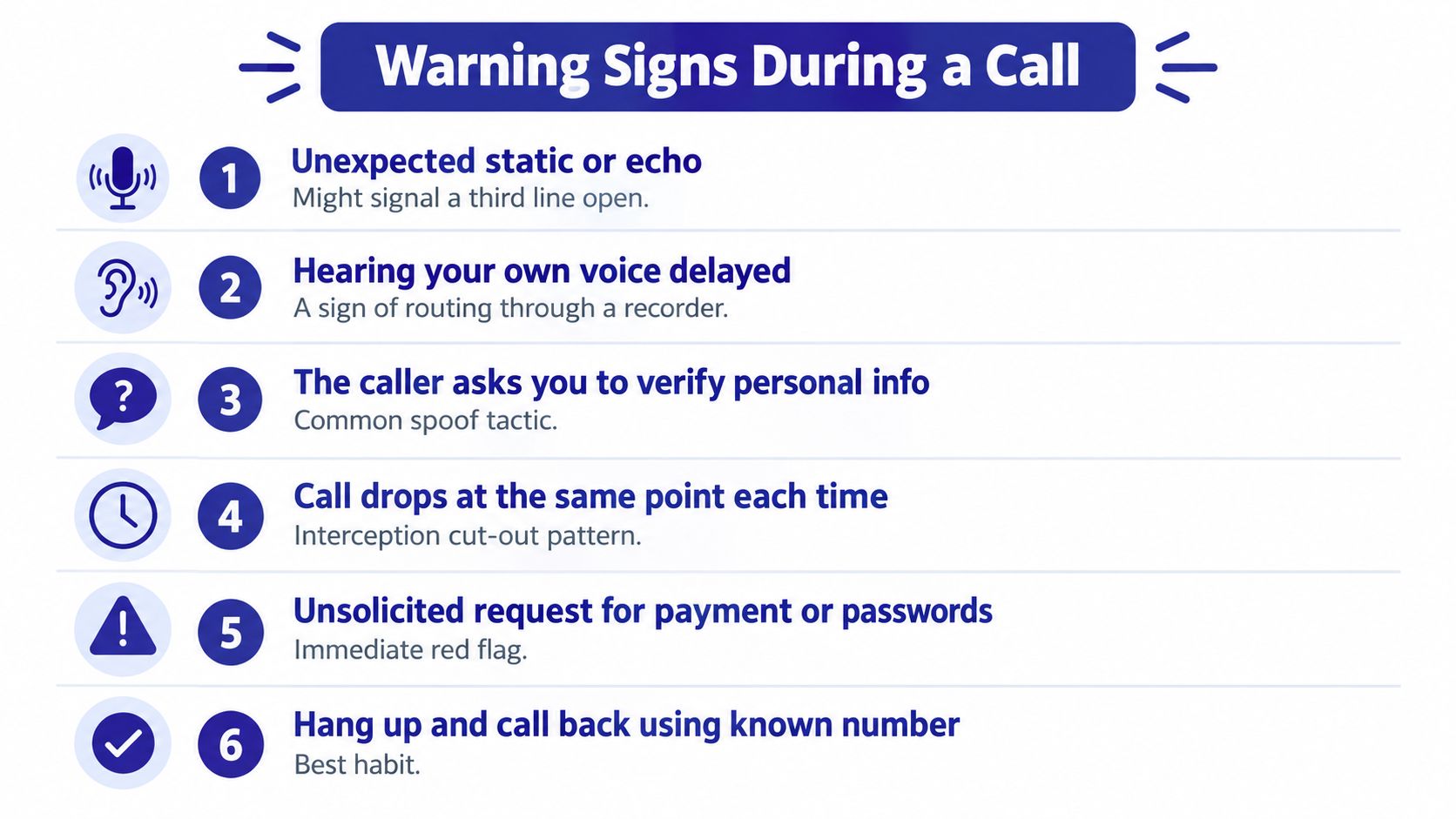
Start with pressure. A caller who demands secrecy, insists that you stay on the line, or claims that delay will cause arrest, account closure, or immediate loss is trying to control your decision window. Slow the conversation down. Legitimate organizations generally give you a way to end the call and contact them through a known channel.
Listen for the combination, not one odd sound
Static, echo, clipped syllables, delayed responses, or unnatural pauses can occur for harmless reasons, including weak reception or network congestion. One audio artifact doesn't prove interception. Several artifacts combined with an urgent request deserve caution.
Use a simple response:
- Ask who is calling and why. Don't accept a vague answer such as “This is security.”
- Refuse to share codes or passwords. A one-time code is an authentication secret, not proof that the caller is legitimate.
- Create a private verification test. Ask a family member to identify a prearranged detail that isn't available on social media.
- End the call if the caller objects. Dial the organization using the number on its official website, card, statement, or app.
- Preserve evidence. Screenshot messages, note the displayed number and time, and save voicemails before reporting the incident.
A delayed voice isn't a verdict. The caller's reaction to verification tells you more.
AI-generated speech may sound convincing, but conversation has context. A genuine relative may know an agreed family phrase, accept a callback, and understand why you need confirmation. An impersonator often treats every safety step as an obstacle.
Protect the next account, not only this call
If the caller asks you to read an SMS code, move money, install remote-access software, or share a password, stop. Contact the bank, carrier, employer, or government agency independently. Don't use a callback number supplied during the suspicious conversation.
Consumer fear has consequences beyond missed spam. TNSI reporting says 80% of Americans reportedly ignore important calls because they suspect scams, which means “answer less often” can protect some people while causing others to miss genuine medical, family, or work calls. The stronger goal is trusted analysis during the conversation, not permanent avoidance of unknown callers.
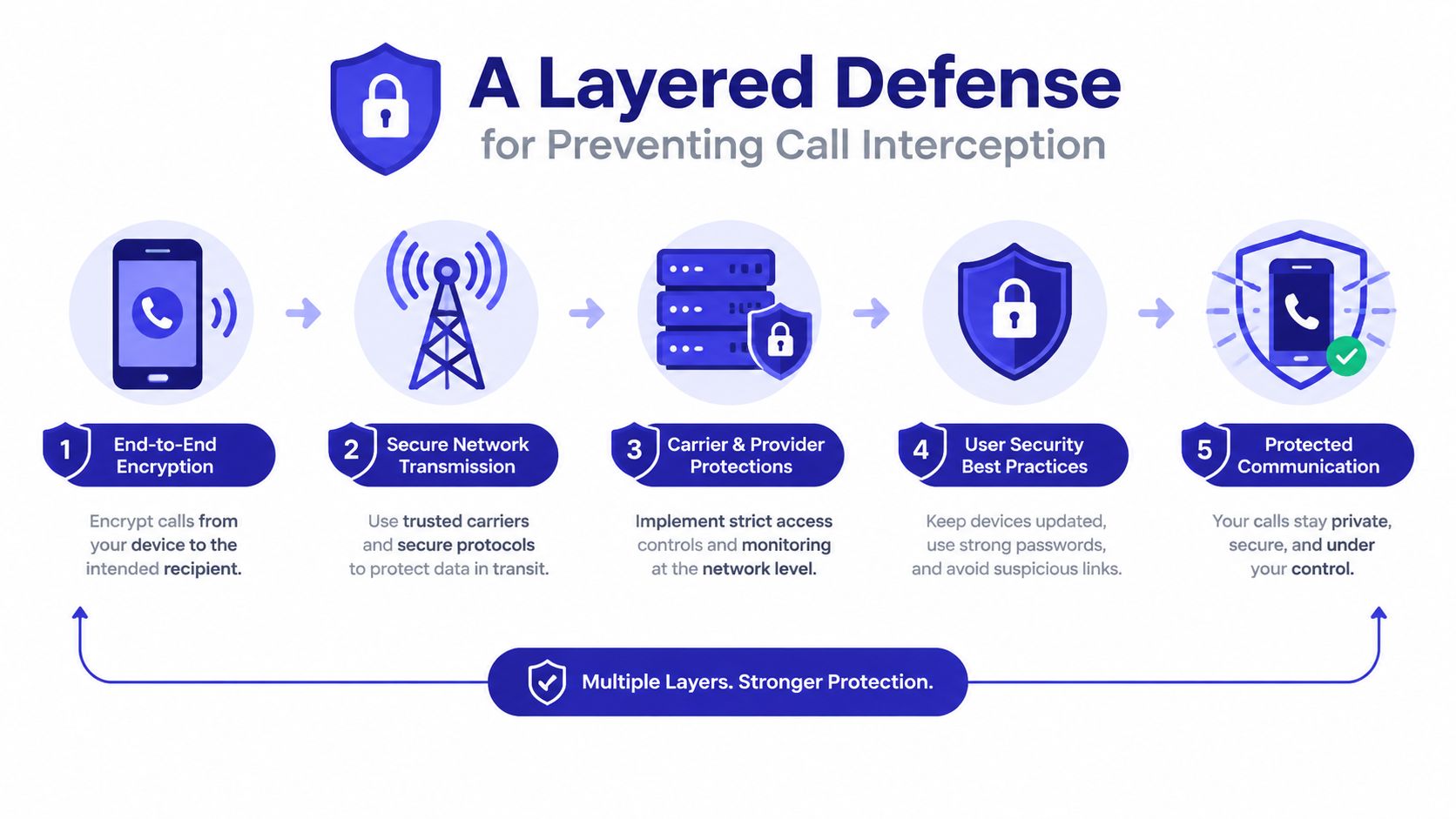
A Layered Defense for Preventing Call Interception
No single setting can solve phone call interception because the risk exists across the carrier, device, account, and conversation. A practical defense uses several layers so one failed control doesn't expose everything.
Start with the carrier
Turn on your carrier's spam filtering and call-labeling tools. Use caller authentication where your provider and device support it, but remember that FCC materials identify gaps when calls cross non-IP portions of the network. Trade-association comments citing TransNexus data reported that 38.8% of calls arriving at terminating providers still retained SHAKEN information in October 2025, compared with about 24% in January 2023, according to the INCOMPAS and CCA filing. Improvement doesn't equal complete end-to-end coverage.
Registering with the Do Not Call Registry can reduce some legitimate telemarketing, though it won't stop criminals who ignore the rules. The FTC reported more than 258 million active registrations by the end of fiscal year 2025 and over 2.6 million Do Not Call complaints that year, as described in its National Do Not Call Registry report.
Reduce account and device exposure
Ask your mobile carrier to add an account PIN or other protection against unauthorized number transfers. Avoid using voice calls or SMS as your only method for protecting important accounts when stronger options such as authenticator applications, passkeys, security keys, or biometrics are available.
Keep your operating system and communication apps updated. Review call-forwarding settings, connected devices, voicemail access, and app permissions. If you use a business VoIP system, administrators should also protect management accounts, encrypt voice traffic where appropriate, apply security updates, and monitor unusual routing.
Make behavior part of the architecture
Your habits are a security layer, not an afterthought. Don't transfer money because a caller sounds familiar. Don't disclose one-time codes. End unexpected calls and restart contact through a known number or trusted app.
For organizations deploying automated calling, the same principle applies at a larger scale. Documentation about enterprise AI calling security can help teams evaluate authentication, privacy, monitoring, and escalation controls around AI voice agents.
Suppose a cloned family voice calls with an urgent financial request. Carrier filtering may label or block the number. Account protections limit what a stolen phone identity can accomplish. Your verification habit stops the transfer. Live conversation analysis can flag the urgency and request pattern while the call is happening. This is the value of defense in depth, each layer addresses a different failure.
For a broader overview of practical safeguards, see these fraud prevention solutions.
How Gini Help Fits Into a Modern Interception Defense
Static filters operate before the conversation. They compare a number with reputation data, patterns, and carrier signals. That remains useful for known campaigns, but it can miss rotating numbers, neighbor spoofing, SIM-box routing, and AI-cloned voices.
Gini Help adds a live-conversation layer. Its AI call screening can answer an unknown call first, ask who is calling and why, and decide whether to connect the call. For calls you do answer, Live Call Analysis evaluates the conversation as it develops and can provide a risk score and haptic warnings when it detects suspicious patterns.
That approach shifts attention from “Who owns this number?” to “What is this speaker trying to make me do?” The system can consider intent, urgency, requests for credentials or payments, and resistance to verification. It doesn't replace caution, carrier controls, or legal reporting. It supports judgment during the unpredictable middle of a call, where a trusted contact can be impersonated and a clean number can still deliver a scam.
Gini Help also screens texts and emails through the same app, which matters because modern fraud can move between channels. A suspicious call may be followed by a message containing a payment link or a request for a verification code. Keeping the decision focused on the whole interaction is more useful than treating caller ID as a complete identity check.
Gini Help offers pre-call screening and live analysis for suspicious conversations, helping you assess intent before sharing money, codes, or personal information. Visit Gini Help to add real-time conversation checks to your carrier protections, device settings, and verification habits.