Can You Block a Landline Number? A Simple, Effective Guide
By Josh C.
Yes, you can absolutely block a number on your landline. But let's be honest, it’s rarely as straightforward as tapping a button on your cell phone. While there are ways to stop a specific, persistent caller, the real battle is against the relentless flood of robocalls, telemarketers, and sophisticated scams that make the phone ring off the hook.
The fundamental issue? Most traditional blocking methods are reactive. You get a call, you block the number. By then, the scammers have already moved on to a dozen new numbers. A recent report from YouMail highlighted the severity of this issue, revealing that Americans received over 4.3 billion robocalls in a single month. This data underscores that manual blocking is no longer a viable strategy against such an overwhelming volume of calls.
The Unwanted Noise of the Modern Landline
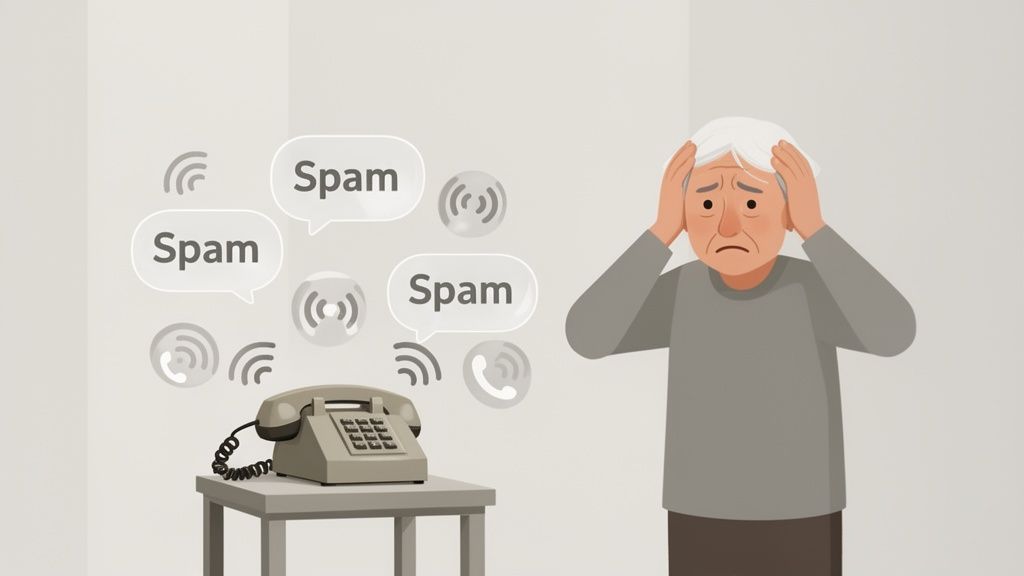
For too many of us, the sound of the home phone ringing no longer brings a sense of connection. Instead, it triggers a moment of dread. What was once a lifeline to family and friends has become the primary way telemarketers and fraudsters invade our homes. This isn't just a small hassle; it's a daily drain on our peace and quiet.
The sheer volume is enough to make anyone want to unplug the phone for good. This is particularly true for older family members who often rely on their landline as a primary communication tool, unfortunately making them a top target for scams designed to exploit their trust.
Just How Bad Is the Landline Spam Problem?
The scale of this issue is genuinely staggering. While it might feel like everyone has moved on to smartphones, a surprising 39 million U.S. households still use a landline. Together, these homes are bombarded with an incredible 1.5 billion calls every single week.
The kicker? A whopping 87% of those calls are pure junk.
Think about what that means for the average home. Out of roughly 46 landline calls received in a week, only about six are from people you actually want to talk to. The other 40 are a mix of intrusive spam, automated robocalls, or outright scams. You can see more data on the state of landline calls here.
This constant barrage isn't just annoying—it's a security risk. Scammers have gotten smarter, using tactics like neighborhood spoofing to make an incoming call look like it’s from a local number. They know we're more likely to let our guard down and answer a call that seems familiar.
Manually blocking one number at a time is like trying to empty the ocean with a teaspoon. For every number you add to your block list, scammers have thousands more in their arsenal, making your list obsolete almost as soon as you update it.
This endless game of whack-a-mole makes it clear that we need a better approach. The real solution isn't about blocking known bad numbers after the fact; it's about intelligently screening all unknown callers before they ever get a chance to bother you.
To take back your phone line, you need a modern gatekeeper. A powerful tool like the Gini Help app functions like a personal call assistant, using AI to screen unknown numbers and stop scams cold. It offers a level of protection that old-school blocking methods simply can't provide.
Ready to secure your peace of mind? You can download the Gini Help app from the Google Play Store or the Apple App Store and get started today.
A Look at Your Landline Call Blocking Options
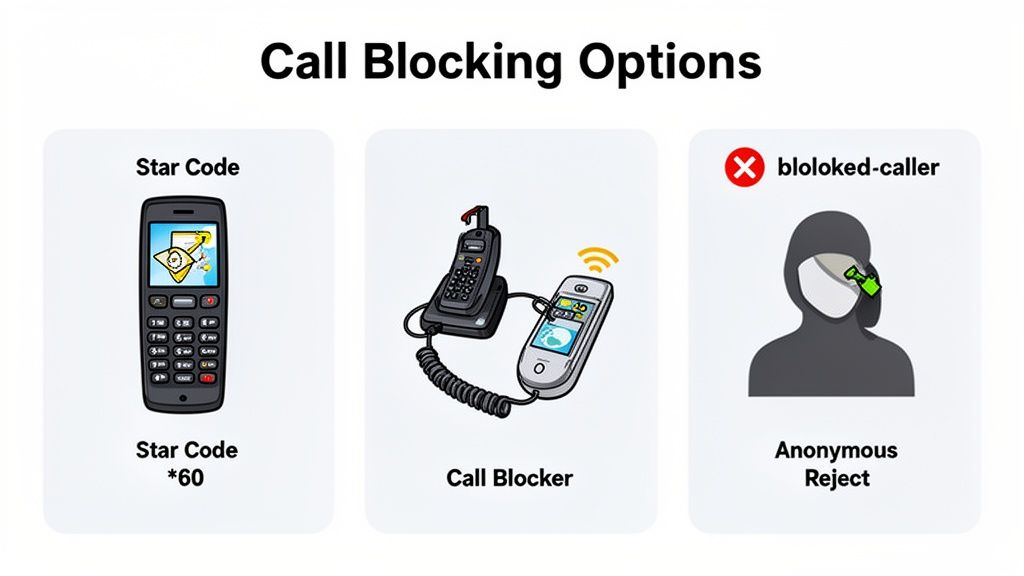
Trying to figure out how to block numbers on a landline can feel like you’ve stepped back in time. The tools are there, but most were designed for an era before robocallers and sophisticated phone scams became a daily nuisance.
Let's walk through the most common methods available for traditional landlines, from the free codes your phone company provides to the little gadgets you can buy online. Each has its place, but as you’ll quickly see, they all struggle to keep up with today’s threats.
Carrier-Provided Star Codes
Most phone companies offer a handful of "Star Codes"—simple commands you dial to manage calls. Think of these as built-in network features that have been around for decades.
*Call Block (60): This is the classic reactive tool. After a spammer calls, you hang up, pick up the receiver again, and dial
*60. An automated voice then guides you through adding that last caller to your block list. The biggest downside? It’s entirely manual, and you can only block a number after it’s already interrupted your day.*Anonymous Call Rejection (77): This one sounds perfect on the surface. When you turn it on, your phone automatically rejects any call that comes through as "Private" or "Unknown." The catch is that a lot of legitimate organizations, like hospitals or doctors' offices, block their outgoing numbers for privacy. By using
*77, you risk missing an important appointment reminder or a call from a family member’s hospital room.
These codes offer a very basic level of control, but they put all the work on you.
Physical Call Blocking Devices
Another common solution is a dedicated call-blocking device. These are small physical boxes you plug in between your phone and the wall jack. Many come pre-loaded with thousands of known spam numbers and let you add new ones to the list, often with a single button press.
While they're definitely more user-friendly than dialing Star Codes after every junk call, they suffer from the same core problem: they depend on a static list of numbers. Scammers burn through phone numbers faster than you can block them, making the device's list outdated almost the moment you plug it in. You’re still playing a frustrating game of whack-a-mole.
To put it into perspective, here's how these traditional methods stack up against modern scams.
Effectiveness of Traditional Call Blocking Methods
| Blocking Method | How It Works | Effectiveness Against Scams | Key Limitation |
|---|---|---|---|
| *Star Code (60) | Manually add the last number that called to a carrier-level block list. | Low. Only blocks one number at a time, after the fact. | Completely reactive; scammers use new numbers for every call. |
| *Anonymous Reject (77) | Automatically rejects all calls with a hidden or private Caller ID. | Medium. Stops some spammers but also blocks legitimate calls. | High risk of blocking important calls (e.g., from doctors, hospitals). |
| Physical Blocker | A device with a pre-loaded list that also lets you manually add numbers. | Low to Medium. The built-in list becomes outdated quickly. | Can't keep up with the sheer volume and speed of new scam numbers. |
These methods were not designed for the modern world of spoofed numbers and relentless robocalls. They are simply outmatched.
Traditional methods force you to manage a list of "bad" numbers. This strategy is fundamentally flawed because scammers can generate "new" numbers faster than you can block them.
Exploring Modern Alternatives
The glaring weaknesses of these old-school tools are why so many people are looking for better solutions. If you want to add some modern features to your current phone, a phone internet adapter can sometimes bridge the gap, connecting your traditional handset to a VoIP service that might offer more advanced call filtering.
But for a real defense, you need an approach that's smarter, not just bigger. Instead of relying on a list of "bad" numbers, modern solutions like the Gini Help app focus on screening unknown callers before they can bother you. It uses AI to figure out who is calling and why, stopping scammers in their tracks.
Stop playing defense. It’s time to secure your phone line proactively. Download the Gini Help app from the Google Play Store or the Apple App Store and get your peace and quiet back.
Why Your Block List Just Isn't Cutting It Anymore
If you’ve been diligently adding every spam call to your landline’s block list, you’ve probably noticed a frustrating pattern: it doesn't work. For every number you block, two more seem to pop up in its place. This isn’t your imagination; it’s a sign that you’re fighting a modern problem with an outdated tool.
The core issue is that scammers and robocallers have completely changed their tactics. They don't use one or two phone numbers anymore. Instead, they rely on a strategy called rapid-fire number cycling, burning through thousands of different numbers every single day. By the time you’ve hung up and blocked the number that just bothered you, they've already moved on to a hundred others.
Your manual block list becomes obsolete almost the second you update it. It’s a reactive approach in a world that demands a proactive defense.
The "Neighborhood Spoofing" Trick
One of the sneakiest tactics scammers use today is "neighborhood spoofing." This is where they manipulate the caller ID to show a number that looks local—same area code, maybe even the same first three digits as your own number.
It’s a clever bit of social engineering. We're all conditioned to be wary of strange area codes, but a local number feels different. It could be your pharmacy, a neighbor, or the kids' school. This simple trick makes you far more likely to pick up. And once you answer, you've just signaled to them that your line is active, which unfortunately puts you on the "call again" list. Blocking these numbers is a waste of time because the number you see isn't real, and the next call will just come from another fake "local" number.
It's time for a mindset shift. The goal isn't to build a bigger block list. The goal is to find an intelligent gatekeeper that screens calls before they can bother you. Trying to block every number one-by-one is a game you simply can't win.
Understanding the Scale of the Onslaught
It's hard to grasp the sheer volume of these unwanted calls. We're not just up against a few rogue telemarketers; this is an industrial-scale operation. To put it in perspective, the French telecom giant Orange launched a service that has blocked a mind-boggling 111 million unwanted international calls since September 2019. You can read about this massive blocking initiative on Orange's newsroom.
When a single company has to block over a hundred million calls, it's clear that individual efforts are just a drop in the ocean.
This is exactly why new thinking is needed. An AI-powered service like the Gini Help app doesn't even look at your block list. It uses real-time conversation analysis to screen calls from unknown numbers for you, figuring out if it's a scammer or a legitimate caller before your phone ever rings. It's a modern defense for a modern problem, and it works across your landline, mobile, email, and texts.
If you're tired of playing whack-a-mole with spam callers, you can download the Gini Help app from the Google Play Store or the Apple App Store and finally get some peace and quiet. And for those callers who take it a step further by hiding their identity, take a look at our guide on how to find a No Caller ID number.
A Smarter Way to Block Calls: AI Call Screening
What if your phone only rang when someone you actually know is on the other end? This isn't science fiction anymore. It's the reality of AI-powered call screening, a completely different way of thinking about how to block unwanted landline calls.
Forget the old, reactive methods of manually blocking numbers one by one. This is about setting up an intelligent gatekeeper to answer the phone for you. This is exactly where a next-generation solution like the Gini Help app comes in, acting as a personal call assistant that provides a proactive shield that traditional blocklists just can't offer.
How AI Screening Outsmarts Scammers
Here’s the key difference: unlike physical gadgets or carrier services that rely on a static list of "bad" numbers, Gini's AI intercepts unknown calls before they even have a chance to bother you. It answers on your behalf and analyzes the conversation as it happens.
This isn't just about checking a number against a database. The system uses sophisticated language models to instantly tell the difference between a legitimate caller and a potential threat.
- A Real-World Example: Imagine a delivery driver calls from a number you don't recognize to confirm your address. The AI understands the context, flags it as safe, and can connect the call straight to you.
- A Scammer Example: A slick, AI-voiced robocall launches into a fake pitch about your car's warranty. Gini's AI identifies the scam tactics within seconds and ends the call. You’re never disturbed because your phone never rang.
The technology is built to understand intent, not just a phone number. This is how it stops even the newest and most convincing scams cold. You can learn more about how a smart call blocker uses these modern techniques to protect you.
The crucial shift is moving from a reactive "block list" to a proactive "allow list." Instead of trying to keep up with an endless list of threats, an AI screener focuses on verifying legitimate callers. This effectively closes the door on all unwanted noise.
A Complete Safety Net
This intelligent screening gives you a complete safety net that older methods simply can't provide. Features like Live Call Analysis add another powerful layer of security, giving you real-time risk scores and haptic warnings on your mobile device if a suspicious conversation is detected on a call you do decide to answer.
As you can see in this screenshot from the Gini Help app page, the focus is on being a comprehensive scam protection service.
The emphasis on "Scam Protection" instead of just "Call Blocking" really highlights its advanced ability to guard against modern digital threats that go way beyond simple nuisance calls.
It’s time to stop spam before it disrupts your life. You can take the first step toward a quieter, more secure home by downloading the Gini Help app from the Google Play Store or the Apple App Store.
Your Action Plan to Secure Your Landline Now
Alright, it's time to move from frustration to action. Taking back your landline from the constant flood of unwanted calls isn't impossible, but it does require a smart strategy. The best approach is to think of it like building a multi-layered defense for your home.
Start with the basics: the tools your carrier provides. They have their limits, of course, but they give you a foundational level of control. For real, modern-day protection against the sophisticated, relentless spam and scam calls we all get, the next layer is absolutely crucial: integrating a powerful AI screener.
Setting Up a Proactive Defense
The goal here is to stop playing whack-a-mole with individual numbers. Instead, you want to create an intelligent barrier that only lets legitimate callers through. A service like the Gini Help app is built to be that gatekeeper, turning your landline from a source of constant stress back into a reliable communication tool.
This flowchart breaks down how an AI screener completely changes the game when an unknown number dials your phone.
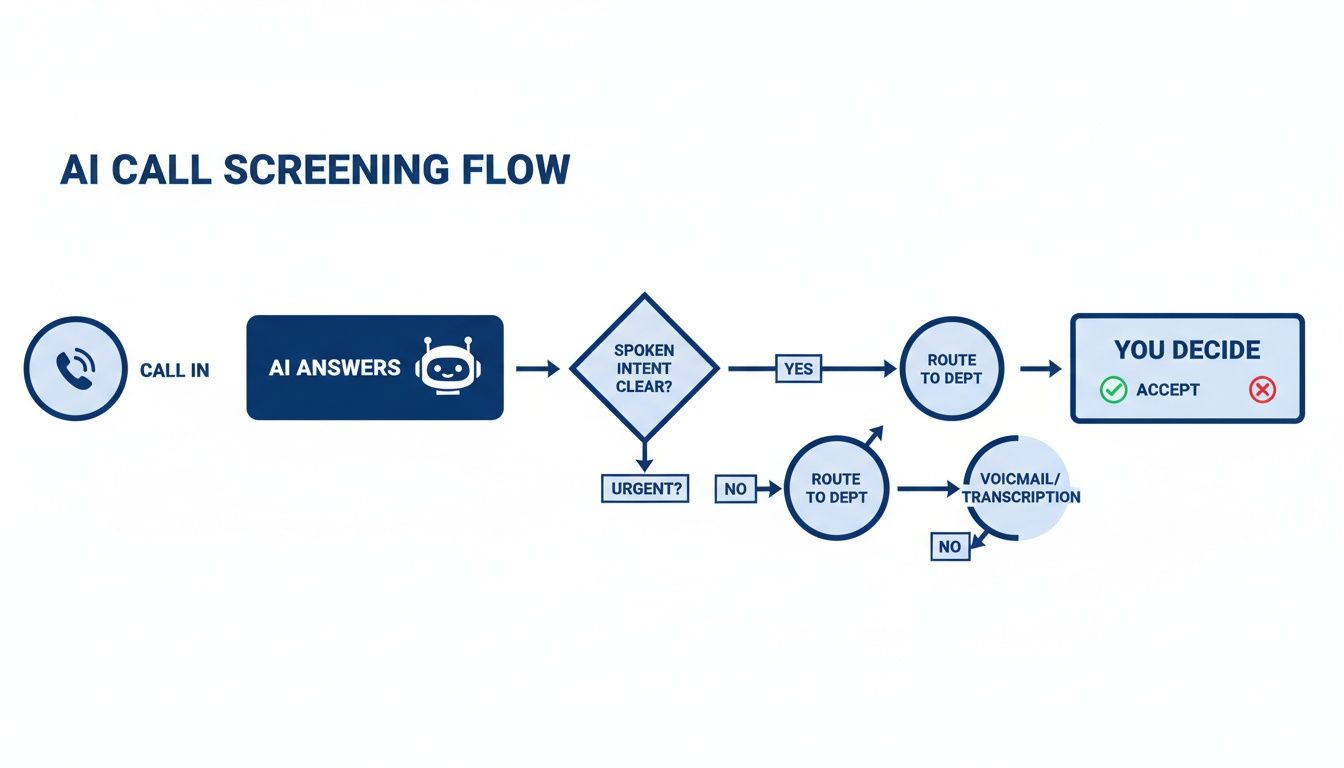
As you can see, the system intercepts the call before your phone even rings. It analyzes the caller's intent and only alerts you if they're legitimate. It's a system that ends the problem before it ever reaches you.
Protecting Your Loved Ones
This approach is a game-changer for protecting vulnerable family members, like an elderly parent who still relies on their landline. Setting up an AI screening service on their phone can provide incredible peace of mind for everyone. Many services, including Gini Help, even offer family plans that create a shared shield, letting you manage and monitor a loved one's phone security from your own device.
The numbers don't lie. Worldwide, a staggering 29% of all unknown calls are spam. Of those, 22% are a nuisance, but a dangerous 7% are outright fraud. Since scammers are constantly spoofing and cycling through numbers, manual blocking just can't keep up. You can learn more about the global scope of phone scams in this Hiya report.
For older adults, who are frequently targeted by fraudsters, trying to stay vigilant is exhausting. Gini Help takes that burden away by having AI answer unknown calls first. It vets them with real-time conversation analysis and silently blocks threats without ever bothering them.
This layered strategy—combining basic carrier features with a smart AI screener—gives you a definitive path forward. It fully answers the question "can you block a landline number?" because it stops the calls you know about and, more importantly, all the ones you don't. Our complete guide on how to stop spam calls offers even more strategies to explore.
Take the first step toward a quiet, secure phone line today. You can download the Gini Help app from the Google Play Store or the Apple App Store to get started.
Answering Your Top Questions About Landline Call Blocking
Even with the best tools, you’re bound to have some specific questions once you start tackling unwanted landline calls. Let's dig into some of the most common issues people run into and get you some straight answers.
What Can I Do About "Private" or "Unknown" Callers?
This is a huge source of frustration for a lot of people. You can't block what you can't see, and traditional methods rely on having a specific number to add to a block list. When the caller ID just says "Private," you're stuck.
Sure, you can use carrier features like Anonymous Call Rejection (usually by dialing *77), but that’s a blunt instrument. It often ends up blocking legitimate calls you want to get, like from a doctor's office or a hospital that intentionally masks its numbers for privacy reasons.
This is exactly where a more advanced AI screener like Gini Help really proves its worth. It doesn't care if there's a number or not. The AI picks up first. If it's met with silence or the tell-tale start of a robocall script, it simply hangs up. If a real person is on the line, the AI will interact with them to find out who they are and why they're calling before it even considers ringing your phone.
Do Do Not Call Lists Actually Work Anymore?
The National Do Not Call Registry was a great idea, and to be fair, legitimate telemarketing companies usually follow the rules. The problem is, modern scammers and illegal robocall operations couldn't care less. They operate outside the law, so a government list means nothing to them.
Think of the Do Not Call list like a "No Trespassing" sign. It works for people who respect the law, but a burglar is going to ignore it completely.
It's still worth understanding your legal rights, and you can learn more about the framework designed to protect consumers by reading about the Telephone Consumer Protection Act (TCPA). But for stopping the calls that plague you day-to-day, you need a more active defense than a list that criminals simply ignore.
Is It Hard to Set Up an AI Blocker for My Parents?
This is a question I hear all the time from caregivers, and it’s a perfectly valid concern. The last thing you want is to give your loved one another complicated piece of tech to manage.
Fortunately, modern solutions were built with this exact scenario in mind. Getting a service like Gini Help up and running is surprisingly simple and doesn't require any technical wizardry. It’s all handled through a user-friendly smartphone app that you can link to their landline service.
From your own phone, you can control the settings, see which calls have been screened, and tweak the approved caller list. Your parent doesn't have to do a thing. It’s designed to be a "set it and forget it" shield that runs in the background, giving both of you some much-needed peace of mind.
It's time to reclaim your peace and quiet and keep your loved ones safe from predatory scams. With Gini Help, you can stop those frustrating calls before they even make your phone ring.
Download the app today from Google Play or the Apple App Store.