How to Identify Scam Calls Like a Pro A Definitive Guide
By Josh C.
When you think of a scam call, you might picture an obvious, robotic voice demanding gift cards. But the game has changed. The first sign of trouble is often a feeling of intense pressure. Scammers create a false sense of urgency, impersonating your bank or a government agency and threatening you if you don't act now.
A legitimate organization will never operate this way. They won't demand immediate payment over the phone using untraceable methods like gift cards, wire transfers, or cryptocurrency. That's a massive red flag.
The Evolving Threat of AI-Powered Phone Scams
Forget the clunky robocalls of yesterday. Today’s scammers are armed with sophisticated artificial intelligence, making their attacks frighteningly convincing. The latest threat is AI voice cloning, which allows a fraudster to perfectly mimic the voice of a loved one in a manufactured crisis or sound exactly like a legitimate bank official.
This technology creates a powerful illusion of trust and urgency, and the financial fallout has been devastating. As of 2024, the Federal Trade Commission (FTC) has been issuing warnings about the surge in these "grandparent scams" powered by AI voice cloning, where scammers use a familiar voice to create a believable emergency. Imagine getting a call from what sounds like your child, panicked and asking for money. It's a terrifyingly effective tactic.
This explosion in AI-driven scams is a global problem. According to the FTC, American consumers reported losing a record $10 billion to scams in 2023, with imposter scams being the most frequently reported category. Much of that is now fueled by these new, hyper-realistic voice scams.
Why Old Defenses Are No Longer Enough
Simply blocking numbers one by one is a losing battle. Scammers use "spoofing" technology to constantly change their caller ID, so the number that called you five minutes ago might already be out of service. This is a huge reason why you keep getting spam calls even after you block them.
This constant cat-and-mouse game makes manual blocking almost completely useless.
The core challenge has shifted from simply blocking known bad numbers to analyzing the intent of an unknown caller in real-time. This is why a modern defense is so critical.
To stay safe, you need a solution that intercepts and analyzes calls before your phone even rings. Modern tools can act as a personal gatekeeper, using their own AI to screen unknown callers on your behalf and figure out if they’re a threat.
For a powerful, AI-driven defense against these evolving threats, consider downloading the gini help app from the Google Play Store or the Apple App Store.
Spotting the Red Flags of a Scam Call
The key to beating a scammer is recognizing you're on the phone with one in the first place. This is harder than it sounds. Scammers are pros at psychological manipulation, and their scripts are carefully designed to short-circuit your critical thinking.
Their entire game plan hinges on creating a sense of manufactured urgency. They want to get your heart racing so you can't think straight. You’ll hear things like, "Your account will be suspended in 30 minutes if you don't act," or "There's a warrant for your arrest, and you have to pay this fine right now."
Let's be clear: real organizations don't operate like this. Ever.
This infographic breaks down how these threats have changed, moving from obvious spam to sophisticated, AI-powered deceptions.
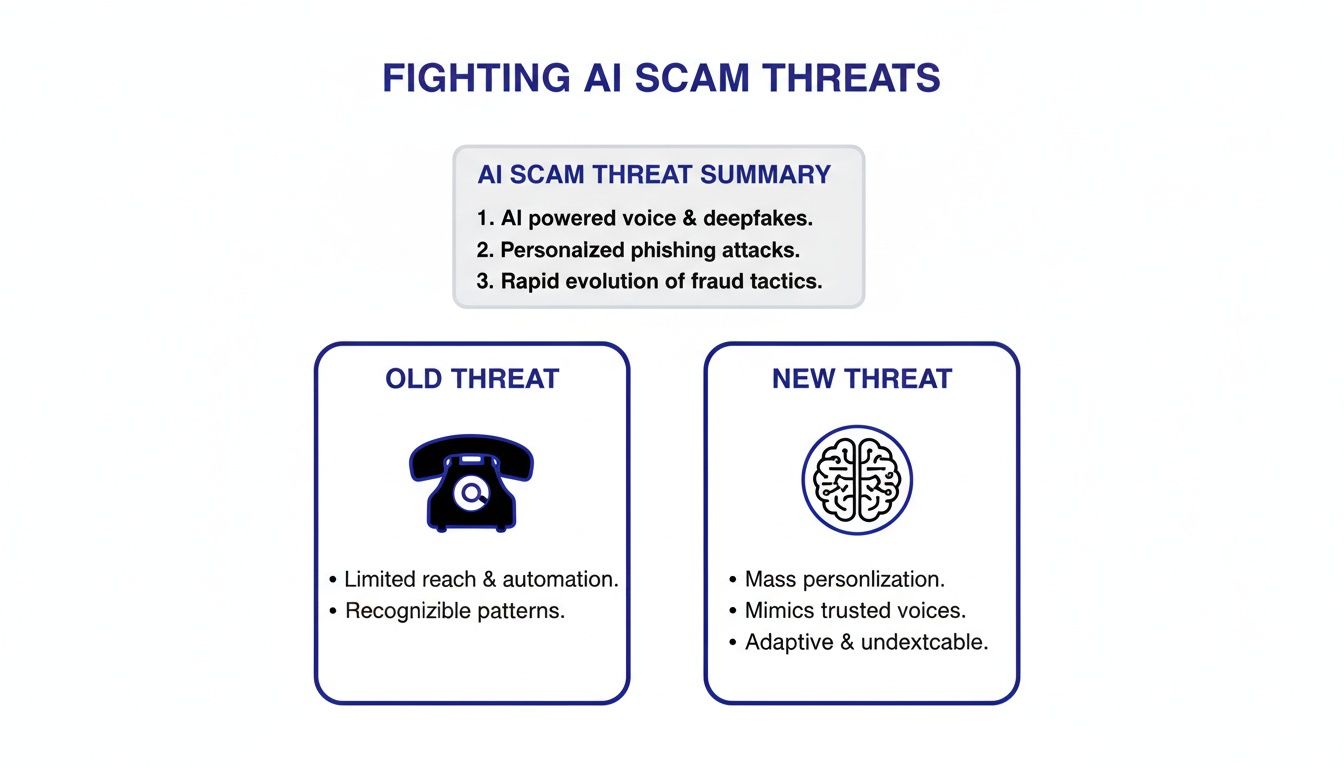
The core goal—getting your money or information—hasn't changed. But the methods they use have become scarily personal and believable.
Phrases and Tactics Designed to Manipulate You
Scammers are experts at pushing emotional buttons to bypass your logical defenses. Here are the big ones to watch out for:
- Fear and Intimidation: The classic threat of legal trouble, an account being closed, or even arrest is designed to make you panic and comply without question.
- Excitement and Greed: A sudden call saying you've won a lottery or a grand prize you never entered is meant to get you excited and lower your guard.
- Empathy and Panic: The "grandparent scam" is a perfect example. They'll create a fake emergency involving a loved one to pull at your heartstrings and trick you into sending cash immediately.
One of the most common tricks in the book is Caller ID spoofing. Scammers can make their number appear as if it's coming from a local area code or even a government agency. Understanding and identifying caller ID spoofing is a huge step in protecting yourself. If you're tired of seeing those vague, untraceable numbers, you can learn more about how to stop them here: https://ginihelp.com/blog/how-to-block-no-caller-id-calls.
Key Takeaway: Scammers thrive on speed and pressure. Their entire strategy falls apart the second you slow down, hang up, and take a moment to verify the claim on your own. Always, always trust your gut.
Unusual Payment Demands Are a Dead Giveaway
How someone asks you to pay is often the biggest red flag of all. No legitimate business or government agency will ever demand that you pay a bill or fine using:
- Gift cards (like Google Play, Apple, or Target cards)
- Cryptocurrency (like Bitcoin or Ethereum)
- A wire transfer (from services like Western Union or MoneyGram)
Why these methods? Because they are virtually impossible to trace and the transactions are irreversible. For a scammer, it’s like being handed a bag of cash.
Legitimate Request vs Scam Tactic: A Quick Comparison
When you're on a call and feeling pressured, it can be tough to tell what's real and what's a trap. This quick-reference table breaks down the difference between how a real organization behaves versus a scammer.
| Situation | Legitimate Company Behavior | Scammer Tactic |
|---|---|---|
| Verification | Will encourage you to hang up and call them back on an official number. | Will pressure you to stay on the line and tell you not to hang up. |
| Payment Methods | Accepts standard, traceable payments like credit cards or bank debits. | Demands payment via gift cards, crypto, or wire transfers. |
| Sense of Urgency | Provides clear deadlines and communicates through official channels. | Creates a fake crisis that demands immediate action within minutes or hours. |
| Personal Information | Will already have your account details and only verify partial info. | Asks you to "confirm" your full Social Security number, password, or PIN. |
| Contact Initiation | May call you but will direct you to official websites or mail. | Often involves an unexpected call or text about a problem you didn't know you had. |
Think of this as your cheat sheet. If the caller's behavior lands in the "Scammer Tactic" column, you know it's time to hang up immediately.
The statistics show just how effective these pressure tactics are. A recent Truecaller report highlighted that in 2023, the average American received 16 spam calls per month, with many being fraudulent attempts. Research from the Global Anti-Scam Alliance further reveals that these quick, high-pressure tactics are incredibly effective, with a shocking number of successful scams hooking their victims within just 24 hours of the first contact.
This isn't just bad luck; it's a calculated strategy that works. The best defense is to have a shield that stops these calls before they can even try to manipulate you. An intelligent call screening app can be that shield, analyzing calls for threats in real time.
You can download the Gini Help app from the Google Play Store or the Apple App Store to get that AI-powered protection working for you.
How to Handle a Suspicious Call with Confidence
Knowing the red flags of a scam call is half the battle. The other half is knowing exactly what to do when you’re in that high-pressure moment, with your heart starting to race.
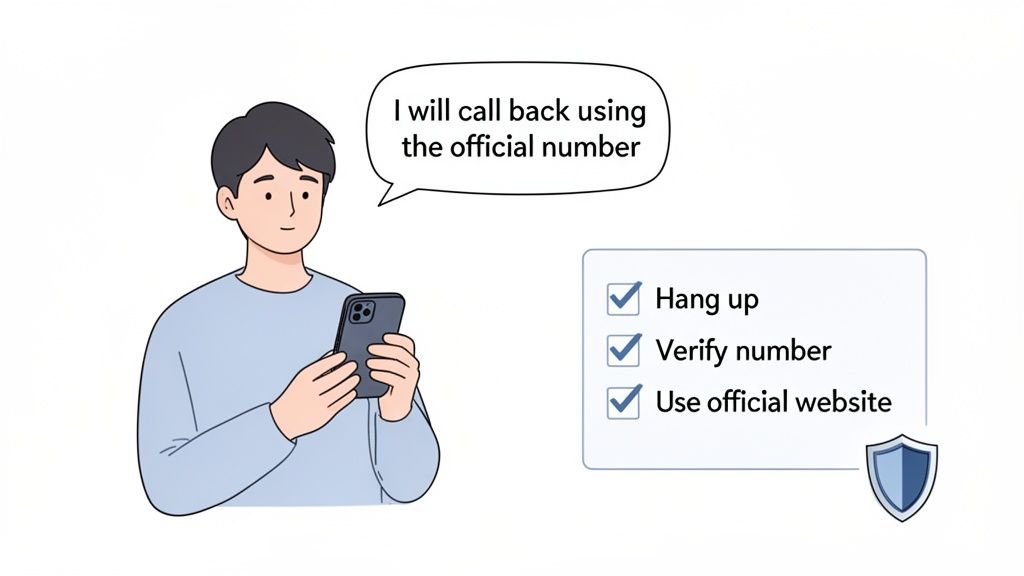
The single most powerful move you can make is what I call the "Hang Up and Verify" method. It's simple, it's effective, and most importantly, it puts you back in the driver's seat.
The second you feel that pit in your stomach—whether it's an aggressive threat or an offer that’s just too good to be true—your only job is to get off the phone. Don't argue. Don't ask questions. And definitely don't try to outsmart them. Scammers are professional manipulators, and every second you stay on the line is a win for them.
Just hang up.
Taking Back Control with Simple Phrases
Having a go-to phrase ready can make it easier to end the call calmly. Think of these as your personal exit scripts, designed to shut down the conversation without giving the scammer anything to work with.
- "Thanks for the information. I'll call back using the number on your official website."
- "I don't handle personal info on calls I wasn't expecting. I'll look into this myself through official channels."
- "I'm not comfortable with this call, so I'm ending it now."
Let's be clear: these phrases aren't for their benefit—they're for yours. They provide a clear, confident exit ramp and reinforce your decision to take control of the situation.
Now, you might be tempted to gather evidence. Before you even think about hitting 'record,' it’s essential to know if is it legal to record a conversation without consent where you live.
The most critical rule of verification is to never use contact information provided by the caller. Never call back a number they give you or visit a website they spell out. This is a trap designed to lead you to another part of their scam.
Finding Legitimate Contact Information
Once you've hung up, take a breath. That false sense of urgency the scammer created will start to fade. Now, you can check out their claim safely.
- Banks or Financial Institutions: Flip over your debit or credit card. The real number is right there. You can also find it on an official bank statement.
- Government Agencies: Go directly to their official website, making sure it ends in .gov. That’s where you’ll find a verified public contact number.
- Tech Companies: Pull up their main website and look for the "Contact Us" or "Support" page.
When you're the one making the call using a number you found yourself, you completely neutralize the scammer's game. It's a simple step that guarantees your security.
Of course, the best way to handle a suspicious call is to never get it in the first place. This is where a service like the Gini Help app can be a game-changer. It acts as your personal call screener, filtering out the garbage so only legitimate calls get through. You can grab it from the Google Play Store or the Apple App Store and let technology handle the threats for you.
Decoding the Psychology of Impersonation Scams
There's a reason impersonation scams are so dangerously effective: they tap directly into our built-in respect for authority. When a call comes in from someone claiming to be from the Social Security Administration, Microsoft, or your local sheriff's office, our natural instinct is to listen and take them seriously.
Scammers are masters of this psychological game. They don't just ask for your money—they weave a detailed story designed to kick your brain into panic mode, completely bypassing your logical thinking. This emotional manipulation is their entire strategy.
Fear and Authority: The Scammer's One-Two Punch
At the heart of every impersonation scam are two powerful emotional triggers: fear and authority. Scammers blend them to create situations that feel both believable and absolutely terrifying, making you feel like you have no choice but to do exactly what they say, right now.
You’ve probably heard of these classic plays from their handbook:
- The Government Threat: Someone calls claiming your Social Security number was found at a crime scene. They'll use official-sounding jargon and threaten immediate arrest or frozen bank accounts to pressure you into "fixing" a problem that never existed in the first place.
- The Tech Support Ploy: You get a pop-up or a call from "Apple" or "Microsoft" claiming your computer is riddled with viruses. They use the trusted name of a tech giant and your fear of losing photos and files to trick you into giving them remote access to your device.
These tactics are incredibly damaging. According to the latest data from the FTC's full report on these scams, consumers lost $2.7 billion to imposter scams alone in 2023, making it the top fraud category by losses reported.
Scammers create a crisis out of thin air and then immediately present themselves as the only possible solution. Your first defense is recognizing this manufactured panic for what it is.
Shifting from Emotion to Logic
The key is to train yourself to step back from that initial jolt of fear. When a call from an "official" source starts making threats, your first thought shouldn't be, "Oh no, what did I do?" It should be, "Wait, is this really how that organization operates?"
Think about it: a real government agency will never call you out of the blue to threaten arrest or demand payment via gift card. A legitimate tech company isn't monitoring your computer for viruses and calling you personally to fix it. That's just not how they work.
Once you understand the psychological triggers, you can start to identify scam calls by how they make you feel. That sudden, overwhelming sense of urgency and fear is your signal to stop, hang up, and check things out for yourself.
The best way to sidestep these psychological traps is to have an impartial filter doing the work for you. For powerful, automated protection that screens out impersonators before they ever get a chance to manipulate you, download the Gini Help app from the Google Play Store or the Apple App Store.
Using AI as Your Ultimate Scam Call Defense
Trying to spot every red flag on your own is exhausting. With the sheer volume of spam calls hitting our phones daily, it’s a battle you can't win alone. Let's be honest, the traditional call blockers most of us have used are like bringing a knife to a gunfight. They rely on static blocklists, which are basically useless the second a scammer spoofs a new number—and they can cycle through millions of them.
This is where the game has to change. We need a smarter, more dynamic defense. Instead of just blocking known bad numbers, modern tools can analyze the intent of a call as it's happening. This is where artificial intelligence steps in, acting like a personal security guard for your phone line and shifting your defense from reactive to truly proactive.
Beyond Basic Call Blocking
Think of an AI-powered service as an intelligent gatekeeper. It screens every single call from an unknown number before your phone even makes a sound. It’s like having an assistant who picks up, has a quick chat with the caller, and instantly figures out if it’s the delivery driver you're waiting for or a fraudster trying to fleece you.
This automated screening is the heart of a modern defense strategy. It stops threats cold. Only verified, legitimate callers ever make it through to you. You can dive deeper into how a smart call blocker uses this exact approach to give you a genuinely quiet, scam-free phone experience.
The goal isn't just to block numbers anymore. It's to build a shield so scammers can't even get the chance to speak to you. AI makes that possible by becoming a powerful, intelligent filter for every call.
How AI Detects Scams in Real Time
AI-driven systems go way beyond just checking a number against a list. They use sophisticated language models to analyze the conversation itself, listening for the classic tricks of the trade.
- Urgency and Threats: AI is trained to instantly pick up on aggressive language, threats of legal action, or fake deadlines—anything designed to make you panic and act without thinking.
- Impersonation Clues: It can identify specific phrases and patterns common in government, bank, or tech support impersonation scams.
- Weird Requests: The moment a caller asks for payment via gift cards, wire transfers, or demands sensitive personal info, the AI flags the call as high-risk.
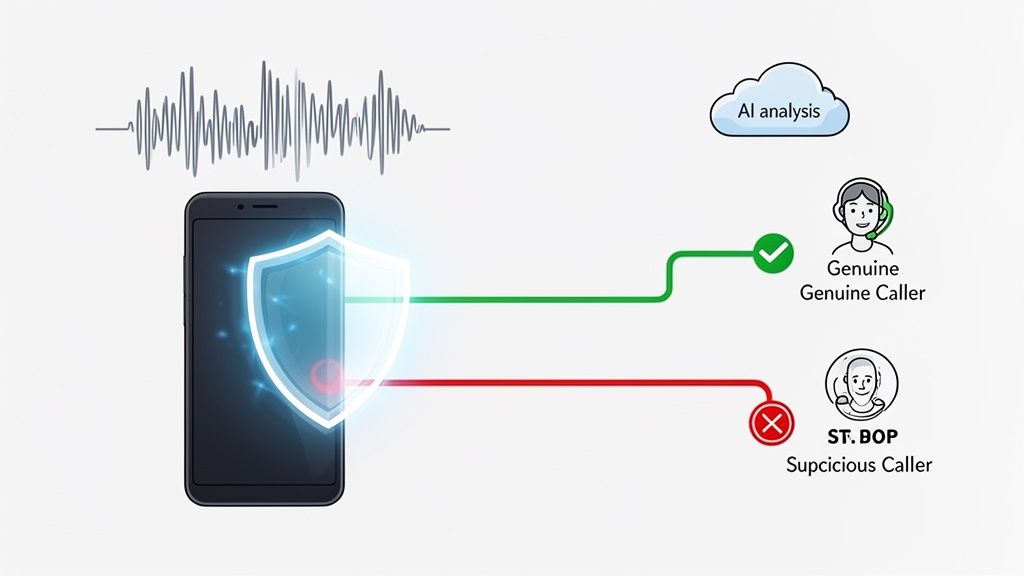
As you can see, the right tool provides a clear, real-time assessment, empowering you to make a safe decision on the spot.
Some of the best services even offer Live Call Analysis for those calls you decide to answer. If you pick up a call from an unknown number, the AI can listen silently in the background. If the conversation starts veering into dangerous territory, it can send you a subtle haptic warning—a little buzz—letting you know it's time to hang up.
This kind of automated protection isn’t a luxury anymore; it’s essential. For powerful protection, you can download the Gini Help app from the Google Play Store or the Apple App Store.
Answering Your Lingering Questions About Scam Calls
Even with the best game plan, some questions always pop up. It's totally normal. Let's tackle some of the most common ones to make sure you feel completely confident in handling whatever these scammers throw your way.
What’s the Very First Thing I Should Do After a Scam Call?
Simple: hang up.
Don't say another word. Don't argue, don't try to outsmart them, just end the call. The longer you stay on the line, the more opportunity they have to manipulate you. Immediately after, block the number.
Next, you need to verify their story, but on your terms. Never, ever use a phone number, website, or email address the caller gave you. Instead, find the official contact information yourself. Flip over your debit card, pull up a recent bank statement, or go directly to the company’s official .gov or .com website. Call that number and ask if there’s a genuine issue.
Finally, report the call. It might feel like a small thing, but reporting scam attempts to the Federal Trade Commission (FTC) gives law enforcement the data they need to spot patterns and shut these operations down.
Is It Okay to Answer an Unknown Number if I Just Stay Silent?
I get the logic, but the safest move is to not answer at all.
Sometimes, a scammer's only goal is to confirm your number is active. If you pick up, even without speaking, they've won. Your number gets marked as "live," and you can bet you'll start getting even more spam and scam calls. This is the whole trick behind the "one-ring scam"—they hang up hoping your curiosity gets the best of you, so you call back a premium-rate number that drains your wallet.
There's also a small but growing risk of voice-cloning scams. Sophisticated software can potentially use a recording of your voice—even a simple "yes" or "hello"—to authorize charges or try to bypass voice-ID security on your accounts. It's a long shot, but why take the risk? Let the call go to voicemail or, better yet, let a screening service handle it for you.
Are Scam Texts and Emails Really That Different from Calls?
The delivery method changes, but the playbook is almost identical.
Whether it’s a phone call, a text message (smishing), or an email (phishing), scammers rely on the same core tactics: creating a false sense of urgency, preying on your emotions (fear, excitement, kindness), and asking for things legitimate companies never would, like gift card payments or remote access to your computer.
The biggest difference is that texts and emails often use malicious links as the weapon. Clicking one can take you to a fake login page designed to steal your passwords or secretly install malware on your device. The golden rule is the same across the board: never trust, always verify. Don't click, don't reply, and always use an official contact method to check things out for yourself.
Scammers thrive on knee-jerk reactions, no matter the medium. Pausing to think is your most powerful defense, whether you're on a call, reading a text, or checking your inbox.
How Can I Help Protect My Elderly Parents or Relatives?
This is a huge concern for so many people, and it takes a mix of conversation and technology.
First, talk to them. Don't be condescending; just have open, honest conversations about the specific scams we've covered here. Using real-world examples makes the threat feel more real. Walk them through the red flags—the urgent demands, the weird payment methods, the threats—so they can recognize them in the moment.
But conversation alone isn't always enough. The single most effective thing you can do is set them up with a reliable, automated protection service. An app that screens and blocks suspicious calls for them is a game-changer. It takes the pressure off, removing the need for them to make a split-second judgment call when a professional con artist is on the line. It's genuine peace of mind for you and a powerful shield for them.
The best way to stop stressing about identifying scam calls is to make sure they never reach you in the first place. Gini Help puts an AI-powered assistant between you and unknown callers, screening them on your behalf so only real, important calls make your phone ring.
Protect yourself and the people you care about. Download the Gini Help app from the Google Play Store or the Apple App Store and get your peace of mind back.