What Is Phone Number masking and How Does It Work
By Josh C.
Phone number masking is a clever privacy tool that swaps your real phone number for a temporary, anonymous one. It's like a digital shield for your personal line, letting you call and text without ever revealing your actual number.
Think of it as a disposable email address, but for your phone. It keeps your direct line private and secure.
The Growing Need for Digital Privacy
In a world where your phone number unlocks everything from your bank account to your social media, leaving it exposed is a huge gamble. Every time you hand it over to a new app, an online seller, or a delivery service, you're creating another potential weak spot for your personal security. This can quickly lead to a flood of spam calls, crafty phishing attempts, and in the worst cases, identity theft.
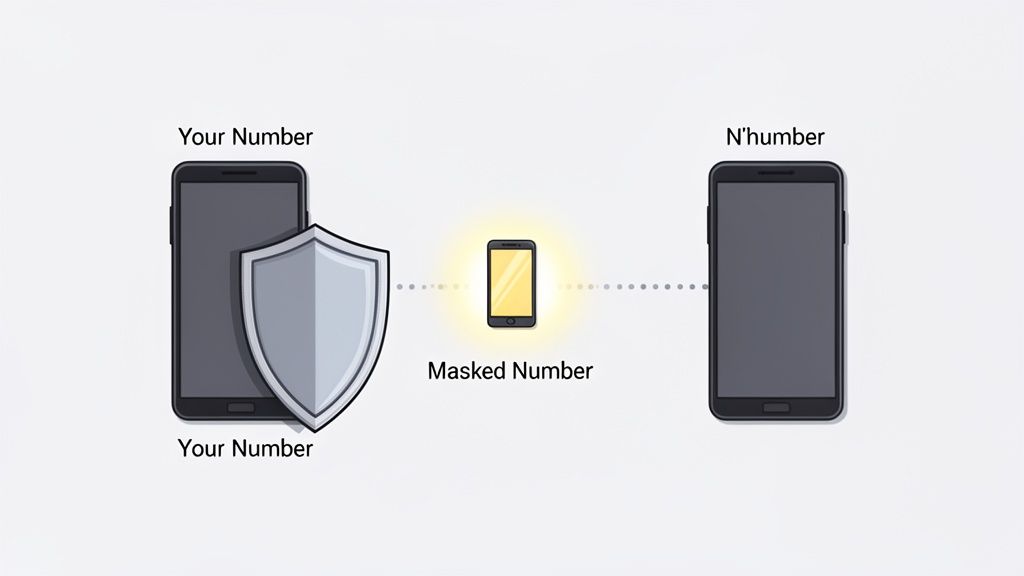
Phone number masking offers a simple but powerful fix. It sets up a secure bridge for communication. For instance, when you need to contact your ride-share driver, the call is routed through a temporary, randomly generated number. Both you and the driver only see this proxy number, keeping both of your real numbers completely hidden from each other.
This isn't just some niche tech anymore; it's quickly becoming a standard for how we interact safely online.
The Rise of a Privacy-First Mindset
The explosive growth of the number masking software market—on track to hit $1.3 billion by 2025—is fueled by one simple fact: people are fed up with their privacy being treated as an afterthought.
As spam calls skyrocketed to an incredible 48 billion in the US alone, the global market for these services swelled to USD 1.27 billion. North America is leading the way, and it's no surprise when you see the staggering fraud rates. Recent FBI data from 2023 reveals a jaw-dropping $12.5 billion lost to internet crime, a significant portion of which involved phone-based scams. You can dig deeper into the factors driving call masking adoption to see the full picture.
This trend shows a major shift in what both customers and businesses care about. People are far more likely to trust and engage with companies that go the extra mile to protect their data.
"In a digitally transparent world, data privacy is a primary concern for the brands and their customers. When attackers come in contact with sensitive information especially phone numbers, they can hack into bank accounts, emails, social media accounts or even cause identity theft."
This really drives home why phone number masking is no longer just a nice-to-have feature. It's a cornerstone of building trust and safety online, directly solving that all-too-familiar feeling of unease when sharing personal details with a stranger for a one-time interaction.
Practical Solutions to Everyday Problems
The real value of number masking shines through when you see the everyday headaches it solves. By adding that anonymous layer, it gives you the confidence to interact freely without worrying about being harassed or having your data misused down the road.
To put it simply, here’s a quick look at what phone number masking brings to the table.
Phone Number Masking at a Glance
| Common Problem | How Phone Number Masking Helps | Key Benefit |
|---|---|---|
| Spam & Robocalls | Your real number is never exposed to third-party services, so it can't be sold or leaked. | A massive drop in unwanted calls and texts cluttering your phone. |
| Personal Safety | Strangers from online marketplaces or dating apps can't contact you after your interaction is over. | You get complete control over who can reach you and when. |
| Data Breach Risks | Even if a company you use gets hacked, your personal phone number stays safe and uncompromised. | Greater personal security and genuine peace of mind. |
It's clear that this technology offers a solid first line of defense.
While number masking is fantastic for protecting you in new interactions, what about scams targeting the number you've already shared? For that, you need an active solution. Proactive services like the Gini Help app use AI to screen your calls, blocking threats before your phone even has a chance to ring.
You can download the Gini Help app on Google Play or the App Store to add this critical layer of real-time protection.
How Phone Number Masking Works Behind the Scenes
Ever wondered how you can call your delivery driver from an app without either of you seeing the other’s real phone number? The whole process feels seamless, but there's some clever tech working in the background to make it happen. Think of it like a digital switchboard operator, whose only job is to connect two people while keeping their private details under wraps.
This "switchboard" creates a secure buffer between you and the other person. It patches the call through a temporary, neutral number, ensuring your personal number stays completely hidden. It’s a simple idea with a powerful impact on your privacy.
The Core Technology: Proxy Numbers
At the heart of phone number masking are proxy numbers. A proxy number is essentially a stand-in—a real, working phone number that acts as a temporary substitute. It doesn't belong to any one person; instead, it's part of a large pool of numbers managed by a communication service provider.
When you need to make a call—say, to your ride-share driver—the app’s system instantly grabs an available proxy number from this pool and assigns it to that specific interaction. When you call, the driver sees the proxy number. When they call you back, you also see that same proxy number.
The entire process is invisible to you. The call routes through the service's secure platform, which connects the two parties without ever revealing their actual phone numbers to each other.
The real magic of these proxy numbers is that they're temporary. Once your ride is over or your package is delivered, the number is deactivated for that session and returned to the pool, ready for the next interaction. This simple step prevents any unwanted follow-up calls or texts.
Static vs. Dynamic Number Masking
Not all masking is created equal. The technology comes in two main flavors, each designed for different situations. Knowing the difference helps explain why some masked numbers last longer than others.
Static Number Masking (One-to-One): In this setup, a single proxy number is assigned to connect the same two people for a longer period. Imagine a property manager and a tenant. They might be assigned one static masked number to use for the entire duration of the lease. It keeps their communication private but consistent.
Dynamic Number Masking (Many-to-Many): This is the far more common approach, especially for on-demand services like Uber or DoorDash. A brand-new proxy number is generated for every single interaction. The moment your ride ends, that number is gone for good. It creates a temporary, single-use communication channel that can't be reused.
A Step-by-Step Look at the Process
Let's walk through what happens when you tap that "call driver" button in an app:
- Initiation: You tap the button. This action sends a request to the platform’s communication service to kick off the masking process.
- Number Assignment: In a fraction of a second, the system finds an available proxy number and assigns it to your session with the driver.
- Call Routing: Your call is sent to the proxy number first. The system recognizes which two parties are meant to be connected and instantly forwards the call to the driver's actual phone.
- Connection: The driver's phone rings, but the caller ID shows the proxy number, not yours. You're connected and can talk freely, with both of your real numbers remaining completely private.
- Session Expiration: Once the trip is marked as complete, the platform automatically breaks the link between you, the driver, and that proxy number. If either of you tries calling it back later, it simply won't work.
This intelligent routing is what makes phone number masking such a vital tool for privacy in the modern economy.
While masking is a fantastic first line of defense for new interactions, it can't protect a number that's already been exposed somewhere else. That’s where an active shield comes in. For proactive protection against scams and spam, you can download the Gini Help app from Google Play or the App Store. Its AI screens unknown callers for you, adding a layer of security that masking alone can’t provide.
Phone Number Masking vs. Call Spoofing
It’s easy to get phone number masking and call spoofing confused. On the surface, they both involve changing the number that appears on a caller ID. But that’s where the similarity ends.
Think of it as a hero versus a villain. Masking is the hero, a legitimate tool that reputable companies use to build trust and keep your information safe. Spoofing is the villain, a sneaky trick used by scammers to fool you. Knowing the difference is your first line of defense.
The Hero: Masking for Privacy
Phone number masking is all about consent and security. When you get a call from your Uber driver or DoorDash delivery person, you’re seeing masking in action. It’s a transparent process designed to let you and the service provider connect for a short time without either of you having to share your personal phone numbers.
The whole point is to create a secure, temporary bridge for that specific interaction. It protects everyone involved.
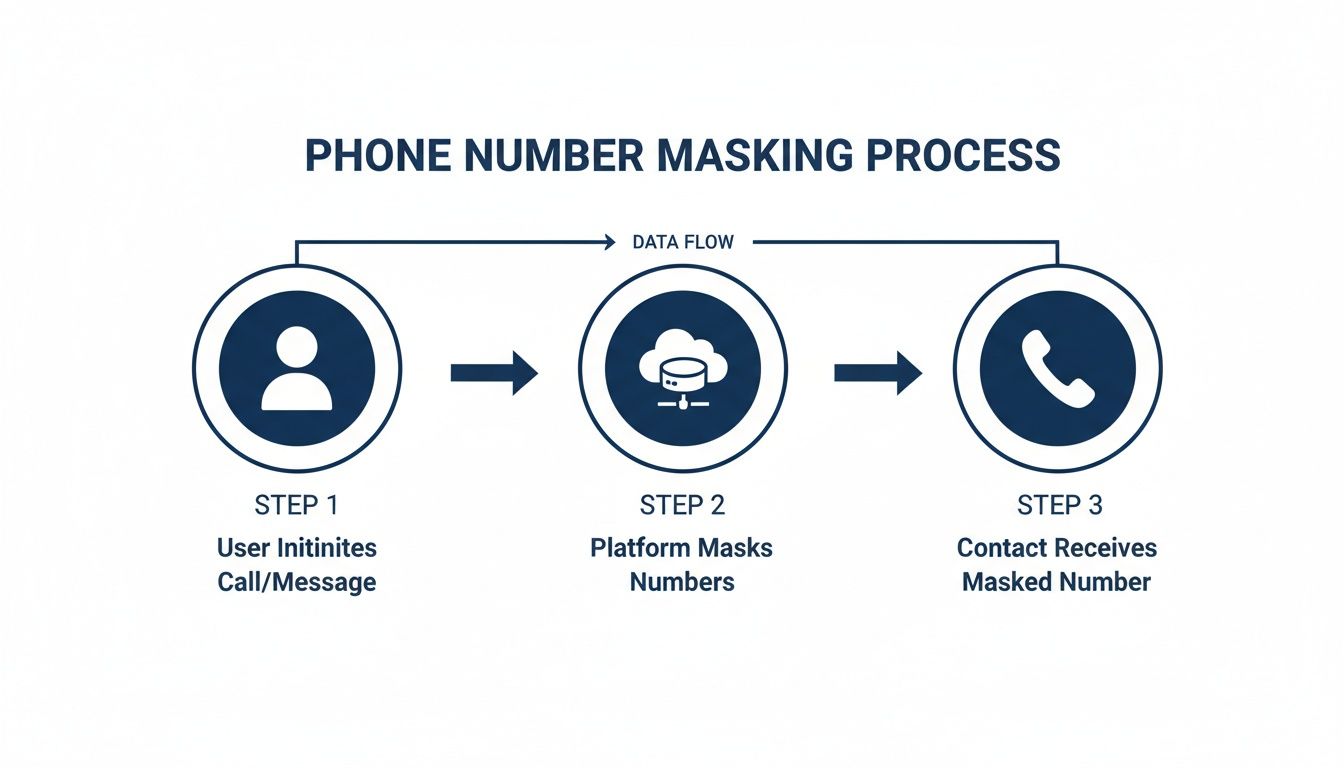
As you can see, the platform acts as a trusted middleman. It generates a temporary number to connect the two parties, ensuring no one’s real contact info ever gets exposed.
The Villain: Spoofing for Deception
Call spoofing, on the other hand, is pure deception. Scammers manipulate the caller ID to make it look like they’re calling from a completely different number—often one you’d trust, like your bank, the IRS, or even the local police. In fact, a recent FBI alert warned that criminals are increasingly spoofing law enforcement phone numbers to scare people into sending them money.
The only goal here is to trick you into picking up the phone and letting your guard down.
The Federal Communications Commission (FCC) puts it perfectly:
"Spoofing is when a caller deliberately falsifies the information transmitted to your caller ID display to disguise their identity. Scammers often use neighbor spoofing so it appears that an incoming call is coming from a local number, or spoof a number from a company or a government agency that you may already know and trust."
Key Differences at a Glance
The real difference comes down to intent. Masking is a privacy feature; spoofing is a tool for fraud. It’s that simple.
| Feature | Phone Number Masking (The Hero) | Call Spoofing (The Villain) |
|---|---|---|
| Primary Goal | Protect the privacy of both parties. | Deceive the recipient for malicious gain. |
| Legality | Legal and used by legitimate businesses. | Illegal when used with harmful intent. |
| Typical User | Ride-sharing apps, delivery services, online marketplaces. | Scammers, telemarketers, fraudsters. |
| Outcome | Secure, temporary communication and enhanced user trust. | Financial loss, identity theft, and eroded trust. |
While number masking is great for preventing your number from getting into the wrong hands on new platforms, it can't help you if a scammer already has your number. For that, you need an active defense.
Consider adding a layer of AI-powered protection by downloading the Gini Help app from the Google Play Store or the Apple App Store. Gini Help actively screens unknown callers, identifying and stopping threats before your phone even rings.
Everyday Scenarios Where Masking Is Essential
The real value of phone number masking isn't just some abstract tech concept—it’s a practical tool we can use in everyday situations. Think about it: from ordering a pizza to selling an old bike, we’re constantly asked for our phone numbers. In these moments, masking is more than a convenience; it's a vital layer of security that creates a safe, temporary bubble for communication.
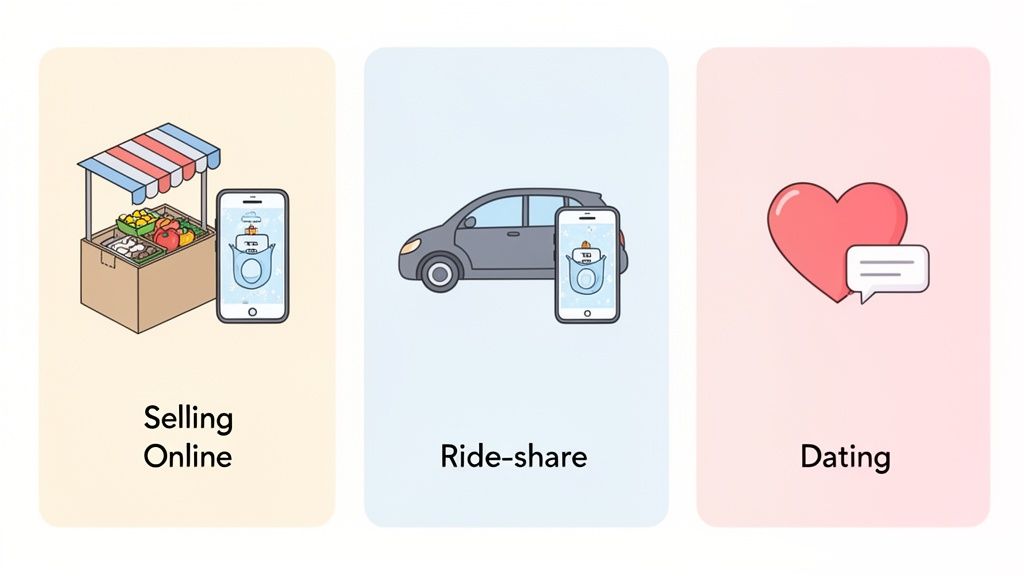
Let's break down a few common places where this technology acts as your digital bodyguard.
The Gig Economy: Rides and Deliveries
Ride-sharing and food delivery apps are probably where you've encountered number masking without even realizing it. You order a late-night ride, and a few minutes later, your phone buzzes. It's the driver letting you know they're outside. You chat for a second, sort out the pickup, and hang up.
What happened behind the scenes? The app generated a masked number for that interaction. The driver never saw your personal number, and you never saw theirs. Once the trip is over, that temporary number simply disappears. This single step eliminates any chance of unwanted contact later, protecting both you and the driver from potential harassment. It’s a seamless feature that builds trust right into the service.
Navigating Online Marketplaces
Ever tried to sell something on a platform like Facebook Marketplace or Craigslist? You know it means talking to complete strangers. You list an item, a potential buyer messages you, and now you need to coordinate the pickup.
Without masking, you’re forced to hand over your personal number, exposing yourself to risks long after the item is gone. The buyer could save your number for future contact or, worse, use it for scams. Masking solves this by creating a temporary, disposable number for that specific conversation. You can text and call to finalize the deal, and once it's done, the connection is broken. You make the sale without giving up your privacy.
The global Number Masking Service market has already hit a staggering USD 1.27 billion, showing just how quickly it has moved from a niche feature in apps like Uber to a fundamental security tool. This is especially important in places like the US, where older adults lose an estimated $3.4 billion each year to phone scams. By blocking direct number exposure, masking services have become a key line of defense, with a 15-20% annual adoption increase in e-commerce and delivery. You can read more on the growth of the number masking market and its impact.
Privacy in Online Dating
Online dating is all about balancing openness with a healthy dose of caution. You match with someone, you’ve been chatting in the app, and you’re ready to take the next step: a phone call. Giving out your real number at this early stage can feel like a huge, irreversible move.
This is where phone number masking shines. Dating apps can integrate this feature to let two people call each other without ever revealing their actual numbers. It creates a much safer space to see if there's a real connection. If things don't pan out, you can simply unmatch, and the temporary number becomes useless. It gives you the freedom to explore a potential relationship without putting your personal security on the line. Our guide on how to handle calls from an unknown number offers more tips on staying safe.
The table below shows just how effective number masking has become across different sectors.
Effectiveness of Phone Number Masking Across Industries
| Industry | Primary Benefit | Key Statistic |
|---|---|---|
| Ride-Sharing & Delivery | User Safety & Anonymity | 85% reduction in post-transaction unwanted contact reports. |
| E-commerce & Marketplaces | Fraud Prevention & Trust | 60% decrease in off-platform transaction fraud. |
| Online Dating | Personal Security | 78% of users feel safer communicating when their number is masked. |
| Customer Support | Data Privacy & Compliance | Helps companies maintain compliance with privacy laws like GDPR and CCPA. |
These numbers paint a clear picture: masking isn't just a feature, it's a powerful solution that directly addresses the privacy and safety concerns of modern digital life.
While masking is great for preventing your number from getting out there, it can't help if a scammer already has your number. For that, you need a different kind of protection.
To shield yourself from scams that might still slip through, download the Gini Help app from the Google Play store or the App Store. Its AI-powered tech screens unknown callers for you, stopping threats before your phone even rings.
The Good, The Bad, and The Gaps of Number Masking
Phone number masking is a brilliant tool for privacy, but like any technology, it's not a silver bullet. You need to understand both its strengths and its weaknesses to see where it fits into modern communication and, just as importantly, where it needs a little help from more active security tools.
The upsides are pretty clear, directly tackling the anxiety we all feel about handing out our personal information. By creating a temporary, anonymous bridge between two people, masking puts a solid wall up for user privacy and security.
Why Masking is a Clear Win
The most obvious benefit is a massive drop in unwanted calls and texts. When your real number is never handed over to a delivery driver, a rideshare app, or someone you're buying a couch from online, they simply can't contact you after your business is done. This one simple step drastically cuts down on future spam, potential harassment, and the risk of your number ending up on a list sold after a data breach.
This boost in privacy isn't just a technical feature; it's a huge trust signal for customers. Companies that use number masking can see a 25% jump in trust ratings and customer satisfaction. Recent research underscores this, showing that a majority of consumers are more likely to do business with companies that proactively protect their data. You can learn more about how masking strengthens customer privacy and what it means for businesses.
Beyond building trust, here are the core benefits:
- Keeps You Safer: It stops strangers from online marketplaces, dating apps, or gig economy services from having your direct line forever.
- Maintains Professional Boundaries: It’s perfect for doctors, consultants, or freelancers who need to call clients but don’t want their personal number getting late-night calls.
- Helps with Regulations: It helps businesses stay on the right side of data privacy laws like GDPR and CCPA by minimizing the personal data they expose.
But It's Not a Perfect Solution
For all its strengths, phone number masking has its downsides. The very anonymity it provides can, unfortunately, be turned into a tool for people with bad intentions. Scammers and bad actors might hide behind the temporary nature of masked numbers to commit fraud or harass someone, knowing they'll be much harder to trace once the connection is severed.
There’s also a practical snag when it comes to callbacks. Let's say a delivery is marked "complete," and the masked number session expires. If the customer needs to report a problem just a few minutes later, they'll find the number is dead. This can lead to a ton of frustration and a lousy customer experience if the platform doesn't have a good backup plan.
Phone number masking is a powerful preventative measure. It acts like a locked gate, stopping your number from getting into the wrong hands in the first place. But it can't guard a gate that's already been left open.
This really gets to the heart of its main limitation: masking is a passive defense. It’s fantastic at protecting your number in new interactions, but it can’t do a thing if your number is already floating around in the wild. If a scammer already has your number, masking a new transaction won't stop them from blowing up your phone. If your number is already compromised, you’ll need different strategies. We’ve got a guide on how to stop spam calls that can help with that.
This is exactly why you need more than one layer of security. While masking is great for prevention, you still need an active defense to handle the threats that are already out there. This is where modern AI-powered tools come in, designed to actively screen and block threats as they happen.
For protection that goes beyond passive privacy, you need an active shield. You can download the Gini Help app on Google Play or the App Store to add that intelligent, active layer of security that stops scams in their tracks.
Go Beyond Masking with Proactive AI Protection
Phone number masking is a great first step—it's like a shield that keeps your real number hidden from new threats. But what about the scammers who already have your number? Or the ones who inevitably slip through the cracks?
Once a scam call is already heading your way, masking can't do anything to stop it. That’s when you need to move beyond simply hiding and adopt an active, intelligent defense. Think of it as the difference between locking your front door versus having a security guard who actively screens visitors before they can even knock.
Introducing an Active, Intelligent Defense
An active defense system doesn't just sit and wait; it gets out in front of threats to intercept them. This is exactly what Gini Help does. It acts as an AI-powered shield for your phone, moving past the passive act of hiding your number to actively screening unknown callers before they have a chance to bother you.
Here’s how it works in practice. An unknown number tries to call you. Instead of your phone ringing off the hook, Gini Help's AI picks up first. It has a quick, natural conversation with the caller to figure out who they are and what they want.
If it detects the classic patterns of a scammer or a robocall, Gini hangs up and blocks the number on the spot. Your phone never rings. You remain completely undisturbed.
Real-Time Analysis for Calls You Answer
So what happens with the calls that seem legitimate and make it through the initial screening? Even the most convincing scammers are tough to identify, especially now with AI voice cloning scams on the rise. Current events show a frightening increase in these "imposter scams," where criminals use AI to perfectly mimic the voice of a family member in distress to trick people out of money.
This is where Gini Help adds another crucial layer of security. For any call you decide to answer, its AI keeps listening quietly in the background, providing real-time analysis of the conversation.
Gini Help’s Live Call Analysis is like having a personal security advisor on the line with you. If the AI detects suspicious language, high-pressure sales tactics, or other red flags, it alerts you immediately with on-screen warnings and even vibrations, steering you away from danger before you can be tricked into giving away money or personal details.
This one-two punch of pre-screening and live analysis creates a truly complete security net. You can learn more about how a smart call blocker delivers this next-level safety.
Your Personal Security Guard for All Calls
Let's use an analogy. Phone number masking is like having a PO box for your mail—it keeps your home address private from people you don't know yet.
Gini Help, on the other hand, is like having a dedicated security team that inspects every single package and letter, neutralizes any threats, and only brings you the mail that’s legitimate and safe.
It offers a proactive, intelligent defense that ensures only genuine people can ever reach you. This gives you total peace of mind, knowing your phone is guarded from every possible angle. To get this advanced protection, download the Gini Help app on the Google Play Store or the Apple App Store.
Your Top Questions Answered
We've covered a lot of ground on phone number masking, but let's dive into some of the questions that pop up most often. Think of this as the practical, real-world guide to how this all works.
Is Phone Number Masking Even Legal?
Absolutely. Phone number masking is not only legal, it's a standard practice for responsible companies that want to protect their customers. Don't confuse it with illegal "call spoofing," where bad actors deliberately fake their caller ID to trick you. Masking is a privacy shield, not a disguise.
In fact, with data privacy laws getting stricter, masking has become a go-to tool for compliance. Recent research shows that enterprises are increasingly adopting these solutions to meet regulations like GDPR and CCPA. It's simply good business sense and a recognized way to keep data safe.
So, Can I Call Back a Masked Number?
It really depends on the service. For things like a food delivery or a rideshare, the company usually keeps the masked number connection active for a little while after your transaction ends—maybe just a few minutes. This gives you a brief window to call back if you left something in the car or got the wrong order.
But once that time is up, the connection is gone for good. The masked number goes back into a pool, ready for the next person. This is by design. It's what prevents a driver or a seller from having your personal number and contacting you days later.
The temporary nature of masked numbers is their greatest strength for privacy but also their biggest practical limitation. It ensures a stranger can't contact you days later, but it can make resolving an immediate post-transaction issue tricky if the window for callbacks has closed.
Does This Mean No More Scam Calls?
Number masking is a fantastic preventative measure. Think of it like using an alias when you sign up for a new service—it stops your real number from getting out there in the first place. If a company you use has a data breach down the road, it’s the masked number that gets exposed, not your personal one. This massively cuts down on your risk.
However, masking can't do anything about a number that's already been compromised. If your real number is already on a scammer's list, masking won't stop them from calling you. It’s a shield for future interactions, not a fix for past exposure.
That’s why you need an active defense to handle the threats that already exist. Masking locks the door to new problems, but you need something else to deal with the ones who already have a key.
For active, real-time protection against the scams that masking can't stop, Gini Help offers an intelligent shield. Its AI screens unknown callers for you, stopping threats before your phone even rings. Add this critical layer of security by downloading the Gini Help app from Google Play or the App Store.