Calls from 281 Area Code: A Quick Safety Guide
By Josh C.
A 281 call appears while you're making dinner, helping a parent with a prescription, or waiting for a contractor to return your message. The number looks familiar, so you hesitate before sending it to voicemail. That hesitation is exactly what a scammer wants.
Calls from 281 area code can be legitimate Houston-area calls, but the prefix doesn't authenticate anyone. The danger begins after you answer, when a live caller creates urgency, asks for secrecy, requests a payment, or tries to obtain a one-time code. Blocking the prefix alone misses that conversational layer.
The 281 Area Code and Where It Came From
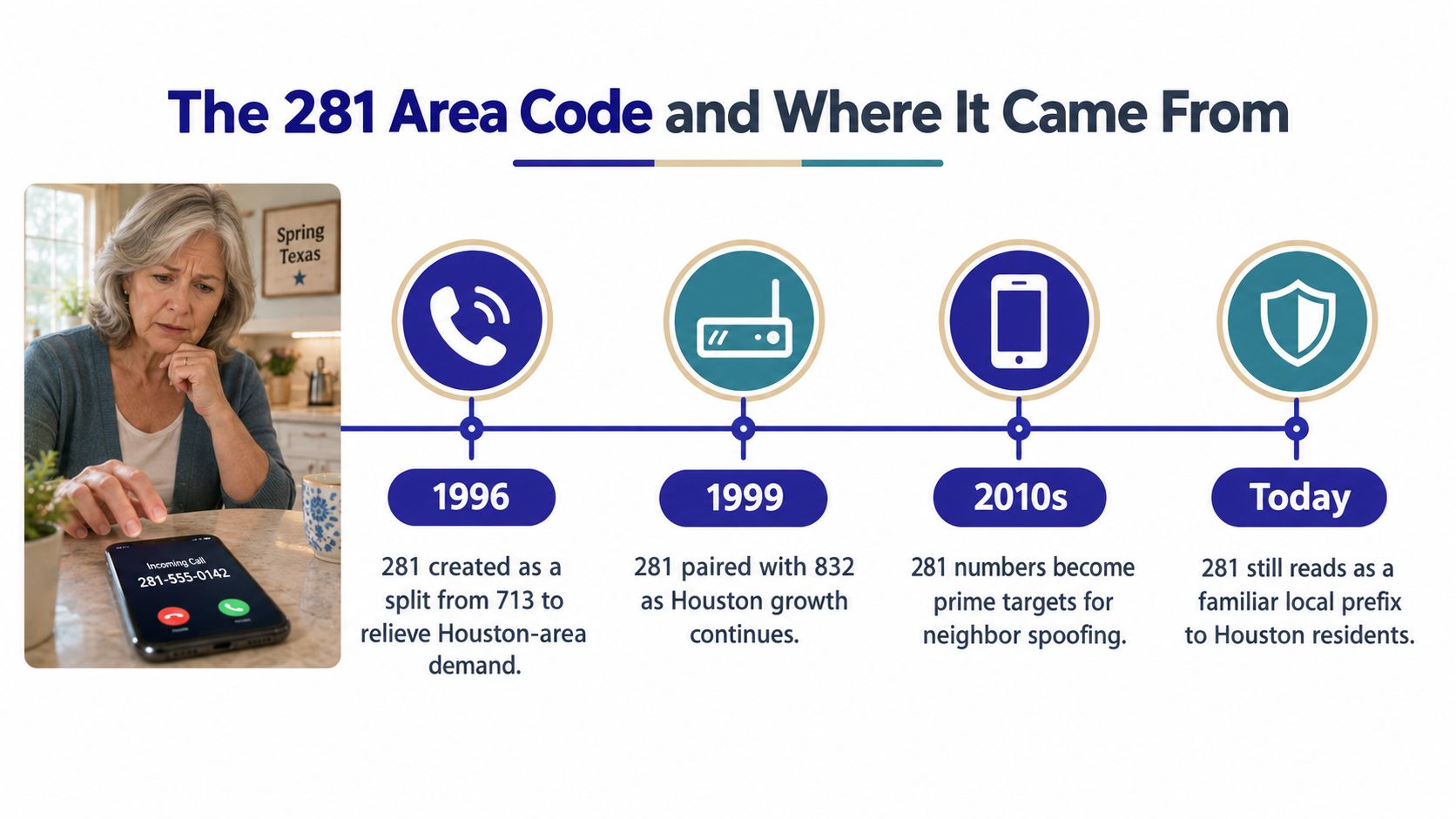
A grandmother in suburban Spring, Texas, sees an incoming call from 281-555-0142. She doesn't recognize the rest of the number, but the prefix feels familiar. It could be a doctor's office, a neighbor, a pharmacy, or a contractor who recently worked nearby. She lets the phone ring while deciding whether “local” means safe.
It doesn't.
Area code 281 entered service on November 2, 1996, when Texas regulators and numbering administrators split the existing 713 territory. Central Houston retained 713, while most suburbs outside Houston's Beltway 8 received 281. The change responded to Houston's expanding population, growing businesses, and rising demand for telephone numbers. The history of area code 281 shows why residents came to associate it with suburban and outer metropolitan communities rather than Houston's inner core.
That geographic boundary didn't last. On January 16, 1999, area code 832 was introduced as an overlay across the broader 713 and 281 region. The overlay eliminated the old boundary and made ten-digit dialing necessary throughout the combined service area. Area code 346 joined the same Houston overlay complex in 2014, and the North American Numbering Plan Administrator has confirmed that area code 621 is planned for the region alongside 281, 346, 713, and 832. The NANPA planning letter describes the shared service territory.
What the prefix tells you
A 281 number can be associated with Greater Houston communities such as Baytown, League City, Missouri City, Pasadena, Pearland, Sugar Land, and The Woodlands. It can belong to a real resident, school, hospital, energy company, or local business. It can also belong to someone who moved away and kept the number through mobile-number portability.
The overlay matters because 281, 346, 713, and 832 serve the same broad region. A prefix can suggest a market, but it can't establish a precise city, carrier, current address, or caller identity. A displayed number is a label on your screen, not an identity document.
That's why the decision shouldn't end with, “Is 281 a legitimate area code?” It is. The useful question is, “What is this caller trying to make me do?” The answer usually appears in the conversation, not in the first three digits.
Why a 281 Number Does Not Prove the Call Is Local
Caller ID is a display system. It isn't a secure identity check.
A scammer can manipulate the number shown on your screen so it shares your area code and exchange. The FCC calls this neighbor spoofing, a technique designed to make a call look familiar and increase the chance that you'll answer. The FCC's explanation of spoofing also warns that changing spoofed local numbers makes conventional call blocking difficult.
A caller may be somewhere outside Houston, outside Texas, or outside the United States while presenting a 281 number. The number can look local even when the person has no connection to the region. Overlay codes make the social trick more effective because locals already recognize several overlapping Houston prefixes as familiar.
Complaint data reinforces the need for caution, without proving that every 281 call is fraudulent. Consumer-report datasets summarized for 281 numbers include 28,529 Federal Trade Commission complaints associated with 11,735 unique numbers, along with 1,546 Federal Communications Commission complaints. The same data reports that 82.2% of victims were Texas residents and 66% had a 281 number themselves, a pattern consistent with neighbor spoofing. The 281 complaint summary notes that these are complaint-based figures, not a census of every call.
| What Caller ID Shows | What It Actually Means |
|---|---|
| A 281 prefix | The number is associated with the Greater Houston numbering region, or is displaying a spoofed local prefix |
| A familiar exchange | The caller wants the call to feel nearby, not that the caller is nearby |
| A business name | The displayed label may be supplied by a phone system or manipulated caller ID |
| A number matching your area code | The caller may be using neighbor spoofing |
| A local-looking call at an odd hour | Treat it as unverified until the organization and purpose are independently confirmed |
The same dataset reports that 63% of respondents who answered 281-number calls identified them as robocalls, while 12% of complaints named impostor calls. Another pattern showed 77% of FTC complaints came from people whose own numbers began with 281, and 90% came from Texas. Those figures describe reported experiences, not the behavior of every 281 subscriber.
Use the prefix for geographic context only. Judge the call by its request, its pressure, and the verification path it offers. For a plain-language explanation of how criminals manipulate displayed numbers, see this guide to what caller ID spoofing means.
Common Scam Patterns Linked to 281 Numbers
A scam conversation often starts with a harmless question. The caller confirms your name, mentions a familiar Houston-area organization, and waits for you to volunteer information. The number on the screen supplies the first layer of trust. The script does the rest.
The local pharmacy or Medicare opener
The caller claims to represent Medicare, a pharmacy, or a medical supplier serving Houston. They may say a prescription needs confirmation, a benefit is expiring, or a refund is available. Then they ask for a member number, date of birth, insurance details, or a one-time verification code.
The red flag isn't the pharmacy reference. It's the demand that you verify sensitive information during an unsolicited call. End the conversation and call the pharmacy or insurer through a number on an official statement, insurance card, or verified website.
The utility shutoff threat
A caller claims to represent a utility serving a Harris County address. They say payment is overdue and service will be disconnected unless you act immediately. The preferred payment rails may include gift cards, wire transfers, or Zelle, because those methods can be difficult to reverse.
A real billing issue can be checked without obeying the caller. Don't use the callback number they provide. Open a recent bill, use the provider's official website, or contact the utility through a known customer-service channel.
The energy contractor after a storm
After severe weather, a caller may pose as a local energy contractor or restoration vendor. They offer urgent repairs, request a deposit, or ask for account access so they can “release” equipment. The 281 number makes the story feel connected to the Houston market.
Ask for the company's legal name, physical business address, written estimate, and a callback number. Then verify those details independently. Don't allow an unexpected caller to rush you into work, payment, remote access, or a code.
The grandchild in trouble
The caller says a grandson or granddaughter has been arrested, injured, or stranded. They may use a local number and tell you not to contact other relatives because the situation is embarrassing or time-sensitive. The caller then asks for gift cards, a wire transfer, or Zelle payment.
Secrecy is the giveaway. A family emergency deserves a second channel. Hang up and call the relative directly using a saved number, or contact another family member. Don't accept a voice, a story, or a 281 prefix as proof of identity.
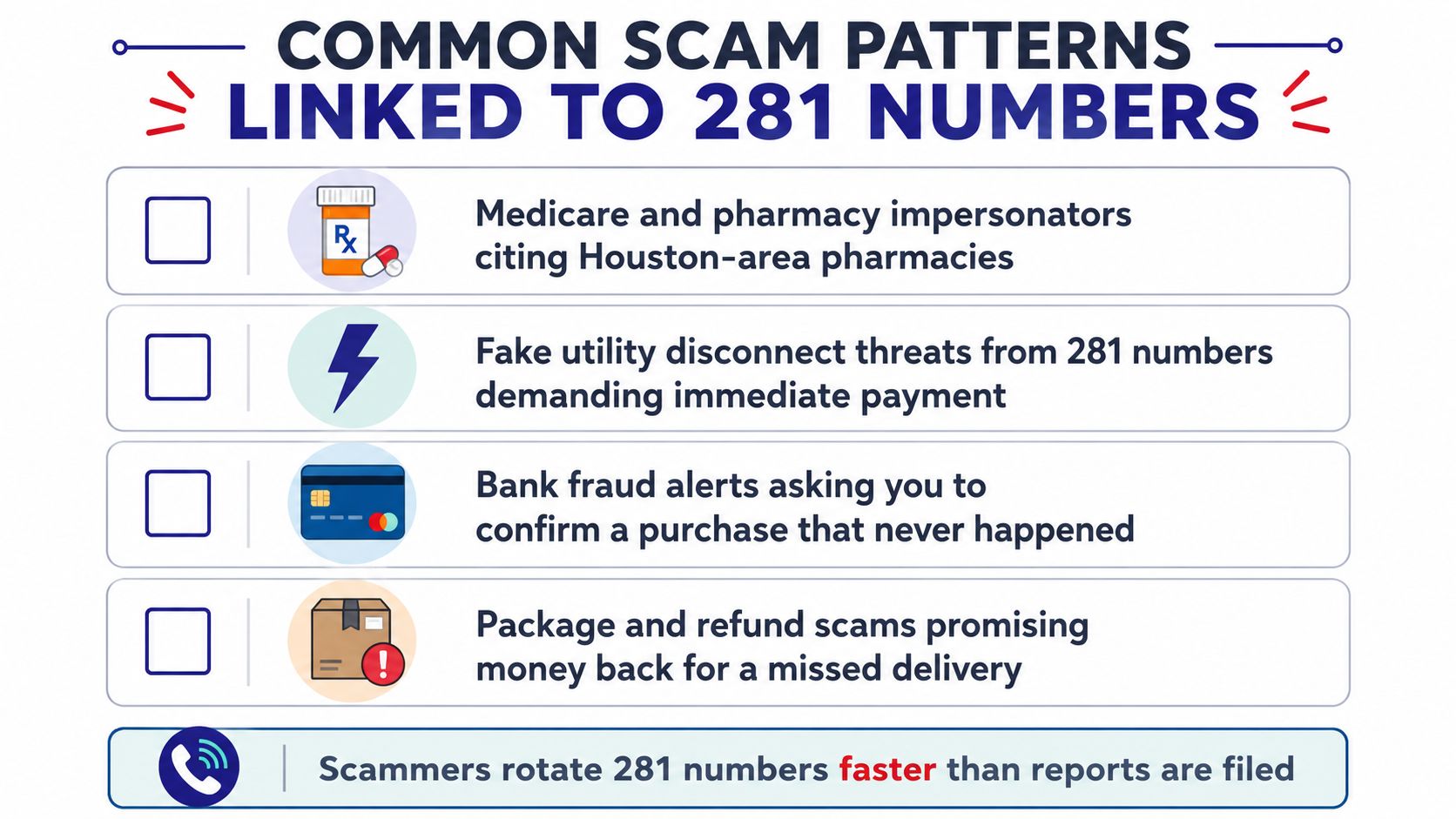
The practical test: If the caller creates urgency, demands secrecy, asks for payment, or requests a one-time code, stop treating the call as a normal service conversation.
Static block lists can't hear whether a caller says, “Stay on the line,” “Don't tell your daughter,” or “Read me the code you just received.” Those phrases reveal social engineering in progress. Pay attention to the shape of the conversation, not just the number that started it.
What to Do When a 281 Call Comes In
Treat an unfamiliar 281 call as unverified, not automatically dangerous and not automatically trustworthy. Your first move should reduce pressure.
Before you pick up
Let the call go to voicemail. A legitimate clinic, school, contractor, or family member can leave a purpose and a way to respond. Check the complete number against your contacts and recent records, but don't assume a search result proves ownership.
Don't call back a number you don't recognize because it looks local. If you're unsure how to evaluate an unanswered call, this practical guide explains how to handle missed calls on site.
If you answer
Don't start by confirming your full name, address, account number, or date of birth. Ask, “Who are you calling from, and what is the purpose of this call?” If the caller claims to represent an organization, request a callback number and case ID, then end the call and verify both through an independent channel.
Use this sentence when pressure begins:
“I don't make payments or share codes on an unsolicited call. I'll contact the organization directly.”
For a supposed grandchild, say:
“I'm going to hang up and call the family member directly.”
For an alleged IRS or utility emergency, say:
“I'll verify this through the official number on my statement.”
Then hang up. Don't argue, negotiate, or explain why you're ending the call. Every extra minute gives a skilled manipulator more opportunities to create doubt.
Afterward, write down the date, time, exact number, claimed organization, request, payment method, and any case ID. If you need device-level instructions, use this guide on how to block a number on a cell phone. Blocking helps with that specific number, but it won't solve the spoofing problem by itself.
How AI Call Screening Catches What Block Lists Miss
A prefix filter asks, “Does this number look suspicious?” A conversation-level screener asks, “What is this caller trying to make the person do?” The second question is more useful because scammers can change the number while keeping the same script.
The Federal Trade Commission received more than 2.6 million Do Not Call complaints in FY 2025, and consumers reported mostly robocalls. The leading themes included debt reduction, imposters, medical and prescription matters, energy and utilities, and home services. The FTC's FY 2025 report also describes a complicated picture: complaint volume remained about 48% below FY 2021 levels, yet it still exceeded 2.6 million, and high-dollar impersonation losses among older adults increased sharply.
Lower call volume doesn't mean lower danger. A smaller number of contacts can still be targeted, adaptive, and financially serious.
Why static tools fall behind
A reputation database can block a number after people report it. Neighbor spoofing lets the caller change the displayed number, so the next call may arrive from another 281 sequence. Prefix rules can also create false positives by blocking legitimate Houston residents, hospitals, schools, and businesses.
Carrier authentication, including STIR/SHAKEN, can provide useful network-level signals, but no caller-ID label can tell you whether the person is asking for a gift card or a one-time code. That information appears in the dialogue.
Conversation-level screening changes the order of operations. An AI service can answer first, ask the unknown caller for a name and purpose, identify pressure or payment language, and connect the call only when it passes a legitimacy check. The approach is especially relevant for older adults who may answer familiar-looking numbers instinctively.
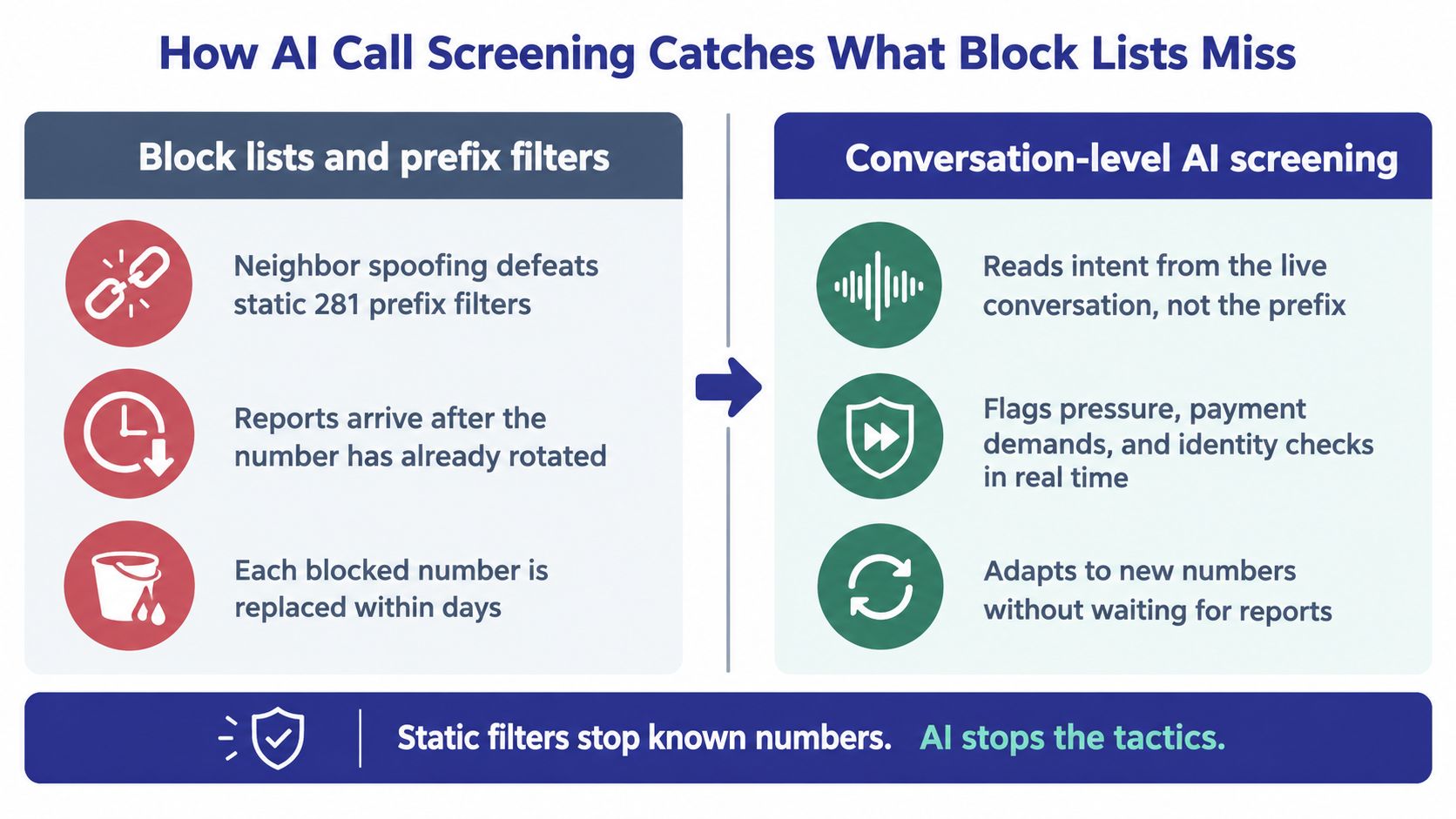
A service such as Gini Help's call screening is designed around that conversation-level model. It can screen unknown callers before the person answers, while live call analysis can help identify risk during calls that do get through. That doesn't replace independent verification, but it puts a useful barrier between a suspicious script and an impulsive response.
Reporting, Blocking, and Documenting the Call
Don't delete the evidence after you block the number. A screenshot, voicemail, and accurate description can help your carrier, regulators, and family recognize the next version of the same campaign.
Start with the phone itself. Screenshot the caller ID, save the voicemail, and record the exact number as displayed. In a dedicated note, write the date, time, claimed organization, name used by the caller, requested payment method, callback number, case ID, and any instructions involving passwords, remote access, or one-time codes.
Use the right reporting channel
| Agency | Channel | What to Submit | Best For |
|---|---|---|---|
| Federal Trade Commission | ReportFraud | Caller ID screenshot, number, script, organization impersonated, and payment demand | Consumer fraud and impersonation |
| Federal Communications Commission | Consumer Complaint Center | Number displayed, call details, robocall or spoofing information, and your carrier | Unwanted calls, spoofing, and telecommunications complaints |
| FBI | Internet Crime Complaint Center | Financial loss, payment method, digital messages, caller details, and supporting files | Cases involving money sent or online follow-up |
| Texas Attorney General | Consumer protection office | Caller identity claim, Texas connection, payment request, and documentation | Houston-area and Texas consumer complaints |
If money changed hands, contact the payment provider immediately. A bank, card issuer, wire service, or payment app may have recovery procedures, but speed matters. Don't continue communicating with the scammer while pretending to cooperate.
Reporting also helps other people. Complaint records contribute to the reputation signals used by carriers, security services, and screening tools. Your report may connect a voicemail script to numbers that haven't yet accumulated a visible reputation.
Share a clean warning with caregivers
Send your family a short message instead of a vague alert:
“A caller displayed [number] on [date and time], claimed to represent [organization], and asked for [payment, code, password, or personal detail]. No information was provided. Don't answer or call back. Verify through [official channel].”
That format lets relatives recognize the behavior without blocking every legitimate local number.
A Layered Protection Plan for You and Your Family
No single control deserves your trust. Build protection in layers, with each layer handling a different failure.
First, use carrier-level signals. STIR/SHAKEN authentication and carrier spam warnings can flag some suspicious calls before they reach the device. They're useful, but they can't reliably interpret a persuasive live conversation.
Second, turn on device-side filtering. iPhone and Android phones, along with major carriers, offer tools that silence, label, or block suspected spam. Use them to reduce noise, not as proof that every unflagged call is safe.
Third, add conversation-level screening. This is the decisive layer for calls from 281 area code because it evaluates what the caller says. The screener can ask for a name, purpose, and verification details before the human answers, then identify pressure, impersonation, payment demands, or requests for codes.
Download Gini Help from Google Play or the App Store. It's designed to screen calls, texts, and emails, and its call protection focuses on analyzing unknown callers and suspicious conversation behavior rather than relying only on a block list.
Fourth, coordinate with family. Create a shared group chat for suspicious calls. When a parent receives a fake utility demand or grandchild emergency, send the number, script, and requested payment method to the group. Family members can cross-check the story without taking control away from the older adult.
Fifth, review patterns together. Set aside time to look at call logs, saved voicemails, and reports with an older relative. Ask what the caller requested and what made the call feel convincing. The goal is confidence and recognition, not surveillance.
Install the app with the parent who keeps receiving 281 calls, configure the screening greeting together, and test it with a known contact. Make sure everyone understands the family rule: no payment, password, remote access, or one-time code gets shared because an incoming number looks local.
Gini Help screens unknown calls and analyzes live conversations for scam signals before suspicious callers reach you, which directly addresses the social engineering that prefix blocking misses. Visit Gini Help to set up a safer call-screening layer for yourself or a family member today.