Area Code 320 Spam Calls: Spot and Report
By Josh C.
Area code 320 is a real central Minnesota code, so the display alone neither proves a scam nor proves the caller is local. Blocking every 320 number isn't a reliable solution to unwanted calls.
That popular advice focuses on the easiest thing to see, not the most important thing to judge. A calm caller who knows your name and claims to represent your bank can deserve more scrutiny than an obvious recorded sales pitch. Judge the request, not the area code, especially when the conversation turns toward money, passwords, or immediate action.
What a 320 Caller ID Can and Cannot Prove
320 is a legitimate numbering area, not a scam label. The history of area code 320 records that it was created from 612 and entered service on March 17, 1996, after growing demand for telephone numbers in the Minneapolis–St. Paul region required a split. It serves central and western Minnesota communities including St. Cloud, Alexandria, Willmar, and Hutchinson.
During the transition, callers could temporarily use either prefix. That permissive-dialing period ended on September 15, 1996, according to the same numbering history, making the new code mandatory for affected destinations. None of that geographic history establishes who's speaking on an incoming call today.
What a 320 caller ID signal can and cannot prove
| Signal | What it can mean | What it cannot prove | Safer next move |
|---|---|---|---|
| 320 on caller ID | Display claims a central Minnesota number | Caller is local or trustworthy | Don't treat the prefix as a verdict |
| Same first six digits as yours | Neighbor spoofing meant to look familiar | The caller knows you personally | Send it to voicemail or screening |
| STIR/SHAKEN attestation present | A carrier signed the displayed number | The purpose of the call is legitimate | Still judge what they ask for |
| Prerecorded or synthetic voice | Likely an automated campaign | Every recorded call is illegal | Hang up and note date and time |
| Demand for gift cards, crypto, or a code | Payment or credential social engineering | The named bank or agency is involved | Stop and call a number you already trust |
| Many different numbers, few repeats | A rotating spoof campaign | Blocking one number ends it | Report the pattern, don't chase each line |
The distinction between the displayed number and the person using it matters. The FCC's spoofing guidance explains that callers can deliberately falsify caller-ID information to disguise their identity. It also describes lawful uses, such as a doctor displaying an office number instead of a personal mobile number.
A clinic's recognizable number therefore isn't automatically suspicious, but it isn't proof of identity either. Nor does an unfamiliar voice prove deception: an organization may have someone else handle its calls. You generally can't settle the caller's physical location, identity, and honesty from the display alone.
Read the clues without overreading them
A matching prefix can create familiarity without a personal connection. That's the point of neighbor spoofing: the caller wants the number to feel ordinary enough that you'll answer without thinking. A number's reputation can help with screening, but a resident or business may also have its number impersonated.
The other table rows answer different questions. Authentication concerns the number, while a recorded voice concerns how the message is delivered. A request for gift cards, cryptocurrency, remote access, or a one-time code concerns what the caller wants you to do, which is far more useful for deciding whether to continue.
Our explanation of caller ID on your phone can help you separate the display from the caller's claims. Don't spend the conversation trying to prove that someone really is in Minnesota.
Practical rule: A recognizable number can justify checking a message. It doesn't justify sharing a secret or sending money.
If the call seems suspicious, save the displayed number, date, time, and any separate callback number. Verify the claimed organization through a number printed on a bill, payment card, or official website, not through the route the caller gives you.
Common Scripts Behind Area Code 320 Spam Calls
The story matters more than the prefix. A caller might borrow the authority of a government office, the familiarity of your bank, or the emotion of a family emergency. These are recognizable scenarios, not proof that a particular organization or Minnesota number is involved.
Listen for the moment the caller moves from explaining a supposed problem to controlling how you solve it. A request to buy gift cards, install remote-access software, or keep the conversation secret deserves a different response from an ordinary appointment reminder.
Scripts often paired with a 320 caller ID
| Script | Typical opening | Pressure move | What to do |
|---|---|---|---|
| Government impostor | Social Security, IRS, or Medicare problem | Arrest, frozen benefits, or secrecy | Hang up and use the agency's published number |
| Bank or utility | Account locked or bill past due | Wire, gift card, or crypto | Call the number on your statement or card |
| Tech support | Virus or hack on your computer | Install software or read a one-time code | Grant no access and share no code |
| Prize or delivery | Package held or you won a prize | Pay a fee or tap a text link | Ignore their callback and their link |
| Relative in trouble | A grandchild or family emergency | Send money now and tell nobody | Check with another relative before paying |
Recognize the requested action
Say someone claims your bank account is locked. They sound patient, explain a plausible security concern, and offer to help move your balance into a protected account. The useful question isn't whether the caller sounds professional. It's whether you've independently confirmed the instruction to move your money.
A tech-support scenario takes a different path. The caller may start by describing an infection, then ask you to install software so they can fix it. Don't grant access to investigate an unsolicited claim, and don't read aloud a code sent to your phone.
With a family-emergency story, secrecy is especially important to notice. Someone claiming to be a frightened grandchild may insist that contacting another relative would make things worse. Checking with family is precisely the interruption you need before considering payment.
Recorded calls raise a separate question
The Congressional Research Service's robocall overview explains federal restrictions on automated calls and robotexts to mobile phones, including consent requirements and applicable exceptions. Prior express written consent is generally required for covered automated telemarketing, but the legal analysis depends on the call's purpose, technology, and consent circumstances.
A recorded pitch combined with deceptive caller ID can raise more than one compliance issue. For your immediate safety, though, you don't need to decide which law applies. Recognize the story, refuse the proposed payment or access route, and avoid following a text link sent to continue the conversation.
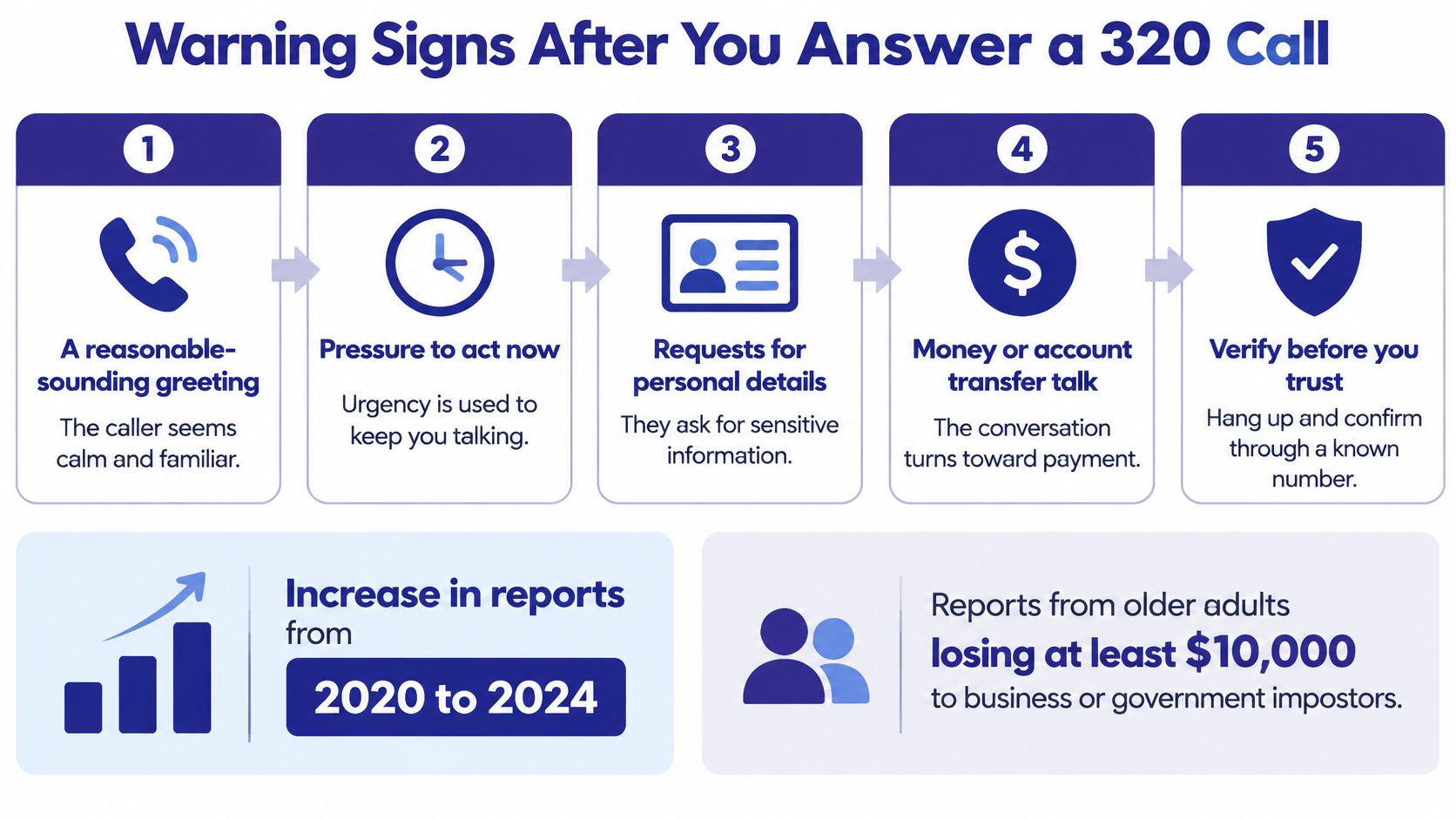
Warning Signs After You Answer a 320 Call
The financial danger isn't limited to noisy, repetitive robocalls. The FTC's analysis of older-adult impersonation reports found that, from 2020 to 2024, reports from older adults losing at least $10,000 to business or government impostor scams increased more than fourfold. In that analysis, reported losses involving older adults who lost over $100,000 rose eightfold to $445 million.
Those findings don't measure a 320-specific risk. They show why getting through a spam filter isn't a reason to trust a conversation. A live impostor can concentrate on persuasion rather than repeated dialing, gradually turning a reasonable-sounding explanation into a demand for a transfer.
Watch for the change in the conversation, not just the opening greeting.
Use a deliberate pause
If a caller asks for money, passwords, or urgent action, independently check the request before acting.
You don't need to win an argument, expose the caller, or explain why you're suspicious. While you still have control of the conversation, use this pause:
- Say you'll call back and hang up. A short statement is enough. Don't remain connected while the caller talks you out of checking.
- Don't use the number they just dictated, even if they describe it as a direct fraud-department line.
- Find an independent contact. Use your existing banking app, a statement, an agency's official website, or a relative's saved contact details.
- Tell a trusted person before making any transfer. Explain what the caller asked you to do, not just who they claimed to be.
- Keep the evidence. Write down the displayed number, the time with time zone, and the requested payment, information, or software.
Make checking an ordinary household habit
Caregivers can agree on this pause before anyone receives a stressful call. A parent shouldn't have to invent a response while a stranger insists that their savings or benefits are in danger.
Use a neutral agreement: unexpected financial instructions get checked with someone else first. That protects the person's independence rather than turning every phone call into a test they might fail.
A caller may respond to your hesitation by offering an employee number, a case reference, or personal information about you. Treat those details as claims to verify, not permission to proceed. The immediate objective is simple: keep the money where it is until you've checked the request elsewhere.
Layered Checks That Beat a Blocked Prefix
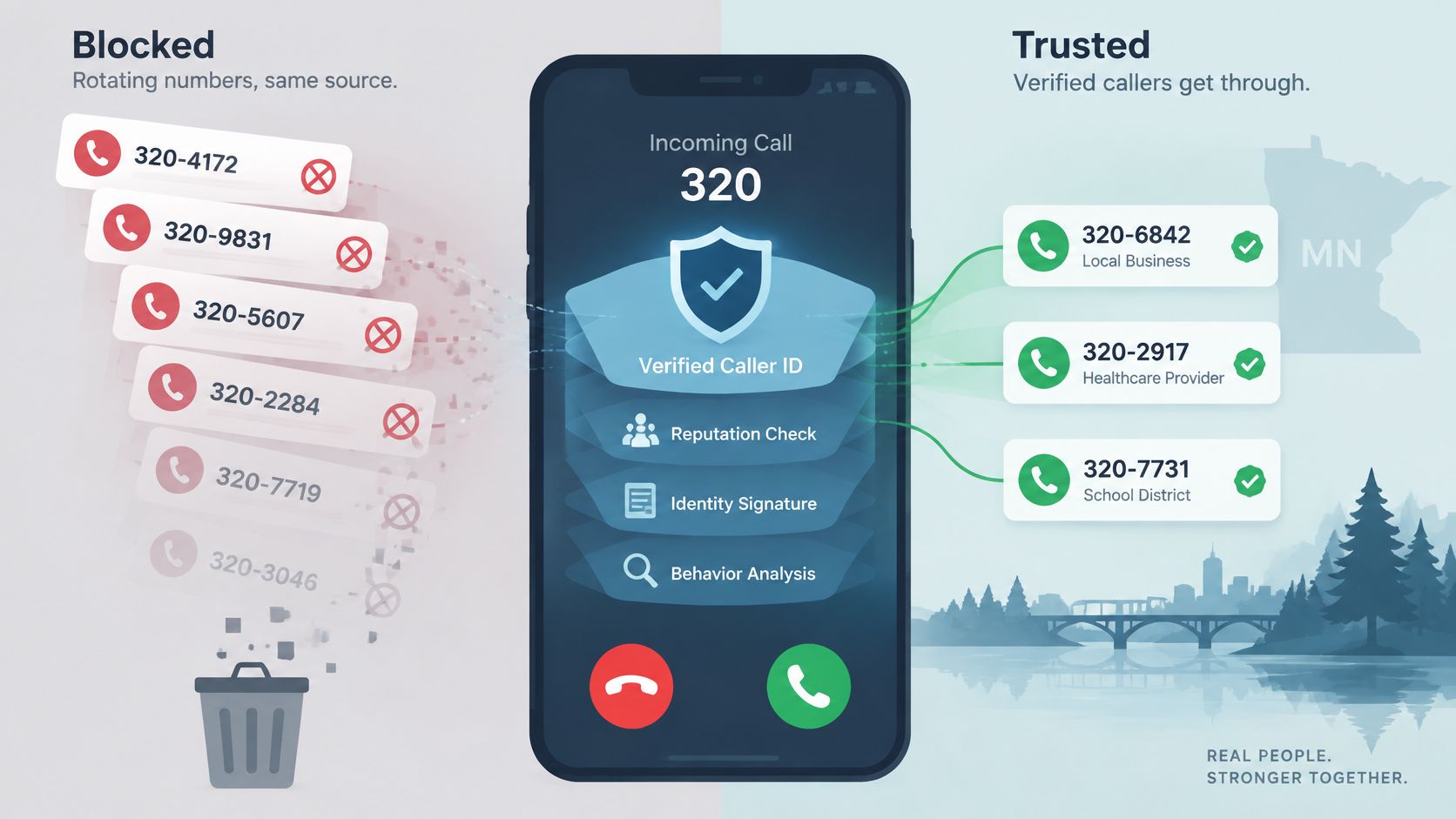
Blocking every 320 number can exclude residents, clinics, schools, and businesses while a spoofing campaign changes its display. The FTC's guidance on blocking unwanted calls supports using call-blocking and screening tools without treating caller ID as proof of identity.
A layered approach separates the checks instead of asking the prefix to answer every question.
What authentication adds
The FCC's explanation of STIR/SHAKEN describes how originating carriers digitally sign caller-ID information and receiving carriers validate it across internet-based voice networks. That information helps carriers label calls, block suspicious traffic, and investigate where calls originated.
It doesn't certify the caller's intentions. A fraudster can use a real number, receive limited attestation, or take advantage of gaps between networks. An authentication indicator should therefore contribute to the decision, not end it.
The useful combination is technical information plus behavior:
- Authentication and reputation help assess the displayed number and its calling history.
- Calling patterns help identify repeated or rotating contact attempts.
- Conversation screening examines the reason for contact and signs of impersonation, payment pressure, or requests for access.
- Independent verification checks consequential instructions outside the incoming conversation.
The distinction between filtering a number and checking a caller is also useful to keep in mind while watching this video.
Keep the limits visible
Screening reduces unwanted calls, but it can't identify every scam or guarantee that every caller is safe. A person who passes an initial check can still make a dangerous request later. Don't interpret a ringing phone as an assurance that everything said next is trustworthy.
Some unwanted calls can still arrive. In one customer's account, a small number got through, mostly during the first weeks, so it's better to keep a verification habit than expect absolute protection.
Apply the same caution to a home phone. An impostor's instructions don't become safer because they arrive on a familiar landline rather than a mobile device. The operating rule is straightforward: the prefix is a hint, the dialogue informs the decision, and an independent callback confirms the claim.
How to Block and Report a Suspicious 320 Call
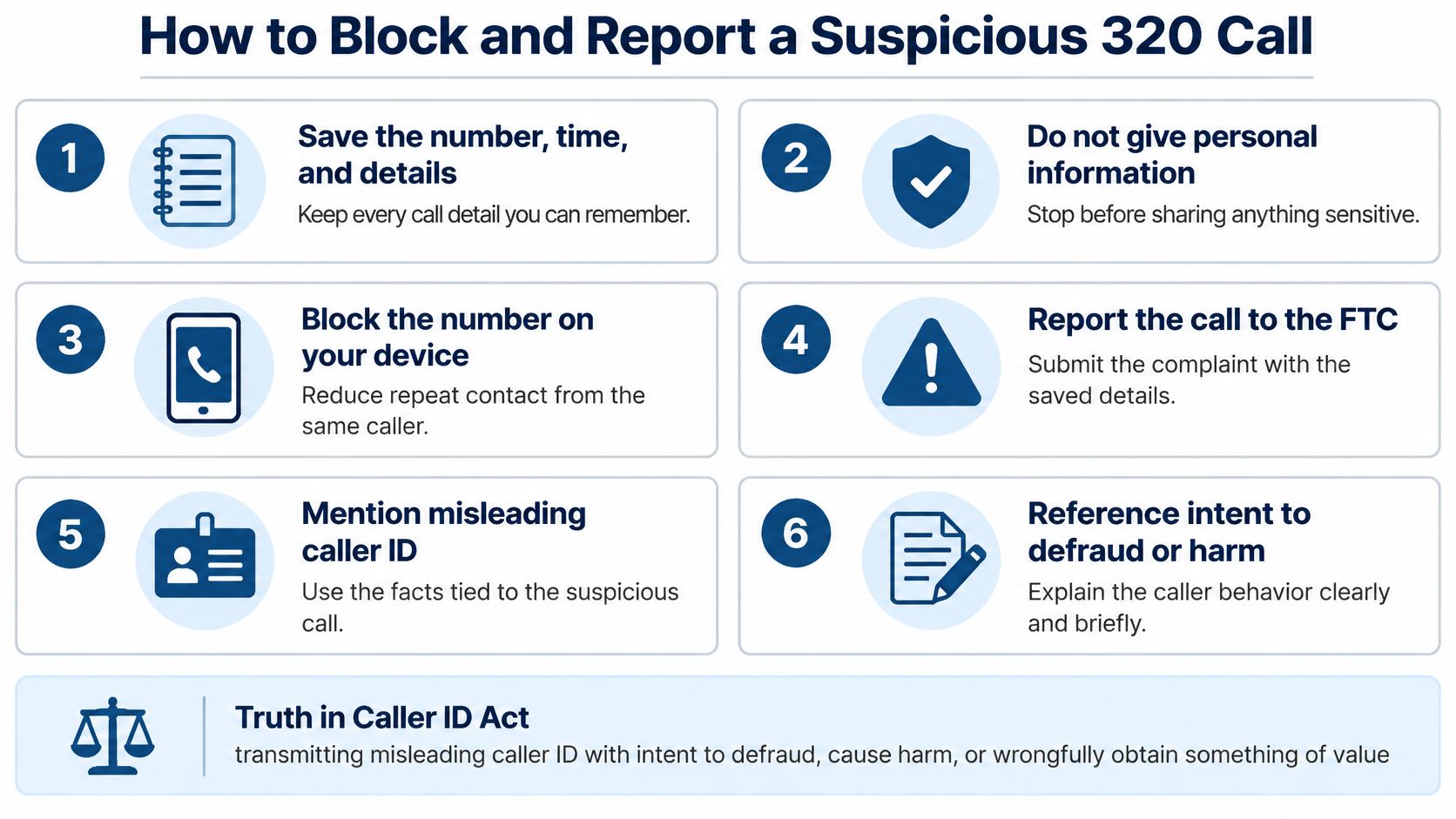
A useful report describes a particular event, not merely an annoying area code. Under the Truth in Caller ID Act, the FCC's unwanted-communications guidance explains that transmitting misleading or inaccurate caller ID with intent to defraud, cause harm, or wrongfully obtain something of value is prohibited. Lawful business callback displays and doctors' office numbers are different from deceptive impersonation.
Describe what happened without claiming to know who owns the displayed number. If someone spoofed an innocent person's line, the caller-ID owner may have nothing to do with the attempt.
Follow the blocking and reporting path
- Block the specific number on your mobile phone. Use the recent-call entry to open its details and select the blocking option. Silence unknown callers if that suits your needs, but check voicemail for legitimate messages.
- On a landline, ask your phone company about anonymous-call rejection and selective call blocking. These controls serve different purposes, and neither establishes who was behind a call.
- File an FCC complaint with the saved details. Include the number that received the call, the displayed caller-ID name and number, date and time with time zone, whether the phone was landline or wireless, and your contact information.
- Also submit a report through ReportFraud.ftc.gov, especially when someone requested money or credentials. Include related robotexts, their wording, and whether they followed a missed call.
- If you already transferred money, contact your bank or card issuer the same day. Ask about stopping or reversing the transaction and keep the confirmation of your report.
Use this checklist to keep the evidence and immediate safety tasks together.
Keep a usable record
A concise account might explain that the caller claimed to represent your utility, threatened disconnection, and requested payment using cryptocurrency. Save messages and transaction records alongside your notes. Those details are more useful than a conclusion that every call from Minnesota is fraudulent.
Our guide to reporting scam calls can help you organize the information. If repeated illegal robocalls raise questions about legal remedies, Kons Law's explanation of filing claims over illegal robocalls offers additional context, separate from submitting a regulatory complaint.
Reporting creates a record. It doesn't promise that a single complaint will stop a campaign.
Keep emergency access separate from unwanted-call controls. Emergency calls to 911 are never blocked or screened by our service. Blocking suspicious incoming contact shouldn't mean hesitating to call for emergency help.
Screen Unknown 320 Calls Before They Ring
The broader financial stakes support taking unexpected calls seriously without treating a whole region as dangerous. The FTC's older-adults report records approximately $3 billion in reported fraud losses among people age 60 and older in 2025, up from about $2.4 billion in 2024, with roughly 123,000 age-identified reports indicating monetary loss.
These are reported losses, not a complete count of fraud. They aren't a measurement of area code 320 spam calls, either. The practical response is to reduce the occasions when an unexpected caller gets your undivided attention before you know why they're calling.
Let the caller explain first
Consider downloading Gini Help from Google Play or the App Store. Unlike blockers that only consult known-spam databases, we answer unknown calls, ask who's calling and why, and only let real people through to your phone; every plan includes AI screening before the phone rings. Plus plans add Live Scam Detection, which keeps listening after you answer and warns when the conversation turns toward requests such as verification codes, account numbers, or immediate action.
A real person can still be an impostor, so keep your verification habit ready. Our explanation of how to screen phone calls can help you decide how unknown callers should reach you.
- For households: Keep trusted contact details accessible so checking a claim is easy.
- For people handling client calls: Review how calls should reach the right person. VoxNote's guide to choosing forwarding rules for client calls provides useful operational context.
- For any suspicious conversation: Preserve the details and report the request rather than judging the prefix.
Gini Help offers screening before unknown calls ring and live scam warnings on eligible plans, helping you assess more than a local-looking 320 number. Visit Gini Help to explore protection for your phone, and keep independent verification as your final check before sharing information or moving money.