Unknown Phone Numbers: What They Mean and How to Respond
By Josh C.
Among adults aged 60 and older who reported losing at least $10,000 to a business- or government-impersonation scam in 2024, 41% said the initial contact was a phone call, according to the Federal Trade Commission's impersonation analysis. An unfamiliar caller can be more than an interruption, but an unfamiliar number alone doesn't establish that someone is trying to deceive you.
The useful response to unknown phone numbers isn't panic or automatic trust. It's a repeatable habit: read the signals, limit what you disclose, and verify the caller through a channel you choose.
Why Unknown Phone Numbers Still Deserve Caution
U.S. robocall complaints fell roughly 68% from the 2021 peak, yet fiscal 2024 still brought approximately 1.1 million robocall complaints, according to the FTC's National Do Not Call report. That report also recorded more than 2 million complaints against a registry containing over 253 million active registrations, including more than 158,000 imposter-call reports and over 170,000 medical and prescription-related complaints.
Those are consumer reports, not a complete count of unwanted calls or a probability-based survey. Falling complaints are encouraging, but they don't tell you whether the next caller is trustworthy or establish which protective measure caused the decline.
A familiar-looking number isn't enough
Say you're waiting for a prescription update when a local number appears. You answer, and the caller claims there's a payment problem before asking for your card details.
The pharmacy context feels plausible. The request still needs checking, because scammers can change or spoof numbers rather than keep using a number you've already blocked.
The safety distinction is simple: recognizing a number and verifying a request are different tasks. You can remain reachable without treating every caller's story as established fact.
These warning signs help separate the number displayed from the behavior that deserves your attention.
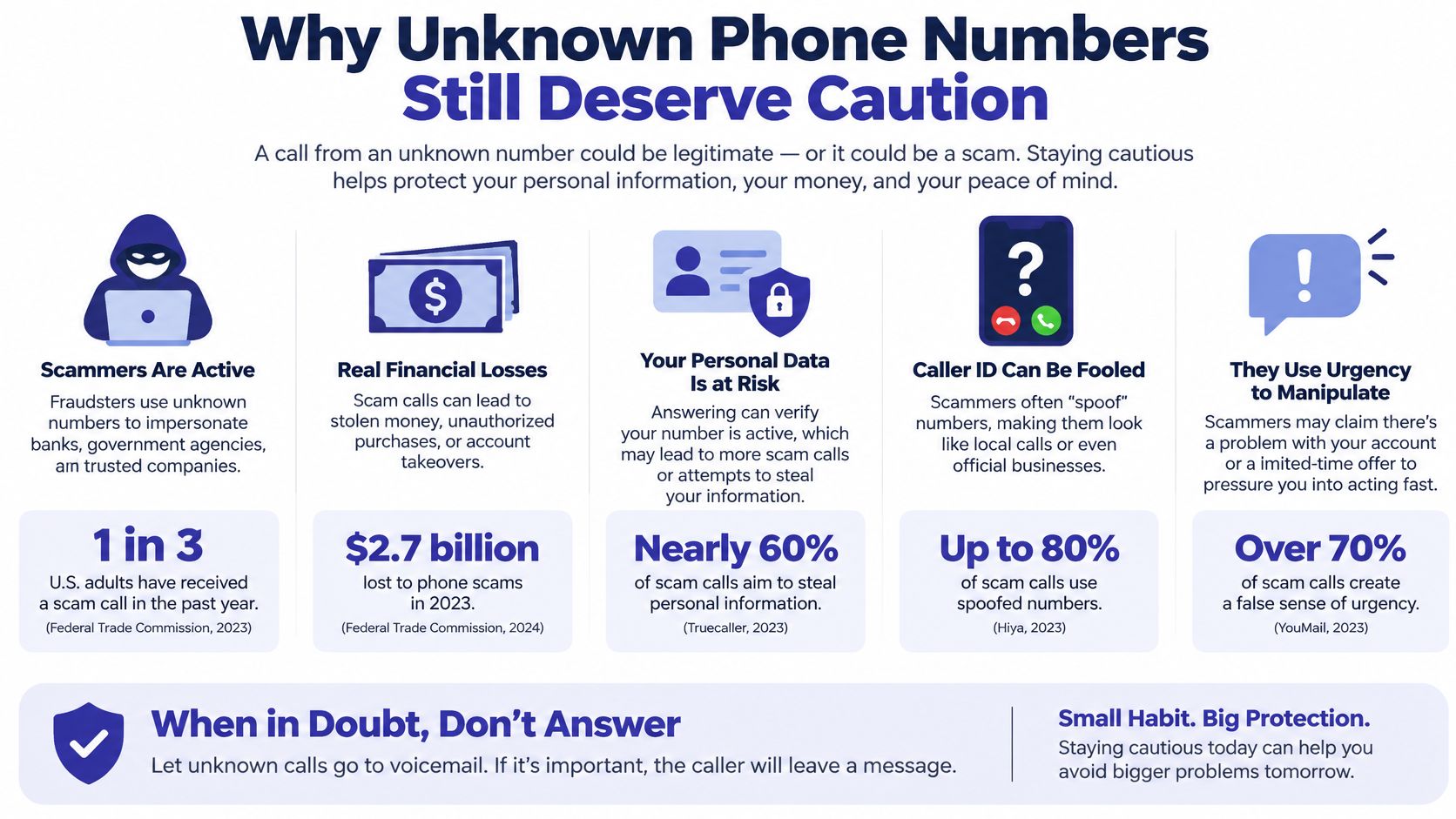
Practical rule: Judge an unfamiliar caller by what they ask you to do, not by how ordinary their number looks.
A useful screening routine combines context, caller behavior, and an independent check. The signal-to-response table below gives each common situation a safer starting point, without pretending that a phone number can prove someone's intentions.
What an Unknown Phone Number Can Mean
Caller ID displays an asserted number, not necessarily a verified identity. Under the Federal Communications Commission's call-authentication framework, STIR/SHAKEN uses digital certificates and signed call information to help providers authenticate whether the originating provider is authorized to present a number.
That's a technical check on the number's presentation, not a judgment about the conversation. An authenticated number can still be misused, while a legitimate call may lack authentication when it crosses international, non-IP, or incompatible networks.
Spoofing means the number on your screen may belong to someone who has nothing to do with the call. Returning it could reach an innocent person or business rather than whoever contacted you.
For a plain-language explanation of display names, numbers, and their limits, our guide to caller ID on your phone separates what you see from what you can safely conclude.
Match the signal to the response
These risk levels are practical triage categories, not calculated probabilities. A low-risk message still needs verification before you disclose sensitive information, while a high-risk request is enough reason to end the conversation.
Unknown call signals, likely meanings, risk levels and safer responses
| Call signal | What it likely means | Risk level | Safer first response |
|---|---|---|---|
| Recorded message urging immediate action | Possible mass robocall campaign | High | Hang up without pressing any digit |
| Caller claims to be your bank or a government agency and asks for codes or passwords | Possible impersonation scam | High | Hang up and call the organization on its official number |
| Caller demands payment by gift card, wire transfer or cryptocurrency | Possible scam payment demand | High | Refuse the unsolicited demand and verify independently |
| Caller knows your name and details but pushes for a one-time verification code | Possible account takeover attempt | High | Never read out the code during an unsolicited call |
| Local number rings once or twice and leaves no message | Possible spoofed probe, robocall, or ordinary missed call | Medium | Let voicemail filter it; don't call back solely because it looks local |
| Missed call from an international or unusual number | Possible Wangiri callback-bait scam | Medium | Don't return an unexplained call |
| Specific voicemail with appointment, delivery or case details | Potentially legitimate business call | Low | Return the call through the organization's official number |
A Wangiri call is callback bait: the caller wants a brief missed call to make you curious enough to return it. An international number isn't proof of that scheme, especially if you expect an overseas call, but an unexplained missed call creates no obligation to respond.
Likewise, a caller who knows your name hasn't passed an identity test. The important question is whether they're asking you to surrender access, money, or control.
Unknown means unverified, not guilty. Use the caller's behavior to decide how much distance to put between the call and your next action.
Assess Risk and Respond Without Exposing Personal Information
Consumers reported more than $12.5 billion in fraud losses in 2024, a 25% increase from 2023, and the median reported loss when people interacted with a scammer by phone was approximately $1,500, according to the FTC's Consumer Sentinel Network Data Book. Those figures cover reported fraud, not a prediction of what any individual call will cost.
You don't need to solve the caller's identity while they're speaking. Your first job is to prevent an unverified conversation from becoming an irreversible action.
Use this checklist before giving an unfamiliar caller your attention or information.
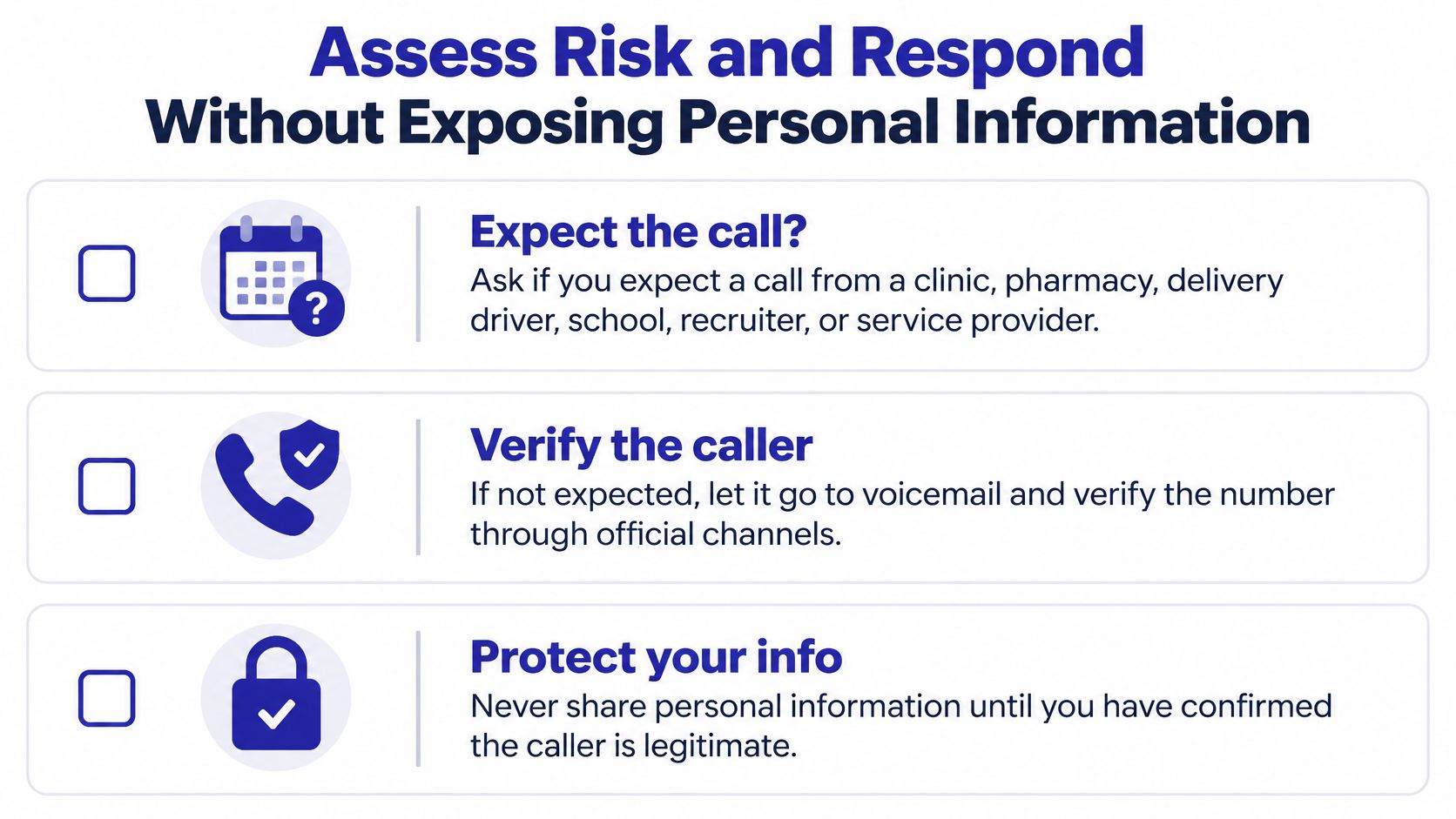
Apply a three-layer check
Before answering, ask whether the call fits something you expect. A clinic appointment, pharmacy request, delivery, school matter, job application, or service visit gives you useful context, but not proof. When possible, let voicemail capture the explanation.
During the call, ask whether you can pause without consequences. Pressure to act immediately, keep secrets, reveal a code, install software, grant remote access, or move money fails this check. You don't have to determine which scam script it resembles before hanging up.
Afterward, ask whether you can confirm the request without using anything the caller supplied. Open the organization's existing app, use a saved number, or type its known website address yourself. A caller-provided link or transfer to a supposed supervisor isn't independent verification.
Follow a repeatable response procedure
Let unexpected calls reach voicemail. If you must answer because you're awaiting something urgent, start by listening rather than volunteering details.
Review the message for a named organization, a clear purpose, and context you recognize. A callback number is useful information to record, but it isn't automatically safe to use.
Keep sensitive information private. Don't share one-time codes, passwords, full card numbers, or Social Security numbers during unsolicited contact. Don't approve remote access or an unexpected login prompt.
End pressure immediately. Hang up mid-sentence if necessary. You don't owe a persuasive caller an explanation or permission to disconnect.
Don't press menu digits or follow instructions to say yes during a suspicious recording. An ordinary spoken yes isn't itself proof that your accounts are compromised, but there's no benefit in continuing the interaction.
Verify through an independently chosen channel. Use the number on your bank card, an existing statement, an appointment letter, or the organization's established app. Don't rely on the number displayed in your recent calls.
Report and label the call. Submit suspected fraud through the FTC's ReportFraud service and mark the call as spam in your phone's dialer. Describe what the caller requested, rather than assuming the displayed number identifies the offender.
Act quickly if you disclosed something. Contact your bank through its official number if you shared card or financial-account details. Secure any affected account with a new password, review recent activity, and tell the organization if you shared a code or approved access.
For a family member who gets flustered on calls, practice the response aloud: they can end the conversation and check independently. Keep official contact numbers somewhere accessible rather than expecting them to search while worried.
This video provides another way to review unknown-call precautions.
Reduce exposure without becoming unreachable
Blanket never-answer advice doesn't fit everyone: about 21% of U.S. adults answer unrecognized numbers at least half the time, while nearly one-third receive a scam call daily, according to PIRG's phone-scam report. The report also describes a longitudinal study that recorded 121 calls to Do Not Call-listed numbers versus 135 to unlisted numbers, showing no clear reduction during that observation period.
Do Not Call registration addresses legitimate telemarketing; it isn't a barrier that criminals reliably respect. A quieter phone isn't necessarily a safer one.
If callers use publicly available personal details to sound convincing, the RepErase guide to data removal explains how to approach removing a FastPeopleSearch listing. Reducing exposure can support your precautions, but it doesn't replace checking the request.
Verify on your terms, through channels you chose.
When an Unknown Number Is Actually Legitimate
A clinic calls to confirm an appointment, but the displayed number doesn't match the reception number you saved. Let the message identify the department, then contact the clinic through your appointment paperwork or patient portal.
A pharmacy may need to discuss a prescription, and a delivery driver may be outside a locked gate. You can coordinate an arrival without supplying a payment-card number or revealing an account login code.
Businesses may place calls through outbound call centers, internet-based phone systems, or pools of numbers. That can make an ordinary call look unfamiliar even when you already have a relationship with the organization.
Handle the purpose, not just the number
- School contact: If someone calls about your child, use the school's established office number when the situation allows. Don't let a demand for secrecy prevent you from contacting another responsible adult.
- Recruiter follow-up: Match the call to an application you submitted. Confirm the employer before sending identity documents or completing financial paperwork.
- Contractor delay: Discuss the arrival time, but independently confirm any unexpected change to payment instructions.
- Bank fraud alert: Take the warning seriously without following the inbound caller's instructions. Check your account in the bank's app or contact its fraud team through a known number.
If a caller offers an extension, write it down and ask the organization's main switchboard to connect you. Our caller-verification guide explains how to separate a plausible introduction from a confirmed identity.
Repeated calls don't settle the question
One number called a Gini customer 105 times. It belonged to a company he does business with, and he had already asked it repeatedly to stop calling.
That example matters because persistence alone doesn't establish fraud. A business follow-up, debt-collection attempt, or wrong-number loop can be disruptive without being an impersonation scam.
Document the pattern, confirm who's calling, and decide whether the contact should continue. If it's a business you recognize, use its established contact channel to repeat your request to stop.
Annoying isn't the same as dangerous. Verification helps you handle both without confusing them.
Scam Scripts That Start With an Unknown Number
An unknown number works like a label on a package. It tells you something arrived. It does not tell you the contents are safe. The voice may claim to be a bank, a government office, a tech company, or a relative in trouble. Read the request before you trust the tone.
Imposter fraud is a large share of the scams people report. Contact can arrive by call, text, email, social media, or a search result. The costume changes. The aim often stays the same: get you to treat a claimed title as permission to skip the checks you would use with a stranger.
Compare the claim with the requested action
Common scam scripts behind unknown numbers
| Scam script | What the caller claims | What they push for | What the real organization does |
|---|---|---|---|
| Bank fraud alert | A suspicious transaction must be verified now | Login codes, card details, or a transfer to a supposed safe account | Uses its own account-support channels; an inbound demand to move money needs a separate check |
| Government impostor | You face a warrant, suspended benefits, or back taxes | Gift-card or wire payment, or your Social Security number | Offers official ways to look up a case; a threat that demands immediate phone payment is not a reason to pay |
| Tech support | Your computer is infected or your accounts are compromised | Remote access and payment for fixes | Offers help through its own support channels; an unsolicited virus claim does not create a support relationship |
| Grandparent emergency | A relative is jailed, hospitalized, or stranded | Urgent cash or gift-card transfer | The relative or another trusted family member can be reached on a number you already have |
| Prize or lottery win | You won but must pay fees or taxes first | Upfront payment and bank details | A real prize does not require paying an unsolicited caller before you can collect |
A script is a rehearsed path from a story to an action. You do not have to win an argument about whether the story could happen. Watch what the next step would give away: a one-time code, money, a Social Security number, or control of a computer. A guest can wear a uniform at a party. The uniform still does not open the cash drawer. The keys stay with the organization, on a channel you choose, not inside the caller's story.
Watch for the handoff to another channel
A person claiming to be from your bank may text you, then ask you to read the code back. The text can be real while the person asking for it is not. That code is often the last step in an account change the impostor cannot finish alone.
A fake tech-support caller may email a case number or pass you to a “supervisor.” Those extras do not confirm the first claim. One operation can run the call, the email, and the follow-up conversation.
Do not call a suspicious number back on the digits that appeared on your screen. Check the organization through a contact method you already trust before you act. Hold music, a polished script, or a familiar logo only shows that someone chose the channel. It does not show who is on the other end.
If the story is a family emergency, pause the payment and use a separate route. Call the relative, or someone else who would know where they are, on a number saved in your phone. Strong emotion is a signal to slow the money down, not a reason to send it.
Build Your Protection Layer Before the Next Call
Treat every unknown number as unverified until you've checked it: voicemail first, official-channel verification, and no information traded under pressure. Put that rule into your phone settings and family habits before the next interruption.
Start with carrier spam labels, a working voicemail greeting, and saved contacts for your bank, clinic, school, and close family. Register for Do Not Call protection against legitimate telemarketing and report suspected fraud when you can.
Choose a layer you'll actually use
Protection options by effort and cost
| Option | Effort | Cost | Best for |
|---|---|---|---|
| Carrier spam labeling | Low, one-time setup | Check your carrier's included features and optional charges | Everyday unknown calls |
| Do Not Call registration | Low, one-time | Free | Reducing legitimate telemarketing only |
| Reporting through the FTC's ReportFraud service | Low, per incident | Free | Contributing fraud reports for enforcement and analysis |
| Gini Help AI call screening | Medium, app installation and contact setup | Subscription; review the selected plan before enrolling | Older adults, caregivers, and busy professionals |
If number-based blocking leaves too many interruptions, compare it with smart call blocking and screening. The useful distinction is whether the system only checks a number or also asks the caller to explain the call.
With Gini Help, our AI answers unknown calls, asks who's calling and why, and lets real callers through while saved contacts ring normally. Every plan includes an allow list for trusted callers and a block list for unwanted callers; Plus plans add live scam detection that warns you when an unknown caller uses scam tactics.
Our coverage across calls, texts, and email suits people who want fewer separate tools to manage, including older adults, caregivers, and busy professionals. Screening reduces unwanted calls, but it can't identify every scam or guarantee that every caller is safe.
Download the app from Google Play or the App Store, then save your key contacts so legitimate callers pass through normally. Keep independent verification as your final check whenever money, account access, or sensitive information is involved.
Unknown phone numbers don't have to force a choice between answering everything and missing important calls. Visit Gini Help to explore screening that asks unfamiliar callers who they are and why they're calling before your phone rings, then set up your trusted contacts and calling preferences.