AI Based Phishing Detection: What Works in 2026
By Josh C.
By the end of 2025, AI-generated phishing had reached 56% of detected attacks in a single month, up from under 5% earlier that year, according to Hoxhunt's analysis of AI phishing attacks. That shift changes the central security question. It's no longer enough to ask whether a sender, domain, or message appears on a known-bad list. Defenders must ask what the message is trying to make someone do, whether that behavior fits the sender, and whether the same signal appears across email, SMS, or a phone call.
AI based phishing detection provides that broader view. It combines language analysis, sender and device behavior, link inspection, conversation signals, and human review to identify suspicious intent in real time. The technology is powerful, but benchmark accuracy can hide a serious production problem: a detector may perform well in a test environment and still lose reliability when attackers change the model, language, or delivery channel.
Why Phishing Needs a Smarter Defense in 2026
The Anti-Phishing Working Group reported 971,181 phishing attacks in Q1 2026, up 13.8% from 853,244 attacks in Q4 2025, with 470 to 475 brands targeted during the quarter (APWG Q1 2026 Trends Report). APWG later reported 425,808 attacks in June 2026 alone, a 10.1% rise in Q2 and the highest monthly total since April 2023 (APWG Q2 2026 Trends Report).
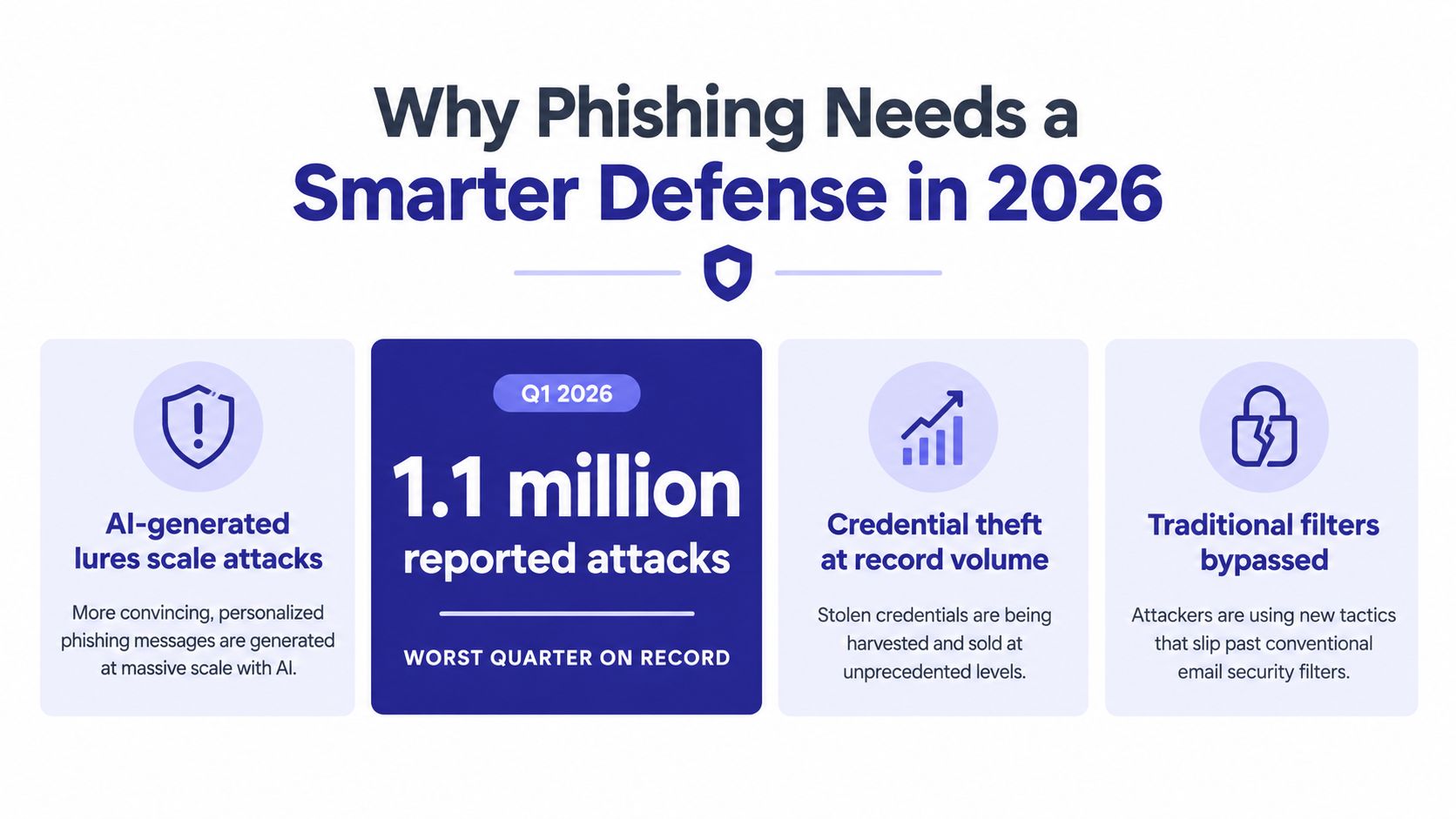
The volume matters, but the bigger change is operational. Attackers can use generative AI to produce fluent messages, imitate a company's tone, translate scams, and create many variations of the same lure. A reputation filter may recognize a previously reported domain, but it has less to work with when the attacker registers a fresh domain, uses a legitimate hosting service, or rewrites the message before each delivery.
Traditional controls still have an important role. Known malicious URLs, compromised senders, and repeated signatures can be blocked quickly and cheaply. The weakness appears when a message is new, polished, and technically ordinary. A familiar-looking invoice request can arrive from a new account, use a valid certificate, and contain language with no obvious spelling errors.
The practical shift from lists to intent
AI based phishing detection treats a message less like a fixed object and more like a situation. It examines the sender's usual behavior, the requested action, the relationship between the sender and recipient, the destination of a link, and the language used to create urgency or fear. The same reasoning can apply to an SMS asking for a delivery payment or a caller requesting a one-time code.
That approach resembles anomaly detection systems, which look for meaningful departures from normal behavior rather than relying only on known malicious indicators. A new sender isn't automatically dangerous, and a familiar sender isn't automatically safe. The system assigns risk from several signals and gives the user or analyst a reason for the warning.
Practical rule: Use static controls for high-confidence known threats, then add AI analysis for new, adaptive, and socially engineered attacks.
The strongest deployments are layered. They combine reputation checks, authentication, URL analysis, behavior modeling, language understanding, multifactor authentication, and a human escalation path. AI adds adaptability, but it shouldn't be treated as a magic replacement for every other control.
How AI Based Phishing Detection Actually Works
A useful way to understand AI based phishing detection is to compare it with a security team examining a suspicious visitor. One person checks identification, another observes behavior, and another asks what the visitor wants. No single observation decides the case. The combined evidence produces a more reliable judgment.
Five layers turn a message into a risk decision
Machine learning acts like a pattern-spotting intern. It learns from examples of legitimate and malicious messages, then looks for combinations of features that commonly appear in phishing. Those features can include sender history, URL structure, attachment properties, timing, and message content.
Natural language processing, or NLP, reads the message more carefully than a keyword filter. It can examine tone, grammatical structure, requests, impersonation cues, and the relationship between a warning and the action demanded. “Your account needs attention” is not automatically malicious, but the phrase becomes more concerning when paired with an unfamiliar link and a request for credentials.
Large language models, or LLMs, can evaluate meaning and intent in complicated wording. They may recognize that a polite message is still attempting to bypass a payment process, collect a password, or pressure a recipient into secrecy. LLMs can also help produce an explanation that a non-technical user understands.
Behavior analysis checks whether the event fits normal activity. A message that appears to come from a bank but asks someone to log in from a new device at an unusual time creates a stronger risk signal than the text alone would reveal. In a business, an invoice request that bypasses the established approval workflow deserves scrutiny even if the sender's writing looks professional.
Intent detection asks the clearest question: what is the sender really trying to make the recipient do? The answer might be “open this attachment,” “send money,” “share a code,” “move the conversation to another channel,” or “log in through this link.”
The pipeline behind the warning
A typical system first ingests headers, sender information, URLs, text, attachments, metadata, and, where applicable, call audio or transcripts. It extracts useful features, scores the message with one or more models, combines those scores into a risk decision, and then presents an action such as deliver, warn, quarantine, or escalate.
That sequence is similar to how technology has adapted everyday communication over time. A readable overview of Thanksgiving tech evolution from Nutmeg Technologies offers useful context for seeing how familiar activities acquire new digital layers, including new opportunities for abuse.
The final explanation matters as much as the score. “Dangerous” is less useful than “the sender address differs from the reply path, the link leads to an unfamiliar domain, and the message requests a password.” For practical guidance on this email layer, see AI email filtering.
The Core Techniques Behind Modern Phishing Defenses
Modern systems usually combine several technical approaches rather than choosing one model. A URL classifier may be fast, while a language model understands social engineering, and behavior analytics can reveal that a seemingly normal message doesn't fit the account's history.
Content and URL classifiers
Classic machine learning models, including logistic regression and gradient boosting, can evaluate URL structure, domain features, message tokens, sender metadata, and attachment signals. Transformer models such as BERT go further by interpreting context across a message instead of treating each word as an isolated keyword.
One benchmark over 17,538 emails reported DistilBERT accuracy of 98.77%, with 99.10% precision, 98.97% recall, 99.02% F1, and 99.91% AUC under an 80:20 split. The study recorded 25 false positives and 23 false negatives (the DistilBERT phishing detection benchmark). Those results show what contextual models can achieve on a defined corpus, but they don't prove that the same threshold will work unchanged against tomorrow's attacks.
Semantic and LLM-based analysis
Transformer and LLM detectors examine meaning, persuasion, and intent. They can identify a request that avoids obvious phishing vocabulary but still pressures the recipient to click, pay, disclose information, or ignore normal procedures.
An evaluation of GPT-4o, Claude Sonnet 4, and Grok-3 reported about 95% accuracy on phishing email detection, while refined, prompt-injected, or cross-lingual variants achieved attack success rates of 10% to 40% against the systems (the LLM phishing detection evaluation). This is why an LLM should support layered detection rather than operate as an unquestioned final authority.
Behavior and conversation analysis
Behavior models observe login velocity, device changes, unusual access patterns, and impossible-travel signals. Conversation analysis extends that logic to SMS and voice by examining pressure, requests for one-time codes, payment instructions, impersonation, and attempts to move a target away from a trusted channel.
| Technique | Typical Accuracy | Recall on Novel Lures | Latency | Best Channel |
|---|---|---|---|---|
| URL and reputation classifier | High for known indicators | Often weaker when domains are new | Low | Email, SMS |
| Traditional content classifier | Strong on familiar patterns | Can decline after wording changes | Low to moderate | |
| Transformer-based detector | 98.77% accuracy in one DistilBERT benchmark | Requires testing against drift | Moderate | Email, chat |
| LLM intent analysis | About 95% accuracy in one evaluation | Exposed to prompt injection and cross-lingual variation | Moderate to high | Email, chat, voice transcripts |
| Behavior and telemetry analysis | Depends on available account signals | Useful when message content looks normal | Low to moderate | Email, identity systems |
| Conversation analysis | Depends on transcript and audio quality | Useful for evolving social-engineering scripts | Near real time | SMS, phone calls |
The best design fuses these techniques. It doesn't ask whether a URL model or an LLM is “the winner.” It asks which combination produces a defensible decision at an acceptable speed, with enough explanation for the person who must act.
AI Detection vs Traditional Filters
Traditional filters work like a building's access list. If a visitor is already known to be dangerous, security can turn them away immediately. In email security, that role belongs to blocklists, signatures, domain reputation, attachment rules, and other deterministic controls.
AI based phishing detection works more like a trained guard who notices context. A new visitor may not appear on any list, but unusual behavior, a forged identity, and a request to enter a restricted area can still trigger review. That makes AI particularly valuable against newly registered domains, rewritten messages, and attacks with no prior reputation.
| Criteria | Traditional Filters | AI Based Detection |
|---|---|---|
| Known threats | Fast, inexpensive, and effective | Also effective when indicators are available |
| New domains | Limited until reputation develops | Can assess content, behavior, and intent |
| Obfuscated wording | Rules may miss subtle changes | Language models can generalize across wording |
| False positives | Often predictable when rules are narrow | Can rise when thresholds or training data are poorly calibrated |
| Explainability | Usually straightforward, such as a matched rule | Varies from clear feature reasons to opaque model scores |
| Latency | Usually very low | Depends on model size and analysis depth |
| Language coverage | Requires separate rules or lists | Can support broader language analysis, but quality varies |
| Maintenance | Analysts update lists and signatures | Teams monitor drift, retrain, test, and recalibrate |
| Best role | High-confidence blocking | Adaptive analysis and risk ranking |
The distinction is not just old versus new. Traditional systems remain valuable because they provide predictable, low-cost decisions for known threats. AI adds pattern generalization, but it brings operational overhead, including threshold management, data quality checks, privacy review, and adversarial testing. Reputation-based filtering remains a useful layer rather than an obsolete one.
A practical security stack doesn't replace a fast known-bad block with a slower model call. It uses both, then routes uncertainty to a warning or review process.
Buyers should compare three separate questions. How well does the product detect attacks? How well does it defend against attackers who adapt? And how much work does the defender need to retrain, tune, investigate, and maintain the system? A product can score highly on the first question and still disappoint in production if it performs poorly on the other two.
Where AI Detection Still Falls Short
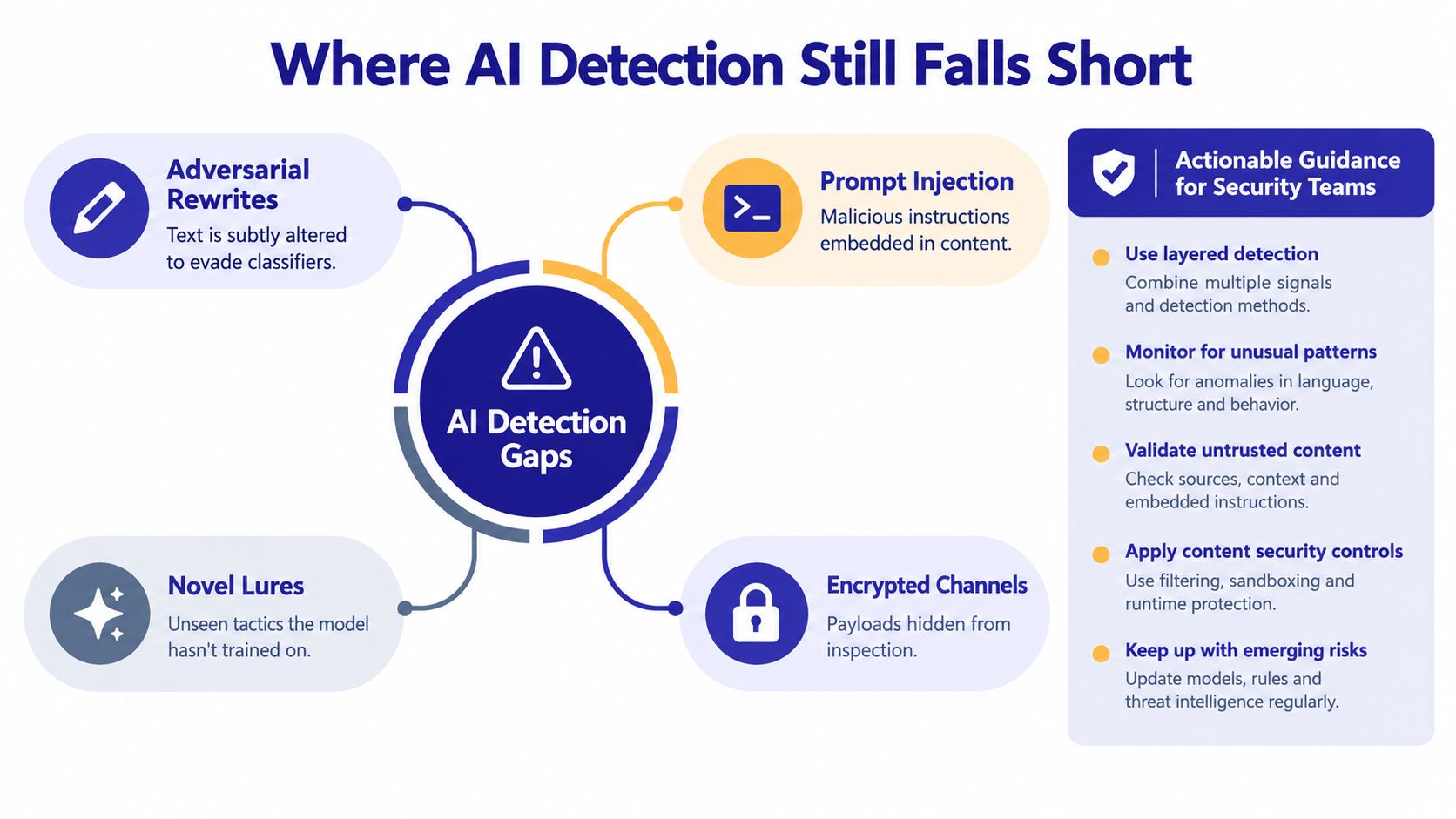
AI detection doesn't fail only because a model makes an occasional mistake. It fails structurally when the environment changes faster than the evaluation process. Attackers can rewrite a message, switch languages, change the generating model, hide the payload in an attachment, or place the request in a channel the detector doesn't inspect.
The calibration problem
A 2026 study found a 28.0 percentage-point F1 gap under the default threshold when detectors were tested across different phishing generator models, although AUC-ROC remained above 0.96 in every off-diagonal case. Threshold recalibration on a small target sample reduced the gap to 4.0 points, while pooled training nearly eliminated it with F1 = 0.997 (the cross-model robustness study).
The lesson is easy to miss. A high AUC can indicate that a model ranks risky messages well, while the production threshold still produces poor precision or recall. If the attacker's generator changes, the probability attached to “high risk” may no longer mean what the security team thinks it means.
Other gaps teams must test
- Adversarial rewrites: Attackers can preserve the same malicious request while changing phrasing, structure, or translation.
- Prompt injection: Malicious instructions embedded in content can manipulate an LLM-based detector or distort its explanation.
- Language variation: Dialects, code-mixed messages, uncommon languages, and poor transcripts can receive uneven treatment.
- Model drift: Retraining that lags behind new campaigns leaves yesterday's detector facing today's tactics.
- Explainability: Analysts may struggle to approve or reject a decision when the product exposes only a score.
- Dependency concentration: If multiple services rely on the same foundation model, one weakness can affect many defenses.
Research on adaptive and multi-modal phishing also emphasizes that fresh domains, valid certificates, rewritten language, and realistic page designs can challenge heuristic and signature-based systems. A 2026 review of AI-assisted phishing detection frames the practical problem well: detection must consider behavior and intent, not just whether a message contains a suspicious word or URL.
The answer is layered resilience. Pair AI with allowlisting, MFA, user education, channel isolation, secure payment procedures, and human review for high-impact decisions. A detector shouldn't be expected to stop every attack alone. Its job is to reduce exposure, explain uncertainty, and make the next safe action clear.
Real-World Use Cases Across Email, SMS, and Phone Calls
Phishing campaigns often move across channels. An attacker may send an email claiming to represent a bank, follow with an SMS containing a shortened link, then call to request the verification code. Separate filters can miss that sequence because each tool sees only one event. A shared risk system connects sender identity, links, timing, language, and the requested action, much like assembling separate clues into one case.
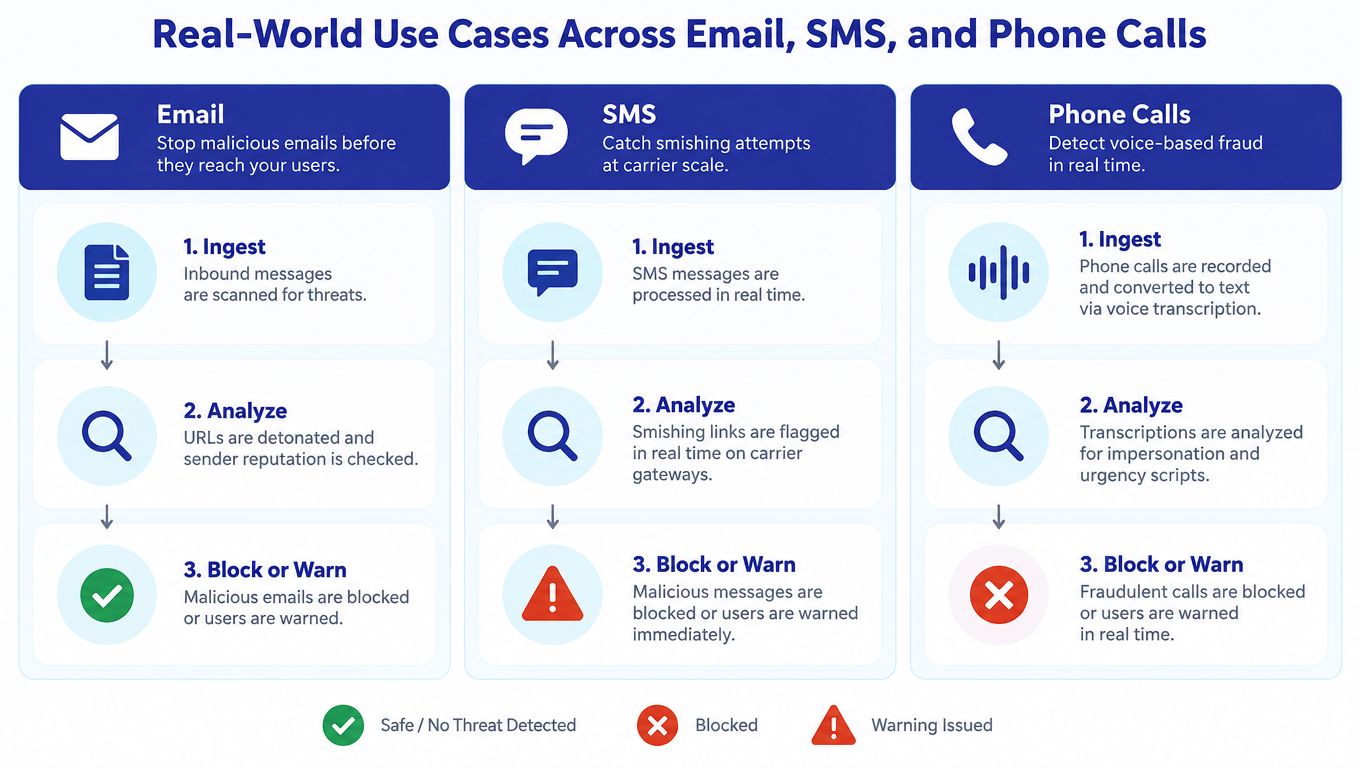
Email analysis can examine the visible sender, reply path, embedded URLs, attachments, wording, and the sender's previous behavior. Transformer models assess meaning, while link and reputation systems inspect the destination. Depending on the risk and policy, the message may be quarantined, labeled with a warning, or sent to a review queue rather than delivered without context.
The inbox is only one delivery route. Calendar invitations, attached HTML files, and QR codes can redirect a recipient beyond a basic email workflow. Security teams should verify whether remediation also removes related calendar content and whether the user receives a clear explanation of the decision.
SMS
SMS messages provide less text, so surrounding context carries more weight. A short notice about a parcel, account suspension, or unpaid toll can be assessed through URL analysis, sender history, and signals from an earlier email. The objective is to identify the combined pattern of urgency, impersonation, payment pressure, and an unsafe destination, rather than block every unfamiliar number.
Phone calls
Voice protection can transcribe a conversation, examine pressure tactics, and detect requests for passwords, payments, or one-time codes. It can also assess attempts to impersonate a trusted organization or persuade someone to skip normal verification. Live warnings matter because a call can become risky after it is answered, even when the number has no negative history.
AI-generated content makes fluent wording a weaker trust signal. An industry analysis reported a sharp rise in AI-generated phishing content (Hoxhunt's AI phishing analysis). The finding concerns email, yet the practical lesson applies to calls and SMS: polished language does not establish legitimacy.
A multi-channel platform can flag a destination URL that appears in both an email and an SMS, or recognize that a caller repeats the payment pressure used in earlier messages. Shared telemetry helps close gaps between siloed tools and gives users consistent warnings across inboxes, text threads, and live calls. Its performance still needs calibration after deployment, because attack wording, sender behavior, and channel patterns change over time. A strong benchmark result can weaken when real-world traffic drifts.
Choosing an AI Phishing Detection Service That Delivers
A product demo can make any detector look convincing. A useful evaluation asks whether the service remains reliable when the sender, language, generating model, and channel change. Run a controlled pilot with representative email, SMS, chat, and voice scenarios, then inspect not only blocked attacks but also the legitimate messages the system delays or quarantines.
Start with measurable decisions
Ask how precision is measured. Request results at the threshold your team will use. A vendor should explain false positives, false negatives, recall, precision, and how scores map to actions such as warn, quarantine, or block.
Test calibration under drift. Provide messages generated or rewritten in different styles and languages. Ask how the service monitors changes in score distributions, when it recalibrates thresholds, and whether administrators can validate performance on a small sample from their own environment.
Check channel coverage. Confirm whether protection covers email, SMS, voice, and chat, or whether the vendor uses separate products with no shared telemetry. If live-call analysis matters, ask whether the system analyzes only recorded transcripts or can provide warnings during an active conversation.
Inspect explanations and audit logs. Analysts need to see which sender, link, language, behavior, or intent signals influenced the decision. Logs should show the model version, policy action, analyst override, and remediation history.
Measure operational speed. Ask for latency by channel and by analysis depth. A lightweight email score may be acceptable for every message, while attachment detonation or detailed voice analysis may require a different workflow.
Probe adversarial resistance. Ask the vendor to demonstrate testing against paraphrases, prompt injection, multilingual text, look-alike pages, QR codes, attachments, and changes in the phishing generator. A generic accuracy slide isn't a substitute for an adversarial test plan.
Review privacy and integration. Verify data residency, retention, encryption, access controls, and whether customer data trains shared models. Check integrations with the existing SOC, ticketing system, identity provider, mail platform, mobile controls, and human review queue. Guidance on how organizations defend against phishing in M365 can help frame questions for Microsoft environments.
Red flags in vendor claims
Be cautious when a vendor advertises accuracy without a recall baseline, test-set description, threshold, or false-positive count. Single-channel coverage, opaque scoring, no drift monitoring, and no human override path create practical weaknesses even if the model looks strong in a controlled demo.
Gini Help is one consumer-focused option that screens calls, texts, and emails, uses AI to assess suspicious senders, links, urgency, and requests for sensitive information, and provides risk labels and live call warnings. It can be evaluated alongside enterprise email gateways, mobile protections, and identity controls according to the user's needs.
Download the Gini Help app on Google Play or the Gini Help app on the App Store, then visit Gini Help to see how multi-channel screening can help you assess suspicious calls, texts, and emails before you act. Use the evaluation checklist above to test whether its warnings, explanations, and live analysis fit the people and channels you need to protect.