AI Scam Detection: How It Works and Where It Fails
By Josh C.
In 2025, people over 60 filed more than 201,000 internet-crime complaints with the FBI and reported losses exceeding $7.7 billion, a 59% rise in reported losses from the year before. The average reported loss among those victims topped $38,000, and at least 12,400 of them said they lost $100,000 or more, according to the FBI's account of scammers targeting older adults.
That doesn't look like a robocall problem. It looks like a conversation problem. A convincing person, a plausible story, and a request that lands at the right moment.
This guide walks through what AI scam detection reads when it evaluates a call, a text or an email, how live screening works before your phone rings, and where the technology still fails. The through line is simple. The useful question isn't whether a voice sounds synthetic. It's what the caller is trying to make you do.
Why Scam Detection Now Depends on AI
In 2024, the Internet Crime Complaint Center logged 859,532 complaints and reported losses exceeding $16.6 billion, a 33% increase over 2023, according to the FBI's 2024 IC3 report. Of those complaints, 256,256 involved a reported financial loss. The average loss among those reports was $19,372.
Reported figures show only the cases people bring forward. Some victims may not recognize a scam until later, while others may feel embarrassed about reporting it. That makes protection based only on known cases slow to respond to changing tactics.
A blocklist works like a doorman checking a guest list: it can stop names already on the page, but scammers can switch phone numbers, email addresses, and links. A doorman who watches behavior can spot someone in a courier uniform asking to enter through the back, even when the name is unfamiliar.
The shift that matters: a message's identity can be faked. The intent behind it is harder to hide.
AI scam detection can assess what a caller is trying to make you do, rather than relying on whether their voice sounds synthetic. It looks for behavior such as impersonating an organization, creating urgency, directing a payment, asking for a one-time code, or resisting a callback to a known number. Like a doorman watching conduct instead of checking names alone, it weighs the pattern of a request.
Financial institutions are increasingly using AI to speed up fraud investigations and spot new tactics as they appear. The same basic idea guides the questions ahead: which signals a system checks, how it can assess a call as it unfolds, and what its limits mean for using it safely.
The Warning Signs AI Checks in Every Message
The fastest way to understand AI scam detection is to stop hunting for one giveaway and start looking for a pattern. A detector scores a message on several signals at once, then combines them. No single signal proves fraud. Two or three together in the same conversation do.
| Signal | How it appears | Why it matters |
|---|---|---|
| Urgency | "Act now or your account will be closed" | Pressure leaves no time to verify |
| Authority claim | Caller says they're from a bank, agency or tech support | Impersonation is the most reported fraud category |
| Payment or secrecy request | Gift cards, wire transfer, "don't tell anyone" | Legitimate institutions rarely request these |
| Credential request | Asks for a one-time code or password | Codes unlock accounts and bypass protections |
| Verification resistance | Refuses a callback on a number you already know | Real organizations accept independent checks |
| Sender mismatch | Email domain or number differs from the organization named | Rotating numbers make blocklists unreliable |
Reading down that column tells you why a combination beats a keyword. Here's how the weighting usually works out.
- One signal is weak evidence. Banks really do call about suspicious charges, and they really do sound urgent. A single flag should raise an eyebrow, nothing more.
- Two signals deserve a pause. Urgency plus a payment request, or an authority claim plus a demand for a code, moves the score into territory where checking costs you nothing and skipping the check costs a lot.
- Three or more is a stop sign. Authority, threat and secrecy together describe a script, not a coincidence.
A legitimate caller can trip a single signal. A hospital billing office chasing an unpaid balance will push for speed. A real fraud team will ask you to confirm transactions. That's exactly why the scoring weighs context and combinations rather than isolated words, and it's the reason a risk score is calculated from the whole exchange rather than one sentence.
Your own three-second check: before you act on any message, count the signals you noticed. Two or more, and the next move is verification, not compliance.
Detectors do the same count at machine speed across hundreds of calls, which is the only way to keep up with scripts that change weekly.
How Real-Time Analysis Works During a Call
A live call is the hardest case, because nothing exists to inspect until the other person starts talking. Screening handles that by changing who answers first.
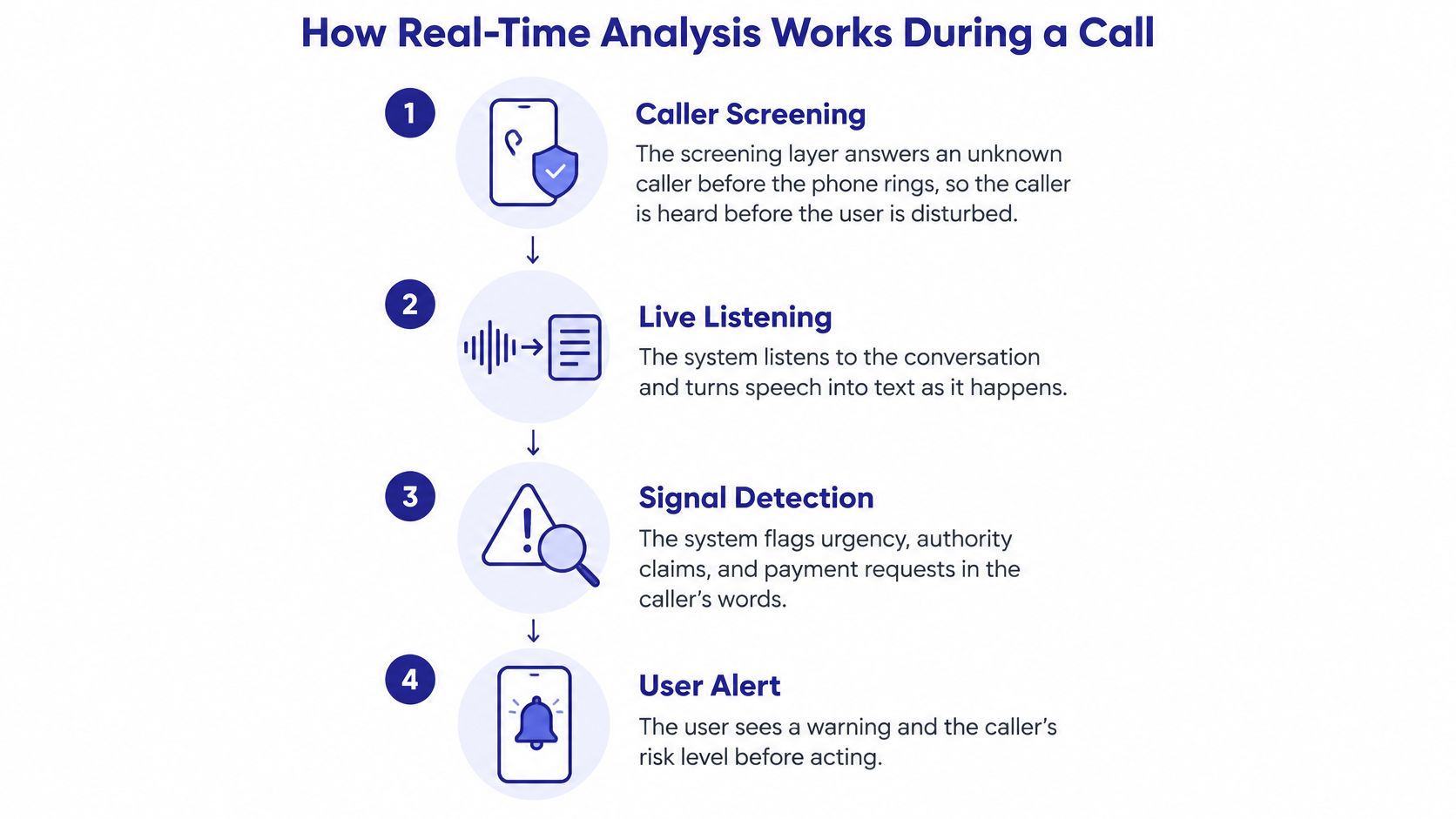
The screening layer answers the unknown caller first. Your phone never rings until the system has heard why someone is calling. The reason is simple: you can't evaluate a pitch you haven't heard, and you shouldn't have to be the one who absorbs it.
Speech is transcribed as it arrives. Each utterance gets checked against the signals above, so a request for a verification code is caught the moment it's spoken rather than after the money has moved.
A running score updates with every new sentence. This is the part people underestimate. A scam often opens with friendly small talk and only turns coercive four minutes in. Judging the first ten seconds would miss it entirely.
A calibrated threshold triggers a warning, with a reason attached. You might get a spoken alert or a vibration plus a line of plain text explaining that the caller is asking for an account number. The explanation matters as much as the alarm, because a vague beep gets ignored.
The call is then connected, held, or ended. Clear-cut legitimate calls go through. Clear-cut fraud gets stopped. Ambiguous calls move to an escalation step, which could mean a second question to the caller or a prompt for you to verify independently.
Every threshold in that chain is a trade-off. Set it loose and scams slip past. Set it tight and a daughter calling from a new work number gets treated like a threat. Operators tune that balance against the cost of each mistake, which is why a warning is a nudge to slow down rather than a verdict.
When a warning does appear, stop talking about codes and account numbers. Hang up and call the organization back on a number you already have. If you want the mechanics behind this in more detail, how conversation analysis turns a live call into a risk score covers the sequence step by step.
How AI Screens Texts and Emails
A message is easier than a call, because the whole thing already exists. Nothing unfolds in real time, so the system can read it in one pass, before you do.
- Compare the sender. The display name, number or email domain gets checked against the organization the message claims to represent.
- Inspect the links. Shortened URLs, lookalike domains and links whose visible text names one site while the target points elsewhere all get flagged.
- Score the body. Urgency, authority claims, gift-card or transfer requests and credential prompts are each measured, then combined.
- Route on the score. High-risk texts go to a separate folder, suspicious emails carry a warning, and low-risk messages land in the normal inbox.
| Channel | What AI reads | When it acts |
|---|---|---|
| Phone call | Speech transcript, urgency, credential and payment requests | During the call, per utterance |
| Text message | Sender ID, links, urgency wording, payment requests | On arrival, before the message is opened |
| Sender domain, reply-to mismatch, link targets, attachments, payment changes | On delivery, before the inbox or in a separate folder |
Every Gini Help plan includes text and email scam scanning, which checks texts and your Gmail or Outlook inbox and moves scam texts into their own folder so they can't be tapped by reflex. Outage-themed phishing is a good test case for why link inspection matters, and fake service outage email red flags breaks down how those messages are assembled. For the filtering logic itself, how AI email filtering reads a message explains the ordering.
The limit is worth stating plainly. A short message with no links and no obvious pressure can still pass, and a flagged message can be perfectly legitimate. A warning prompts a check, not a guilty verdict.
Impersonation Scams AI Is Built to Catch
Say a retired teacher answers a call from a local-looking number. The man says he's from the federal agency that oversees bank deposits. Her savings account, he explains, has been flagged in a money-laundering investigation, and the funds need to move to a protected account while agents clear her name. He stays on the line while she drives to the bank. He tells her not to mention the investigation to the teller, because the teller might be involved.
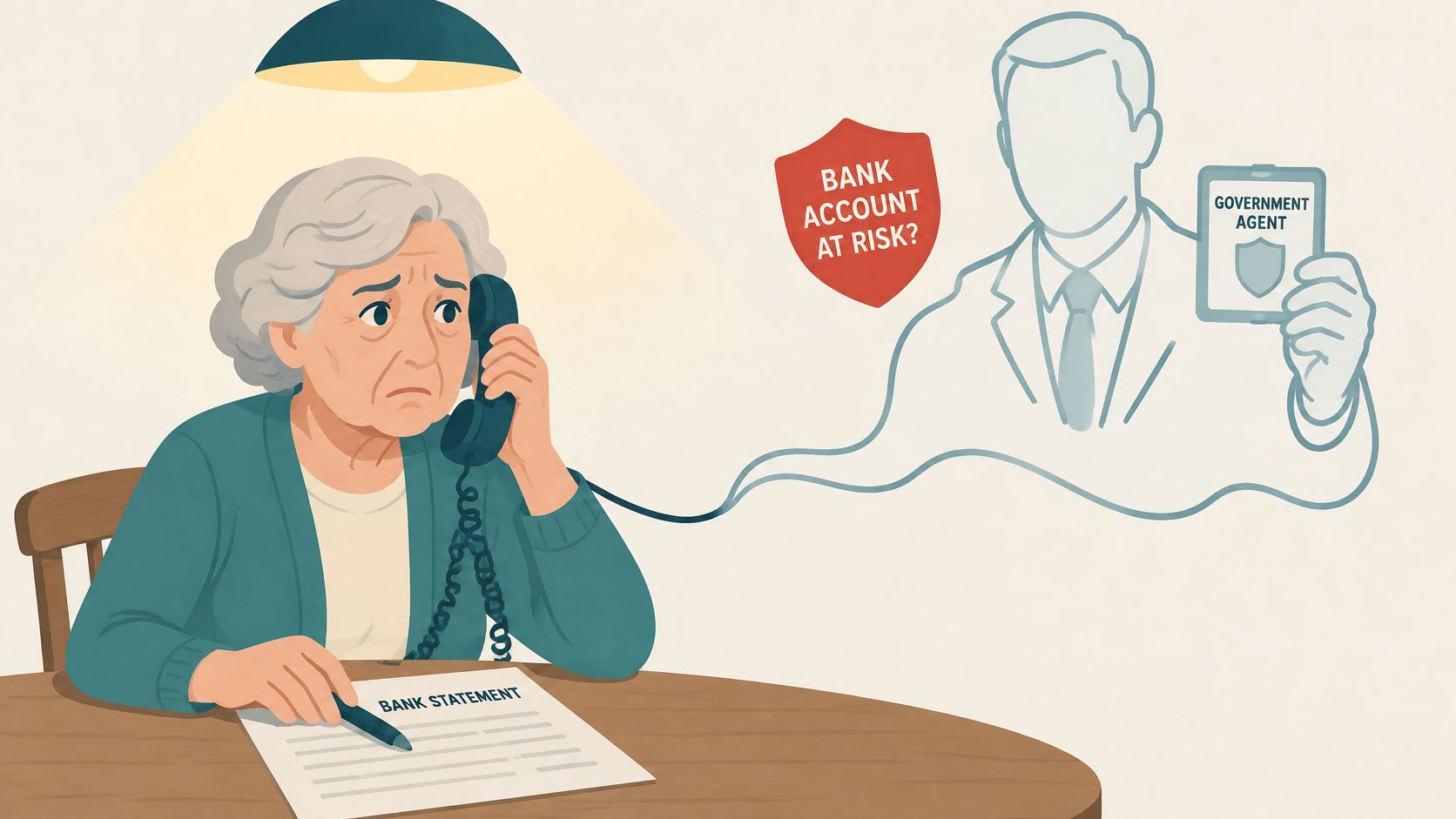
The signals in the order they arrive
The sequence is predictable. Authority claim first, then an immediate threat to her money, then an instruction to transfer funds for protection, then a demand for secrecy. A detector that only listens for the first thirty seconds hears a polite government employee. One that keeps scoring hears the theft being assembled.
What the numbers show
Imposter scams were the most commonly reported fraud category in 2024, with 845,806 reports and $2.95 billion in reported losses among the 22% of those reports that included a dollar figure, per the FTC's 2024 Consumer Sentinel data book.
The damage concentrates hard at the top. FTC analysis of impersonation scams found that reports from older adults who lost $10,000 or more increased more than fourfold between 2020 and 2024, while losses above $100,000 rose eightfold, from $55 million to $445 million, according to the FTC's impersonation scam data.
Why blocking numbers fails here: criminals impersonate a trusted agency and tell people to move money to protect it. The transfer is the theft, and the same script travels by call, text, email or a social-media profile.
That pattern has only grown. In 2025, impersonation scams generated $3.5 billion in reported U.S. losses, nearly one in three fraud reports, arriving through text, phone, email, social media and search results, per the FTC's 2025 imposter scam figures.
Follow the intent, not the caller ID. A perfectly human-sounding voice can be the most dangerous call of the week, while a clumsy synthetic one may be harmless noise.
Where AI Scam Detection Falls Short
A detector can perform exceptionally well on test data and still struggle with a real call. StreamFraudNet, an incremental speech model designed to detect phone scams as dialogue unfolds, reached a ROC-AUC of 0.9953 on benchmark testing across 1,600 balanced synthetic English conversations. External evaluation of the same work reported only 0.7131 accuracy and 0.7058 F1, according to the StreamFraudNet study on incremental phone scam detection.
That gap matters. A benchmark is a controlled test; a live call is more like a noisy kitchen, where people mumble, use speakerphone, and change their story.
- Strong test scores can mislead. Models trained and tested on tidy synthetic scripts may learn details of the sample, such as its audio quality or vocabulary, rather than the behavior that signals a scam.
- False positives have consequences. A hospital billing office, a bank fraud team, or a grandchild asking for help may use language that resembles a scam. Blocking legitimate calls can cause harm, so detectors must balance catching suspicious behavior with letting ordinary calls through.
- Models may learn the topic, not the tactic. Benchmark models can score well against unrelated examples yet drop sharply when tested against closely related legitimate conversations. That distinction matters because a detector needs to recognize what a caller is trying to make you do, not react to familiar words or topics. A doorman checks behavior, not whether a guest's name appears on a list. Likewise, AI scam detection should assess pressure, requests, and context, not whether a voice sounds synthetic.
- Performance can weaken across accents, languages, speech-to-text errors, and unfamiliar scam tactics. A system's results on one set of calls do not guarantee the same performance in every conversation.
What this means when you pick up
Treat a warning as a reason to pause and check, not proof that a call is fraudulent. A clean result means the system did not identify a warning sign, not that the caller is safe. Some scams will still get through, especially when they use tactics a detector has not encountered before.
The limits shape how to use the technology. If a caller asks for money, passwords, or urgent action, verify the request independently before you act, regardless of what the software says.
Verify Every Urgent Request Before You Act
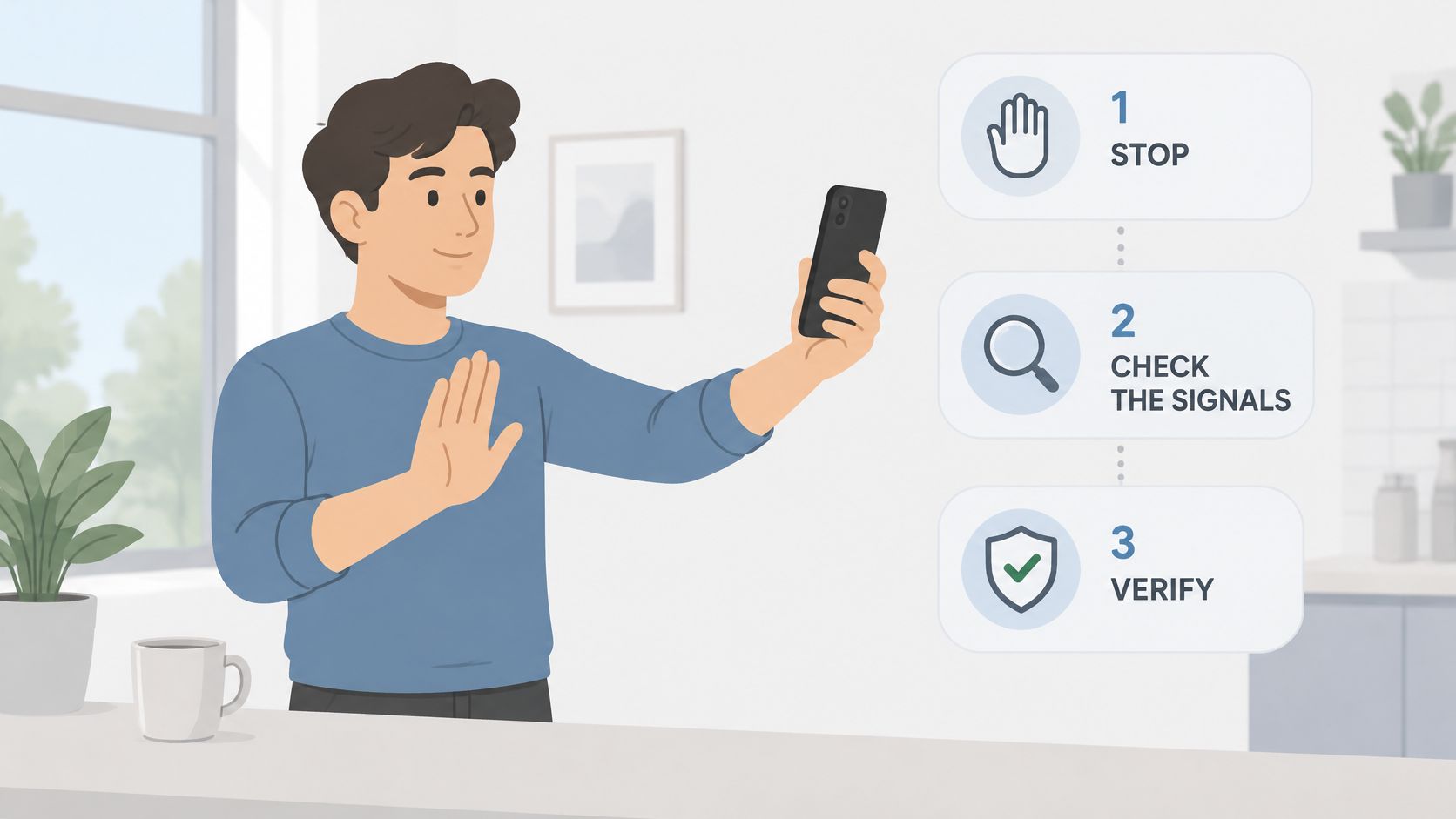
A warning gives you a reason to pause, not proof that a request is fraudulent. Use a routine that checks the request through a channel the caller cannot control.
- Stop. Don't act while someone is pressuring you. A request for money, passwords, or immediate action deserves a pause.
- Notice the pressure. A caller may claim authority, demand secrecy, ask for payment or credentials, or insist you act now. Focus on what they want you to do, not whether their voice sounds real or artificial.
- Verify independently. Hang up and call the organization using a number from your statement, card, or its official site. Don't use a number the caller provides.
- Ask someone you trust. A second person can help you consider the request before money or account details are shared.
- Report suspected fraud. File a report with the FTC at ReportFraud.ftc.gov. If money is gone, you can also report it to the FBI's IC3.
Phone requests can feel especially convincing because pressure unfolds in conversation. The FTC's annual report to Congress on protecting older adults covers the agency's efforts to protect older adults from fraud. Whatever a warning says, independently check requests involving money, passwords, or urgent action.
Where automated protection fits
Screening can buy time by checking an unknown caller before the phone rings. Gini Help uses AI to answer unknown callers and screen them, with legitimate calls continuing according to your setup and unwanted calls stopped.
Live Scam Detection is available on eligible plans with the required setup. After you answer, it keeps listening and can warn you during a call if someone asks for a verification code or account number, or pressures you to act right away. The warning points to behavior that deserves a closer look; it cannot guarantee that every request is safe. Verify important requests through a number you already trust.
You can find Gini Help on Google Play or the App Store.
Every plan includes text and email scam scanning, which checks texts and your Gmail or Outlook inbox and warns about scams. Some scams can still get through, so keep the same independent-check routine for messages as for calls.