What Is AI Detection and How It Protects You in 2026
By Josh C.
A weekday afternoon, a grandmother is home alone after a recent hospital visit when her phone lights up with a number she doesn't recognize. The caller says he's her grandchild, claims he's in trouble, asks her not to tell his father, and demands a wire transfer before anyone can help. The story feels urgent because it has been designed to leave no room for calm thinking.
AI detection proves more useful than an academic debate about whether a machine wrote an essay. The same pattern recognition that can identify machine-like writing can also examine a suspicious voice, a pressured request, or a strange conversation. Used carefully, it can become an invisible safety layer that evaluates a call or message before a person makes a costly mistake.
A Phone Rings at the Worst Possible Moment
A familiar-sounding voice calls from a local number. The caller knows a relative's name and mentions a detail from the family's life, then claims an urgent problem requires money immediately. If the voice seems different, he blames a poor connection or a new phone. He asks the recipient to keep the conversation secret, leaving little space for a second opinion.
Stress changes what people notice. A worried person may follow the emotional story instead of examining how the request is being made. Urgency, secrecy, impersonation, and a request for money create a recognizable fraud pattern, even when the number looks nearby or the caller knows genuine personal details.

The invisible assistant
An AI detection system can review the signals available during a call, text exchange, or email and turn them into a practical warning. It can check whether the sender is pushing for immediate action, asking for payment details, seeking credentials, or telling the recipient not to involve someone else. It can also compare the voice, wording, and conversation flow with patterns linked to known scams.
The system does not need to prove the caller's identity. Its job is to notice when several concerns appear together and give the person time to check the story. A protection service such as Gini Help might delay the connection, show a warning, or suggest confirming the caller through a trusted channel.
Practical rule: A warning is a prompt to pause and verify, not a declaration that a person is guilty.
Fraud targeting older adults makes that pause especially valuable. The Federal Trade Commission's report on protecting older adults says reported fraud losses for people aged 60 and over rose from approximately $600 million in 2020 to $2.4 billion in 2024, while people aged 80 and over reported a median loss exceeding $1,600. AI detection cannot replace family support or careful judgment. It can add a moment for verification when a scam call, phishing text, or fraud email is designed to remove doubt.
What AI Detection Actually Means in Plain Language
So, what is AI detection? In simple terms, it's pattern recognition that estimates whether content or behavior is likely to come from an artificial-intelligence system or indicate a fraudulent interaction. The result is usually a probability or confidence score, not proof.
A spell-checker offers a useful comparison. When it underlines a word, it doesn't know with absolute certainty that the word is wrong. It notices that the spelling doesn't match a familiar pattern and asks you to review it. AI detection works similarly, except it can examine much richer signals and combine them into a risk assessment.
The system may look at four broad families of clues:
- Linguistic patterns: Word choice, phrasing, sentence rhythm, repetition, and unusual consistency can suggest that text was generated or heavily shaped by a machine. In a scam, the language may also reveal a scripted appeal or a carefully repeated demand.
- Behavioral patterns: Urgency, secrecy, emotional pressure, requests for payment, and attempts to prevent independent verification can increase concern.
- Acoustic patterns: In a call, the system may examine cadence, pauses, pitch, background sound, and possible signs of synthetic speech.
- Contextual patterns: The caller's identity, device or sender reputation, message timing, link destination, and relationship to the recipient add context that words alone can't provide.
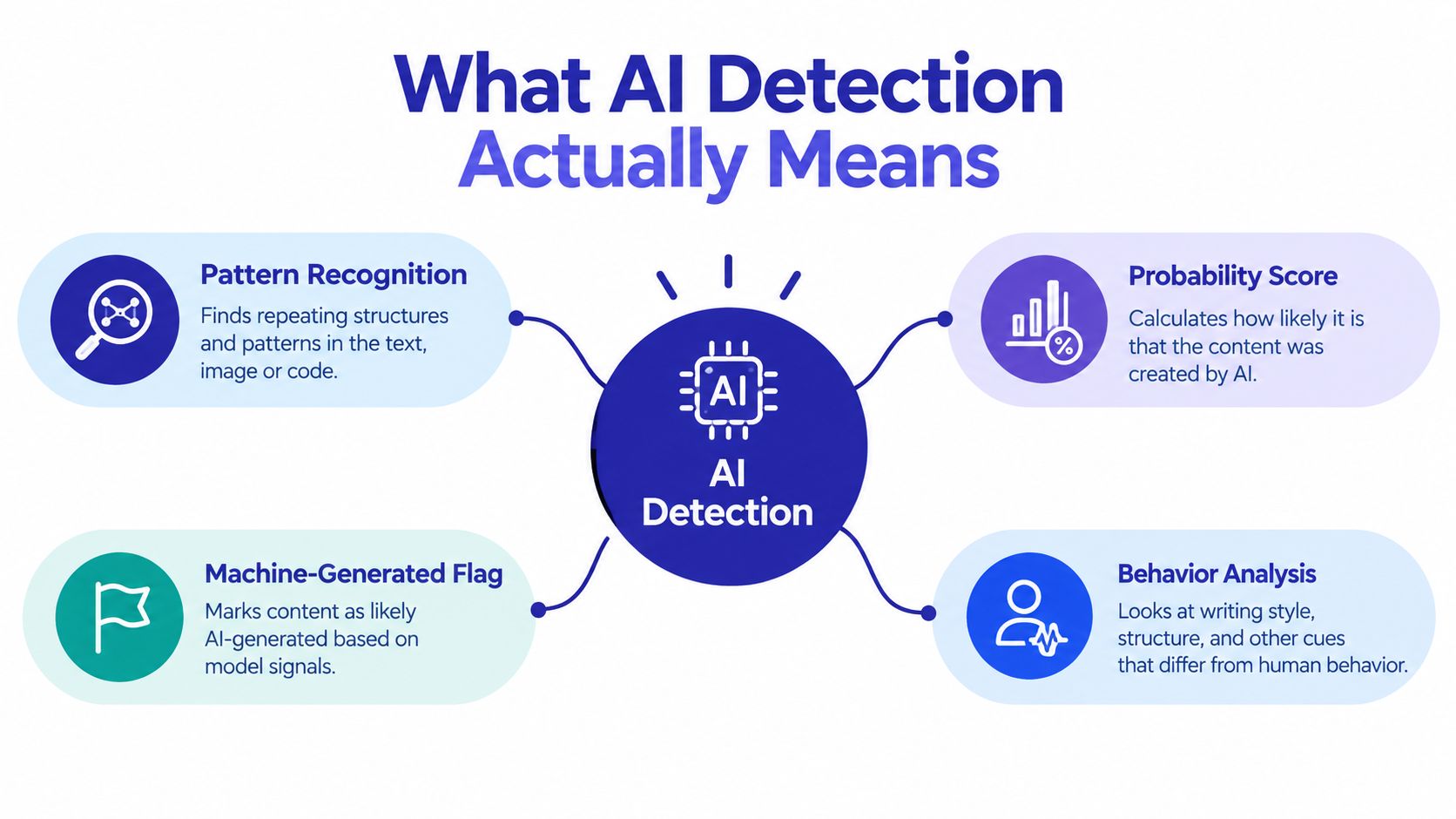
No single clue should decide the outcome. A nervous pause doesn't prove fraud, and polished writing doesn't prove AI involvement. The system weighs multiple signals, then presents a confidence score that supports a human or another safety tool.
That distinction matters because anomaly detection systems also work by identifying behavior that differs from an expected pattern. A high score can justify extra checking, but it shouldn't become an unquestionable accusation.
Research reinforces this caution. In a study of human-written and AI-generated behavioral-health texts, commercial and free detectors produced both false positives and false negatives. One free detector labeled a median of 27.2% of academic texts as AI-generated, even though those texts were written before today's generative-AI boom, as reported in the PubMed study on AI text detectors. The lesson transfers directly to scam protection: a detector identifies risk resemblance, not authorship or intent with certainty.
How AI Detection Works Step by Step
A live detection system can be understood as a four-stage pipeline. Each stage resembles a familiar activity, which makes the technology easier to follow.
Stage one captures the material
First, the system receives an input. That might be an audio stream, a transcript, an email body, an SMS message, or information about a sender and link. Think of this as a security camera recording activity at a front door. The camera doesn't decide whether the visitor is dangerous. It preserves what happened so the next layer can examine it.
For a phone call, the input may change as the conversation continues. A caller who initially sounds ordinary might later introduce a payment request or insist that the recipient stay on the line.
Stage two turns details into clues
Next, the system extracts measurable features. It can examine word frequencies, sentence structure, pause lengths, voice pitch, repeated phrases, link characteristics, and the type of request being made. A detective might perform the same task by listing every clue at a scene before deciding what those clues mean together.
The system isn't necessarily looking for one magic phrase. Scammers can replace “send a wire” with “make a transfer” or use a different story altogether. A stronger process considers the relationship among the language, timing, request, and surrounding circumstances.
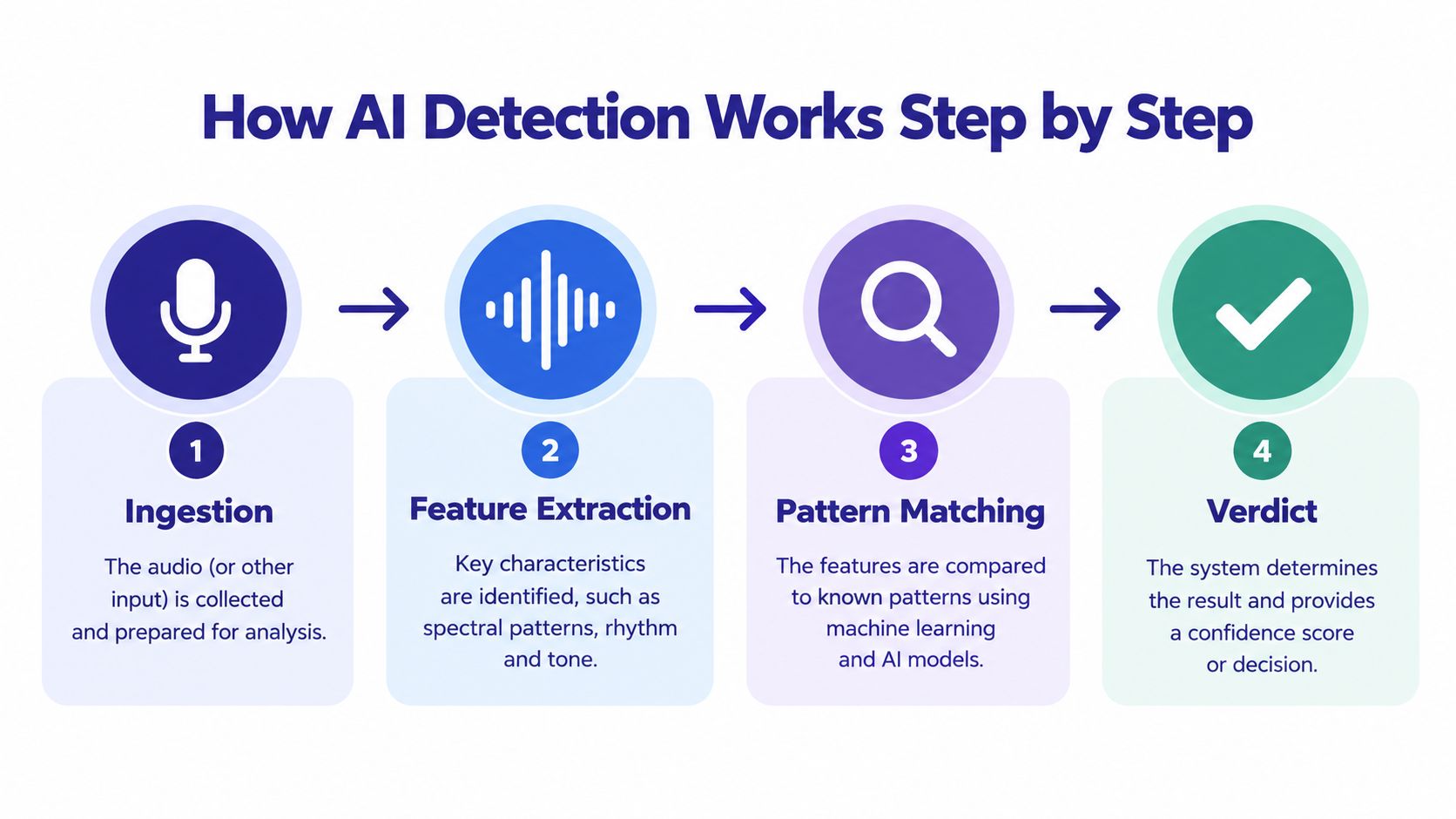
Stage three estimates the risk
A trained model compares the extracted features with patterns from legitimate and fraudulent interactions. This resembles a weather forecast. A forecaster doesn't use temperature alone, but considers pressure, humidity, wind, and other conditions before estimating the chance of rain.
The same principle applies here. An unfamiliar caller may not be risky by itself. A caller who is unfamiliar, claims to be a relative, creates an emergency, demands secrecy, and requests money presents a much stronger combined signal.
Technical systems may use contextual token representations and classifiers to produce a confidence score. The NIST text-to-text evaluation framework explains why results vary by generator, detector, and threshold. In practical language, the score ranks concern across possible situations. It doesn't establish a fact about the person behind the interaction.
Stage four triggers an action
Finally, the score connects to a predefined response. The system might tag an email, hold a message for review, display a warning, or route a call through screening. The important design question is not only whether the model detects a risk, but also what the product does with uncertainty.
Live protection needs low delay, clear explanations, and an easy way for a legitimate caller or message to get through. A real-time risk assessment approach is most useful when it turns complex analysis into a simple next step, such as “verify the caller before sending money.”
Why Old Spam Filters No Longer Keep Up
Traditional spam protection often begins with a list. A carrier or app compares an incoming number with reports from users and security databases. That works well when the same number repeatedly contacts many people and accumulates a reputation.
Scammers understand the weakness. They can rotate numbers, spoof a local pharmacy, or send a message from an account that has not yet been reported. A blocklist sees an unfamiliar number. It may not know that the caller is pretending to discuss a prescription refill while requesting payment details.
Static rules versus changing conversations
A conversation-level system examines what the caller says and how the exchange develops. It can notice a sudden move from a routine question to an urgent payment request, or a demand that the recipient ignore the pharmacy, bank, or family member directly.
| Traditional filtering | Conversation-level detection |
|---|---|
| Compares numbers with known lists | Examines language, behavior, and context |
| Works best after repeated reports | Can identify suspicious patterns in a new interaction |
| Often treats the number as the main clue | Treats the conversation as evidence |
| May miss a spoofed or recently created number | Can flag pressure, secrecy, and payment demands |
Email creates the same problem. A keyword filter may catch a crude message containing obvious phrases, but a polished phishing email impersonating a bank can avoid those terms. It may use natural language, a familiar logo, and a link that appears safe at first glance.
Why context changes the result
AI detection adds context to the basic question. Instead of asking only, “Has this number been reported?”, it can ask, “Does this interaction resemble a known fraud pattern?” That shift helps address scams that are new in their surface details but familiar in their behavior.
NIST's overview of its generative-AI pilot evaluation notes that detection performance changes across systems and that edited or previously unseen content can reduce sensitivity. The same caution applies to scam screening. Dynamic analysis is more adaptable than a fixed list, but it still needs representative testing, regular updates, and human review.
Where AI Detection Shows Up in Everyday Life
The same basic idea can protect several communication channels, even though each channel provides different evidence.
Phone calls
An unknown caller claims to be a grandchild in trouble. A system can transcribe the audio as the conversation unfolds, identify emotional pressure and a request for money, and compare the interaction with patterns associated with impersonation scams. The resulting warning might appear before the recipient answers or while the call is in progress.
The goal isn't to decide that every emotional caller is fraudulent. It's to make a high-pressure situation easier to question before money or account information changes hands.
Text messages
A message appears to come from a delivery service and asks the recipient to open a shortened link. The detector can examine the sender's reputation, the destination behind the link, the structure of the message, and the request for information or payment. It can then label the message as a likely smishing attempt and explain why.
People who want a simple way to understand unfamiliar language or summarize a message can also explore the smry AI reading app from smry. Reading assistance and scam detection serve different purposes, but both can help users slow down and understand what a message is asking them to do.
An email looks like a security alert from Microsoft. Detection can examine header information, the sending domain, the age or reputation of the domain, and whether the sign-in story fits the recipient's normal activity. If several indicators conflict, the message can be quarantined or shown with a prominent warning before the recipient clicks.
This is the role of a smart call blocker extended into a broader communication layer. The input changes from voice to text to email metadata, but the principle remains consistent: combine multiple clues, estimate risk, and give a person a useful action rather than an opaque label.
The Honest Limits of AI Detection
AI detection isn't a truth machine. It estimates whether a pattern resembles something the system has learned to recognize, and its performance can change when the language, speaker, genre, model, or editing style changes.
Two terms explain the central trade-off. Precision asks whether the alerts that appear are usually correct, or whether the system cries wolf too often. Recall asks whether the system catches most genuine threats, or misses dangerous interactions. Increasing caution may catch more scams but also interrupt legitimate conversations. Reducing alerts may feel smoother while allowing more threats through.
Why errors aren't evenly distributed
Some accents, dialects, communication styles, and languages can be more difficult for a detector to interpret. The University of Oklahoma's overview of AI detector concerns summarizes reported false-positive rates ranging from 15% to 50%, depending on the tool, threshold, and sample. It also cites a finding in which common detectors classified more than 60% of TOEFL essays by non-native English speakers as AI-generated, while misclassification among U.S.-born eighth-grade students was nearly nonexistent.
Those figures concern writing detection, not scam calls, but they reveal a broader design risk. A system can mistake a person's communication style for suspicious machine-like behavior. Responsible products should test across relevant populations, show reasons for a warning, provide override options, and preserve a path for human review.
Scammers also adapt. They may add pauses, background noise, scripted small talk, or other distractions to make a synthetic voice seem natural or to avoid a familiar acoustic pattern. A detector that relies on one signal can be fooled more easily than a system that combines conversation content, context, provenance, and behavior.
A warning should change your next action, not end your thinking.
The NIST research on detector evaluation reports AUC values ranging from 0.75 to 1.00 across tested models, with no system achieving complete reliability. It also describes known human-written abstracts being incorrectly classified as AI-generated by up to 8%, and human participants identifying passages correctly in 48 of 69 decision rounds. For consumers, the takeaway is practical: treat AI detection as one protective layer, never as stand-alone evidence.
The Fraud Crisis That Makes AI Detection Essential
A scam can change shape while a person is still deciding what to do. The caller may switch numbers, imitate a trusted organization, tailor the story to the target, and create pressure before the recipient has time to check the facts. The same pattern appears in phishing texts and fraud emails.
The financial harm is particularly serious for older adults. The FTC reported that people aged 60 and over lost $159 million to tech-support scams in 2024. Losses above $100,000 were frequently connected with investment scams, romance scams, and impersonation schemes, according to its report on fraud affecting older adults. These contacts are managed attempts to control attention, emotion, and behavior, not merely unwanted messages.
A wider view than a blacklist
Blacklists still help with known numbers and addresses. They cannot keep pace with a fraudster who changes contact details or disguises the request. Conversation-level detection adds context by looking for an emergency story, resistance to independent verification, requests for credentials, or pressure to use a particular payment method. Those behaviors can connect separate scams even when their wording and contact details differ.
A protection service such as Gini Help can use that signal to explain why a conversation deserves caution, giving the recipient a clear moment to pause and verify.
Matching scale with context
Software can evaluate patterns continuously while people remain responsible for the final decision. Like a second set of eyes, it can combine several weak signals that a busy recipient might overlook and turn them into a plain-language warning. The goal is useful guidance during a live interaction, not an automatic verdict about the person or message.
The same approach connects AI detection with provenance rules. Under Article 50 of the EU AI Act, applicable from 2 August 2026, providers of systems that generate or manipulate synthetic content must mark outputs in machine-readable form so downstream tools can detect them. The European Commission's transparency rules describe provenance markers and human-facing disclosures within that framework. A machine-readable marker can help a receiving system recognize synthetic material, while a visible disclosure helps a person understand what they are seeing or hearing.
Detection is therefore becoming a combination of model analysis, metadata, and behavioral context. That combination gives services more information to assess a suspicious call, text, or email, while leaving the final choice with the person being protected.
Smarter Protection Starts With the Right Tools
Good protection doesn't depend on one perfect detector. It combines device settings, carrier tools, software, verification habits, and a calm response when something feels wrong.
Use this checklist as a practical starting point:
- Update devices promptly: Software updates can improve security controls and reduce exposure to known weaknesses.
- Enable built-in screening: Phone and email providers often offer tools that identify or separate suspicious communications.
- Verify payment requests independently: Call the person or organization through a trusted number, not the number or link supplied in the message.
- Pause before sharing information: Never let urgency decide whether you disclose a password, verification code, bank detail, or identity document.
- Report suspicious contacts: Reporting helps providers and security teams identify patterns that individual users may see only once.
- Use a dedicated protection service: A specialized tool can add analysis across calls, SMS, and email instead of leaving each channel to a separate filter.
Family members can also agree on a simple verification phrase or routine. If an apparent relative calls with an emergency, the recipient can end the call and contact that person through a known channel. A helpful safety product should explain why it raised an alert, offer a clear next step, and make it possible for a trusted family member to help without taking control of every conversation.
The same layered principle appears in physical security. This overview of how gate software enhances community safety offers a useful parallel: access systems work best when identification, monitoring, and human oversight reinforce one another. Digital communication protection follows the same logic.
A useful habit: Don't ask only whether a message looks real. Ask what the sender wants you to do, why the request feels urgent, and how you can verify it independently.
Gini Help screens calls, texts, and emails with AI-powered analysis and turns suspicious patterns into clear warnings before they can become expensive mistakes. Download the Gini Help app on Google Play or the Gini Help app on the App Store, and visit Gini Help to add a practical detection layer for yourself or someone you care about.