Area Code 929 Scams: How to Spot and Stop Them
By Josh C.
Area code 929 is a legitimate New York City overlay that went into service on April 16, 2011. The prefix alone neither proves a scam nor proves the caller is local.
That's why the popular advice to block every unfamiliar 929 number can backfire: it may hide a real call from a doctor's office, school, business, or public agency. A safer approach is to treat the number as a clue, then judge what the caller claims and asks you to do.
What Area Code 929 Actually Covers
A call showing 929 isn't automatically a scam, and the code isn't a criminal brand. Say a 929 number appears on your phone while you're expecting a call from a Queens clinic. The caller could be a legitimate office, a neighbor, or someone pretending to be either one. The area code alone can't tell you which.
New York regulators approved 929 in December 2009. It went into service on April 16, 2011, as an overlay added alongside existing 718 and 347 numbers. An overlay is like adding lanes to a busy road: new numbers use another code, while existing numbers keep theirs. The change responded to demand for mobile phones and new lines that the older codes couldn't accommodate. The history and geographic assignment are summarized in the account of New York's 718, 347, 929, and 465 area codes.
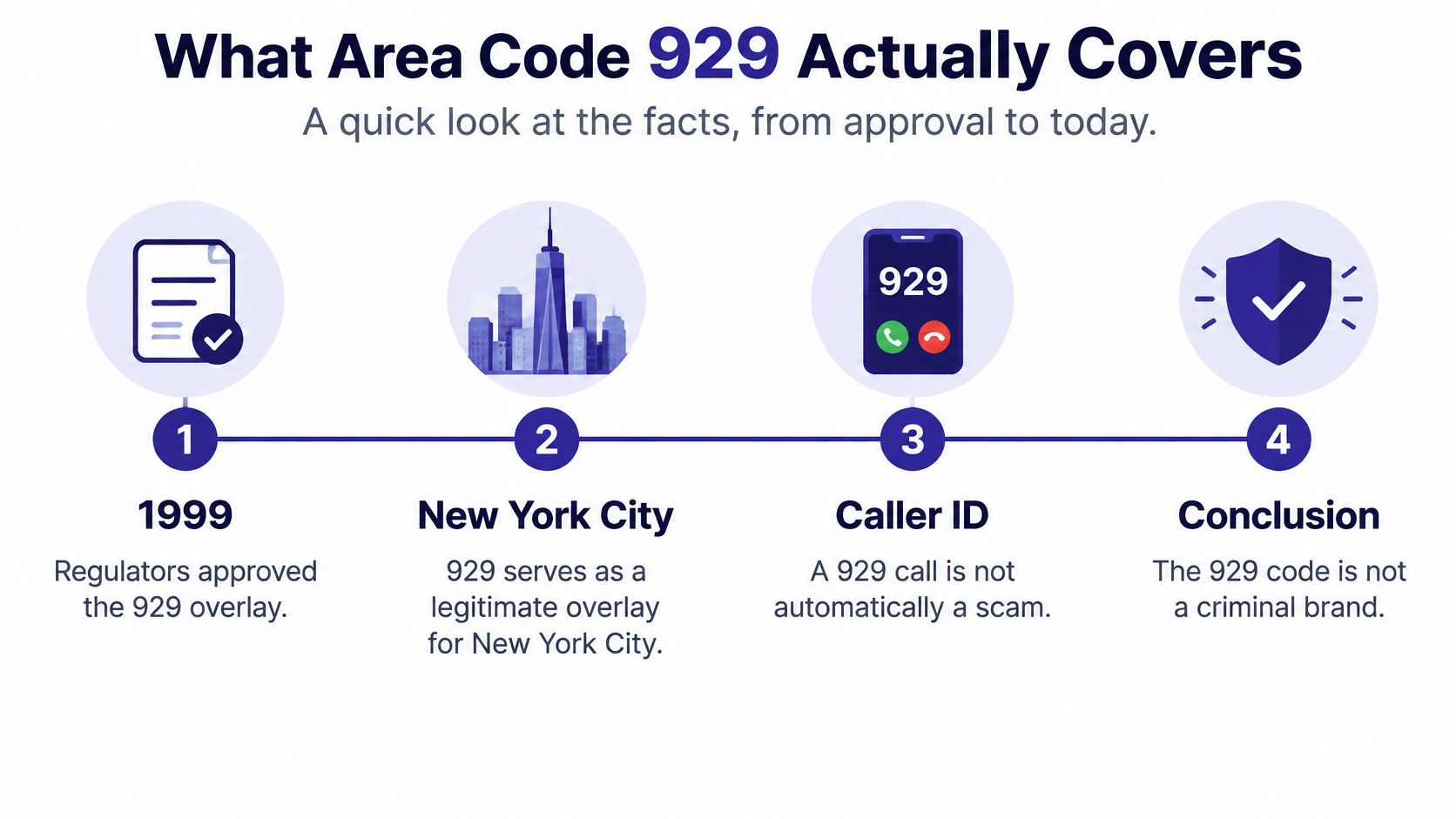
The original 929 assignment covered the Bronx, Brooklyn, Queens, and Staten Island. Manhattan wasn't included in that initial assignment. The code is now associated with the same general region as 347, 718, and 917, including Marble Hill in Manhattan, according to a North American Numbering Plan Administration notice. That means a legitimate caller may have a 929 number even if you don't recognize the prefix.
The important distinction is between the number displayed and the person calling. A resident, medical office, school, company, or government office may use a 929 line. A scammer may also make a call appear to come from one. For area code 929 scams, focus on the caller's claims, the urgency, any request for money or personal information, and whether you can verify the story independently.
Scam Patterns Tied to 929 Calls
A 929 prefix is weak evidence either way. Blocking every call with that area code can hide legitimate calls from New York City, while trusting a number because it looks local can make an impersonation attempt easier. Match the caller's behavior to the request, then choose a safe response.
| Pattern | Typical claim | What they ask for | Do this |
|---|---|---|---|
| Recorded robocall | Warranty, debt, or prize recording | Press 1 to talk or be removed | Hang up and press nothing |
| Neighbor-style live call | A nearby person, office, or agency | Stay on the line and answer questions | Don't call back the number on the screen |
| Victim Compensation Fund impersonation | You may be owed September 11 compensation | Social Security number, bank account, address, medical history | Hang up and use the fund's published number |
| Bank, utility, or government imposter | An account, benefit, or warrant is in trouble | Gift card, crypto, wire, or a transfer to keep money safe | Stop and verify on the official site or the number on your card |
| One-time-code trap | Fraud was detected on your account | Password, account number, or a texted code | Never read a code aloud. Call the number on your statement |
Consumer complaint compilations report robocalls and spoofed numbers associated with the 929 code. Such reports can point to patterns in what callers say, but they do not prove that every displayed number belongs to a scammer. A number may belong to an innocent subscriber whose caller ID was imitated. The area-code 929 complaint compilation and the 929 complaint listing offer examples of reported complaints; treat them as signals to assess a call, not as verdicts about individual callers or the area code.
Pay attention to the request
Robocalls and changing caller IDs help explain why blocking one number may not stop another. The more useful clues are what the caller wants: pressure to act immediately, a demand for a gift card or cryptocurrency, instructions to wire money, or a request for a password or one-time code. If the caller resists your decision to verify independently, end the conversation.
Don't press a keypad option to “remove” your number from an unexpected recording. Don't read a code aloud to someone who called you, even if they say it will stop a fraudulent transaction. Hang up, then contact the organization using information you find independently. A familiar-looking 929 number is only a label, not proof of who is speaking.
How Spoofing Makes 929 Look Local
Think of caller ID as a return address written on an envelope. It can help identify a caller, but it isn't proof that the call came from that place. A scammer can alter the label before the call reaches you, making a number appear to belong to a real Queens or Brooklyn subscriber who never dialed.
The Federal Communications Commission's explanation of 929 and related numbering areas describes spoofing as deliberately altering caller-ID information to disguise the caller. One version is neighbor spoofing, where the displayed number looks local so you're more likely to answer. The FCC's guide to caller-ID spoofing also advises people not to provide personal or financial information in response to an unexpected call.
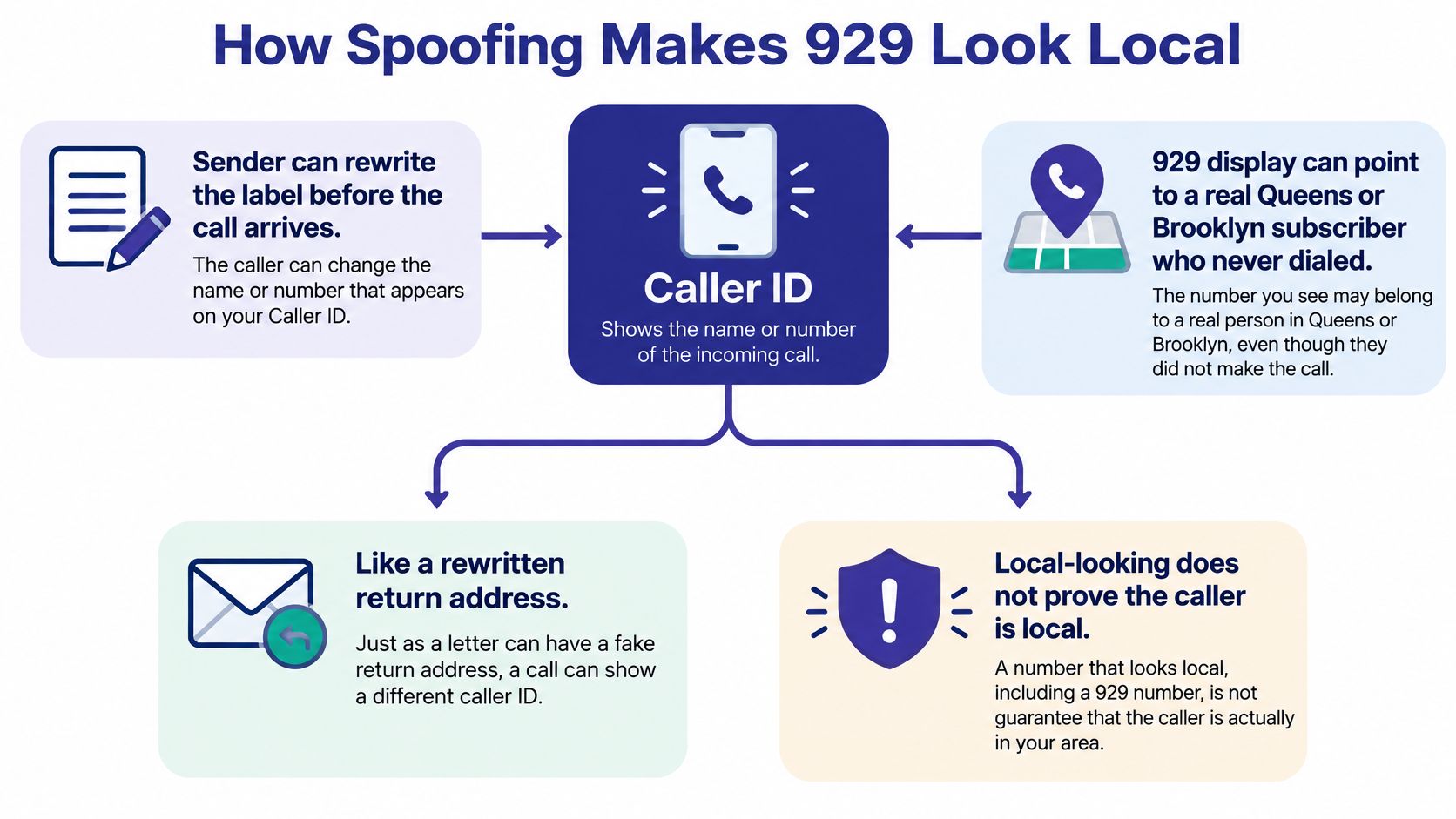
A familiar-looking number can make you pick up. The caller then poses as a bank, agency, or other organization and uses a script to keep you engaged. If you share a password, verification code, or payment information, the caller may use it to pursue identity theft or account takeover. For a closer look at the technique, read this guide to what caller-ID spoofing is.
Blocking the displayed number can help with that specific call, but it won't necessarily stop the campaign. Scammers can switch to another number, and the subscriber whose number appears on your screen may have nothing to do with the call. On the other hand, blocking every 929 number could make you miss a genuine call from a local medical office, school, business, or public agency.
Practical rule: Don't trust a local-looking number as proof of identity. If an unexpected caller asks for money or personal information, hang up and contact the organization using a number you find independently.
The Victim Compensation Fund Impersonation
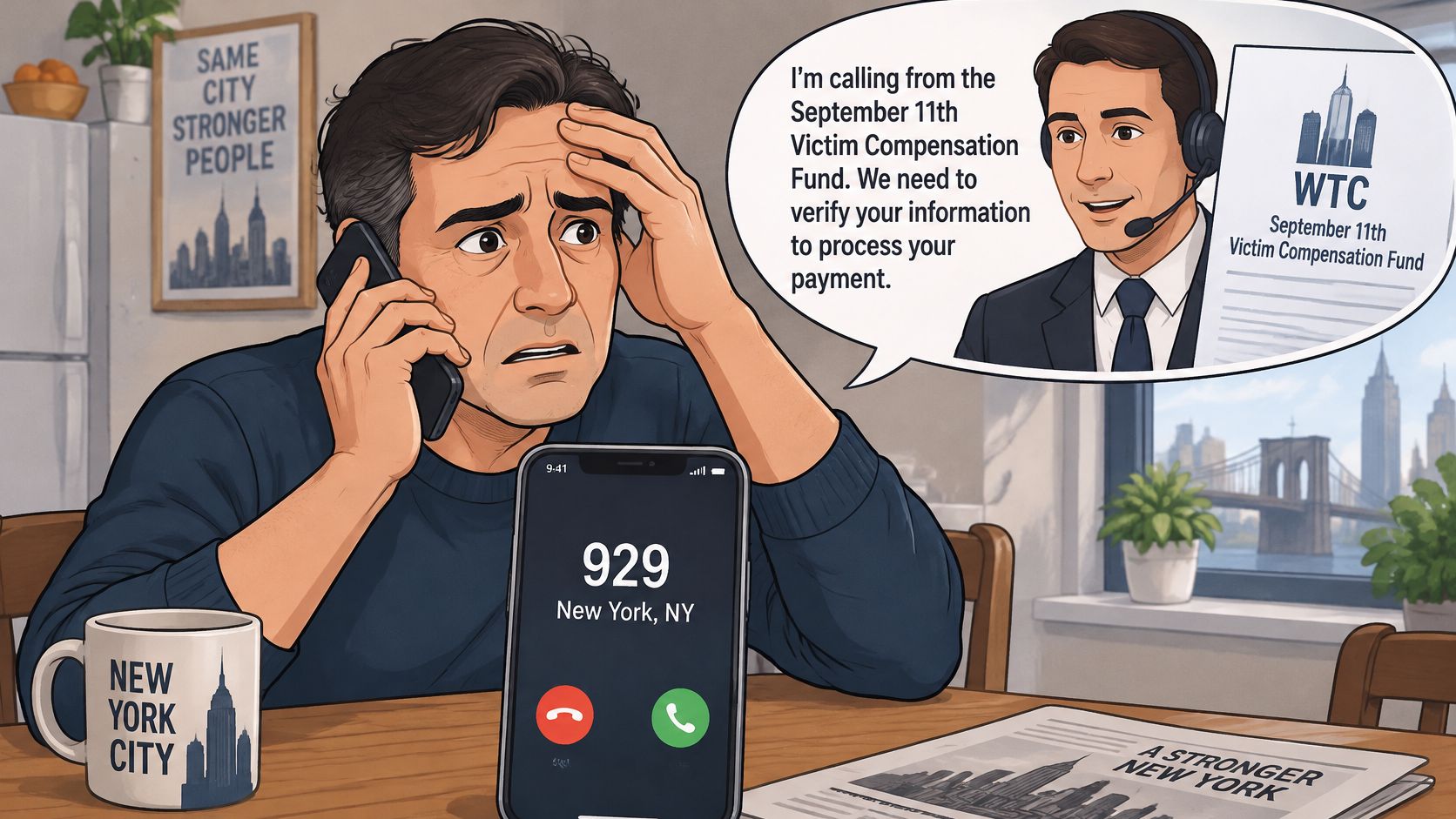
A caller claiming to represent the September 11th Victim Compensation Fund may say you are entitled to money, then ask for personal details such as your Social Security number, bank-account information, address, or medical history. A 929 number can make the story feel nearby and credible, but the display is weak evidence of identity. Blocking every 929 call could also hide legitimate local calls, so judge the request, not the prefix.
The fund may contact claimants, but the FCC and FTC statement about what it will never request is not established here. Treat any unexpected request for sensitive information as unverified. End the call, then contact the fund through a trusted, independently found channel rather than a callback number the caller gives you.
Impersonation can also shift from a benefits claim to an invented emergency. A caller may urge you to move money somewhere “safe,” continue the conversation by text or email, or install remote-access software. Those requests are warning signs, not proof that the caller represents an organization. Pause and verify through an official channel before sharing information or acting.
How to Verify a 929 Caller
Use the same verification routine whether the caller claims to be from a bank, government office, doctor's practice, or the compensation fund. A name on the screen doesn't confirm who is on the other end. For more practical guidance, see how to verify a caller.
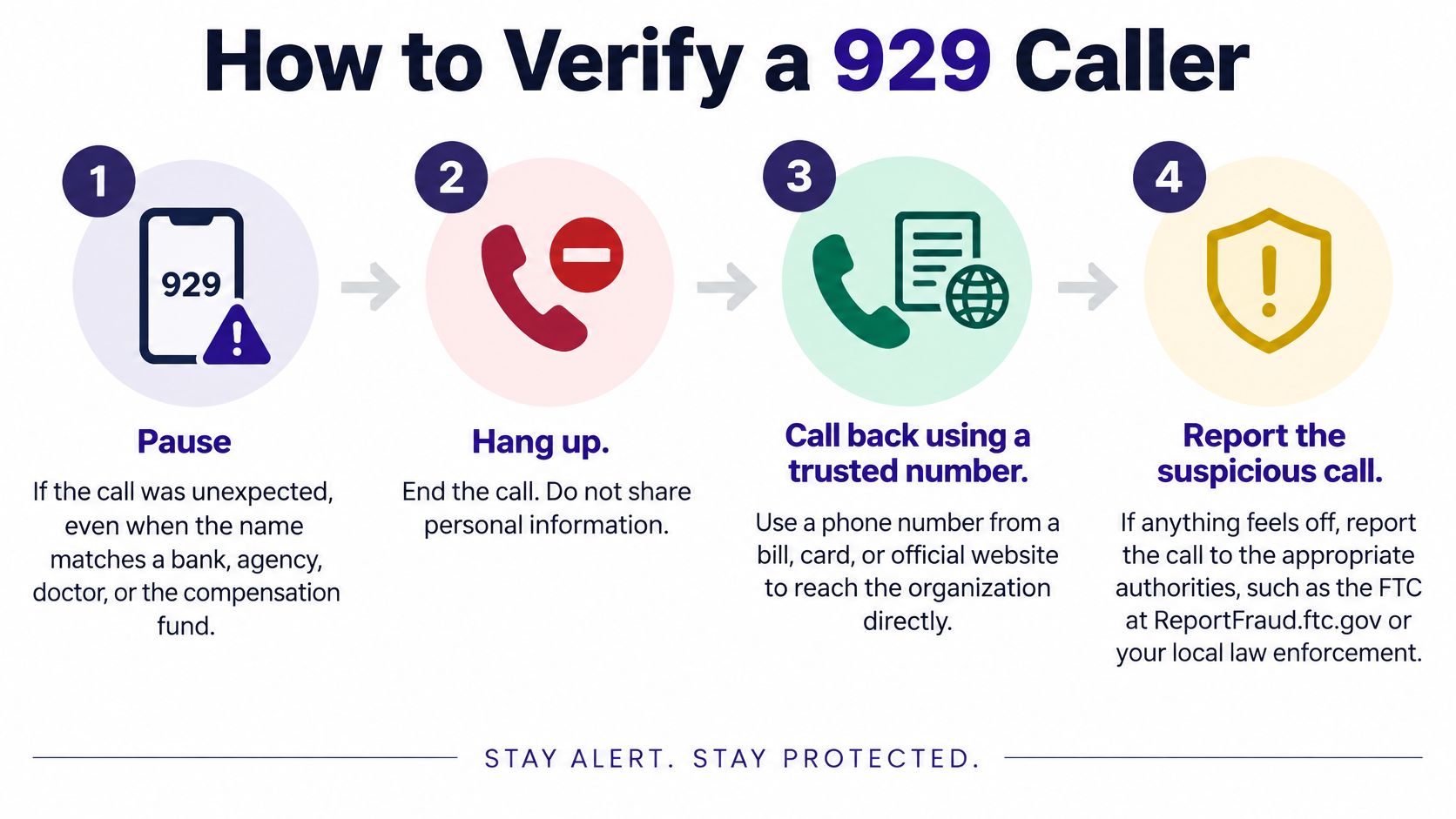
Pause if the call was unexpected. This applies even if the screen shows the name of your bank, a doctor, an agency, or the compensation fund. An unexpected request for money, passwords, or urgent action needs an independent check.
Hang up without arguing. You don't need to persuade the caller that you're suspicious. Don't press a menu key that promises to remove you from a list, and don't let the caller keep you on the line while you search for information.
Ignore the callback details they provide. Don't use a phone number, link, or contact instruction supplied during the call. A convincing caller may still give you a number they control.
Find a trusted number yourself. Use the number printed on your bank card or statement, the agency's official website, or a letter you already have. If the caller says they're from a known local office, ask for their name and reason for calling, then confirm through the office's published line.
Place a new call. Ask the organization whether the request is real. Don't redial the incoming call or rely on a callback number the caller supplied.
Keep the request unverified until confirmed. Money, passwords, one-time codes, and “act now” instructions are reasons to pause, not reasons to comply. A Live Scam Detection risk warning also gives you a reason to stop and check. If a caller asks for money, passwords, or urgent action, independently verify the request before acting.
Use a second person for critical situations. A caregiver, partner, or trusted family member can help verify the request against an official source. Screening and careful listening can still miss a scam, so important requests need an independent check.
A family agreement can make this easier: no one moves money or reads a code aloud until a second person has checked the request through an official source.
A genuine 929 medical office or school may call, which is why the goal isn't to ignore every outer-borough number. The safer test is to end an unexpected call and contact the claimed organization through its published number.
Steps After a Suspicious 929 Call
A 929 display does not tell you whether a call is safe. Blocking the whole area code could hide legitimate calls from New York City's outer boroughs, while trusting a number because it looks local can make impersonation easier. Focus on what the caller asked you to do. If you already shared information or paid, act promptly to limit further loss.
In a Federal Trade Commission analysis, 41% of older adults who reported losses of at least $10,000 to business or government impersonators in 2024 said the initial contact was a phone call. Treat an unexpected request as unverified until you check it through a trusted channel.
- End contact. Don't continue the call or text back a number the caller sends.
- Contact your bank or card issuer. If you shared card details, account information, or a one-time code, call the number printed on your card. Ask about freezing the account or disputing the payment.
- Save the evidence. Keep the caller-ID display, voicemail, texts, emails, receipts, and any gift-card numbers.
- Report the incident. Choose the route that fits what happened:
| Report to | When | What to include |
|---|---|---|
| Bank or card issuer | Card, account, or one-time code was shared | Number printed on your card; ask about a freeze or dispute |
| FTC | Any impersonation or unwanted-call attempt | Caller-ID number, date and time, and the claim the caller made |
| FBI IC3 | Money lost or account taken over | Payment method, receipts, gift-card numbers, and the story told |
| Phone carrier | Repeated 929 calls | Caller-ID displays, dates, and the numbers you blocked |
- Tell someone you trust the same day. They can help watch for follow-up calls or messages.
- Block the specific number. Use your phone's call-blocking feature, remembering that another attempt may show a different number.
- Leave suspicious links unopened. If the caller follows up with a fake delivery or prize text, don't tap its link. Use this guide to reporting scam calls to organize your next steps.
Keep the evidence and alert your bank before engaging with another caller. A local-looking number is only a display, not proof of identity. Check important requests through an official contact method.
Screen Unknown Calls With Gini Help
If unwanted calls keep interrupting your day, screening can add a practical layer without requiring you to block every 929 number. Gini Help is a mobile app that screens unknown callers, helps users spot scams, and shows how calls were handled. It can answer an unknown caller first, assess whether the call appears legitimate, and connect it when appropriate. That can be useful when a caller changes the displayed number and a blocklist can't keep up.
On eligible plans, Live Scam Detection keeps listening after you answer and can warn you during the call if someone asks for a verification code or account number, or pressures you to act immediately. A warning is a reason to pause and check the request, not proof on its own that a call is fraudulent. Text filtering sends scam messages, including fake delivery alerts, prize scams, and phishing links, to a separate folder. Every plan also scans texts and a Gmail or Outlook inbox.
Gini Help also publishes guides on identifying phishing, phone scams, and safe texting. Screening can reduce unwanted calls, but it can't identify every scam or guarantee every caller is safe. Emergency calls to 911 are never blocked or screened. If a caller asks for money, a password, or urgent action, independently verify the request through an official number even if a screening tool hasn't raised a warning.
Download Gini Help on Google Play or the App Store. Use screening to reduce interruptions, and keep independent verification as your final check for important requests.
Gini Help screens unknown calls, scans texts and email for scam signals, and offers Live Scam Detection on eligible plans to warn you during a call. If you want an added layer for suspicious 929 calls without blocking every local number, visit Gini Help and choose a setup that fits your needs.