Area Code 325 Scam Calls: What to Know and How to Stay Safe
By Josh C.
Area code 325 is a legitimate west-central Texas code serving Abilene, and the number itself isn't the scam. The genuine risk is caller-ID spoofing, which can make any number, including 325, appear on your screen.
You're sitting at home when your phone rings. The number looks local, so you hesitate before answering. Maybe it's a doctor's office, a utility company, or someone you know. Instead, the caller says your benefits are at risk, a payment is overdue, or a family member needs urgent help.
That uncertainty is exactly what scammers exploit. Area code 325 scam calls don't depend on the code being fraudulent. They depend on the confidence people place in a familiar-looking number. A calm verification routine can help you separate a genuine callback from a staged conversation without guessing.
Why a 325 Number Is Showing Up on Your Phone
A 325 call can have several ordinary explanations. Someone in west-central Texas might be returning your call, a business may be contacting you, or a medical office could be using a local number. The appearance of a 325 number alone doesn't tell you whether the caller is legitimate.
A second possibility is an automated robocall campaign. Scammers and marketers can place large volumes of calls using changing numbers, and some systems may display numbers that look local. The call might be random, with no connection to Abilene or any other Texas community.
The third possibility is deliberate spoofing. The caller may falsify the information sent to your phone so the screen displays a 325 number even though the call originates somewhere else. The Federal Communications Commission's explanation of spoofing says callers can deliberately falsify caller-ID information, including by using local-looking numbers to increase the chance that someone answers.
Treat the number as a clue, not a verdict
When a 325 call arrives, use this simple sequence:
- Pause before answering. A familiar area code creates recognition, not proof.
- Let unknown calls reach voicemail. A genuine caller can explain the reason for contacting you.
- Listen for pressure. Threats, secrecy, urgent payment requests, and demands for personal information need independent verification.
- Use an official callback route. Don't call the displayed number back until you've confirmed the organization through a trusted source.
This routine works because it removes the scammer's biggest advantage, the few seconds in which surprise turns into compliance. You don't need technical knowledge to use it. You only need to separate the caller's claim from evidence you find independently.
Practical rule: A local-looking number may explain why you answered, but it can't prove who called.
What Area Code 325 Actually Is and Why It Matters
Area code 325 is a real west-central Texas area code. It has served Abilene and nearby communities since April 5, 2003, according to area code information from ThisNumber. The code covers a broad regional calling area, so residents, organizations, and businesses can all use it for ordinary communication.
That legitimacy matters because a scammer doesn't need to create a strange or obviously fake identity. A real code already looks familiar to people in the region. A displayed 325 number may belong to a local hospital, school, utility, small business, or individual. It may also be a false caller ID selected to make a fraudulent call appear nearby.
Key Facts About Area Code 325
| Fact | Value |
|---|---|
| Geographic role | West-central Texas |
| Communities served | Abilene and nearby communities |
| Service began | April 5, 2003 |
| Core safety issue | A real 325 number can be spoofed |
| What the code proves | Only that the displayed code looks local, not that the caller is trustworthy |
The distinction is simple but important: 325 isn't a scam area code. The code itself doesn't identify a criminal, a robocall, or even an unwanted call. The risk comes from someone using caller ID to borrow the appearance of a legitimate local number.
Public reporting also shows why readers may encounter several different 325 numbers rather than one repeated caller. ReportedCalls' 325 complaint summaries describe pressure-based scripts involving supposed legal consequences over Social Security numbers, fake cable or bank offers, and other urgent demands. Multiple numbers appearing in reports fit a rotating-caller-ID strategy. That makes the caller's behavior more useful than the prefix when you're deciding what to do.
How Caller ID Spoofing Turns a Real Code Into a Scam Tool
Caller ID spoofing means the caller deliberately falsifies the information delivered to your phone. The FCC explains that spoofing can disguise a caller's identity, and its consumer guidance on spoofing notes that false caller ID used with intent to defraud, cause harm, or wrongfully obtain something of value is prohibited under the Truth in Caller ID Act.
The technical process doesn't need to be mysterious. A caller uses internet-based calling equipment or a service that sends a selected number as part of the call information. Phone networks then pass that information along, and your device displays the chosen number as if it were reliable.
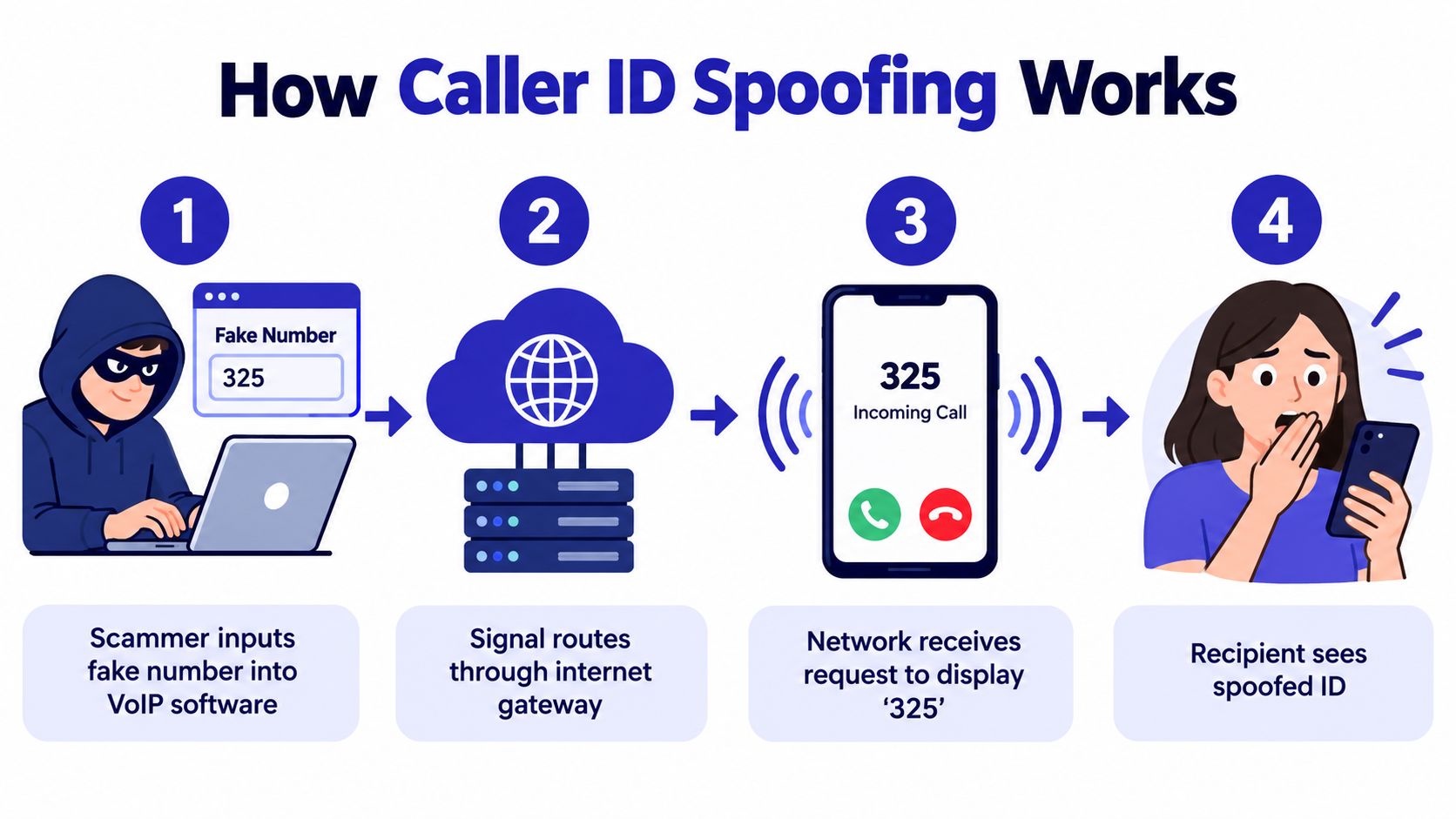
The number is a costume
A scammer might choose a 325 number because the prefix looks familiar to someone in the region. The caller could then claim to represent a pharmacy, sheriff's office, doctor's office, bank, or utility provider. The local appearance lowers suspicion before the caller has established any real identity.
The displayed number isn't a secure identity credential. It's closer to a label attached to the incoming call, and a dishonest caller may change that label. A call showing 325 may originate outside Texas or outside the United States.
This guide to caller-ID spoofing provides more background on why the displayed number can't authenticate the caller. The practical conclusion is more important than the terminology: never use the area code as your main reason to trust a call.
Spoofing also explains why calling the number back can fail as a verification method. The number may belong to an innocent person, a disconnected line, or a real organization that had nothing to do with the conversation. Verification must start with the claimed organization, not with the caller ID.
Common Scam Scripts Tied to Area Code 325
Scammers change names and stories, but their conversations often follow the same structure. They create a problem, demand an immediate response, discourage outside verification, and push for money or sensitive information.
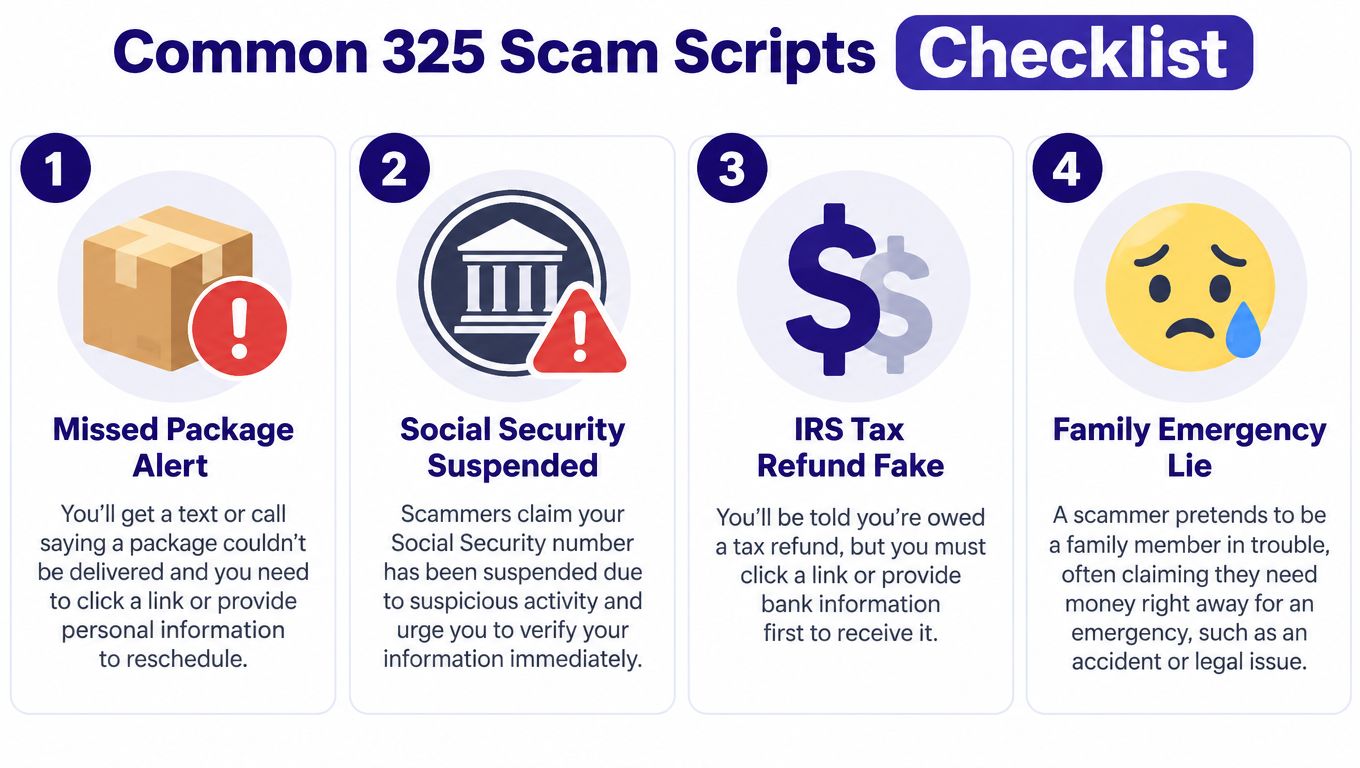
Listen for the structure
- Package delivery: “Your package couldn't be delivered. Press a key or confirm your address.” The caller may ask for a card payment or direct you to a link. The warning sign is an unexpected delivery problem combined with a demand to act through the caller's channel.
- Utility threat: “Your local utility account is overdue, and service will be disconnected today.” The scammer may request a gift card, wire transfer, or payment through an unfamiliar system. A real account concern should be checked through the utility's official website or a bill, not through the incoming call.
- Medicare or Social Security impersonation: “Your benefits or Social Security number are connected to a case.” The caller may ask for identifying details, banking information, or a fee to resolve the issue. Threats of arrest, suspension, or immediate legal action are strong reasons to hang up.
- Family emergency: “I'm your grandchild. I'm in trouble and can't talk normally.” The caller may ask you to keep the situation secret and send money quickly. Contact the family member or another relative through a number you already trust.
- One-ring callback trap: The phone rings briefly and stops. Calling back may connect you to an unwanted service or confirm that your number is active. You don't need to return an unexplained missed call.
The Federal Trade Commission-linked complaint information summarized by CallerSmart shows that reported 325 activity includes prerecorded voices at 38.95% of reports. The same summary identifies complaint themes such as Google Listings calls at 11.58%, payday-loan pitches at 11.05%, health insurance at 7.9%, Medicare and Medicaid at 5.26%, and auto warranty calls at 8.42%. It also reports medical and prescription offers at about 8.13% and impersonation-style calls at 6.70%.
The exact script may change tomorrow. The pattern usually doesn't. Urgency, secrecy, impersonation, and unusual payment instructions matter more than memorizing a particular sentence.
How to Verify a 325 Call Before You Trust It
Verification works best when you move the conversation away from the incoming call. Don't try to prove the caller's identity by asking more questions while staying connected. A persuasive scammer can answer prepared questions, invent employee numbers, and repeat details they found elsewhere.
Use an independent callback routine
- Let the call go to voicemail when possible. Save the message, but don't treat a confident voice or a detailed explanation as proof.
- Record the claim. Note the organization, caller's name, reference number, reason for calling, and requested action.
- Find the organization yourself. Use a statement, bill, official website, insurance card, or the back of a payment card. Don't use the callback number supplied by the caller.
- Hang up and dial the verified number. Ask whether the claimed order, case, account notice, or appointment exists.
- Search carefully. You can search the exact displayed number in quotation marks with terms such as “scam” or “complaint,” but search results are supporting evidence, not identity verification.
Caregivers can make this easier for a parent or grandparent by agreeing on a family rule. The person receiving the call may ask for the caller's name and reference number, then say, “I'll call the organization back using the number on my statement.” They shouldn't confirm a Social Security number, account number, password, one-time code, or banking detail before that independent call.
Remember: A legitimate caller should accept a callback. A scammer needs to keep control of the line.
Voice impersonation can make a familiar voice less trustworthy than it sounds. For readers who want more context, detecting AI-generated audio in 2026 explains why hearing a relative or official-sounding person isn't enough to confirm identity.
For additional phone-checking guidance, see how to check a phone number for spam. The safest habit remains the same: verify through a trusted channel you locate independently.
Where to Report and How to Block 325 Scam Calls
Reporting and blocking solve different problems. Blocking reduces interruptions from a particular number or calling pattern. Reporting gives regulators information about the campaign, especially when scammers rotate through multiple caller IDs.
| Channel | Best For | Key Limitation |
|---|---|---|
| FCC complaint portal | Suspected spoofing, unwanted calls, and caller-ID violations | A complaint may not produce an individual response |
| FTC ReportFraud | Fraud, impersonation, and financial-loss reports | It doesn't guarantee recovery of lost funds |
| Do Not Call Registry | Reducing lawful telemarketing from participating sellers | It won't stop scammers or every robocall |
| Texas Attorney General | State-level consumer complaints | The office can't personally resolve every case |
| Mobile carrier reporting | Sending suspicious calls to your carrier's filtering system | Labels and blocking can miss newly spoofed numbers |
| Phone settings | Silencing or blocking unwanted calls | Settings may also silence legitimate unknown callers |
If you lost money or shared account credentials, contact the relevant bank, card issuer, or service provider immediately through an official number. Preserve the phone number, voicemail, text message, payment record, and a summary of what the caller said. Those details can help when you submit a complaint.
The Do Not Call Registry is useful for reducing some legitimate telemarketing, but it isn't a shield against fraud. Blocking one displayed number also won't stop the next spoofed 325 number.
Match the report to the situation
Use your phone's built-in block feature after documenting the call. iPhone and Android devices also offer settings that can silence unknown callers or identify suspected spam. Carriers may provide their own filtering services, and landline users can consider a physical call-blocking device.
If you want background on legal remedies for persistent robocalls, understanding TCPA lawsuits can clarify why call records and evidence matter. Legal action isn't the right response to every unwanted call, but keeping records is sensible when the conduct continues or causes harm.
Proactive Tools and Apps That Add a Safety Layer
Personal caution remains important, but it can't screen every call while you're working, sleeping, or caring for someone else. A layered approach gives you several chances to interrupt a scam before money or information changes hands.
Start with features already on the phone. iPhone users can enable Silence Unknown Callers, while Android users may have Caller ID and spam protection. Carrier labels such as “Scam Likely” can add another warning before you answer, although no label should be treated as perfect.
Choose one practical layer first
Carrier services can provide additional filtering. AT&T offers ActiveArmor, Verizon offers Call Filter, and T-Mobile offers Scam Shield. Features, availability, and paid options can vary, so check the current terms with your carrier before enabling a service.
Third-party call-screening apps take a different approach. Some depend heavily on databases of reported numbers, while others analyze the interaction itself. Gini Help is one option that screens unknown calls, asks who is calling and why, and can provide live analysis with a risk score and warnings during an active conversation. It also supports protection for calls, email, and SMS in one app, which can help households dealing with several types of suspicious messages.
You can compare spam call blocker app approaches before choosing a tool. Consider whether the service offers a free or paid tier, what permissions it requests, whether it works on your device, and how it handles contacts and recordings.
Don't try to configure every defense at once. This week, enable one built-in spam feature or review your carrier's filtering option. Then explain to the person you're protecting what the warning means and what action to take next.
A Simple Daily Checklist for You and Your Family
A short checklist is easier to use than a long safety lecture. Save these habits in a note, print them near the phone, or share them with the relative who receives the most unexpected calls.
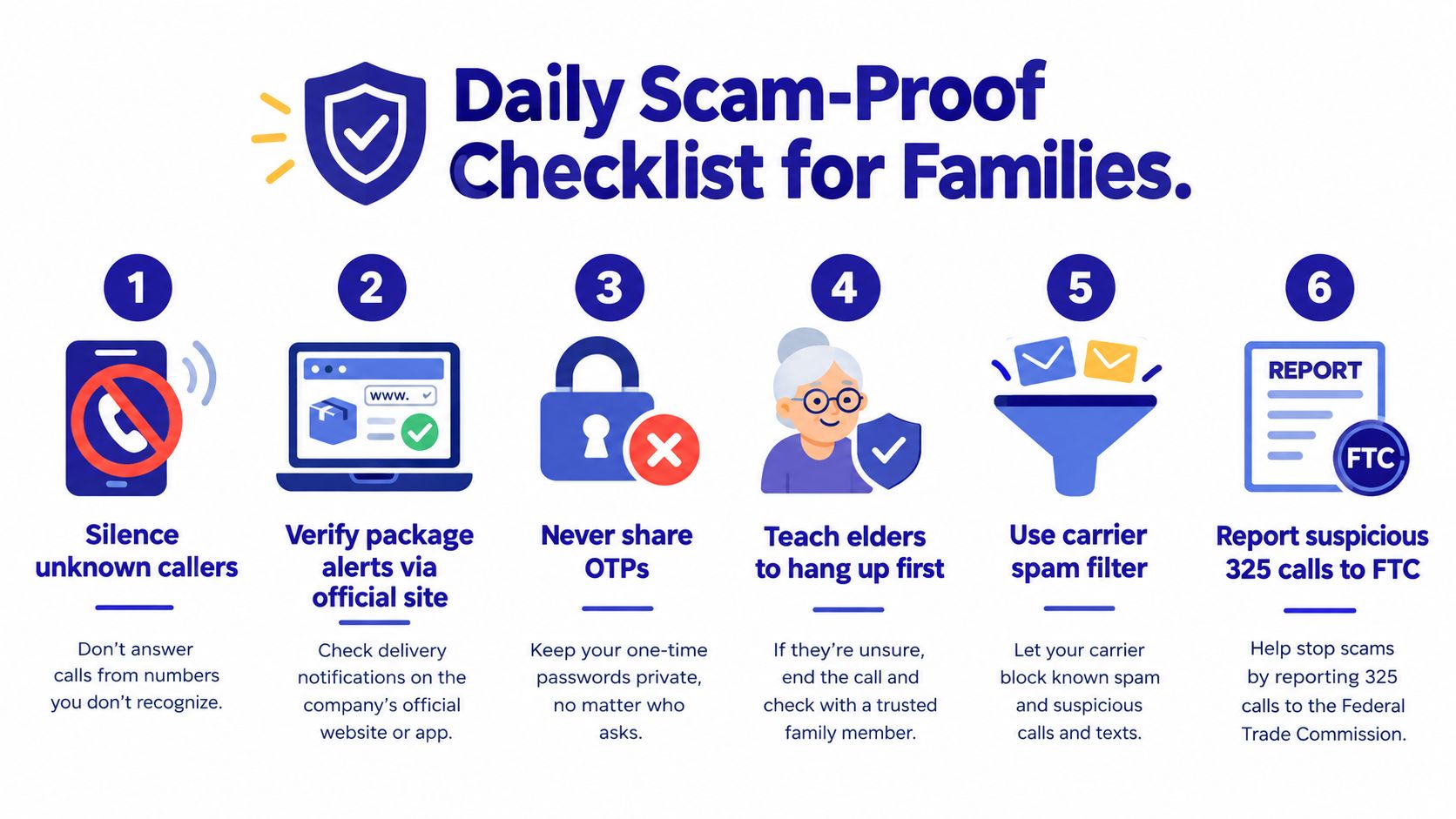
Before answering
- Let unfamiliar numbers wait. Send an unknown 325 call to voicemail unless you're expecting a specific callback.
- Notice warning labels. Treat “Scam Likely” or another spam warning as a reason to pause.
- Consider the timing. An unexpected call at an unusual hour deserves extra caution, especially when it demands immediate action.
During the call
- Protect identity details. Don't share Social Security information, banking details, passwords, or security codes.
- Reject pressure. Hang up if the caller threatens you, demands secrecy, or refuses to let you verify the claim.
- Ignore caller-provided callback instructions. Find the organization's number on a bill, card, or official website.
After the call
- Verify the business independently. Contact the claimed company through a trusted route and ask whether the call was real.
- Document the conversation. Keep the displayed number, voicemail, requested payment method, and claimed organization.
- Tell someone else. A quick warning to family can prevent a relative from answering the same campaign.
Ongoing habits
- Keep devices updated. Install operating-system and app updates from trusted sources.
- Review permissions periodically. Check which apps can access contacts, calls, messages, or notifications.
- Use the Do Not Call Registry where appropriate. It may reduce some lawful telemarketing, but it won't stop deliberate fraud.
- Report confirmed scams. Submit details to the FTC and the appropriate carrier or regulator.
The most valuable protective action may be sharing this checklist with a parent or grandparent before the next call arrives.
Gini Help screens unknown calls, texts, and emails, and can analyze a live conversation for warning signs such as pressure, money requests, or demands for personal information. Visit Gini Help, or download the app from Google Play or the App Store to add a screening layer for area code 325 scam calls.