Area Code 202 Scam: How to Spot and Stop It
By Josh C.
The 202 area code alone doesn't prove a call is genuine, local, or government-linked; what matters is whether the caller asks for money, passwords, verification codes, secrecy, or urgent action. If a familiar-looking number can be copied, why treat the number on your screen as identification?
A convincing caller doesn't need you to believe everything. They need you to trust them long enough to answer a question, read a code, or make a payment. Understanding that sequence makes an area code 202 scam easier to interrupt without assuming every Washington caller is dishonest.
Why a 202 Caller ID Proves Nothing
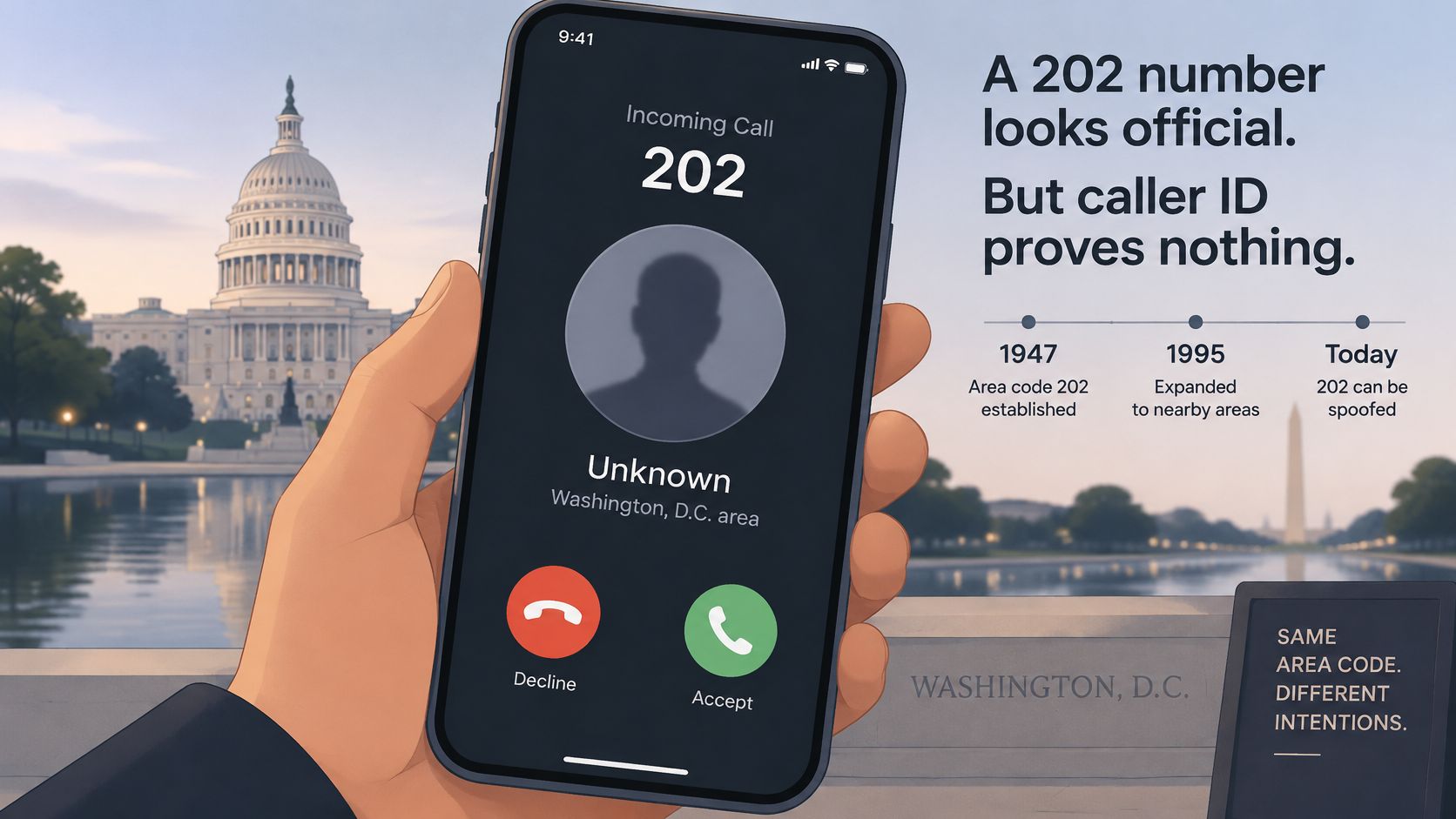
Could a call showing a Washington, D.C., area code come from somewhere else? Yes. The 202 code is a real geographic identifier, but the number displayed on your phone does not establish the caller's identity or location. Someone impersonating a federal office may use it to make a call feel official.
According to the history of Washington, D.C. area codes, 202 was created in October 1947 as an original North American Numbering Plan code serving the District exclusively, and the 771 overlay was introduced in 2021 to serve the same area. Both remain legitimate geographic identifiers.
A familiar number can work like a convincing return address: it may look right without proving who sent the message.
How the number gets onto your screen
Caller-ID spoofing is the falsification of information displayed with a call. Internet-based phone systems can transmit caller-ID information selected by the caller, allowing someone outside Washington, including someone in another country, to display a Washington-looking number. Learn more about how caller-ID spoofing can make a number appear genuine.
The same tactic can make other familiar local numbers seem trustworthy. A U.S. Government Accountability Office analysis documents a sharp rise in neighbor-spoofing complaints to the FCC and FTC between 2015 and 2018. That pattern concerns spoofing broadly, not 202 scams specifically.
Authority is the attraction
A caller claiming to represent a court or agency may use Washington's association with government to make an unexpected request sound official. Knowing your name or mentioning a real institution still does not confirm who is calling.
The reported $6,000 scam targeting an Albany woman shows that financial fraud can affect people outside Washington, too. An area code is a social-engineering cue, not a reliable map of where a caller is or proof of their authority.
Practical rule: Treat the displayed number as unverified. A 202 prefix may suggest a connection to Washington, but it does not establish the caller's identity or location.
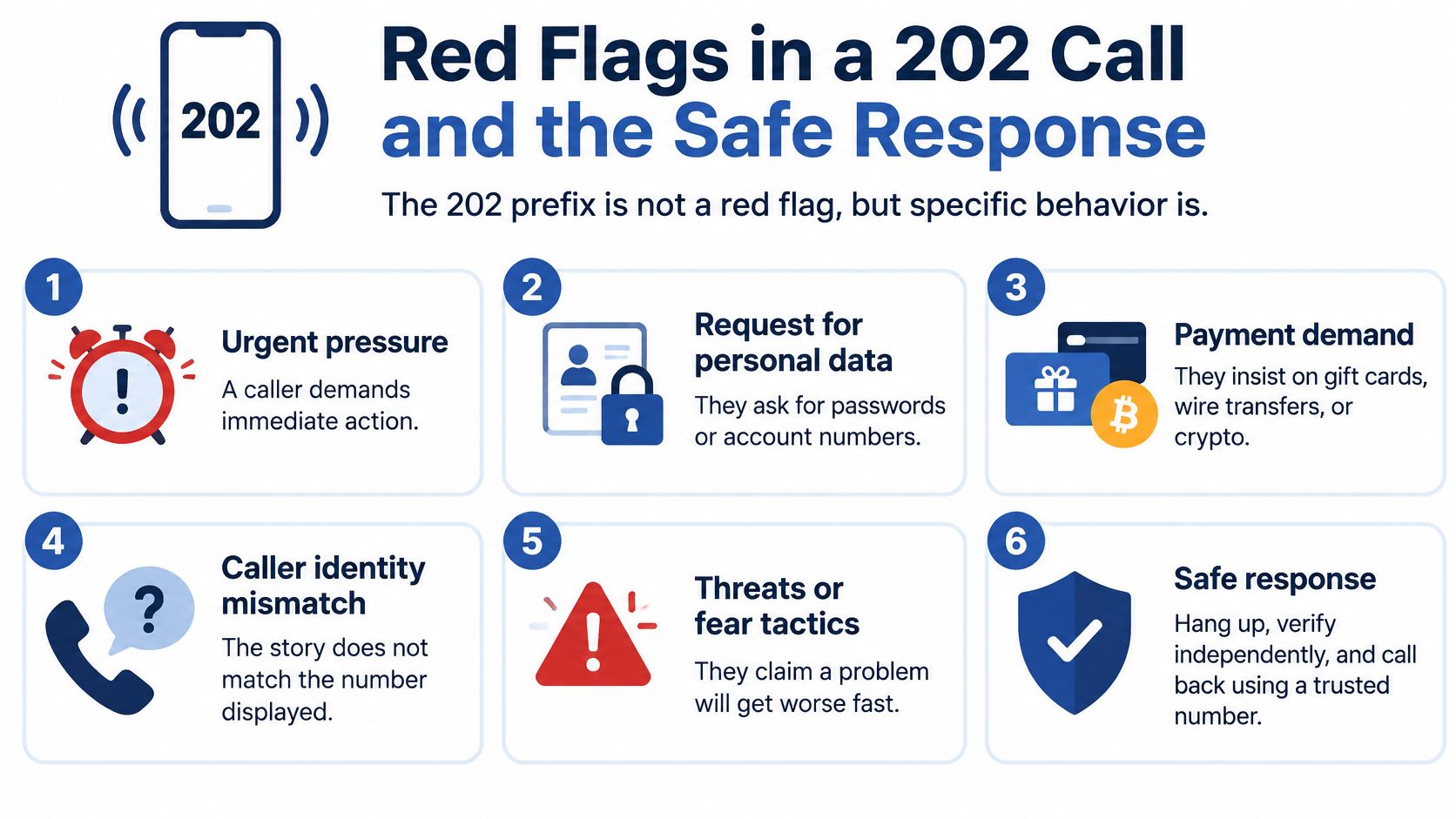
Red Flags in a 202 Call and the Safe Response
The 202 prefix is not a red flag, but specific behavior is.
Red flags in 202 scam calls and the response to each
| Red flag | Typical caller script | Safe response |
|---|---|---|
| Demand for money | Pay a fee, tax or fine right now | Hang up; never pay an unexpected caller by gift card, cryptocurrency or prepaid debit card |
| Request for codes or passwords | Read me the one-time code we just sent you | Hang up; don't give an unexpected caller a sign-in or verification code |
| Urgency or threats | Arrest, lawsuit or benefit cut today | Pause, end the call and call back through an official number you look up yourself |
| Request for secrecy | Do not tell your bank or your family | Treat secrecy as a warning and tell a trusted person |
| Refusal to allow verification | Stay on the line while I process this | End the call; don't press keys to be removed |
| Prize or refund claim | You won a prize or are owed a refund | Don't share bank details; ignore the offer and report it |
Keep this visual checklist available if you find it difficult to remember warning signs under pressure.
Why these tactics work
A payment demand gives the conversation a destination. A request for a password or code may sound like routine security, but it can let the caller enter an account or authorize an action.
Threats discourage reflection. Secrecy removes the bank employee, relative, or friend who might recognize the deception. Refusing a callback keeps the caller in control of how you check their story.
A prize or refund changes the emotion from fear to anticipation, but the boundary stays the same: an unexpected caller shouldn't receive your banking credentials. Government offices won't demand money to release prizes or require prepaid cards to settle supposed debts.
The FTC's caller-ID warning explains that scammers can make calls appear to come from trusted agencies or local numbers. Don't provide account numbers, Social Security numbers, passwords, or financial details during an unexpected inbound call.
Interrupt before you comply
Don't press a key to remove yourself from a suspicious robocall list. That interaction can identify you as a potential target for further calls; hanging up avoids continuing the exchange.
For tax-related pressure, Tax Attorney Stephen A Weisberg's guidance is additional reading about evaluating tax-company promises. A frightening phone demand still needs independent verification, not a decision made while the caller waits.
This video provides another way to review phone-scam warning signs.
Before acting, ask:
- Identity: Who claims to be calling?
- Context: Why is this contact unexpected?
- Request: What do they want from me?
If a caller asks for money, passwords, or urgent action, independently check the request before acting.
Sample 202 Scam Conversations, Step by Step
These are illustrative composites, not transcripts or reports of actual incidents. Each scene shows how an ordinary-sounding introduction can become a demand.
The FTC's warning about government imposters describes callers who claim a tax or other debt, create urgency, and demand prepaid debit-card payments. It also states that a Washington-looking caller ID doesn't establish legitimacy.
Monday morning, the supposed tax investigator
Opening line: The caller says they work for a federal tax office and are reviewing unpaid back taxes. The listener sees a Washington number and stays on the line.
Pressure point: The caller threatens arrest before the listener has time to consult anyone. When the listener asks for a letter, the caller says the matter has moved beyond ordinary correspondence.
First money request: The caller directs the listener to buy a prepaid debit card and read out its details.
End the call: The listener disconnects rather than negotiating a smaller payment. They locate the agency's contact information independently and ask whether there's a genuine account issue.
The caller might substitute gift cards if the listener doesn't understand prepaid cards. Changing the payment method doesn't make the demand safer.
Tuesday afternoon, the supposed benefits agent
Opening line: An automated message claims the listener's Social Security number has been suspended.
Pressure point: The message warns that benefits or identity records are at risk unless the listener connects with an agent.
First data request: It asks the listener to confirm their Social Security number or use a keypad option to continue.
End the call: The listener hangs up without interacting. They don't need to reach a human agent to establish whether the demand is suspicious.
A person who continues might encounter someone asking for more identity information, then instructions to transfer money for supposed protection. The initial automated message can be an entry point rather than the entire scam.
Wednesday evening, the supposed bank fraud team
Opening line: The caller says a Washington bank has flagged a suspicious charge.
Pressure point: They warn that the transaction will proceed unless the listener helps cancel it immediately.
First data request: They ask for a one-time verification code and offer to stay on the line while the listener signs in.
End the call: The listener withholds the code and contacts the bank using the number on their card. They don't install remote-access software or follow instructions to move funds.
A caller's second request often reveals the destination: access, payment, or control. You don't need to wait for it if the opening demand is already unsafe.
The decisive moment is before disclosure or payment, not after you've proved the caller dishonest. Ending an unsolicited conversation doesn't prevent you from resolving a genuine problem through a trusted channel.
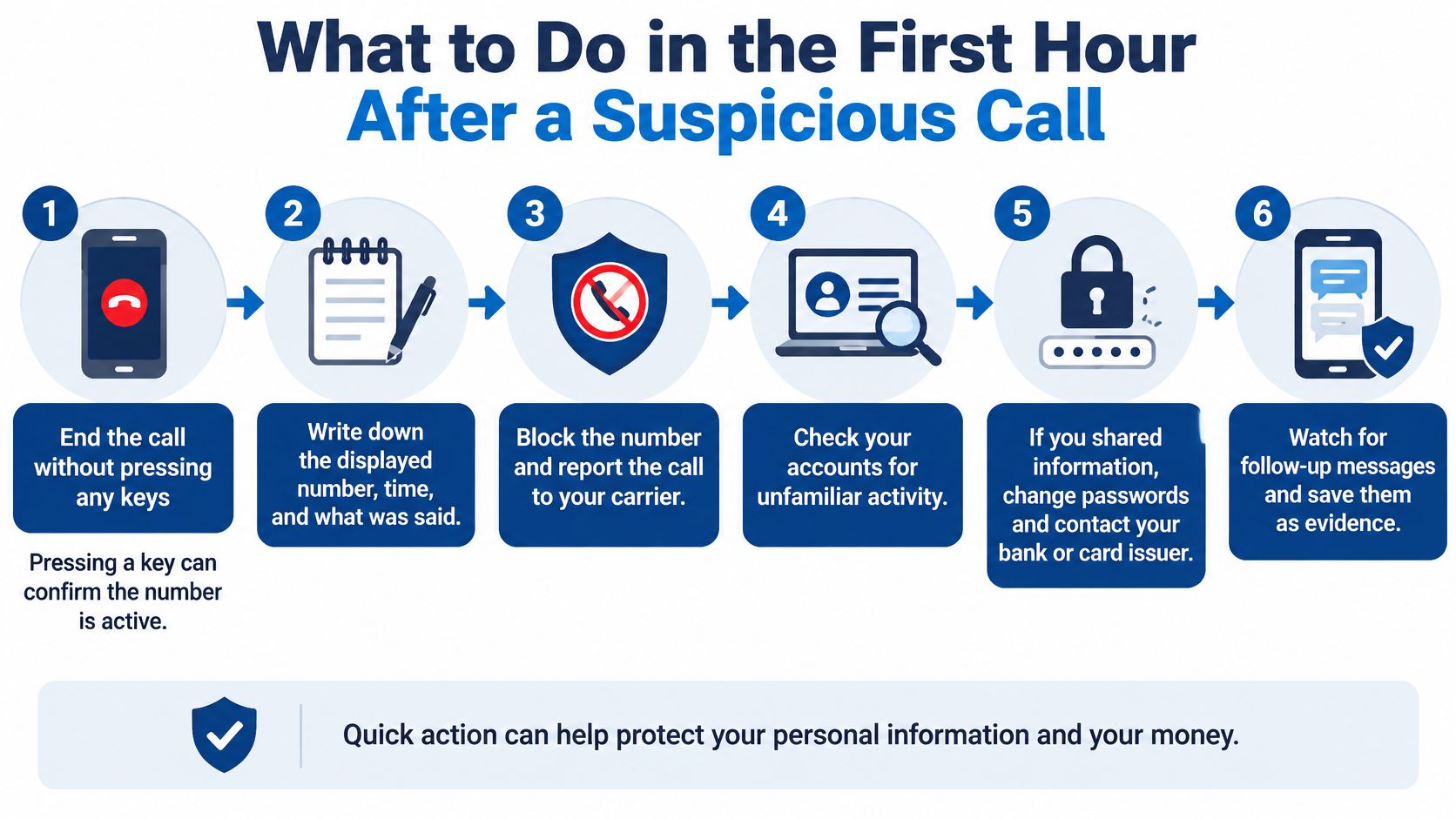
What to Do in the First Hour After a Suspicious Call
If you've already paid or shared account access, prioritize containment over collecting a perfect record. If the caller is still connected, disconnect first.
Protect money and access first
Contact the bank or payment service immediately if anything was shared. Use the number printed on your card or the provider's official app, and explain whether you disclosed a password, verification code, card details, or authorized a transfer. For gift cards, wire transfers, or cryptocurrency, also contact the gift-card issuer, sending service, or exchange with the transaction details; a card issuer alone may not be able to address those payments.
End contact without pressing keypad options. Don't accept a transfer to a supposed supervisor or security department. If you installed remote-access software, disconnect the affected device from the internet and use another trusted device to contact your bank.
Write down the essentials while they're fresh. Record the displayed number, time, claimed name and organization, and what the caller requested. Distinguish what you disclosed from what the caller merely asked for, so the bank can assess the exposure.
Verify through the organization's own channel. Find its number on an official website, an existing statement, or the back of your card, rather than using a number supplied during the call. A legitimate 202 number may belong to an uninvolved person or organization whose identity was copied.
Keep this response checklist somewhere you can find it without searching through messages from the caller.
Preserve evidence and bring someone in
Save voicemails, texts, and call logs. Keep payment receipts and transaction references too, then check accounts for unfamiliar activity. If you shared a password, change it through the official account website or app, change reused passwords elsewhere, and review unfamiliar signed-in sessions.
Tell a trusted relative, friend, or caregiver. Explain what happened without assigning blame: the caller's claim, the requested action, and anything already sent. A helper can take notes or sit with you while you contact the bank, making it easier to follow instructions under stress.
Report the call to the FTC and FCC. Include both the displayed number and any callback number the caller supplied, along with the claimed organization and payment method. You can also report it to your carrier and block the displayed number, recognizing that blocking doesn't prevent the same person from calling with another identity.
For a practical response guide, keep what to do when you get a scam call available alongside your bank's contact details.
For caregivers: Start with reassurance and the next useful action. Embarrassment can delay the very call that might help limit a loss.
Watch for follow-up messages offering refunds, investigations, or recovery services. Don't let someone who contacts you unexpectedly become the person responsible for fixing the original incident.
Current Trends Behind 202 Impersonation Scams
A 202 caller ID may look local to Washington, D.C., but it does not show where a call really comes from. The code is better understood as a possible social-engineering signal: a caller may use a familiar-looking number to make a request seem official. The larger trend is that fewer unwanted-call complaints can coexist with rising losses from fraud affecting older adults.
The figures below concern older-adult fraud and unwanted-call complaints broadly. They do not count scams specifically using 202 numbers.
Current fraud figures affecting older adults
| Measure | Figure | What it means for a 202 call |
|---|---|---|
| Older-adult fraud losses | Older-adult fraud losses have risen sharply, according to the FTC's older-adult report announcement | Treat a suspicious call as a possible financial threat, not just an annoyance |
| Median loss, phone-originated fraud | The FTC's older-adult fraud report reports a $3,000 median loss for older adults when fraud began by phone, compared with $599 when it began on social media | A persuasive voice conversation deserves particular caution |
| High-loss impersonation reports starting with a phone call, 2024 | The FTC's impersonation data spotlight says 41% of older adults reporting business- or government-imposter losses of at least $10,000 identified phone calls as the initial contact, compared with 13% for email and 15% for online ads or pop-ups | The opening call may lead to a longer attack |
| Growth in $10,000+ impersonation losses, 2020 to 2024 | The same FTC data spotlight reports more than fourfold growth in older adults' reports involving at least $10,000 lost, and nearly sevenfold growth in reports involving losses above $100,000 | These are increases in high-loss reports, not proof that every caller is becoming more dangerous |
| Do Not Call complaints, fiscal year 2025 | The FTC's impersonation and unwanted-call findings describe more than 2.6 million complaints, about 48% below roughly 5 million in 2021 | Fewer nuisance-call complaints do not establish that an individual call is safe |
Call volume and financial consequences measure different things. A drop in complaints does not mean that losses from individual fraud cases have also fallen.
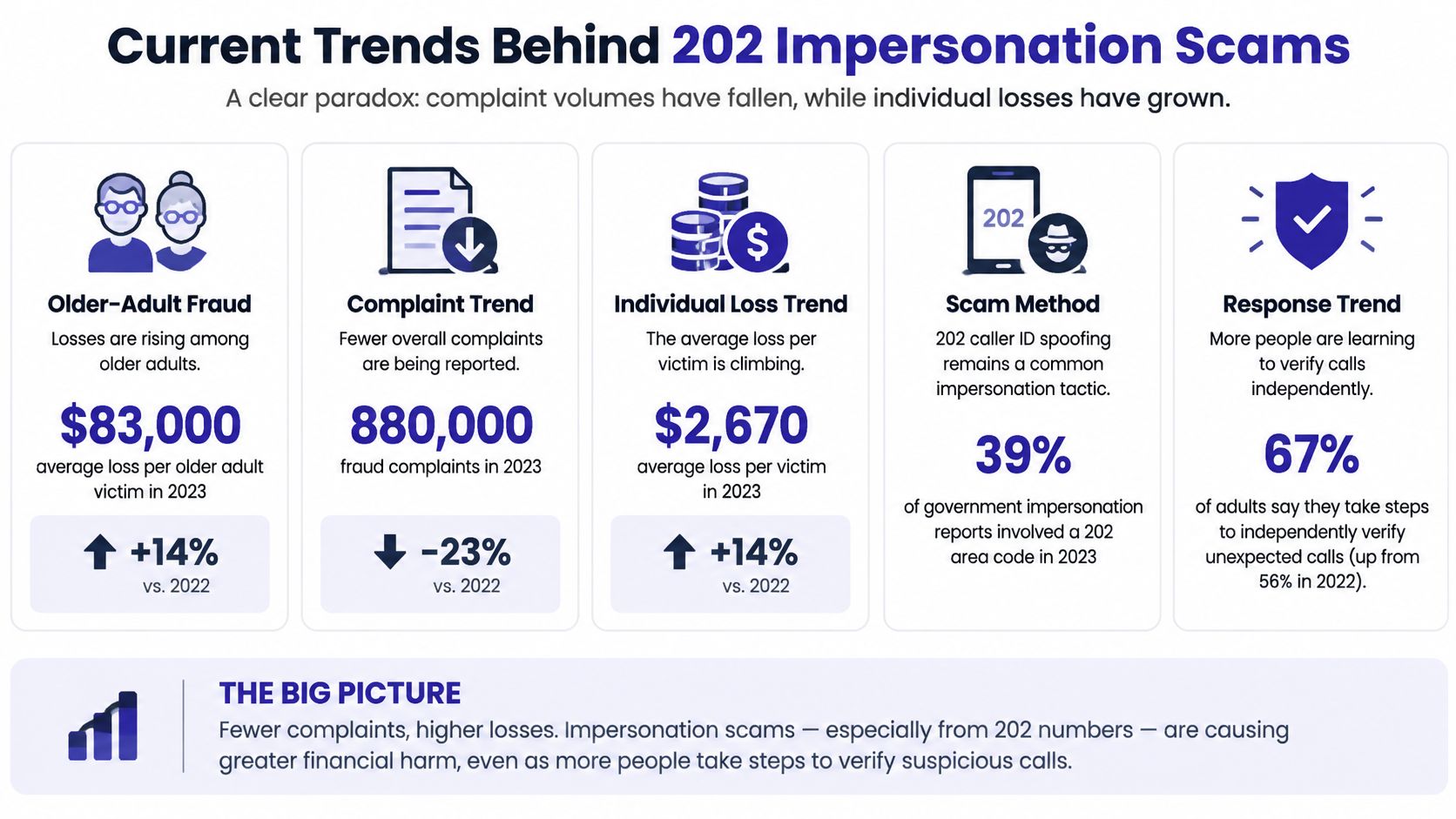
Judge severity, not frequency
Total reported losses do not show what every victim loses. A median is the midpoint, not an average, and complaint totals are not a count of every call people receive.
Phone contact can give an impersonator room to build trust through conversation, then ask for account access or a transfer. The figures describe reported outcomes; by themselves, they do not show that scammers have shifted to fewer, more persuasive calls.
For caregivers, agree in advance that an older relative can end an unexpected call and contact you without embarrassment or needing permission. That shared rule can make it easier to pause when a caller uses a 202 number to create a sense of authority or urgency. Judge the request by its potential consequences, not by how rarely the phone rings.
Protect Your Phone Before the Next Call
A displayed 202 code can't authenticate a caller. You can assess the caller's behavior and check important requests through a separate, trusted channel.
Add screening without giving up verification
Gini Help is one option for screening calls, texts, and email. Our AI call screening answers unknown callers before the phone rings on every plan; our guide to screening phone calls explains the approach.
On eligible plans with the required setup, Live Scam Detection keeps listening after you answer and warns about dangerous requests, including verification codes, account numbers, or immediate action. Every plan includes text and email scam scanning for texts and your Gmail or Outlook inbox.
Screening reduces unwanted calls, but it can't identify every scam or guarantee every caller is safe. Important requests still need independent verification.
Download the app from Google Play or the App Store. Install it for yourself or help a relative aged 50 or older set it up, confirm the selected plan includes the features needed, and keep the callback habit in place.
Gini Help offers unknown-call screening and scam checks for texts and email, with live warnings during answered calls on eligible plans. Visit Gini Help to choose protection that fits your household, while keeping one firm boundary: a Washington-looking number never replaces independent verification.