Text from Unknown Number What to Do and How to Stay Safe
By Josh C.
You're sitting at the kitchen table when a message appears: “Hello, is this Sarah?” A few minutes later, another text claims to be from a delivery company and asks you to tap a link to fix an address. Neither message looks dramatic. That's why people answer.
A text from an unknown number deserves a pause, not an automatic reply. In 2024, consumers reported losing $470 million to scams that began with text messages, and the amount was five times higher than in 2020, according to the U.S. Federal Trade Commission's 2024 text-scam data. The FTC identified package delivery, account security, and impersonation messages among the leading themes.
The safest mindset is simple: assess, don't engage. You don't need technical expertise to make a sound decision. You need a short routine that helps you recognize pressure, links, payment requests, and conversation patterns before the sender gets your attention or trust.
This guide shows how to triage an ambiguous message, when to verify through a separate channel, how to report and block it, and how caregivers can help older relatives build safer habits. If the message mentions a Walmart gift card or an unexpected reward, this Walmart gift card text message warning offers useful context for spotting that familiar fraud pattern.
Introduction Why That Random Text Deserves a Second Look
A genuine mistake can look exactly like the beginning of a scam. Someone may text, “Are we still meeting for lunch?” A courier may send a delivery update. A bank may notify you about an account event. The problem is that scammers deliberately copy these ordinary situations because people respond before they stop to identify the sender.
The FTC found that “wrong number” texts often begin with innocent-looking openers such as “hello” or “do you want to get coffee?” The sender then builds familiarity and moves the conversation toward a costly fraud. That progression makes the message harder to judge than an obvious demand for money.
Unknown-number texts have also become routine. Historical complaint data show robotext complaints rising from about 3,300 in 2015 to 18,900 in 2022, while consumer complaints about text-message scams increased by 500% over only a few years, as summarized by Kiplinger's reporting on the FCC's response. McAfee reported that about 1 in 4 Americans had received a wrong-number text, and broader polling found that 61% of adults receive scam texts at least once a week, according to the same report.
The first decision isn't “Is this definitely a scam?” It's “What could happen if I respond?”
That question changes your behavior. You won't click just because a message uses a familiar company name. You won't call the number shown in the text to “check.” You'll open the company's official app, use a saved contact, or ask a trusted person to help verify the claim.
The rest of this guide gives you that routine in practical terms. You'll learn how to read the sender's approach, identify a wrong-number funnel, inspect urgency and payment language, preserve evidence, report the message to your carrier, and add screening tools for yourself or a family member.
How Scammers Use Texts From Unknown Numbers Today
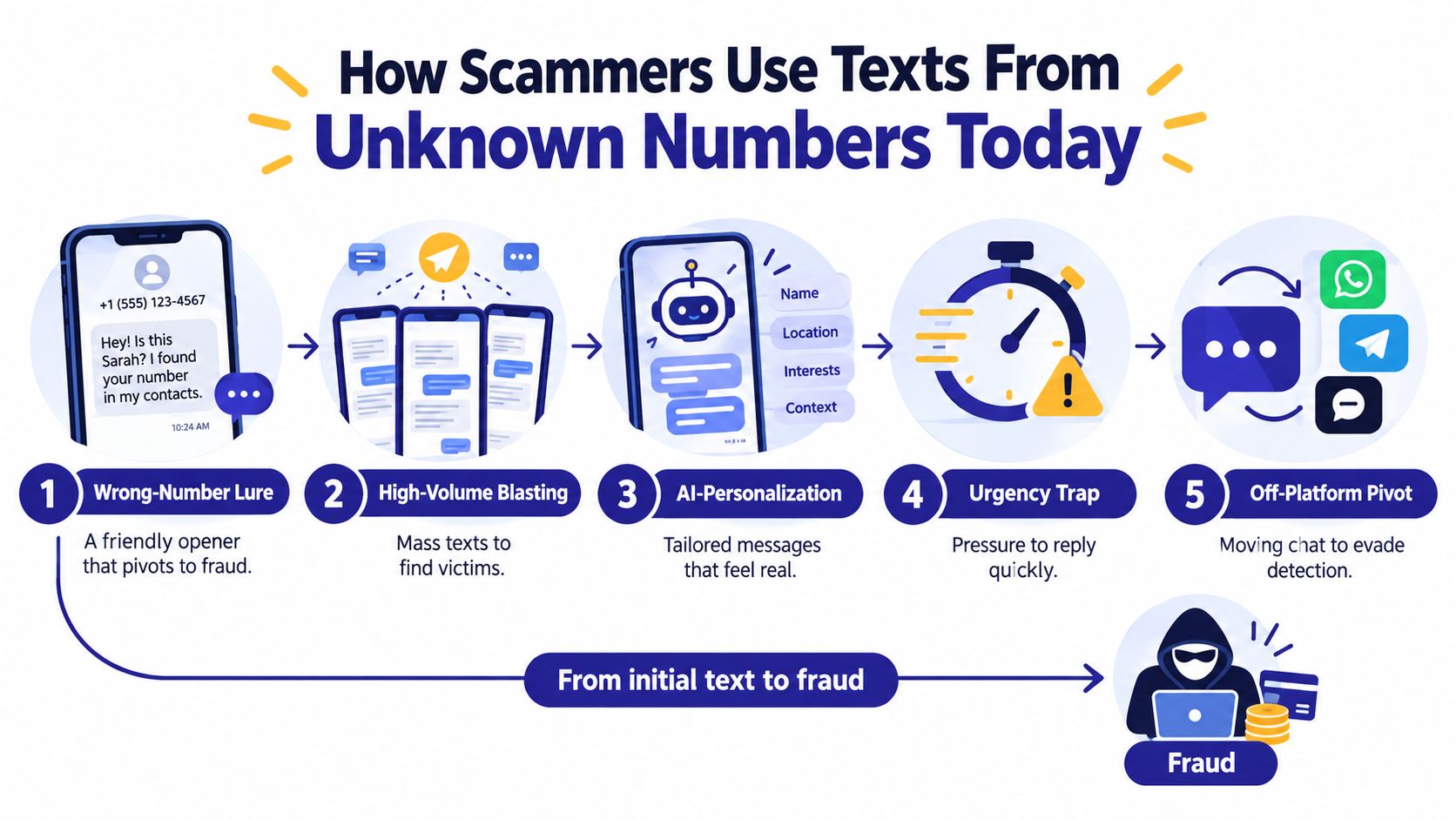
A text that says “Sorry, is this Michael?” may look harmless. The sender could be testing whether the number is active, starting a wrong-number conversation, or just contacting the wrong person. Read the next move before deciding whether to ignore, verify, or report it.
Obvious scams use strange links, fake prizes, or demands for passwords. More effective messages begin with ordinary conversation. The sender apologizes, asks a casual question, and continues chatting after you explain the mistake. The goal is to find people willing to engage, then guide them toward a risky action.
Academic analysis of 119,398 scam texts found wrong-number scams were the largest category, representing 16.36% of all scam texts in that analysis, as reported in the research on large-scale scam-text patterns. The opening is deliberately low pressure. The financial request often appears later, through investment, cryptocurrency, payment, or account-access language.
The conversation matters more than the number
A phone number does not establish identity. Scammers rotate numbers, imitate businesses, and use automated systems to contact many people. Blocking one number may end one thread, but it does not stop the method. Learn how smishing works and why text scams bypass number-based blocking.
Look for this progression:
- Friendly opener: “Sorry, is this Michael?” or “I think I saved the wrong number.”
- Trust building: The sender keeps chatting after learning they have the wrong person.
- Personal positioning: They mention work, travel, investing, family, or another topic that creates familiarity.
- Off-platform pivot: They ask you to move to WhatsApp, Telegram, email, or another channel.
- Financial turn: They introduce an opportunity, emergency, gift card, transfer, or request for account access.
This funnel explains why a polite exchange can still be dangerous. The first message may be testing your willingness to reply rather than asking for money immediately. A stranger who keeps pushing after a wrong-number explanation has given you a clear reason to stop responding.
User-reported text analysis also shows why sender-based judgment fails. One analysis classified 35.12% of unique reported texts as spam, 40.27% as scam texts, and 23.3% as unknown, according to the study of 7726 reporting data. In another finding from that research, people identified fake messages more accurately than legitimate ones, with average accuracy of 67.1% for fake messages versus 43.6% for real messages.
Scammers combine timing, personalization, and automation to make a message feel relevant. A polite tone does not make the requested action safe. Adults 50 and older deserve particular attention. The FTC reported $4.3 billion in fraud losses for this age group, compared with $2.3 billion among younger adults, in its 2025 consumer-loss reporting, summarized by AARP's coverage of the FTC and FBI data.
Ask two questions: “Why is this stranger continuing the conversation?” and “What do they want me to do next?” The answers determine whether you should ignore, verify through a known channel, or report the text.
Quick Safety Check Before You Reply or Tap Anything
Put the phone down for a moment. Don't reply while you're deciding whether the message is legitimate. A quick inspection should answer four questions: Is there pressure, a link, a request to change channels, or a request for money or information?
Look for pressure and a forced next step
Urgency is the strongest warning sign. “Your account will close today,” “You must confirm now,” and “Don't tell anyone” are designed to prevent careful thinking. A legitimate organization may notify you about an issue, but you can usually verify it through its official website or app without using the text's link.
A request to move to WhatsApp or Telegram deserves extra caution. Changing channels can make the conversation harder for your carrier or messaging app to analyze, and it gives the sender more room to build a private relationship.
Links require the same discipline. Don't tap to discover where a link leads. If the message claims to come from your bank, parcel carrier, employer, or a government office, open the known app or type the official website into your browser yourself.
Compare the wording
A legitimate message might say, “Your pharmacy order is ready. View details in the pharmacy app.” A suspicious message might say, “Your prescription is blocked. Click immediately or reply YES to avoid cancellation.”
The difference isn't perfect grammar. It's the combination of fear, secrecy, an unfamiliar sender, and a demanded action. Don't trust a message just because it contains your name, a logo, or a location you recognize.
If you're uncertain, verify separately. Use a known phone number from your records, the back of your payment card, or the organization's official app. Never use the contact details supplied in the suspicious text.
For an additional review of whether a sender appears risky, use this guide to check a phone number for spam, but treat any lookup as supporting information, not proof of identity.
If the message creates panic, asks for secrecy, or directs your money, stop the conversation and verify elsewhere.
What to Do and What Never to Do With an Unknown Text
The safest response to a text from an unknown number is usually no response. Replying can confirm that your number is active, which may invite more unwanted messages. Even “Who is this?” gives the sender an opening to continue.
| Safer choice | Riskier choice |
|---|---|
| Leave the message unanswered while you inspect it. | Reply to correct the sender or ask what they want. |
| Open the official app or use a saved contact to verify. | Tap the link or call the number in the message. |
| Take a screenshot if the message may need reporting. | Delete the evidence before recording the sender and wording. |
| Forward suspicious texts to 7726 through your carrier. | Continue chatting to test whether the person sounds real. |
| Block the sender after preserving useful details. | Share a one-time code, address, password, or account detail. |
The 7726 reporting shortcode is used by most major carriers to collect spam-text intelligence. The FTC's guidance on recognizing and reporting spam texts notes that several mobile providers support forwarding unwanted messages to 7726.
Separate verification from the suspicious thread
Suppose a text says your credit card was locked. Don't call the number displayed in the message. Open your banking app, use the number printed on the card, or visit the institution's official website by entering the address yourself.
Suppose a relative appears to ask for urgent money. Call the relative through a saved contact, or contact another family member who can confirm the situation. Don't rely on the text thread, even if the writing sounds familiar.
If you already tapped a link, don't panic and don't keep interacting. Close the page, avoid entering information, update the relevant account through its official app, and tell a trusted person what happened. If you entered a password, change it through the legitimate service and review account activity.
How to Block Report and Screen Future Unknown Texts
Start with the message itself. Take a screenshot that shows the sender, date, and content. Use your phone's messaging controls to block the number, then delete the conversation if you don't need it for reporting or follow-up.
Next, forward the unwanted text to 7726, which spells “SPAM” on a phone keypad. Follow your carrier's instructions, and don't add commentary that requires you to engage with the sender. Reporting helps providers collect information about malicious campaigns and investigate or block related senders.
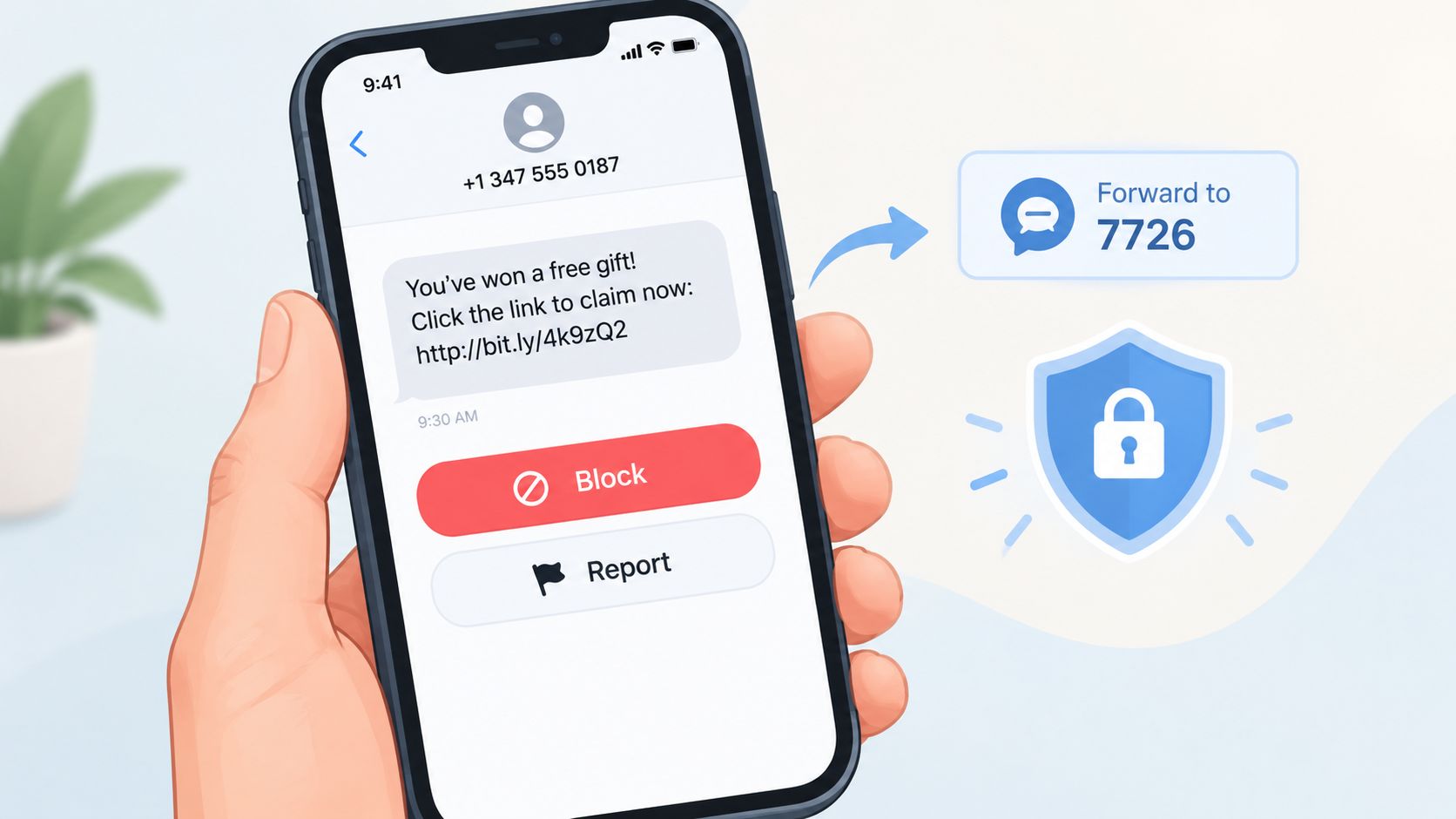
Blocking is useful, but it has a limit. Scammers can switch numbers, so you also need message screening and a family routine. Your phone may offer filtering for unknown senders, spam detection, or automatic separation of suspected junk messages. Turn those controls on and review the filtered folder occasionally, because a legitimate message can sometimes be misclassified.
The guide to blocking unwanted text messages can help you find the relevant settings for your device and carrier.
Carriers and regulators can block enormous volumes without eliminating the deception at first contact. Australian telecommunications companies blocked more than 969.4 million scam SMS messages from July 2022 through September 2025, yet scam pressure continued, according to Nomorobo's 2025 scam report. Blocking supports safety, but judgment and screening still matter.
For households that want another layer, download Gini Help from Google Play or the App Store. It screens calls, texts, and email for suspicious links and requests, giving families another way to review unknown communications before responding.
Show older relatives how to preserve a message, forward it to 7726, block it, and call a trusted person before taking action. A shared routine works better than telling someone to “be careful” after every suspicious text.
Staying Protected and Helping Others Stay Safe
Keep one rule visible on your phone or near a family member's charging station: unknown text, no reply, separate verification. Add three more actions, save evidence, report to 7726, and block the sender. If the message involves money, account access, a one-time code, or secrecy, involve another person before doing anything.
Older adults need practical support, not blame. The FTC reported that fraud losses among adults 60 and over increased about fourfold from about $600 million in 2020 to $2.4 billion in 2024, and losses above $100,000 increased eight-fold, from $55 million to $445 million, according to the FTC's report on protecting older adults. FBI and IC3 reporting for 2025 recorded 201,266 complaints from Americans 60 and older and $7.748 billion in reported losses, according to the 2025 IC3 report snapshot.
Caregivers can reduce risk by agreeing on a simple family plan. Decide which trusted contacts may approve unusual payments, where official account numbers are stored, and what phrase means “stop and call me.” Regular check-ins can reinforce habits without turning every phone notification into a crisis. Resources such as these morning call safety prompts can help families make safety conversations routine.
Keep this short checklist:
- Pause: Don't answer an unfamiliar sender.
- Inspect: Look for urgency, links, secrecy, channel changes, and payment requests.
- Verify: Use an official app, website, or saved number.
- Preserve: Screenshot suspicious messages.
- Report: Forward unwanted texts to 7726.
- Protect: Block the sender and use message screening.
- Ask: Bring in a trusted person before sending money or information.
Gini Help screens calls, texts, and email for suspicious links, scam language, and risky requests, giving you another layer against messages from unknown numbers. Visit Gini Help to learn how it can support safer communication for you and the people you care for.