Text Message Scam Hello: What It Is and What to Do
By Josh C.
An unknown number sends “hello” while you're making dinner. You may want to reply in case someone mistyped, but that answer is the key decision point: it confirms your number is active and opens a conversation. You can leave the message unanswered without figuring out who sent it.
Text-message scams cause substantial consumer losses each year. A greeting can be the first step in a wrong-number scam, so pause before replying. You don't need to determine who sent it to protect yourself.
Why an Unexpected Hello Text Is a Warning Sign
A bare greeting from a stranger deserves caution, not an automatic courtesy reply. It could be a genuine mistake, but you can't establish that from the greeting alone, and you don't owe an unknown sender a conversation.
The wrong-number approach works because it looks ordinary. The sender might write “hello” or “do you want to get a coffee?” rather than opening with an obvious demand. It's like a stranger knocking to see whether anyone answers: each response tells them someone is available.
This is what the opening can look like on your phone.
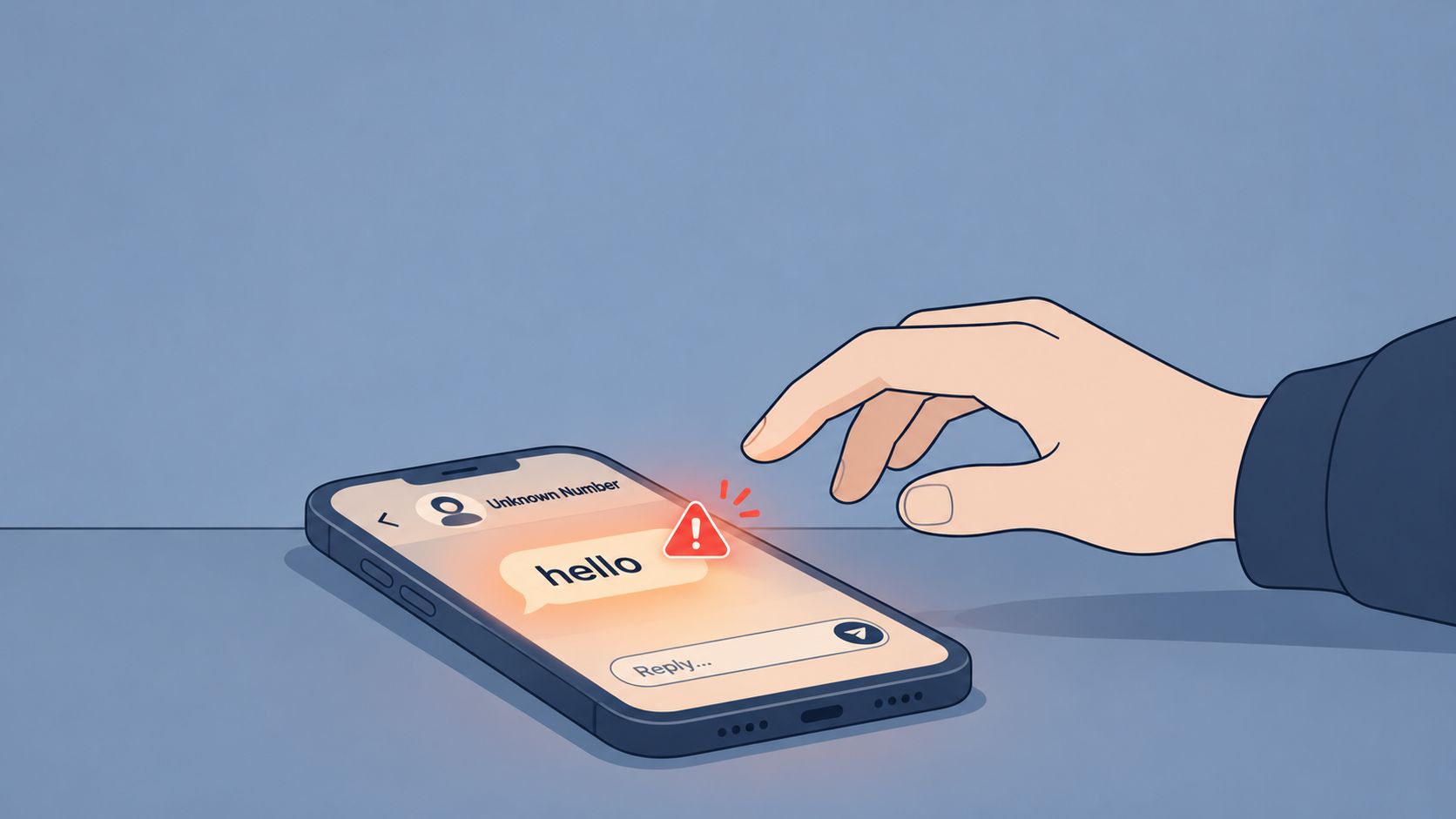
The Federal Trade Commission's text-scam spotlight identifies wrong-number messages among the leading text-scam patterns in 2024, alongside fake package-delivery notices, bogus job offers, bank fraud alerts and unpaid-toll demands, and reports $470 million in U.S. consumer losses, more than five times the 2020 amount despite fewer reports. The FTC also cautions that reported losses understate the total because many people never report fraud.
Courtesy isn't a security check
The problem isn't the word hello. It's the invitation to engage with someone whose identity and intentions you haven't verified.
You might think a correction will end the exchange. A scammer instead treats your politeness as an opportunity to continue, perhaps with an apology, a compliment or a question about your day.
Practical rule: An unexpected greeting from an unknown number gets no reply.
That's a precaution, not an accusation. You can leave a message unanswered without deciding that every unfamiliar sender is a criminal.
How the Wrong-Number Scam Unfolds, Stage by Stage
The ethical-hacking expert cited in HuffPost's explanation of the hello-text scam describes the initial goal as learning whether a real person is attached to the number. After that, the sender can replace broad outreach with more personal persuasion.
The graphic shows the broad progression from first contact to a financial request.
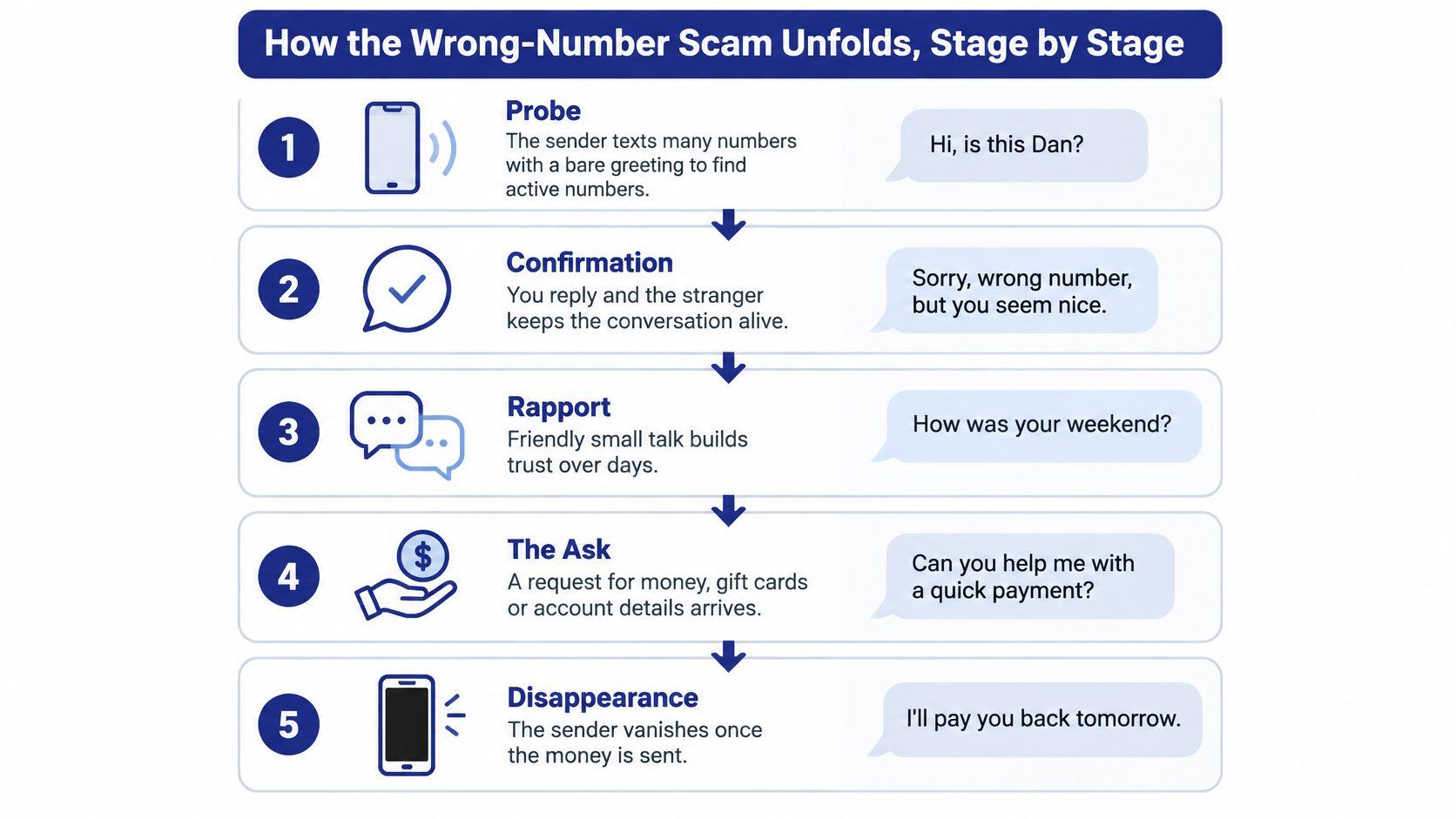
From greeting to request
Consider this illustrative exchange. The sample messages below demonstrate the pattern, rather than reproduce a particular victim's conversation.
- Probe. A message asks whether you're Dan. The sender doesn't need to know your name beforehand; they're testing whether someone responds.
- Confirmation. You correct them, and they apologize but add that you seem kind. Your answer has established that you read unfamiliar messages and may engage.
- Rapport. A follow-up asks how your weekend went. Friendly conversation makes the stranger feel less unfamiliar, without verifying who they are.
- Disclosure. The sender describes a difficult day and asks about your family. Personal stories or photographs can encourage you to share information they can use later.
- Pitch. They mention a successful trader they know or suggest continuing on another app. The relationship becomes a route to a financial opportunity or a less visible conversation.
- Request. A message asks you to send cryptocurrency to activate an investment account. Other versions seek money, account details or a verification code.
The first message may contain no link at all. That's why checking only for suspicious web addresses isn't enough. A harmless-looking opening can precede a dangerous request.
This video offers another way to recognize the conversational setup.
You don't have to wait for the final demand to leave. A shift toward investments, payments or another messaging app is a reason to stop and independently verify, not an invitation to investigate by continuing the chat.
Scam Text Categories Ranked by How Often They Appear
In a dataset of 119,398 reported scam texts, wrong-number scams accounted for 16.36%, banking scams for 9.14%, and delivery or parcel scams for 6.81%. The FTC's text-scam announcement also notes that text-message open rates can reach 98%.
Scam text categories by share and safe response
The figures show the share of reported messages in this dataset. They are a guide to the categories represented there, not a complete measure of every scam in circulation.
| Scam text category | Share of scam texts | Typical request | Safe response |
|---|---|---|---|
| Wrong-number or hello scams | 16.36% | Friendly chat, then investment or payment | Don't reply; block and report |
| Banking scams | 9.14% | Urgent fraud alert, verification code | Call the bank using the number on your card |
| Delivery or parcel scams | 6.81% | Fee or redelivery payment link | Check the carrier's app or official site directly |
| Job offers, toll notices and other categories | Not specified | Paid online tasks or payment of an alleged toll | Verify through a trusted channel |
Bank and delivery texts often give you a reason to act quickly: protect an account or recover a parcel. A wrong-number opener works differently. The sender can use conversation to find out which story might persuade you, then make a request that changes the stakes.
A ranking does not show that link-free greetings caused wrong-number scams to appear often. It does highlight why checking links alone is not enough: a link checker cannot assess a link that has not arrived.
Use categories to choose your response
For examples of how scam messages change, read this guide to new text-message scams. HearSmart's cybercrime data for everyday consumers offers wider context on account security and fraud.
The decision point is your reply. If an unsolicited greeting fits the wrong-number pattern, you do not need to keep chatting to learn the sender's intentions. Use the table's response, and independently verify any request through a trusted channel.
Red Flags That Separate a Real Hello From a Scam
A greeting alone can't authenticate a sender. Instead, examine what the person claims, where they want to take the conversation and what they want you to surrender.
- Who is writing. Be cautious about a generic greeting without your name, someone insisting you should recognize them, or a supposed friend who won't confirm their identity through an established contact method. Familiar language isn't proof of familiarity.
- What they want to move. Watch for pressure to switch apps, keep the conversation private or use an unfamiliar trading platform. A new communication channel or investment site can separate you from checks you'd normally use.
- What they ask for. Money, passwords, account numbers, one-time codes and rushed decisions are reasons to stop. A friendly tone doesn't make a sensitive request safe.
If a casual conversation turns into a cryptocurrency recommendation, don't treat technical vocabulary or screenshots of profits as evidence. MemeAssist's guide to Solana meme coin scam warning signs offers additional checks for that specific investment context.
Check the person without answering the stranger
If someone claims to be a friend, call the number already saved in your contacts. A real friend can confirm through a channel you already share; you don't need to supply family names or other clues to help an unknown sender pass your test.
Your bank doesn't need you to relay an unsolicited login code to a stranger. Open its app yourself or call the number on your card.
Verify the request somewhere other than the conversation that delivered it.
An ordinary wrong-number exchange should need nothing beyond an apology and correction. Persistent questions about your life, efforts to maintain contact or a payment proposal warrant caution, even if the opening looked innocent.
What to Do If You Already Replied and How to Report It
A reply isn't the same as handing over an account. It can confirm that your number is active, but your next action should match what you shared. Don't panic, and don't send another message to explain that you're leaving.
Match recovery to your exposure
Recovery actions by what you shared
These are practical triage labels, not a diagnosis that your phone or accounts have been compromised.
| What you shared | Risk level | First action |
|---|---|---|
| Only “Who is this?” or “Wrong number” | Low | Stop replying, block the number, delete the thread after saving it |
| Friendly chat, no personal details | Medium | Stop, screenshot the chat, block and report |
| Name, address or family details | Medium-high | Stop, review accounts for unusual activity, ask your carrier about account security |
| A one-time code, password or card number | High | Change passwords now, contact the bank using a trusted number, ask your carrier to secure the account |
| Money, cryptocurrency or a clicked link | High | Contact your bank or payment provider immediately, then report to the FTC and FBI IC3 |
The last row groups situations that need prompt attention, but clicking a link isn't automatically equivalent to sending money. If you only opened a page, close it and check whether you entered information, downloaded anything or granted permissions. Contact your bank or payment provider immediately if payment details or funds were involved.
The FTC's older-adults report reports that older adults' aggregate losses from text scams rose 61% in 2025. That's a reason to act promptly, not to assume that a brief reply has caused financial loss.
Take these actions in order
- Stop communicating. Ignore apologies, threats and follow-ups from other numbers. Don't confront the sender or try to trick them into confessing.
- Preserve evidence. Save screenshots showing the conversation, sender's number and timestamps. Keep payment receipts, transaction identifiers and the original message where possible.
- Secure exposed accounts. If you entered a password, change it through the genuine app or a website you open independently. Replace reused passwords on other accounts and review signed-in devices.
- Contact the affected service. Use the bank number on your card, an established app or a trusted statement. Explain exactly what you shared and ask about blocking transactions, replacing cards or recovering access.
- Ask your carrier about account security. Request available protections against unauthorized account changes, including an account PIN and number-transfer protection where offered.
For a caregiver helping someone through this process, Rx360 on protecting older adults provides additional identity-protection context. Offer practical help without blame, and let the person describe what happened before choosing recovery steps.
Block and report
- Block the sender. Use the conversation's contact or information menu in your messaging app.
- Mark it as junk or spam. Use the app's reporting option when available.
- Forward it to your carrier. In the United States, forward suspicious texts to 7726 (SPAM).
- Report unwanted texts to the FCC. The FCC's unwanted-text guidance explains that autodialed or prerecorded texts generally require prior consent, with exceptions such as emergencies, even when your number isn't on the National Do Not Call Registry.
- Report scams and losses. Report phone scams to the FTC and money or cryptocurrency losses to the FBI's Internet Crime Complaint Center, IC3.
Our guide to how to report a scammer can help you organize the reporting process. Preserve evidence before deleting the conversation.
Americans aged 60 and older reported $7.748 billion in losses in 2025, up 59% from 2024, according to the FBI's elder-fraud brochure; those figures cover internet-crime complaints broadly, not just hello texts.
Blocking addresses one sender, and campaigns can rotate numbers. Don't resume a friendly exchange because the person hasn't asked for money yet.
Block, Report and Verify Before You Reply Again
Make your default response simple: leave an unexpected hello unanswered, block and report suspicious messages, and independently check requests for money, codes or account access. You don't have to solve the sender's story.
For ongoing phone settings and habits, our guide to how to stop spam texts provides practical next steps. If you're helping a family member, agree on a trusted way to confirm unusual requests before the next message arrives.
Add screening without surrendering judgment
Gini Help offers text filtering that moves suspected scam texts into a separate folder, helping catch fake delivery alerts, prize scams and phishing links before you encounter them. Filtering and warnings depend on your phone platform, so review the current store listing and setup requirements for your device rather than assuming identical features everywhere.
Our support team helps with SMS safety and reporting scams, as well as call screening and email protection. Email protection is available when you connect a supported inbox.
Screening is a backup layer, not permission to trust an unfamiliar sender.
Some scams can still get through. A message appearing in your main inbox doesn't prove it's safe, and a warning should prompt a pause rather than a conversation with the sender.
Choose the download option for your phone:
- Android: Download the Gini Help app on Google Play.
- iPhone: Download the Gini Help app on the App Store.
Choose one concrete action today: block the unknown sender, report the message or install the app and review its protection settings.
Gini Help offers scam screening and support with SMS safety, giving you an added layer of help when an unfamiliar greeting arrives. Visit Gini Help to explore protection for your phone and get help choosing your next step without replying to the stranger.