Vishing vs Smishing: Calls, Texts and How to Spot Each
By Josh C.
Consumers reported losing $470 million to scams that began with text messages in 2024, more than five times the amount reported in 2020, according to new FTC data on text message scams. That single figure reframes the usual conversation about phishing. The channel often dismissed as a nuisance, a stray text about a package or an unpaid toll, has become a nine-figure fraud business in the United States alone. Yet the same reporting shows that the quieter, less frequent channel, a live phone call, still extracts more money per victim. Understanding why requires looking at both scams side by side, not as rival threats but as two stages of the same playbook.
Vishing vs Smishing at a Glance
Vishing is phishing carried out through a voice call. Smishing is phishing delivered by SMS. Both channels rely on impersonation, urgency and a request that moves the victim toward disclosure or payment. The difference is the pressure point. A call gives the scammer a live conversation. A text gets a tap, a reply or a callback.
According to the FTC Consumer Sentinel Network 2024 data book, phone-call fraud generated 284,659 fraud reports in 2024, $948 million in reported losses and a $1,500 median loss. Text-based fraud generated 246,784 reports, $470 million in reported losses and a $1,000 median loss. That means calls produced about 15% more reports, roughly twice the reported dollar loss and a 50% higher median loss.
| Factor | Vishing (voice call) | Smishing (text message) |
|---|---|---|
| 2024 fraud reports | 284,659 | 246,784 |
| 2024 reported losses | $948 million | $470 million |
| Median reported loss | $1,500 | $1,000 |
| Typical hook | Impersonated bank, agency or carrier with urgency | Fake bank alerts, unpaid tolls, delivery notices, wrong-number chats |
| Main pressure tactic | Live conversation and requests for codes or payment | A link to tap, a reply, or a callback number |
| Where to stop it | Before you read out any code or account detail | Before you tap the link |
The comparison points to a practical conclusion. Texts create the larger stream of suspicious contact because they are cheap to send and easy to fire off at scale. Calls appear less often in the figures, yet each reported case costs more on average. The more frequent channel is therefore not automatically the more costly one.
That pattern matters because the two channels often work together. A text can create the first spark, such as a fake delivery alert or bank warning. A call can then supply the live pressure needed to get a code, account number or immediate payment. Treating them as one chain gives you better defensive priorities. Screen unknown calls for high-value requests. Treat unexpected texts as entry points to links, replies and callbacks. Report suspicious messages and calls so the record reflects the pattern rather than only the final loss.
How Each Attack Unfolds Step by Step
A spoofed bank call and a fake delivery text start from the same impersonation, then split on how they force a decision. Vishing is phishing conducted through voice calls. Smishing is phishing delivered through SMS. In both, criminals pose as banks, government agencies, or mobile operators and try to obtain passwords, payment-card details, bank credentials, or other personal information, as the GSMA fraud and scams safety report describes. The channel sets the pressure. A live caller can steer the conversation and demand an action before you hang up. A text uses curiosity or urgency and points you toward a link, a reply, or a callback number.
A typical vishing call runs in five moves.
- The caller ID is spoofed to match a bank, government office, or carrier.
- The caller claims a problem: a suspicious charge, a frozen account, a missed payment.
- They build authority, often by asking you to confirm details a real agent would already hold.
- They ask for a verification code, card number, or a transfer to a "safe" account.
- You act before the call ends, because the conversation never offers a natural pause.
Smishing is shorter, and it usually stalls unless you continue it.
- A text arrives about a failed delivery, an unpaid toll, a bank alert, or a wrong-number chat.
- You tap a link to a lookalike site or reply to confirm.
- The page collects login or card details, or pushes an app download.
- A follow-up text or call adds pressure if you hesitate.
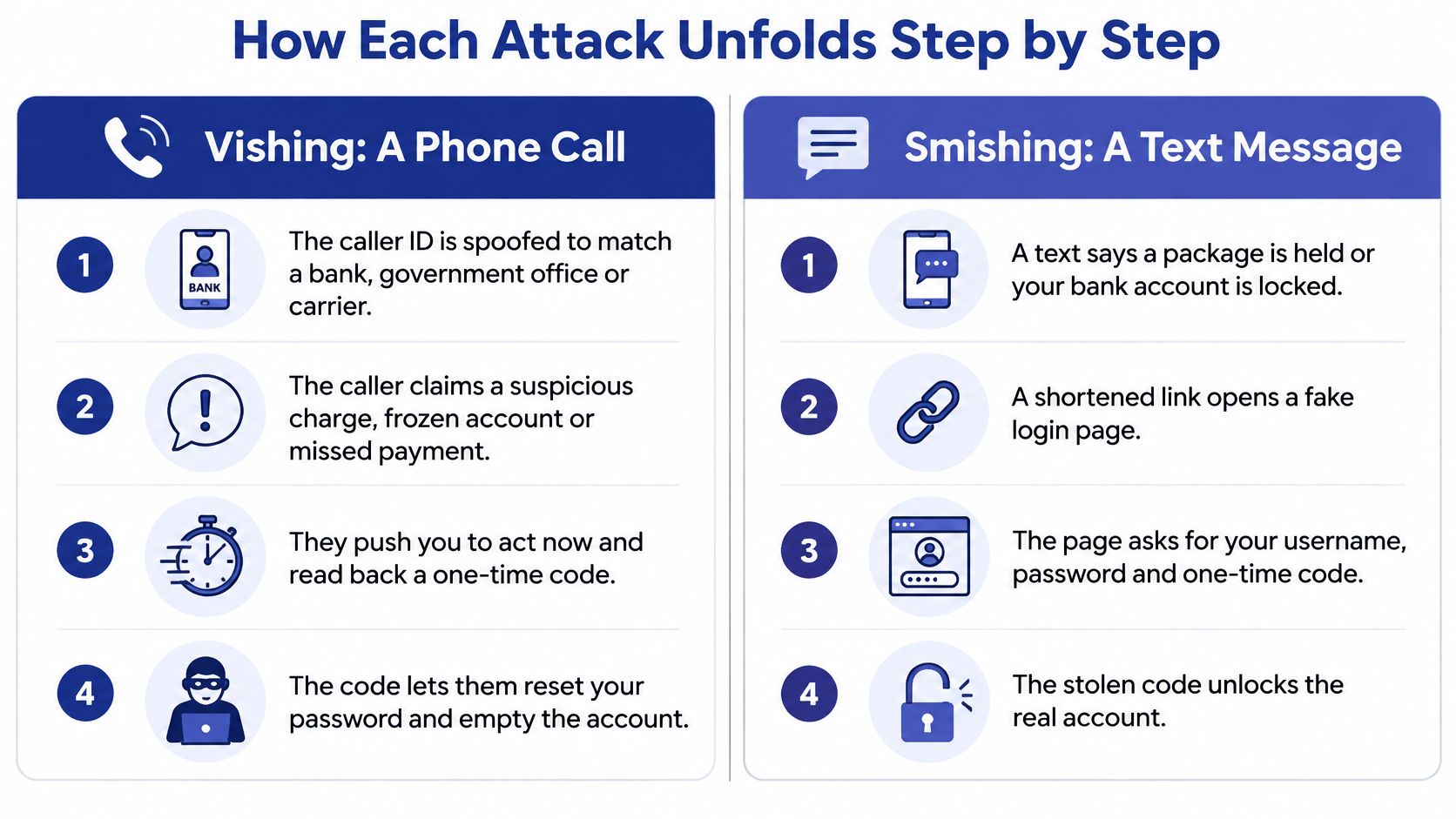
One conversation can finish a vishing fraud. A text usually cannot. It still needs a tap, a reply, or a second contact. That gap is the practical difference: the message leaves a moment to stop and check the sender, while the call is built to keep you talking until you read out a code or move money. Volume does not decide which channel costs more. A cheap text can open the contact, and a later call can be where the larger loss happens.
Warning Signs That Separate the Two
The two channels leave different evidence. A call has to be judged on what the speaker claims, how they escalate and whether they try to stop you from verifying independently. The threat appears in the conversation, not in a known number. A text can be inspected before you act, using sender identity, link destinations, lookalike domains, urgency wording and requests to install software. That's why a static blocklist of known bad numbers is weak against both, and especially weak against vishing, where the danger can emerge from dialogue on a number that was clean yesterday.
| Signal | In a Vishing Call | In a Smishing Text | Safe Response |
|---|---|---|---|
| Sender identity | Spoofed number that looks local or official | Name or number imitating a brand | Ignore the number given and dial the official line |
| Urgency | Pressure to act during the call | Deadline or threat inside the message | Stop; scammers rely on speed |
| Requested action | Codes, account numbers or money moved | Tap a link, install an app or reply | Never share codes or install software from a message |
| Link or callback | Callback number that loops back to the caller | Shortened or lookalike URL | Type the official address yourself |
| Escalation | Caller refuses to let you verify | Follow-up contact from a second channel | End contact and verify through a trusted channel |
On a call, the warning signs to watch are specific. A request for a one-time code is the clearest red flag. So is a refusal to let you hang up and call back on a number you choose. A claim that you must act "right now" is pressure, not service. A caller who knows your name but not your actual account details is working from a list, not a system.
In a text, the tells are visual. A shortened or mismatched link, a brand name with a small spelling change, an unexpected request to reply, or a "wrong number" opener that invites conversation. Our guide to how to detect phishing walks through these cues in more depth.
The universal test: end the contact and reach the organization through the number printed on your card, your statement or its official app. Never the number the message or caller supplied.
Who Gets Targeted and What Scammers Want
A retiree gets a call from someone claiming to be from a Medicare office. They say there's a problem with her account and ask her to read back the verification code that just arrived on her phone. She does, because the caller knew her name and her plan. Minutes later, her password has been reset.
That scenario isn't hypothetical. FTC analysis found that in 2024, 41% of adults aged 60 and older who reported losing at least $10,000 to a business or government impersonation scam said a phone call was the initial contact method. By comparison, 15% identified an online advertisement or pop-up and 13% identified email, according to FTC data on impersonation scams. Across 2020 to 2024, reports from older adults who lost $10,000 or more to these scams increased more than fourfold. Reports involving losses above $100,000 increased nearly sevenfold, and combined reported losses in that highest-loss group rose eightfold, from $55 million in 2020 to $445 million in 2024.
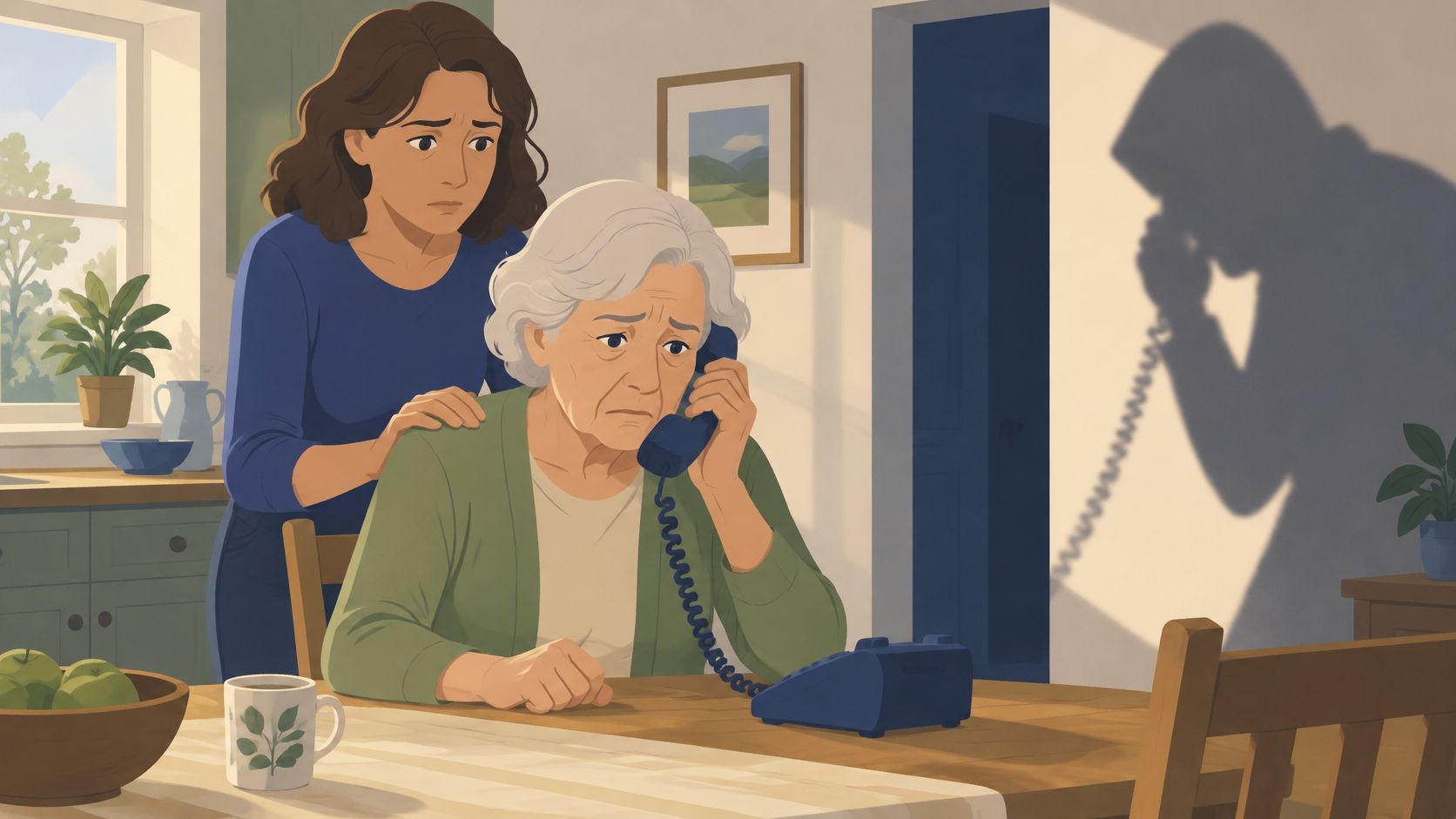
The targeting pattern shows up in ordinary situations. A parent gets a text about an unpaid toll, then a call from a "toll authority" offering to settle it by card over the phone. A caregiver is asked to help "secure" a relative's account by reading out a code. In each case, name the outcome the scammer wants: a one-time passcode, card details, remote access to a device, or a transfer to a "safe" account. The high-loss calls are driven by urgency and authority, not by a link. That's why protecting a family member means rehearsing the code rule, not just warning them about strange links.
If you're evaluating your own exposure, work through three questions. Are you or the person you protect over 60? Do you act as a caregiver for someone's finances or accounts? Does the contact demand codes or money? Two yes answers put you in the highest-risk group regardless of whether the contact arrives by call or text. Teams supporting bring-your-own-device environments face a parallel exposure, since personal phones sit outside corporate controls, as this Purple Access BYOD security overview explains.
When a Text and a Call Are One Attack
A text about a suspicious payment arrives at 9:14. At 9:22, a "fraud department" calls to help you confirm the transaction. Two contacts, two channels, one attacker. Real campaigns increasingly move victims across channels this way. The pattern is simple. A text creates urgency or supplies a callback number, and the follow-up call adds authority and asks for a code or payment. Telephone-based fraud rose 15% from Q4 2025 to Q1 2026, with vishing and smishing both included in that increase, according to the APWG trends report for Q1 2026.
The reverse order works just as well. A "bank" calls first and warns of a problem, then a text arrives containing a one-time code or a link to "complete verification." Both sequences feel like two unrelated contacts. Both are one attack.
The signals that link them are consistent.
- The second contact refers to the first, citing the exact amount, order number or issue you just saw.
- The callback number in the message is the one now asking for codes.
- The contacts arrive within minutes of each other.
- The story changes when you question it, because the script wasn't built for pushback.
That last signal is worth testing directly. Ask the caller to confirm a detail only your real bank would know, or say you will call back through the number on your card. A legitimate institution accepts that. A scripted operation stalls, pushes back or hangs up, because the script depends on you staying inside it.
Channel-by-channel habits create false reassurance. A message that looks harmless in isolation can complete a fraud when a call supplies the missing piece. Advice like "never click suspicious links" doesn't help someone who receives a plausible text and then independently dials the number it lists. The dial feels like the cautious move. It is exactly what the attacker designed the text to produce.
A family habit that works: keep a shared note of any unexpected contact from the past week, whether call, text or email. A caregiver can then see the chain before anyone acts on it.
The frequency of each channel matters less than what the contact demands. A smishing text is cheap to send and arrives in volume, while a vishing call takes an attacker's time and tends to carry the larger ask. Neither label predicts the loss on its own. The question is whether the contact asks you to move money, share a code or skip verification. Those actions carry risk no matter how the request arrives, and they become far more convincing when one channel appears to confirm the other.
Protection Rules for Each Channel
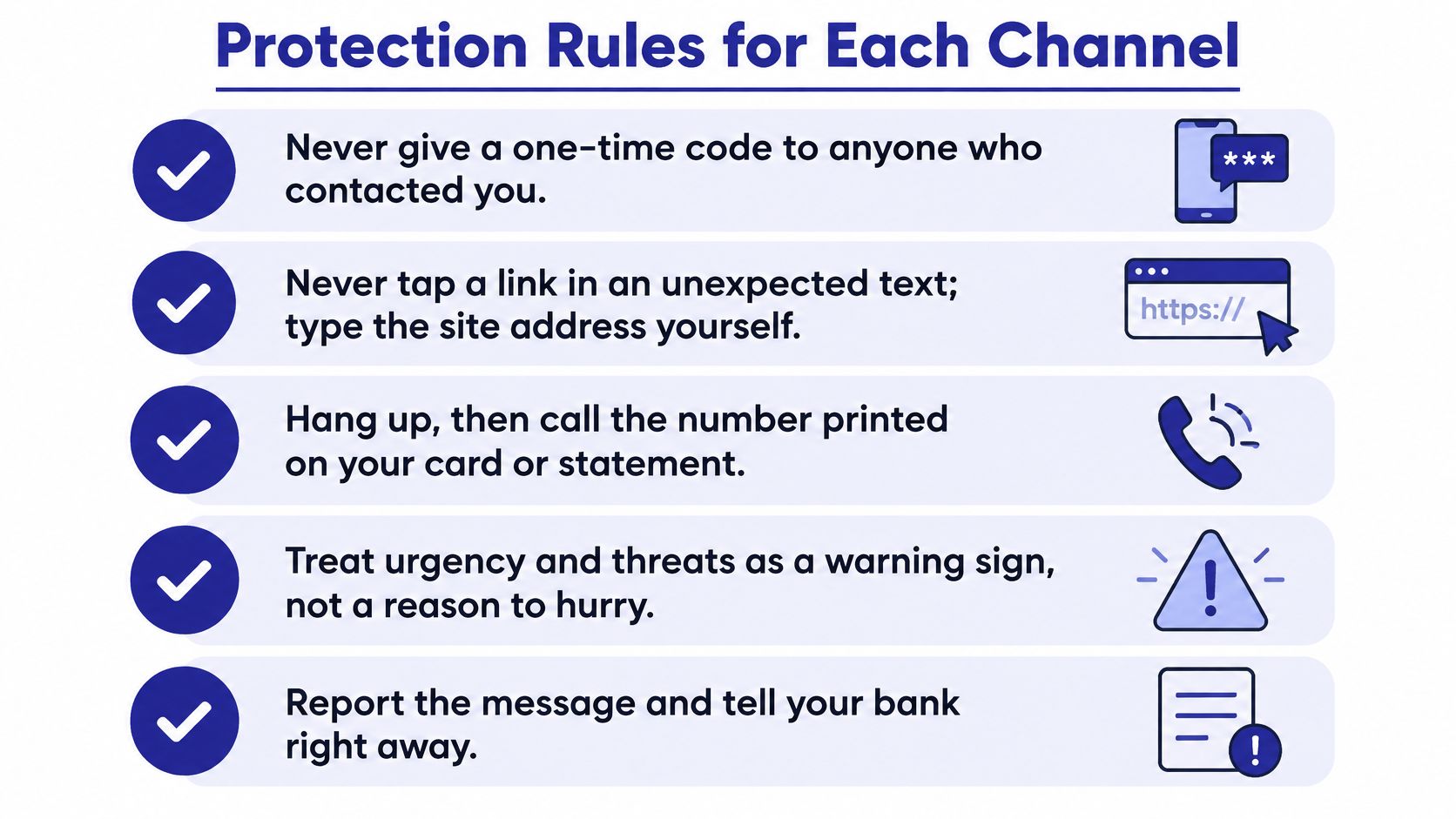
Five rules cover both channels, and they don't depend on you spotting a clever fake.
- Never give a one-time code to anyone who contacted you. No bank, agency or carrier needs it.
- Never tap a link in an unexpected text. Type the site address yourself.
- Hang up and call the number on your card before acting on any call.
- Treat urgency as a warning sign, not a reason to hurry.
- Add a screening layer for calls and texts, then keep using rules one through four.
Screening layers catch what attention misses. Text filtering moves scam texts into a separate folder and catches fake delivery alerts, prize scams and phishing links before you see them. Live Scam Detection keeps listening after a call is answered and warns you during the call if it turns dangerous, such as when someone asks for a verification code or an account number or pressures you to act right now. Email protection scans a connected inbox and warns before you click a dangerous link. Our guide to text message security covers the text side in more detail, and these anti-phishing tips from Finchum Fixes IT help teams build habits around them.
The limit is worth stating plainly. No detector is perfect. A publicly described smishing framework reported 96.2% accuracy, a 3.87% false-positive rate and a 2.85% false-negative rate after text normalization, according to published smishing benchmark research. On a balanced test set, that means roughly 1 in 35 legitimate messages flagged and nearly 1 in 35 malicious messages missed. Real-world performance can be worse when attack prevalence is low, language shifts or scammers deliberately alter spelling and URLs. The rules above still apply, because the human check is the final layer.
Confirm the Caller Before You Act
The decision path is short enough to memorize.
- Stop. Don't act on the urgency.
- Don't use any phone number, link or email the contact supplied.
- Find the organization's number on your card, statement or official app, and call it.
- If you've already shared a code or account number, call your bank or provider immediately.
- Report the contact to the FTC at ReportFraud.ftc.gov, or to your local authority.
The scale justifies the habit. In 2025, consumers submitted more than 1 million reports about imposter scams and reported $3.5 billion in losses, and imposter scams represented nearly one in three fraud reports, according to FTC data on imposter scams in 2025. The FTC also reported that text messages were the most frequently identified contact method when consumers specified how the fraud began. That's the overlap in one sentence: a scam may start with a text and finish on a call, or start with a call and use a follow-up text to grab a code. Our guide to caller verification covers the call side step by step.
A screening app supports the decision path without replacing it. Unlike call blockers that only check a database of known spam numbers, Gini answers unknown calls itself, asks who is calling and why, and only lets real people through to your phone. You can watch a live demo of Gini blocking a real spam call in your browser before signing up. The app is available on Google Play and the App Store.
Gini Help gives you a practical layer of protection against both channels: it screens unknown calls by answering first and asking who's calling and why, filters scam texts before they reach your inbox, and scans email for phishing links. If you want to stop a vishing call or a smishing text before it reaches you, visit Gini Help to see how call screening, text filtering and email protection work together in one app.