Is AI Trustworthy in 2026? a Clear Guide for Users
By Josh C.
Only 46% of people globally said they were willing to trust AI systems, and trust in AI systems fell from 63% in 2022 to 56% in 2024. So, is AI trustworthy? Sometimes, but the honest answer depends on what the system does, what information it uses, and what happens when it gets something wrong.
Would you trust a calculator to add a column of figures, then give the same confidence to a system deciding whether a caller should reach your family? That gap exposes the problem with treating AI trust as a simple yes-or-no question. AI can be useful for drafting an email and unsafe when it acts on your behalf without review.
The practical way to judge AI is through four layers: accuracy, transparency, privacy, and the cost of being wrong. Those layers matter even more in scam and spam protection, where a failure can expose your money, identity, or personal information instead of merely producing an awkward sentence.
The Question Behind the Question
The phrase “is AI trustworthy” hides several different questions. Do you mean whether an AI can summarize a document accurately, whether it can keep your data private, whether it can explain a decision, or whether it should take action without asking you first?
A calculator is trusted for a narrow task because you can inspect the inputs and verify the answer. A self-driving car faces a much harder test because it must interpret a changing environment and make decisions where a mistake can cause physical harm. AI tools sit across that entire range, so the same system may be acceptable for a low-risk task and unsuitable for a high-impact one.
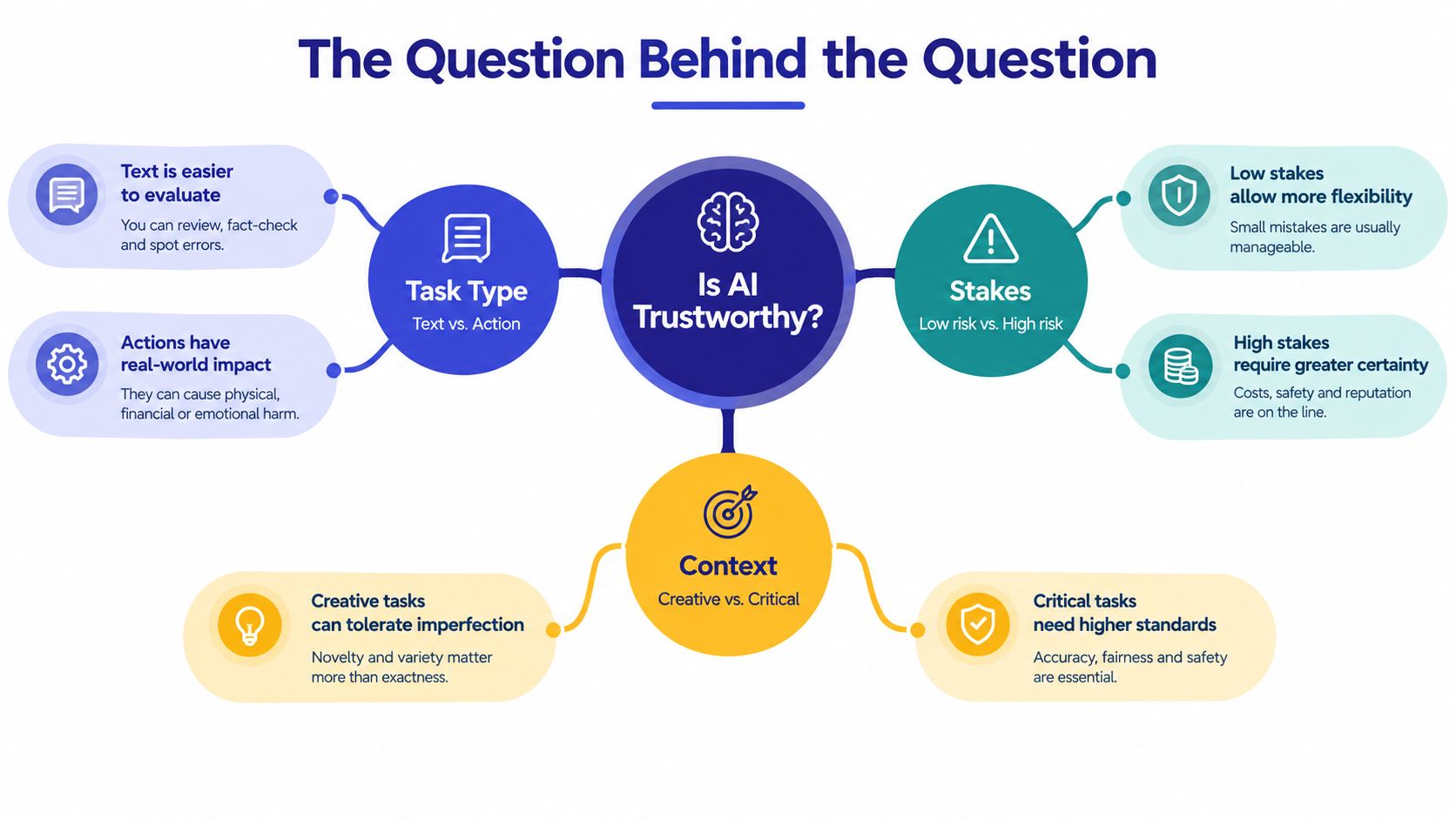
Use these four questions before you rely on any AI product:
- Accuracy: Does it produce correct, consistent results for the task you care about?
- Transparency: Can it show evidence, explain uncertainty, or reveal what led to its decision?
- Privacy: What happens to the information you provide, and who can access it?
- Failure cost: If it makes a mistake, can you easily correct the result, or could you lose money, access, or control?
Public confidence shows why this careful approach matters. KPMG's global report found that trustworthiness declined in 13 of the countries studied, while only 46% of people globally were willing to trust AI systems. That history suggests trust doesn't automatically rise as AI becomes more common. People judge AI through visible performance, safeguards, and accountability, not novelty alone. KPMG's global report on trust, attitudes, and use of AI documents that broader shift.
Keep the four layers in mind as you evaluate everything from a writing assistant to a service that screens calls, texts, and emails. A trustworthy choice isn't the tool that promises perfection. It's the tool whose limits you understand and whose mistakes you can safely manage.
What Trust in AI Actually Means
Trustworthy AI is fit-for-purpose AI. It performs reliably enough for a defined task, communicates its limits, handles data responsibly, and gives people a way to challenge or correct its decisions.
That definition is more useful than asking whether an entire model is trustworthy. A chatbot that invents a citation fails the reliability test for research, but it might still help you brainstorm a birthday message if you check the output yourself. A system that helps identify unusual communication patterns can support a review process, but it shouldn't turn an opaque score into an unquestionable verdict. For background on how anomaly detection works in security contexts, see this explanation of anomaly detection systems.
Four dimensions of AI trust
| Dimension | What It Measures | Example Question |
|---|---|---|
| Reliability | Whether results are accurate and consistent | Does the system correctly distinguish a legitimate message from a scam? |
| Explainability | Whether the system provides understandable evidence or uncertainty | Can it show which words, behavior, or source triggered its warning? |
| Data handling | How the service collects, stores, shares, and uses your inputs | Does it retain your private messages or use them to improve a model? |
| Accountability | Who responds when the system causes harm | Can you appeal a blocked call or reach a responsible company? |
The stakes change the answer. A wrong restaurant suggestion is inconvenient. Incorrect medical guidance, a false fraud alert, or a mistaken lending decision can affect your health, finances, or rights. The model may be identical, but the acceptable level of error isn't.
Explainability also needs careful interpretation. A polished explanation can sound convincing without proving that the underlying result is correct. Good systems should connect decisions to observable evidence, show uncertainty where appropriate, and make human review possible.
Privacy adds another layer. You might accept AI sorting obvious spam, yet reject a service that stores every sensitive conversation indefinitely. Accountability completes the picture because even a well-designed system will sometimes fail.
Practical rule: Trust AI only when you understand its likely failure modes and can tolerate the consequences of those failures.
Where Trust Is Slipping in 2026
AI scams have made familiar warnings harder to spot. A phishing email that once contained awkward wording and obvious formatting mistakes can now resemble a message from a colleague. Voice-cloning tools can make a caller sound like a relative, a manager, or a customer support representative. The accuracy problem now affects the people trying to identify deception, because a convincing message can look legitimate while a legitimate message can trigger suspicion.
The risk is visible in phone abuse as well. U.S. consumers received 52.5 billion robocalls in 2025, and unwanted telemarketing and scam calls accounted for 57% of the total, according to reported robocall and phone-fraud trends. Those figures describe the scale of the problem, not the performance of any particular AI detector, but they show why real-time screening has become a practical trust question.
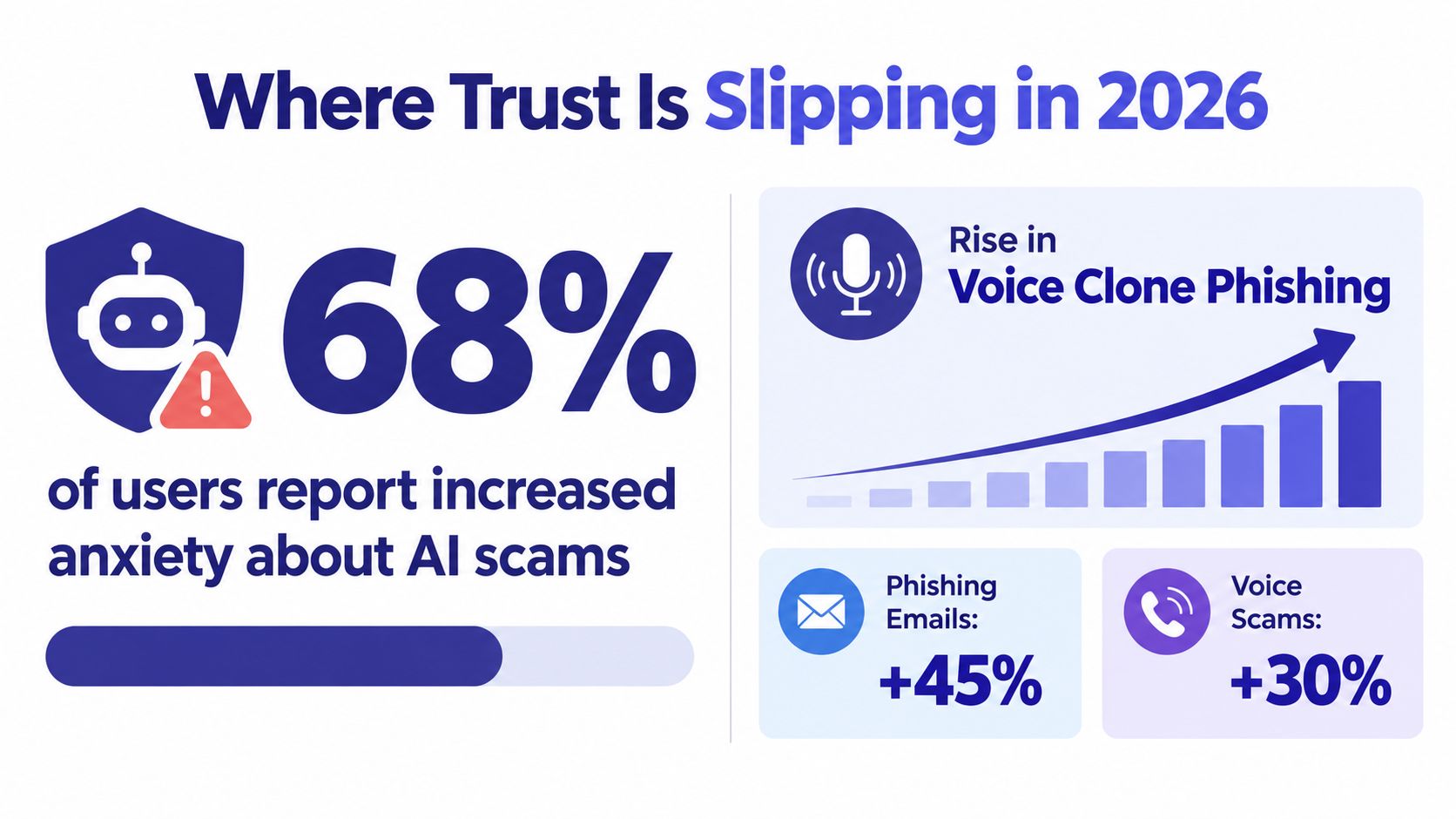
Four pressures on confidence
- Convincing impersonation: Voice clones and carefully written messages make identity harder to verify. That raises the cost of an incorrect “safe” judgment.
- Confident hallucinations: AI-generated search summaries and support replies may present unsupported claims in a polished format. Users often can't tell whether the system checked a source.
- Private prompt exposure: People paste contracts, medical details, customer records, and screenshots into AI tools without always understanding retention or access policies.
- Unfair automated decisions: Hiring and lending systems can reproduce bias in the data or design behind them. A person affected by the result may not receive a clear explanation or a meaningful appeal route.
These problems map directly to the four trust layers. Hallucinations weaken accuracy, hidden model behavior weakens transparency, careless data practices weaken privacy, and unreviewable decisions increase the cost of failure.
AI agents add another concern because they can move from generating content to taking action. The McKinsey survey of AI trust maturity covered approximately 500 organizations between December 2025 and January 2026, offering a recent view of governance as agentic systems expand. Trust now has to cover not only what an AI says, but what it can do next.
How AI Fails in Practice
How can an AI system create harm without intending to deceive anyone? A language model predicts likely language, so it can state a false detail in the same confident tone it uses for a true one. This failure, often called a hallucination, may produce an invented citation, incorrect price, wrong phone number, or unsupported medical claim. In scam and spam protection, that could mean wrongly labeling a legitimate message as dangerous or allowing a convincing scam through.
Researchers test hallucinations across tasks such as summarization, question answering, and natural language inference. The HalluMix benchmark compares outputs with source documents using binary labels, showing that factual reliability depends on the domain, context, and task. The HalluMix benchmark explains why a single accuracy label cannot describe every AI output.
Bias creates another failure path. A resume filter may rank candidates differently because names correlate with patterns in historical hiring data. An image classifier may mislabel a darker-skinned face. In a spam filter, similar patterns could cause messages from certain senders or communities to receive unequal treatment. The affected person often sees only the result, not the data, weighting, or threshold behind it.
Failure can happen at several points
- The input can mislead the system: A scammer may manipulate a prompt, document, or message so the model follows an unsafe instruction. A fraudulent email can also contain hidden text designed to interfere with an automated detector.
- The model can overstate certainty: Confidence estimates do not always match correctness. In a BioNLP calibration study, the best method still had a mean Flex-ECE of 29.8%, so confidence should guide review rather than serve as proof. The calibration study in JAMIA Open
- The data can cross its intended boundary: A pasted screenshot or private conversation may be stored, reviewed, or exposed in ways the user did not expect. Privacy failure can turn a scam investigation into another source of sensitive-data risk.
- The guardrails can be manipulated: Jailbreak prompts and prompt injection attacks attempt to override safety rules or make a system follow instructions hidden inside untrusted content.
For how cloned voices are used in phone scams, see how AI voice cloning scams work.
A freelancer reviewing a contract summary may accept a clause that the agreement never contained. The technical error is a hallucination, while the consequence is a preventable business loss. That distinction matters: trust depends on accuracy, privacy, and the ability to catch or reverse harmful results.
When AI Acts Versus When It Answers
An AI that answers and an AI that acts require different levels of scrutiny. An answering system drafts, summarizes, or predicts. You can read the result, compare it with the original, and decide whether to use it.
An acting system executes a task. It may send an email, approve a transaction, block an account, or filter a call before you interact with the person on the other end. The system's output becomes an intervention, and the opportunity for human review may disappear.
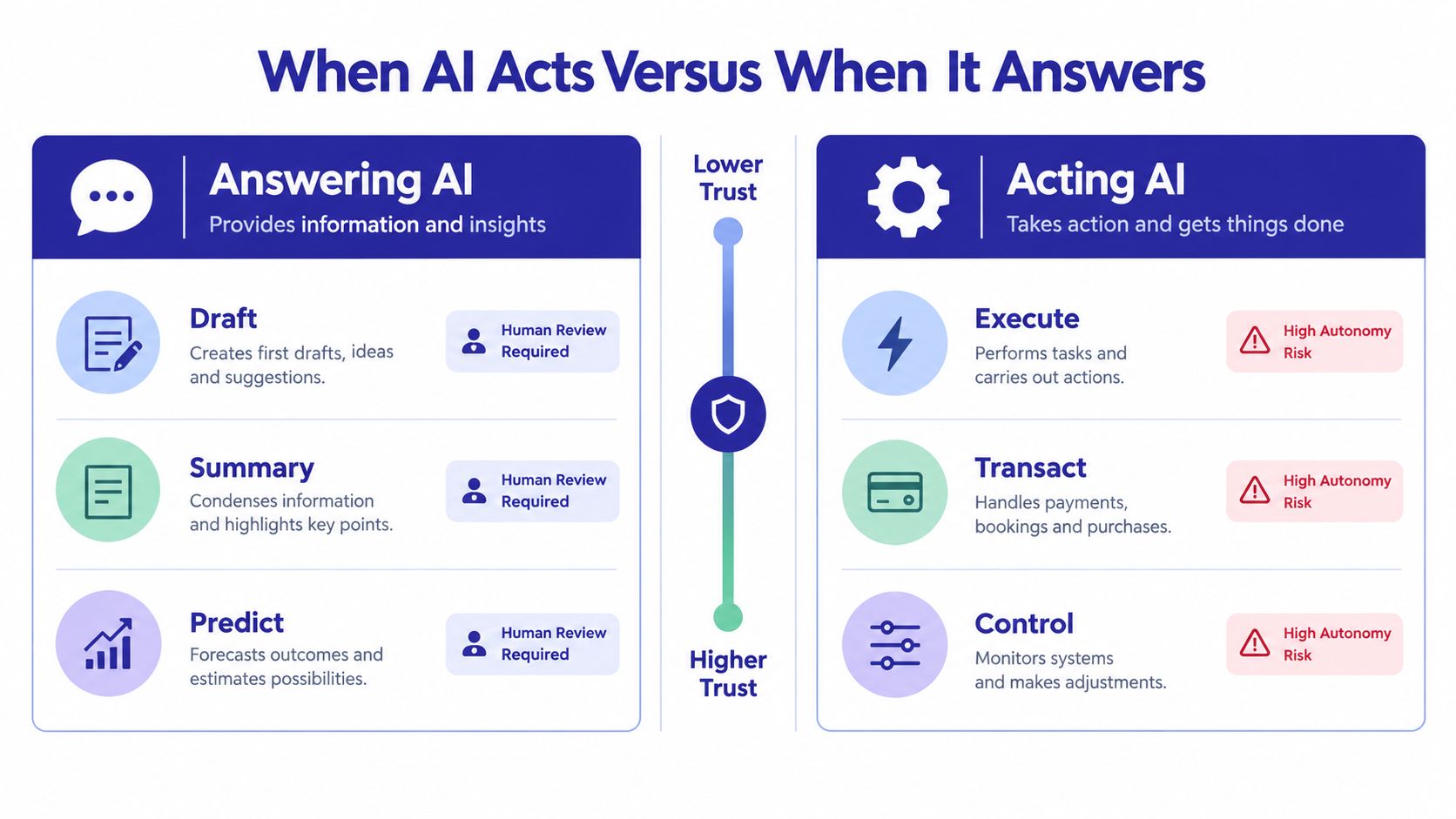
A restaurant chatbot illustrates the difference. If it suggests a place that's closed, you can check before going. If an AI agent books the table, chooses the wrong date, and charges your card, the same kind of misunderstanding has immediate consequences.
Delegation changes the trust test
With answering AI, ask whether you can verify the information. With acting AI, also ask:
- What authority did you give it? Can it spend money, contact people, or change settings?
- What happens when it's uncertain? Does it pause, ask you, or continue anyway?
- Can you undo the decision? Is there an appeal, reversal, or visible action log?
- What does it block or allow? Does a person remain available for high-impact cases?
Call screening sits near the high-risk end of this spectrum because the system can decide whether a caller reaches you. A protection service such as Gini Help describes a workflow in which its AI answers unknown callers, asks why they're calling, analyzes the conversation, and decides whether to connect the call. It also offers protection for texts and email, with Live Call Analysis providing a risk score and warnings during calls you answer.
That design can reduce interruptions, but it also creates intervention risk. A false negative may let a scammer through, while a false positive may block a legitimate caller. A service should therefore explain how it uses evidence, how users can review decisions, and what happens when the system isn't sure.
The closer AI gets to controlling access, money, or identity, the more important human override becomes.
Trust Signals You Can Actually Check
You don't need to understand a model's mathematics to assess an AI product. You need to inspect what the company tells you, what controls it provides, and how it behaves when you ask difficult questions.
Start with documentation. A responsible vendor should describe what the system does, where it performs poorly, and which uses it doesn't support. Look for model limitations, training-data information, known failure modes, and updates that explain meaningful changes.
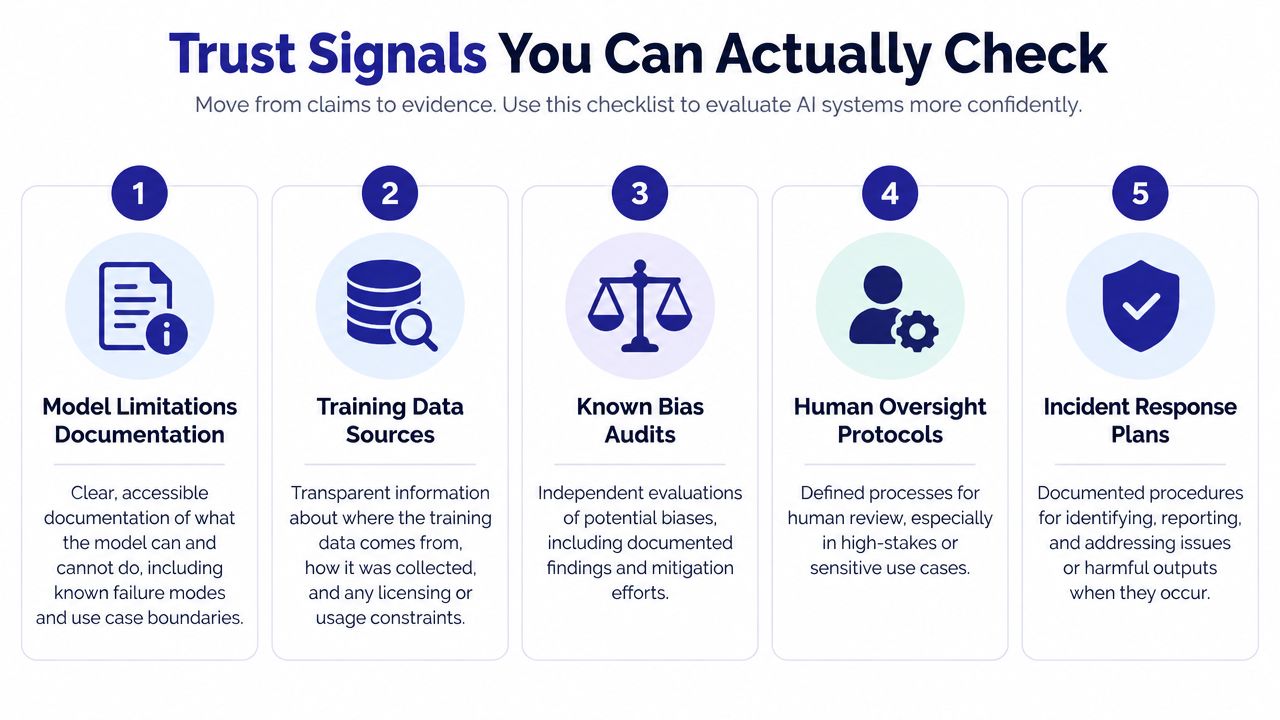
A five-minute review
- Read the limitations: Does the vendor clearly state when the system may be wrong or unsuitable?
- Check the evidence: Does it cite sources, show relevant signals, or distinguish observed facts from predictions?
- Inspect data controls: Can you understand retention, deletion, sharing, and training-use policies?
- Look for human oversight: Can you appeal a decision, request a review, or reach a person?
- Find incident procedures: Is there a named company, security contact, status information, or process for reporting harm?
Be cautious with confidence scores. A high score can describe how strongly a system matched a pattern, not whether the conclusion is true. For a plain-language explanation of why AI confidence can mislead, IamVera.AI offers useful context on the difference between certainty and correctness.
Test before you depend on it
Try an AI tool with a low-stakes task first. Give it a document with an answer you already know, ask it to identify evidence, and see whether it admits uncertainty when the information is missing. For a communication-screening product, learn how its risk scores are generated and what the user can do when a score looks wrong.
Also check the product experience. A visible report button, a human handoff, an action history, and clear notification settings are practical trust signals. So is a straightforward answer to the question, “Can I stop this system from acting?”
A service that hides errors behind a polished interface asks you to trust appearances. A service that exposes uncertainty and gives you control gives trust a concrete foundation.
Bringing It Together
The better question isn't “Can I trust AI?” It's “Can I trust this AI, for this task, with this information, under these controls?”
Start with visibility. What can the system see? Does it process a single message, an entire inbox, a live phone conversation, or account data? The more sensitive the input, the more carefully you should review retention, access, and deletion policies.
Then examine the decision. Can the system show relevant evidence, or does it provide only a label such as safe, risky, or approved? A label can help you prioritize attention, but it shouldn't replace judgment when the consequences are serious.
A practical decision test
- Start small: Test the tool on a low-risk task before connecting important accounts or granting authority.
- Check the path to correction: Know how to reverse an action, appeal a decision, or contact support.
- Keep review where stakes are high: Don't let an AI alone authorize payments, disclose sensitive information, or make decisions that affect someone's rights.
- Treat warnings as prompts: A risk score should encourage verification, not create panic or certainty.
- Verify identity independently: If a caller asks for a password, code, transfer, or urgent payment, use a trusted contact method rather than relying on the caller's voice or the AI's confidence.
For readers who want more material on AI tools and workflows, Browse articles offers additional practical reading. The important habit is not to search for a perfect model. It's to choose systems that admit their limits, fail safely, protect your information, and leave room for human judgment.
Trustworthy AI in 2026 is a capable but fallible assistant, not an oracle. Let it help with tasks where you can verify the result, and demand stronger safeguards when it can touch your money, identity, communications, or access.
Gini Help screens calls, texts, and emails to identify spam and scam patterns before they reach you, and it can analyze calls in real time when you answer. Download the Gini Help app from Google Play or the App Store to add a review layer between suspicious contacts and your everyday communications.