Phone Number Scam Report: Where, How, and Why It Works
By Josh C.
Americans age 60 and older reported $7.7 billion in losses in the FBI's 2025 Internet Crime Complaint Center data, including $352 million tied to AI related scams, according to reporting on the FBI's 2025 Internet Crime Complaint Center data. That scale changes what a phone number scam report is. It's not a complaint about an annoying ring. It's evidence that can expose a campaign before the next caller reaches your parent, your partner, or you.
Why a Phone Number Scam Report Matters More Than You Think
In 2024 the FTC received fraud reports from roughly 2.6 million consumers, with reported losses climbing 25% to more than $12.5 billion, and phone calls ranked as the second most common contact method while consumers who interacted with scammers by phone reported a median loss of $1,500, according to the FTC's announcement of its 2024 fraud loss data. Read those numbers correctly. A single call isn't low stakes just because you hung up quickly.
One report rarely triggers an arrest, a refund, or a personal update. That's the limit you need to accept upfront. Regulators look for patterns across many reports, carriers look for repeat signals they can filter, and investigators look for campaigns worth disrupting. Your filing works when it adds a usable data point to thousands of others.
What Happens After You Submit
A useful report contains more than the number on your screen. Caller ID can be falsified, so the claimed bank, agency, or business matters as much as the digits displayed. Note the script, the urgency tactic, and the payment method requested. That context helps separate a spoofed local number from the operation behind it.
US Fraud Contact Methods Ranked by Frequency and Loss
| Contact Method | Share of Reports | Median Loss |
|---|---|---|
| Most common contact method | Not specified in the cited release | |
| Phone calls | Second most common contact method | $1,500 for phone interactions |
| Text messages | Behind phone calls | Not specified in the cited release |
Don't treat blocking as reporting. Blocking protects your phone today, while reporting helps identify the wider scheme. How your number got into circulation in the first place is covered by this explanation of how scammers get your phone number, which outlines the common routes. File with evidence, expect pattern detection rather than personal rescue, and you'll use the system for what it can do.
Capture the Evidence Before You File Anything
Don't open a reporting form first. Preserve the incident first, because call logs get cleared, voicemails expire, and frightened people delete threads to make the problem feel gone. A report that says only "scam call" gives an investigator almost nothing to work with.
FCC complaint data analysis found that many filers omitted the displayed caller ID number, materially reducing the usefulness of number level analysis and making reports far less actionable, according to the FCC's unwanted calls complaint dataset. That's the most basic failure, and it's entirely preventable.
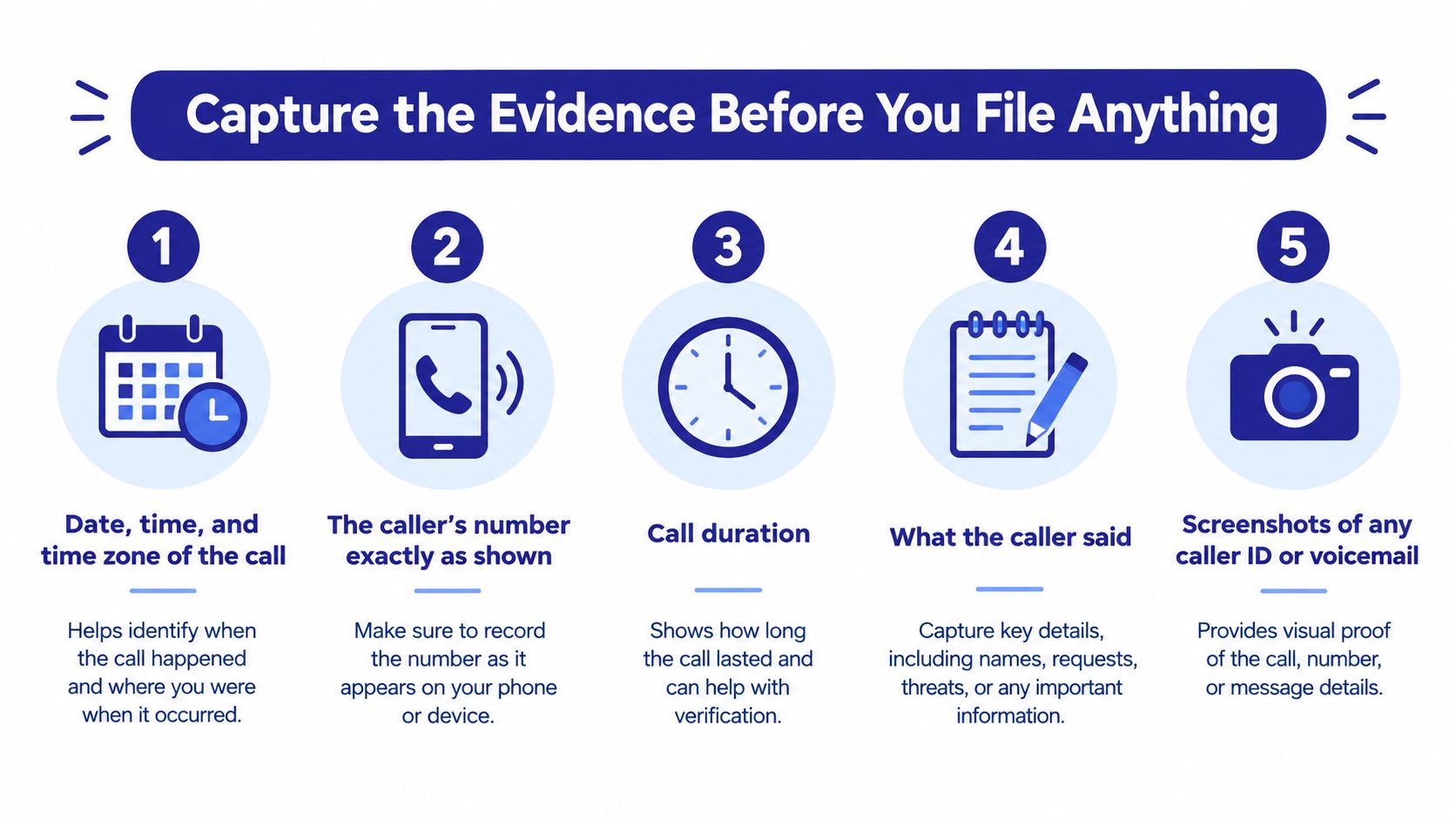
Your Evidence Checklist
- Date, time, and time zone: Write these down immediately, plus how long the call lasted.
- Number exactly as displayed: Photograph caller ID, don't retype it from memory.
- Callback number: Record any different number the caller told you to use.
- Claimed organization: Note the bank, agency, utility, or business name used.
- Requested action: Capture the exact payment method, destination account or wallet, gift card request, or credential requested.
- Artifacts: Save screenshots, voicemail, legally permitted recordings, original texts, email headers, and transaction receipts before deleting anything.
Practical rule: Photograph the phone screen before you clean anything up. A caregiver can reconstruct a case from photos, but not from a cleared call log and a vague memory.
Never call the displayed number back to test it. You may reach an innocent person whose number was spoofed, or you may confirm to criminals that your line is active. Don't click links sent afterward and don't send a small payment to verify identity. Hang up, preserve, then file through official channels using contact details you find independently.
Official US Channels for Filing a Phone Number Scam Report
File in more than one place when the facts support it. Different agencies collect different signals, and a single submission leaves gaps. The two federal destinations below cover most phone cases.
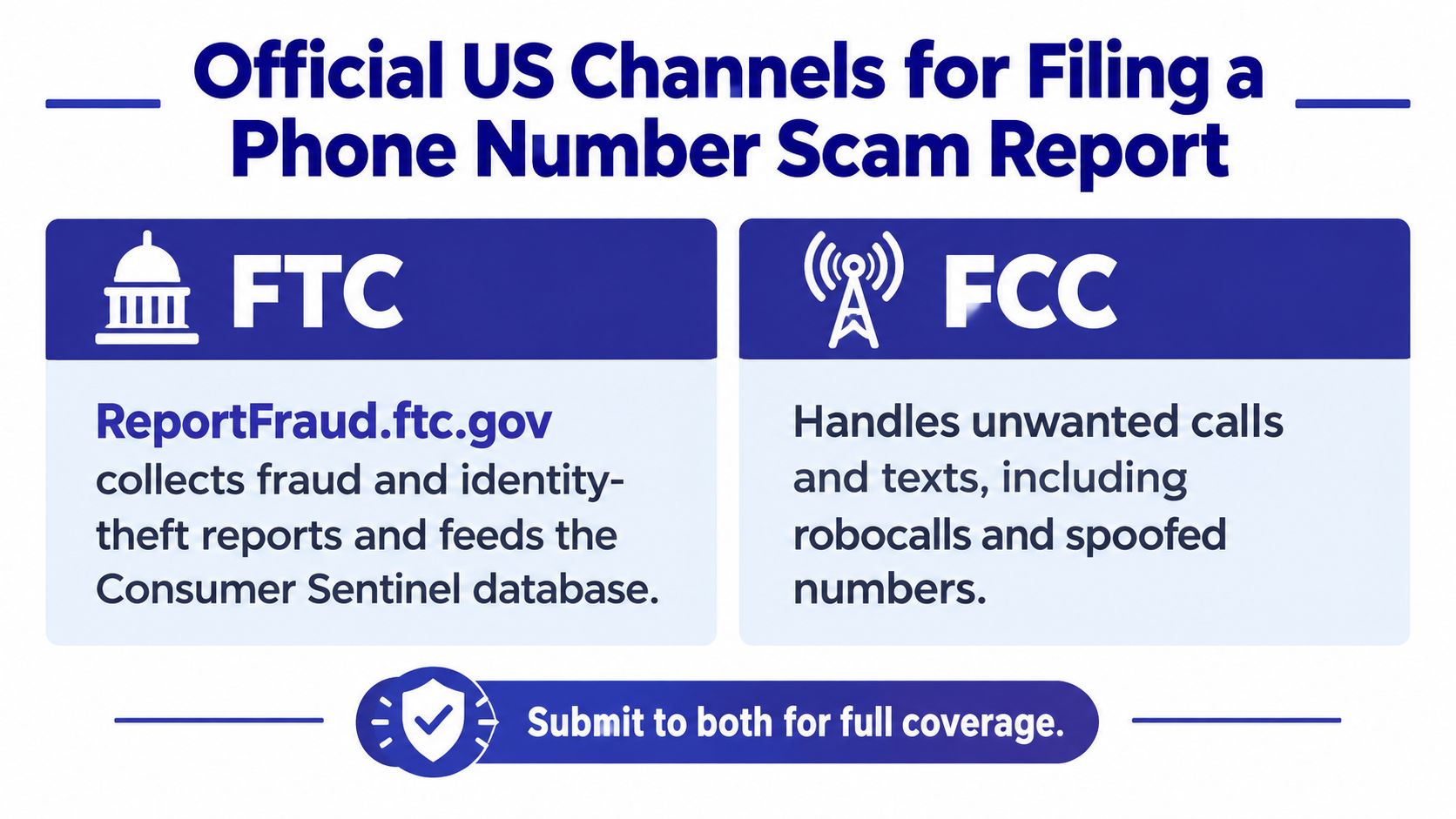
Use the FTC at ReportFraud.ftc.gov for fraud, impersonation, and identity theft. Those reports feed law enforcement trend work. Use the FCC Consumer Complaint Center for unwanted calls, robocalls, and spoofing. Under US rules, illegal caller ID spoofing can carry penalties of up to $10,000 per violation, which is why spoofed calls belong in an FCC complaint rather than only an FTC fraud report, according to the FCC's consumer guide to spoofing.
Your carrier is the third channel, not an afterthought. AT&T, Verizon, and T-Mobile provide unwanted call tools that can affect filtering on their networks. For a scam text, forward it to 7726 so the carrier behind the number receives it. State attorneys general also accept complaints, which can matter when a scheme targets residents in a specific state.
This short video walks through the filing mindset before you start opening agency forms.
Where to Send Each Type of Scam Report
| Complaint Type | Best Channel | What It Triggers |
|---|---|---|
| Fraud or impersonation | FTC | Fraud trend and law enforcement database entry |
| Spoofed or unwanted call | FCC | Telecom complaint and spoofing record |
| Scam text | Carrier via 7726 | Carrier review of the sending number |
| Credentials shared | IdentityTheft.gov | Personalized recovery plan |
Expect confirmations, not case updates. Submit to both federal channels when a call involves fraud and spoofing, because that's full coverage, not duplication.
Cross-Channel Reporting When the Scam Spreads to Text and Email
Phone scams rarely stay on the phone. A caller builds urgency, then a text delivers a link, an email supplies fake paperwork, and a payment app completes the theft. Report each leg through its own channel because regulators and platforms don't automatically merge your story for you.
FBI 2024 figures show 53,369 call center scam complaints and roughly $1.9 billion in reported losses, reinforcing the scale of organized phone based fraud that often extends across SMS and email, according to the FBI's 2024 Internet Crime Complaint Center report. Organized operations switch channels deliberately, so your response has to be layered too.
Match Each Contact to Its Channel
- Call: File the unwanted or spoofed call with the FCC and the fraud itself with the FTC.
- Text: Forward the message to 7726 and preserve the original thread, and this guide to reporting spam texts on iPhone explains the device steps.
- Email: Use the phishing report button in Gmail, Outlook, Yahoo, or iCloud and keep headers intact.
- Payment: Contact the bank, card issuer, or payment app first when money moved and request a recall or freeze.
Order matters. If money has left the account, call the financial institution before you spend twenty minutes on a fraud form, because recovery windows are short. For AI voice or deepfake material, preserve the recording and notify the platform that hosted the clone or video. In the first hour, stop further transfers, secure the account, save transaction IDs, then complete the regulatory reports with that evidence attached.
No Money Lost? Why Near-Miss Reports Still Count
I'm going to be blunt. People who only report after losing money misunderstand prevention. A near miss is often the earliest visible sign of a campaign that's still testing scripts, numbers, and target lists.
In 2024 roughly 74% of fraud reports filed by older adults did not indicate a monetary loss, yet those reports still revealed active campaigns, spoofed identities, and targeting patterns useful for prevention, according to FTC older adult fraud data published through GovInfo. For people aged 80 and over, phone originated scams produced substantially more losses and loss reports than other contact methods, with social media a distant second. Waiting for a loss before reporting means waiting until the most dangerous stage.
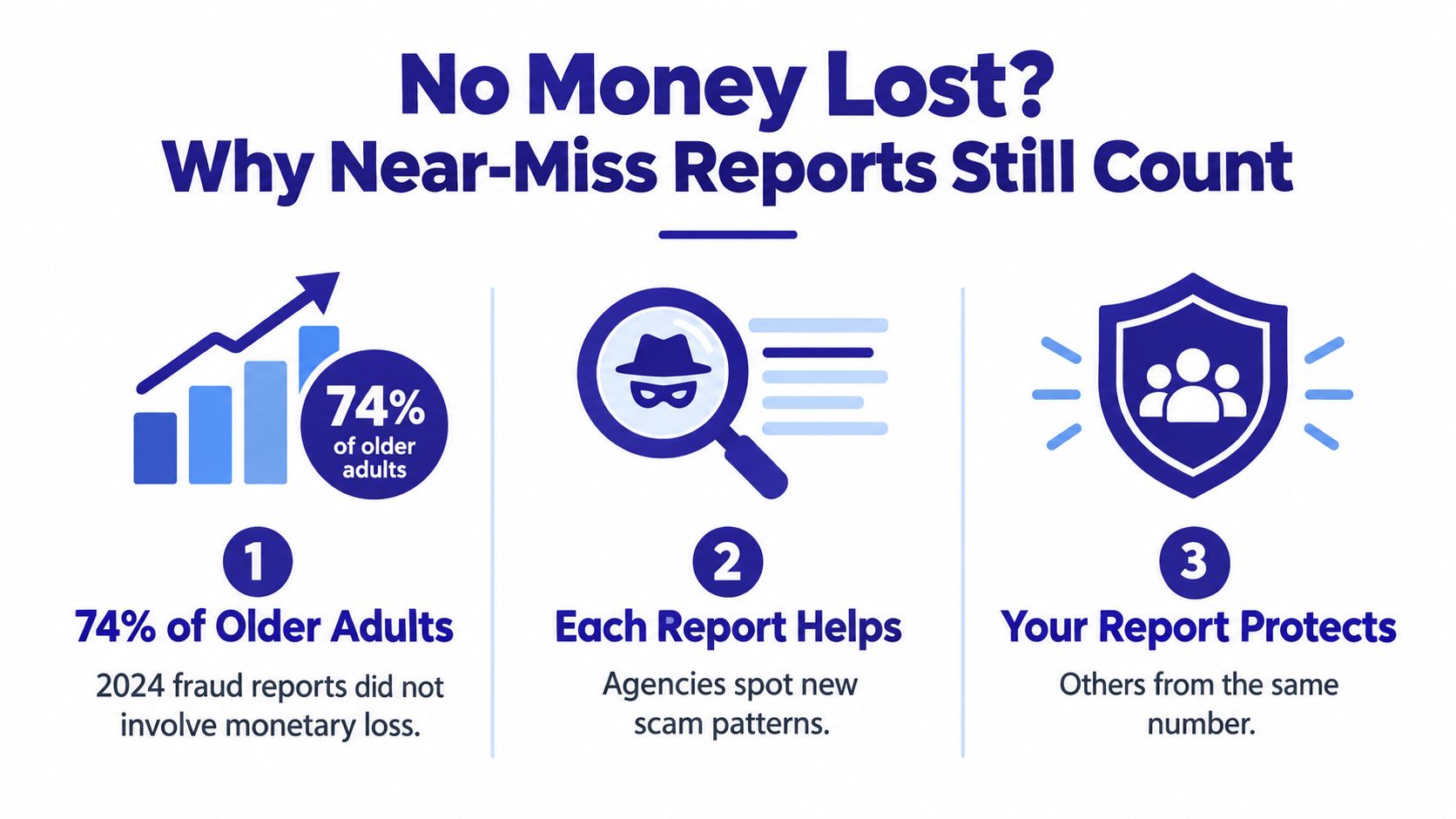
What to Write in a Near-Miss Report
State clearly that no money was sent and no credentials were shared. Then give the displayed number, callback number, claimed organization, date and time with time zone, and the exact request. Quote the threat or urgency line if you remember it accurately. That turns a vague complaint into pattern detection material.
A near-miss report isn't paperwork for an event that didn't matter. It's a warning filed while there's still time for it to protect someone else.
Don't apologize in the form for reporting without a loss. Don't minimize it to family members either. Caregivers should praise the person who hung up and reported, because that behavior is exactly what you want repeated. File it, block through the carrier, and treat repeat attempts as a reason to strengthen call screening.
A Caregiver Playbook for Scams You Discover After the Fact
Most caregivers don't get a clean starting point. You find a strange transaction, a parent who's evasive, or a phone with missing messages. Shame destroys evidence faster than criminals do, so your first job is tone, not interrogation.
A 2025 AARP survey estimated 41% of American adults, roughly 110.1 million people, had either lost money to fraud or had sensitive information stolen and fraudulently used, with adults 50 and older especially concerned about being targeted, according to AARP's 2025 fraud awareness survey. Your loved one isn't uniquely careless. Say that plainly.
Work in This Order
- Photograph what remains: Capture recent calls, texts, voicemail screens, transaction alerts, notes the victim wrote, and any gift card or payment receipts.
- Call the money channel: Ask the bank, card issuer, or payment app about freezes, recalls, disputes, and account restrictions, and document names and reference numbers.
- Handle identity exposure: If credentials, Social Security details, or account access were shared, use IdentityTheft.gov for a recovery plan and change passwords from a clean device.
- File reports: Submit the fraud and telecom reports with the reconstructed timeline, clearly marking estimated times as estimates.
- Reduce repeat access: Turn on carrier blocking and call screening, and review who can reach the household line.
For broader household safeguards, this senior fraud prevention guidance fits naturally into that reset. Discuss limited, clearly defined authority for emergencies if you may need to act with a bank, while preserving your parent's autonomy day to day. Don't promise recovery. Promise that you won't blame them, you'll preserve what's left, and you'll make the next attempt harder to complete.
Layered Defense and a Reporting Habit Worth Keeping
Reporting is one layer, not your whole defense. Pair it with carrier blocking, cautious handling of unknown contacts, and screening that stops suspicious callers before a conversation starts. Registering eligible numbers and reviewing whether a household line is still needed can also reduce exposure, and practical phone advice from Rx360 is useful when your family is weighing home phone and cell phone tradeoffs.
AARP research shows more than one third of US adults, about 95.4 million people, made themselves vulnerable by responding to calls, texts, or friend requests from unknown sources, according to AARP's 2025 fraud survey research. Don't build your safety plan on perfect judgment in a stressful moment. Build it on friction.
A Habit You Can Actually Keep
- Log it immediately: Save the evidence checklist in your notes before details fade.
- File promptly: Complete the right channel reports while screenshots and timestamps are available.
- Review monthly: Check blocked calls, bank alerts, and whether an older relative has seen repeat attempts.
Add an AI screening layer: Download Gini Help on Google Play or Gini Help on the App Store so unknown callers are screened in real time before they reach you. It complements formal reporting, it doesn't replace it.
Every well documented phone number scam report makes the next campaign easier to spot. Preserve first, escalate money movement fast, report near misses, and screen unknown contacts by default.
Stop letting an unknown caller get the first word with you or someone you protect. Gini Help screens calls, texts, and emails with real time AI analysis, asks unknown callers to explain themselves before your phone rings, and warns you during live calls when scam tactics appear. Visit today, set up protection for yourself or a family member, and turn every suspicious contact into a blocked attempt instead of a stressful recovery.