Vendor Fraud Prevention That Stops Payment Diversion
By Josh C.
The payment run is nearly ready when a familiar supplier emails new bank details. The invoice matches an approved order, the sender's name is recognizable, and the message sits inside an ordinary-looking conversation. Your accounts-payable colleague needs to decide whether to update the record or delay a payment that the business expects to make today.
Why Routine Vendor Payments Need Stronger Controls
Nothing about that situation requires an obviously fake invoice. A criminal could be impersonating the supplier through a look-alike address or sending instructions from a compromised mailbox. The goods, supplier relationship, and outstanding balance might all be genuine. The deception concerns where the money goes.
That distinction matters operationally. An invoice approver can correctly confirm that the organization owes money while missing an unauthorized beneficiary change. A payment processor can follow the approved invoice workflow and still release funds to an account the supplier doesn't control.
Familiarity isn't verification
The FBI recorded 21,442 business email compromise complaints and approximately $2.77 billion in reported losses during 2024; total reported internet-crime losses exceeded $16 billion across 859,532 complaints, according to its 2024 Internet Crime Complaint Center report announcement.
Those figures concern reported incidents, not a complete accounting of every attempted or successful fraud. They nevertheless establish why payment diversion deserves attention beyond the IT department. Finance employees make the final business decision, procurement holds relationship context, and operations can confirm whether the underlying transaction makes sense.
Practical rule: Treat a request to change a payment destination as a new authorization decision, not an administrative correction.
Consider a hypothetical supplier asking for an urgent update because its usual account is supposedly unavailable. The employee recognizes the contact and wants to preserve the relationship. A defensible process gives that employee permission to pause, a trusted verification route, and an escalation owner who can handle the resulting delivery or payment concern.
Design for ordinary working pressure
A documented policy isn't enough if staff must bypass it to keep operations moving. Decide who handles a supplier that threatens to suspend service, who can authorize an exception, and what evidence remains mandatory even when a senior manager intervenes.
For smaller teams defining those responsibilities, internal controls advice from MyOfficeOps is a useful starting point for the governance discussion. Pair that discussion with a review of small-business fraud exposure, especially where employees handle supplier requests through personal phones or shared inboxes.
Vendor fraud prevention is an operating discipline, not a single software purchase. Transaction controls, communication screening, and human judgment serve different purposes. An optional screening app can flag suspicious calls, texts, or emails for an employee or household, but it can't establish that a particular beneficiary is authorized to receive a business payment.
Map the Main Vendor Fraud Risks
Vendor fraud is deliberate deception involving supplier relationships, procurement activity, invoices, or payment instructions to obtain an unauthorized benefit. The vendor itself needn't be dishonest. An outsider, employee, supplier representative, or collaborating group could exploit the relationship.
Start diagnosis by separating the entry point from the intended outcome. Supplier impersonation describes who an attacker pretends to be. A compromised mailbox describes access. Payment diversion describes what the attacker wants finance to do.
Distinguish the attack paths
The following matrix is a diagnostic aid, not proof that any particular warning sign establishes fraud.
Vendor fraud paths and first-line safeguards
| Fraud path | Warning sign | First-line safeguard |
|---|---|---|
| Supplier impersonation | An unfamiliar contact requests an urgent beneficiary change | Independent identity confirmation |
| Compromised legitimate account | A known sender introduces an unexpected payment instruction | Verification outside the suspect conversation |
| Insider abuse | An employee controls setup, approval, and release | Separation of incompatible responsibilities |
| Invoice manipulation | Charges don't fit the approved scope or receiving evidence | Transaction matching and exception review |
| Procurement collusion | Relationships or bid patterns aren't adequately explained | Conflict checks and independent sourcing review |
| Payment diversion | The beneficiary differs from the authorized record | Controlled beneficiary changes and release checks |
The ACFE's 2024 research examined 1,921 occupational-fraud cases across 138 countries and territories, involving reported losses exceeding $3.1 billion; more than half involved missing controls or management overriding controls, according to its global occupational-fraud research summary. This is broader occupational-fraud evidence, not a vendor-fraud prevalence estimate.
The same research found that tips identified 43% of cases, employees supplied 52% of tips, and customers or vendors supplied nearly one-third. That makes reporting culture a control consideration, not merely an employee-relations issue.
Ask where the organization is vulnerable
Use the matrix to ask targeted questions rather than assigning every supplier the same generic risk label:
- Access: Can someone alter supplier details without an independent reviewer seeing the change?
- Authority: Can an executive's email replace the evidence normally required for payment?
- Relationships: Who checks whether employees have undisclosed supplier connections?
- Visibility: Would a vendor know how to report an unexpected remittance notice?
- Challenge: Can an employee question a manager's exception without risking retaliation?
Employees, customers, and suppliers may notice a changed contact style, unexplained charge, or relationship conflict before an automated rule flags anything. Give those observations a route into investigation.
Also distinguish invoice fraud from transfer risk when training staff. A practical explanation of wire transfer fraud can help teams understand why a legitimate obligation doesn't automatically validate the destination account.
Assess and Segment Vendors Before Access
A risk rating means little if every supplier answers the same questionnaire. Segmentation is where prevention starts in the payment lifecycle, because the controls applied later (verification calls, dual approvals, monitoring rules) only work if someone decided up front which vendors warranted them.
Assess the proposed relationship before granting system access or activating the supplier for payment. Procurement, finance, security, and the business owner should each contribute their own evidence rather than countersigning a form nobody reviewed. A qualitative low, medium, or high risk classification is enough. A score should explain the decision, not create false precision through an elaborate formula nobody can defend.
Classify the relationship before approving it
Evaluate the service, data sensitivity, payment method, geographic and organizational complexity, ownership structure, and contract terms. Record whether this is a new engagement or a repeat purchase, but don't treat an established relationship as an automatic exemption.
The questions change with the relationship. A supplier delivering ordinary goods without system access presents different concerns from a service provider handling sensitive information. Unusual delivery arrangements, unclear subcontracting, or payment instructions inconsistent with the contracting entity should all increase scrutiny.
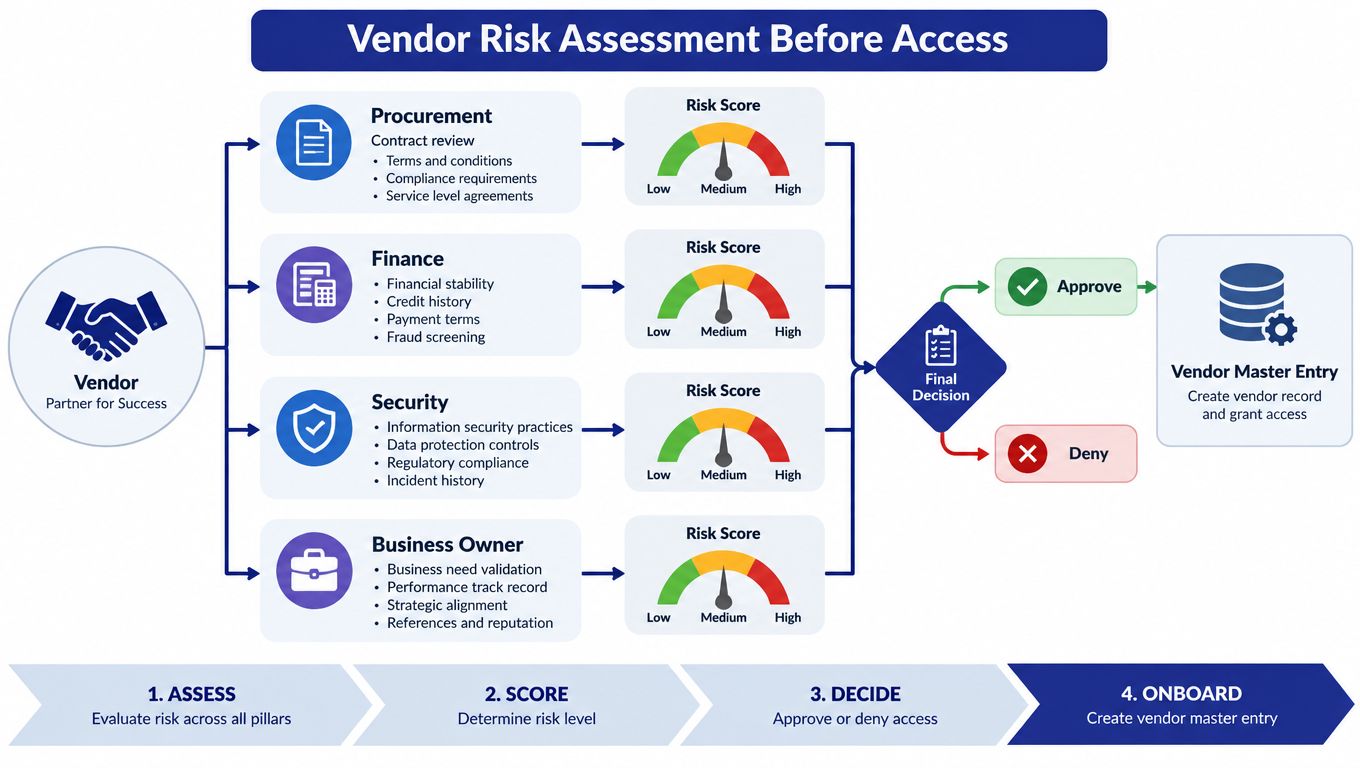
Translate the classification into specific requirements rather than a generic checklist. Enhanced ownership checks might address an opaque corporate structure. An independent sourcing review might address an unusual bid. A technical review should cover proposed access to sensitive systems. A general framework to assess vendor risks can help organize these decisions without reducing every concern to a cybersecurity questionnaire.
Build an approval packet someone else can defend
Start with the legal identity and tax registration, then verify bank-account ownership through an appropriate independent method. Identify beneficial owners, review conflicts of interest, and examine relationships with employees or existing suppliers. Record gaps explicitly instead of marking a field complete because a document was uploaded.
Bank evidence deserves particular care. A supplied letter is evidence to evaluate, not automatic proof that its contents are authentic. Where ownership can't be independently established, record the limitation and pause for manual review or an approved alternative verification method.
Accountability works better when each sign-off owns a defined scope:
| Reviewer | What their approval should retain |
|---|---|
| Procurement | Sourcing rationale, contract review, ownership findings, conflict disclosures |
| Finance | Identity, tax, and banking verification results, including unresolved inconsistencies |
| Security | Access requested, permitted data use, technical review, access restrictions |
| Business owner | Operational need, expected deliverables, person responsible for accepting work |
| Manual-review gate | Pauses triggered by unexplained ownership, unverifiable banking, conflicting identities, unusual terms, or undisclosed associations |
One boundary matters more than most teams expect: approval authorizes defined activities, not unrestricted access. Keep vendor-master activation separate from technical access provisioning so a completed finance review does not silently open the door to company systems.
Verify Vendor Onboarding and Payment Changes
A supplier emails late on a Thursday: its bank account has been frozen, and today's payment needs to go somewhere new. The message carries the right logo, the right contact name, maybe even a thread of earlier correspondence. Whether it looks convincing is the wrong question. The request goes through the controlled change procedure regardless.
Four roles stay separate throughout that procedure: the person who submitted the request, the approver, the vendor-master maintainer who enters the change, and the person who releases payment. Where headcount makes full separation impractical, assign an independent reviewer who examines the underlying evidence before release rather than reconciling totals afterward.
Verify through a channel the requester didn't supply
Contact the supplier using a previously validated channel. Don't use the phone number, replacement email address, or verification link supplied in the change request as the sole means of confirmation.
Ask an authorized supplier representative to confirm that a change was requested, who approved it on their side, and the intended effective date. Confirm the banking details through the approved secure process, then obtain independent authorization before the vendor-master maintainer activates them.
The procurement-fraud prevention guidance recommends independent vendor screening, employee and vendor association checks, market-rate bid review, threshold testing, vendor-list analysis, duplicate-payment audits, and review of unusual transactions. These checks belong in a connected process rather than separate files nobody reconciles.
Some alerts deserve attention even when everything else looks normal: a changed beneficiary on an otherwise identical invoice, a dormant vendor returning to activity, one bank account appearing across multiple supplier records. Shared addresses and accounts can have legitimate explanations. The reviewer's job is to establish and document that explanation, not to clear the queue.
Speed is the attacker's lever here. A legitimate supplier might need to wait while finance reaches its authorized contact. Explain the hold, provide a clear next action, and involve procurement if service continuity is at risk. Do not punish employees for following the procedure because the request later proves genuine, or the next urgent request gets waved through.
The decision record stays short, and it doubles as evidence if the change is later disputed:
- Request received. Preserve the original instruction and identify the affected vendor record.
- Contact validated. Record where the trusted contact information came from.
- Confirmation completed. Document the authorized representative, the callback result, and the secure confirmation.
- Change authorized. Retain the independent approvals and the before-and-after record.
- Exception resolved. State who decided to proceed or pause, on what evidence, and under what restrictions.
A callback is only independent if the contact route was established independently of the suspicious request.
No employee should be able to create a supplier, change its beneficiary, approve the invoice, and release the payment without meaningful challenge.
Harden Contracts Invoices and Payment Release
The invoice matches the purchase order to the cent. The approver recognizes the supplier, receiving posted last week, and payment is due Friday. The problem sits two fields further down: the beneficiary account changed ten days ago, updated by someone with vendor-master access. Approving the obligation and approving the destination are separate checks, and this stage of the lifecycle is where they either converge or get mistaken for each other.
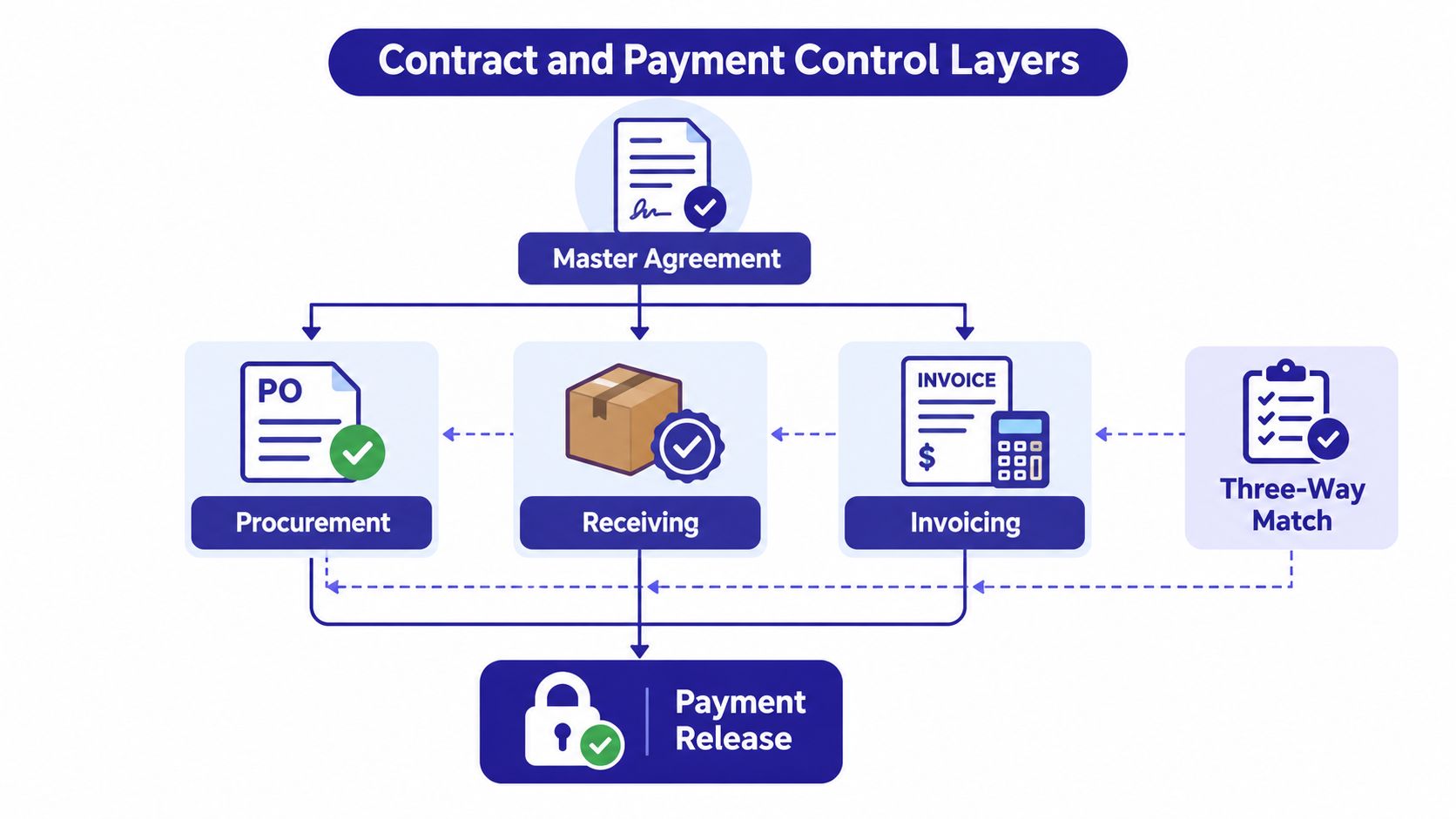
After onboarding, a verified supplier can still send an incorrect invoice, bill outside the agreed scope, or be impersonated later. The control question shifts from who the supplier is to whether this specific payment is supported and authorized. Build the answer from evidence produced by separate activities. Procurement establishes the authorized purchase, receiving confirms delivery or service acceptance, and finance matches the invoice against both.
Give the contract a job at payment time
Contract wording should pin down scope, pricing basis, required supporting documents, and the process for approving changes. State how payment instructions may be updated, and treat that clause as a routing rule. It directs where a change request goes; it does not authenticate one.
Match the purchase order, receiving record, and invoice where applicable. Services need evidence suited to the engagement, an approved deliverable or documented acceptance, because a generic receipt checkbox confirms nothing about what was delivered. Then compare the proposed beneficiary against the authorized vendor record before anyone releases funds.
Exceptions that earn a second look
| Signal | What to compare | What resolves it |
|---|---|---|
| Duplicate-looking invoice | Supplier, reference, amount, underlying obligation | A documented correction or credit note |
| Commercial variance | Pricing against contract, unsupported additions, round-dollar charges | An approved change order or rate card |
| Split purchases | Related orders sitting just under authorization limits | A legitimate reason for separate buys |
| Destination or timing shift | New beneficiary, activity outside the normal payment pattern | A change verified through onboarding channels |
Treat each row as a trigger for review. For staff learning to spot supplier fraud red flags, the practical skill is identifying what evidence would resolve an inconsistency, not labeling every anomaly as fraud.
One more test matters here: override rights. Can someone suppress a mismatch, release a held payment, or approve a change retrospectively? Every override needs a named decision-maker, a recorded rationale, supporting evidence, and an audit trail ordinary users cannot rewrite without leaving a trace. A stack of approvals means little when everyone relied on the same unverified instruction.
Monitor Vendor Activity and Screen Communications
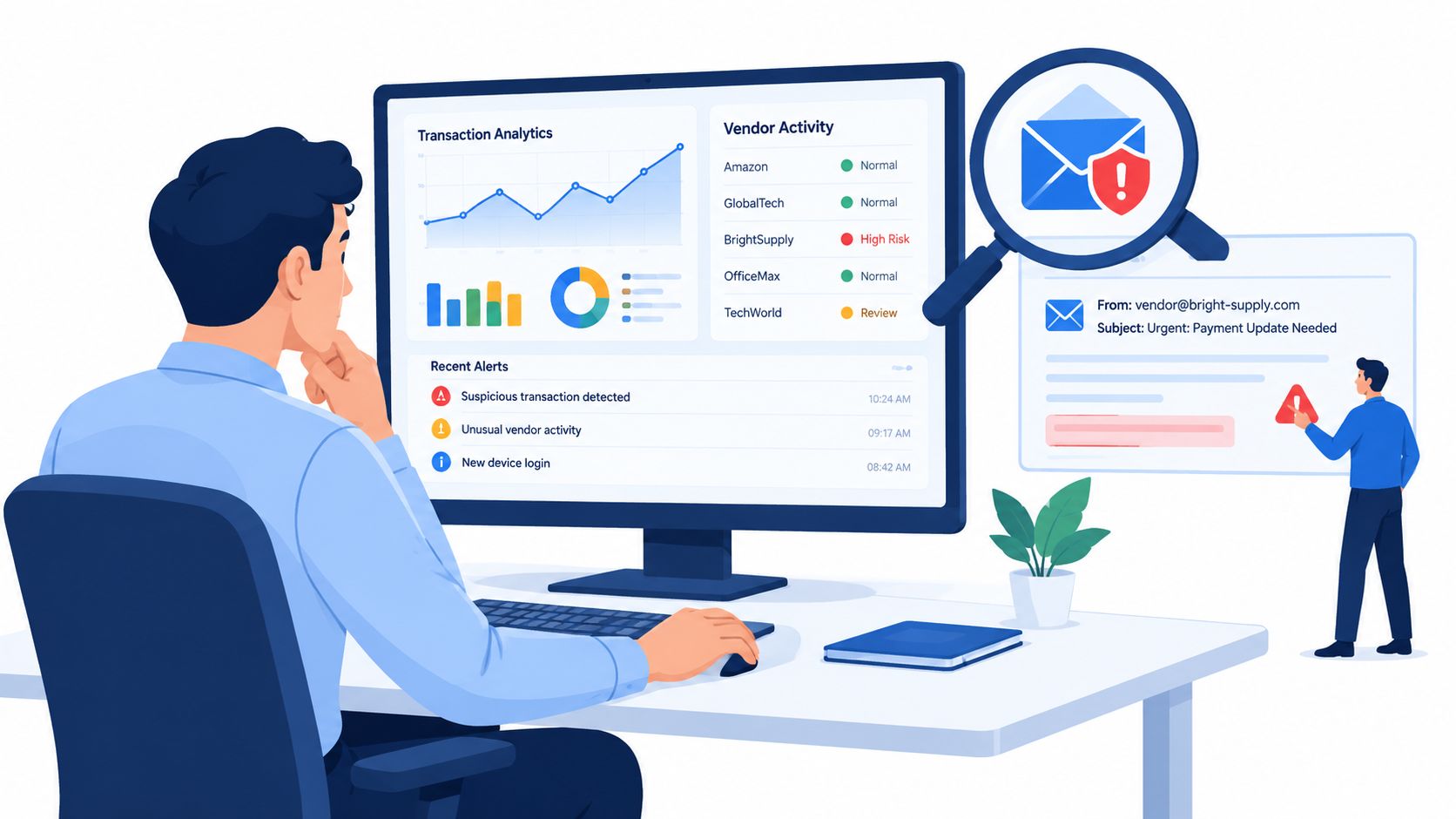
A supplier emails new bank details at 4:40 p.m., the invoice is due tomorrow, and the caller knows the purchase order number. Each fact may be true, stolen, or guessed. Monitoring earns its keep when those fragments land in one case instead of three inboxes.
Keep the review process visible to analysts and process owners. If every anomaly blocks payment, staff learn to bypass the queue; if nothing blocks, fraud walks through. The control has to separate “stop this now” from “someone needs to look.”
Separate payment holds from review queues
A preventive alert should stop a transaction when a mandatory control hasn't been satisfied. A review queue should collect anomalies that require investigation but don't automatically justify blocking every related payment.
Prioritize connected signals. An unexplained beneficiary change combined with unusual urgency deserves different treatment from a duplicate-looking invoice already supported by a documented correction. Group related alerts into a case so analysts don't repeatedly investigate the same underlying event.
Use a consistent triage sequence:
- Contain: Hold the affected payment or change when authorization is unresolved.
- Correlate: Connect the communication, vendor record, invoice history, and existing alerts.
- Assign: Route payment questions to finance, supplier legitimacy to procurement, and suspected account compromise to security.
- Decide: Record what evidence supports release, continued hold, or incident escalation.
Good phishing email prevention supports that workflow, but screening results shouldn't replace supplier verification. A message that isn't flagged still needs the controls appropriate to its requested action.
Use communication screening as an additional signal
Gini Help screens calls, texts, and emails and can flag a suspicious supplier message before it reaches finance. Treat that flag as a communication-risk signal only: it cannot confirm that a beneficiary is authorized to receive a business payment.
Finance and procurement teams considering the app should review how it fits approved devices, privacy requirements, retention rules, and escalation procedures. A clean screen also has limits, because a legitimate-looking message can still carry a fraudulent instruction.
The accompanying video shows the screening workflow.
Use explicit internal policy language: Payment instructions received through email, text, or phone remain unverified until the approved independent confirmation process is complete. Attach the original communication, relevant alert, affected records, analyst assessment, and disposition to the case. An automated score may inform the decision, but a named person must own it.
Build Response Playbooks and Audit-Ready Records
An effective response begins with authority to act. Employees need to know who can hold a payment, who contacts the bank, who investigates account compromise, and who authorizes release after an alert. A shared inbox without an accountable owner isn't an escalation process.
Distinguish suspicion from confirmation throughout the record. Holding a payment is a protective action, not an accusation against a supplier or employee.
Match the response to the suspected event
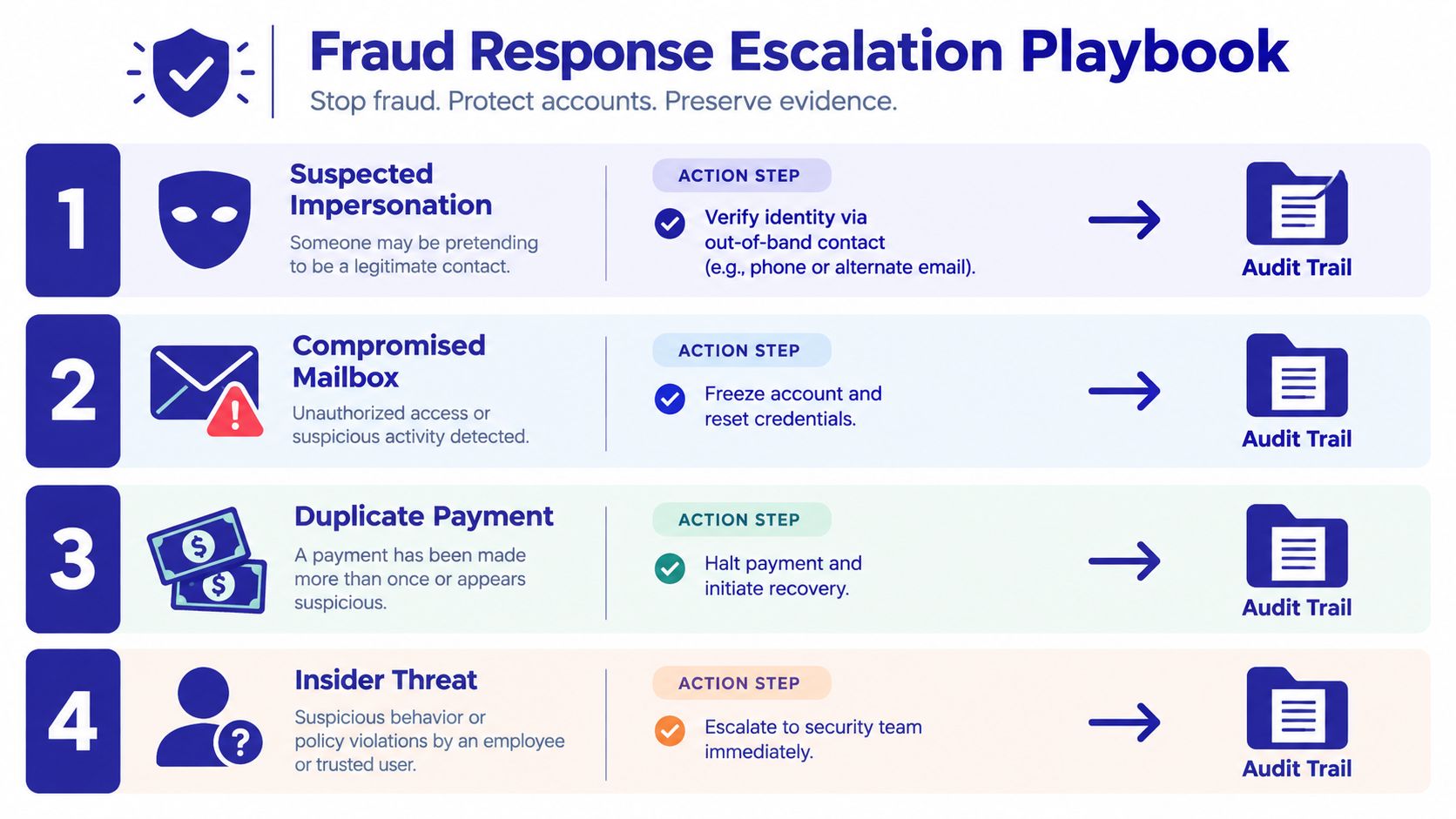
For suspected impersonation, stop the requested change and contact the supplier through a trusted route. Preserve the message before forwarding or otherwise handling it in ways that could lose relevant information.
For a suspected compromised mailbox, involve security to contain the account and investigate access. Security should determine appropriate session revocation, credential resets, and related checks, while finance identifies potentially affected instructions and payments.
For an apparent duplicate payment, pause any unreleased transaction and reconcile the obligation and payment status. If funds have already left, the authorized finance contact should promptly ask the bank about available recovery actions without promising recovery.
For an insider conflict or vendor-master manipulation, preserve access logs and change history, restrict further unauthorized activity, and involve security, legal, or the designated investigation function. Avoid routing the case solely to someone whose decisions are under review.
Use this escalation structure as a working reference.
Keep records that explain the decision
A defensible file should let an independent reviewer reconstruct what happened, what employees knew at the time, and why they acted. Retain original messages and headers, transaction records, supporting documents, approvals, callback results, system changes, and analyst decisions under the organization's retention and access rules.
Use these compact templates as record structures:
| Record | Fields to capture |
|---|---|
| Internal alert | Reporter, receipt time, vendor, affected transaction, concern, immediate hold, assigned owner |
| Investigation record | Allegation, evidence inventory, verification actions, findings, unresolved questions, decision-maker |
| Vendor confirmation request | Trusted contact route, authorized representative, instruction being verified, secure response method |
| Incident summary | Established facts, suspected mechanism, affected records, payment status, notifications, remaining uncertainty |
| Corrective-action log | Control weakness, remediation owner, required change, completion evidence, independent retest |
A vendor confirmation request shouldn't ask the recipient to reply with unrestricted sensitive banking information. Direct the authorized representative to the approved secure process and record the confirmation outcome.
Preserve uncertainty honestly. An investigation record that separates facts, assumptions, and unresolved questions is more defensible than a confident conclusion unsupported by evidence.
Protect reporting and the people affected
Train staff with realistic scenarios: a genuine supplier's compromised mailbox, an executive demanding an exception, or a bank change arriving just before payment release. Ask employees to demonstrate the response, not merely acknowledge a policy.
Provide confidential reporting routes for staff and accessible routes for vendors and customers. Prohibit retaliation, limit case access, and let reporters raise concerns outside their normal management chain when necessary.
Business impersonation also matters for organizations serving older customers and families. The FTC reported more than $3 billion in fraud losses from adults aged 60 and older during 2025 and cautioned that reported losses understate the impact in its older-adult fraud report. Those are consumer-fraud findings, not vendor-fraud totals, but they reinforce the need to address misuse of trusted business identities beyond accounts payable.
Implement controls in a workable order
Start by assigning ownership and protecting the vendor master. Separate incompatible duties, establish independent onboarding and bank-change verification, and connect transaction evidence to payment release. Then refine exception monitoring, train staff, and rehearse incident response.
Measure alert precision, confirmed-fraud yield, time to review, prevented-payment value, independently verified vendor-master changes, override frequency, and audit-trail completeness. Define each measure carefully: a held payment isn't automatically prevented fraud, and a closed alert isn't necessarily a well-investigated case.
Use a compact ownership check:
- Procurement: Can we defend the supplier selection, ownership review, and contract scope?
- Finance: Can we establish the obligation, authorized beneficiary, and release decision?
- Security: Can we control sensitive access and investigate suspicious communications or account activity?
- Business owners: Can we confirm delivery, explain exceptions, and accept operational consequences when verification requires delay?
Stronger verification and monitoring reduce exposure, but resilient vendor fraud prevention also requires human reporting, independent judgment, and disciplined follow-through. The exception that looks ordinary still deserves a supported decision.
Gini Help offers AI-powered screening for calls, texts, and emails that can add a communication-risk signal alongside your vendor-payment controls. Visit Gini Help to review its screening features and decide whether the app fits the employees or family members you want to protect, while keeping independent payment verification in place.