Caller ID Says Spam Risk: What It Means and What to Do
By Josh C.
Your phone rings from a number you don't recognize, and the screen offers four words instead of a name: caller ID says spam risk. You're expecting a call from a pharmacy, a plumber, maybe the clinic billing office. Do you answer? The label feels like a verdict. It's closer to a raised hand.
Plenty of people hang up on a real appointment reminder and then pick up a call that carries no warning at all, from someone who already knows their name and the last four digits of an account. The label catches some danger and misses other danger. Learning to read it correctly, and to stay alert when it's missing, is the skill worth building.
What follows is how the label gets made, what each signal behind it can and can't prove, and what to do in the first thirty seconds of any call, labeled or not.
What a Spam Risk Label Means and Why Carriers Assign It
Caller ID says spam risk because a carrier or a call-analytics service made a judgment about that number. Nobody proved a crime is in progress. The first layer of that judgment is authentication. In internet-protocol voice networks, the company that starts the call signs it under STIR/SHAKEN, and the receiving network checks whether that company was authorized to present the number on your screen. The FCC's requirements for service providers describe how that result travels with the call as an attestation level. A call with strong attestation is more likely to ring through. A call with weak or missing attestation is more likely to be labeled, sent to voicemail, or blocked.
Authentication answers one narrow question: was this provider allowed to show this number? It says nothing about whether the person on the line is honest. That's why carriers stack behavioral signals on top of it, including volume, calling patterns, where the traffic originates, and how many people have complained.
The volume explains the stakes. The 2024 U.S. Spam and Scam Report from the Public Interest Research Group counts 1,099,223 robocall complaints to the Federal Trade Commission in fiscal 2024, plus 763,970 about live callers and 221,940 with no call type reported, close to 2.1 million complaints in all. Robocalls were the largest complaint category in every month of that year. Globally, Hiya's call threat report recorded 13.7 billion suspected spam calls flagged in the second quarter of 2025, roughly 150 million a day. In the United States, U.S. PIRG's 2025 robocall analysis puts YouMail's count at an average of 2.56 billion scam and telemarketing robocalls a month through September 2025, up from 2.14 billion a month in 2024.
Spoofing is why the displayed number lost its authority. A Government Accountability Office review cited in that same report found that complaints to the FCC mentioning spoofing more than doubled between 2015 and 2018. Carriers pushed authentication across much of the network by the end of 2019, which raised the floor without settling the question of intent.
What each signal proves, and what it doesn't
| Signal | What it tells the carrier | What it cannot prove |
|---|---|---|
| STIR/SHAKEN attestation | Whether the originating provider was authorized to show the number | Whether the caller's purpose is honest |
| Call volume and sudden spikes | Automated or unusually high calling behavior | Whether a busy business is legitimate |
| Complaint reports | How many people marked the number as unwanted | That every reported call was a scam |
| Calling pattern and origin | Unusual routing, timing or sequence of calls | Who is actually on the line |
Why a clinic and a scam can wear the same label
Three kinds of caller end up behind those four words, and only one of them is trying to hurt you.
A legitimate high-volume caller sends appointment reminders, prescription notices, or delivery updates through an automated platform. Its dialing pattern looks exactly like the pattern the analytics were built to catch.
A spoofed number copies a familiar area code, or a bank's real line, so the display borrows trust the caller never earned.
A scam operation works the numbers hard, rotates them often, and collects complaints until the label finally sticks, then abandons the number.
Both kinds of error happen, and they happen often. A pharmacy gets stamped while a criminal using a compromised account slides through with clean authentication.
A spam risk label is a pause button, not a verdict. It tells you the network has doubts. It doesn't tell you who is calling.
If you want the mechanics of what your own phone shows and why, how caller ID works on a phone breaks down the display itself. The practical takeaway is simpler: when you see the warning, slow down rather than decide.
Your Response to Each Spam Risk Call
Most flagged calls need one of two responses. Either let them ring through, or call back on a number you control. The table below covers the five situations that account for nearly all of them.
| Call situation | What it usually signals | What to do |
|---|---|---|
| Spam risk label, number matches a saved contact | Possible spoofing or a misdialed number | Let it go to voicemail, then call the contact back on a number you already have |
| Spam risk label, unknown number asking for money or urgent payment | High-risk request pattern | Hang up, then call the organization on the number from its official website |
| Spam risk label, caller asks for a code, password or remote access | Credential theft attempt | Never share it; end the call and report the number |
| Spam risk label, business you already use | Possibly a high-volume legitimate caller mislabeled | Check the request through the account page or official number before replying |
| No label, unknown caller creating urgency or secrecy | No automated signal, so behavior matters most | Pause, refuse to act on the spot, and verify independently |
A saved contact's name appearing next to the warning deserves a second look, because spoofing lets a caller borrow a number you already trust, including your own bank's. Treat the name on the screen as a claim and the callback as the verification. When you dial a number you already have, you're the one who confirmed it.
Codes get their own rule because a one-time code is the last lock on an account. No bank, utility, delivery company, or government office needs you to read a verification code aloud. Hanging up costs nothing. Restoring a drained account costs weeks.
Some flagged calls are real. The FTC's biennial report to Congress on the National Do Not Call Registry recorded more than 170,000 medical and prescription-related unwanted-call complaints in fiscal 2024, over half of them robocalls, which is the kind of legitimate outreach that automated dialing can bury under a warning.
Businesses feel the other side of this. Every call you let ring to voicemail carries a cost of missed business calls at the other end, which is why separating real callers from junk beats blanket blocking. Screening handles that split for you. Every plan shows the caller's name and reason before you call back, so an unfamiliar number arrives as a short summary rather than a decision you make live.
If a caller asks for money, passwords, or urgent action, check the request independently before you act. Write down three things while the call is fresh: the number, the organization the caller claimed to represent, and what they wanted. Those details are what a bank, a carrier, or a family member needs later.
When a Call Without a Warning Is Still Dangerous
The expensive call usually arrives clean. No warning, no red letters, sometimes a number that matches a real bank branch or a government switchboard.
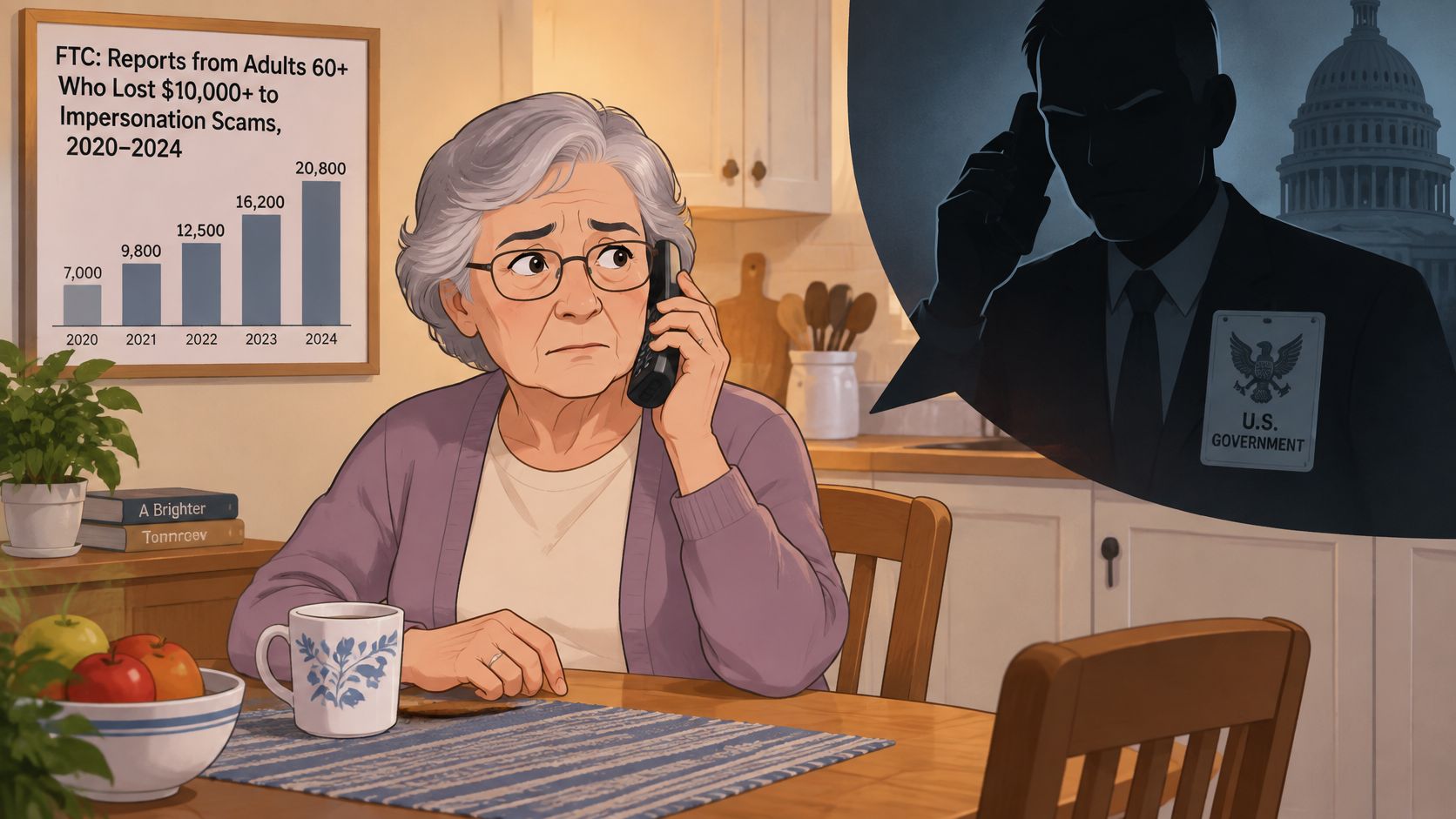
The FTC's imposter scam data spotlight shows why a missing label is no comfort. From 2020 to 2024, reports from adults 60 and older who lost at least $10,000 to impersonation scams increased more than fourfold. Reports involving losses above $100,000 rose nearly sevenfold, and combined reported losses in that top category grew eightfold, from $55 million to $445 million. In 2024, 41% of older adults who reported losing at least $10,000 to a business or government impersonator said a phone call was the first contact.
A warning system built to filter nuisance traffic can't see inside a conversation. Someone using a real number, a real name, and a calm voice passes every check the network runs, then turns dangerous the moment they create urgency.
Warning signs that appear mid-conversation
- Urgency with a deadline. Money must move today, the account closes in an hour, a warrant is being issued.
- Secrecy. Instructions not to tell a spouse, a banker, or a family member, always framed as protecting you.
- Unusual payment routes. Gift cards, wire transfers, cryptocurrency, or cash by courier. No legitimate institution collects a debt that way.
- Requests for access. A password, a PIN, a one-time code, or permission to install remote-support software.
- A move to a safe account. No bank asks a customer to transfer money to protect it.
Say you'll call back, end the call, and reach the organization through its own published number. That single routine defeats most of these scripts, because the script depends on keeping you on the line.
Gini Help's Live Scam Detection keeps listening after a call is answered and warns you mid-conversation when someone asks for a verification code or an account number, or pushes you to act right now. The warning isn't proof of a scam, but a risk alert gives you a reason to pause and check the request before anything moves.
Screening can't identify every scam, and no label can. Judge the request, not the number. A verified number asking for gift cards is still a thief.
How Families Can Handle a Flagged Call Together
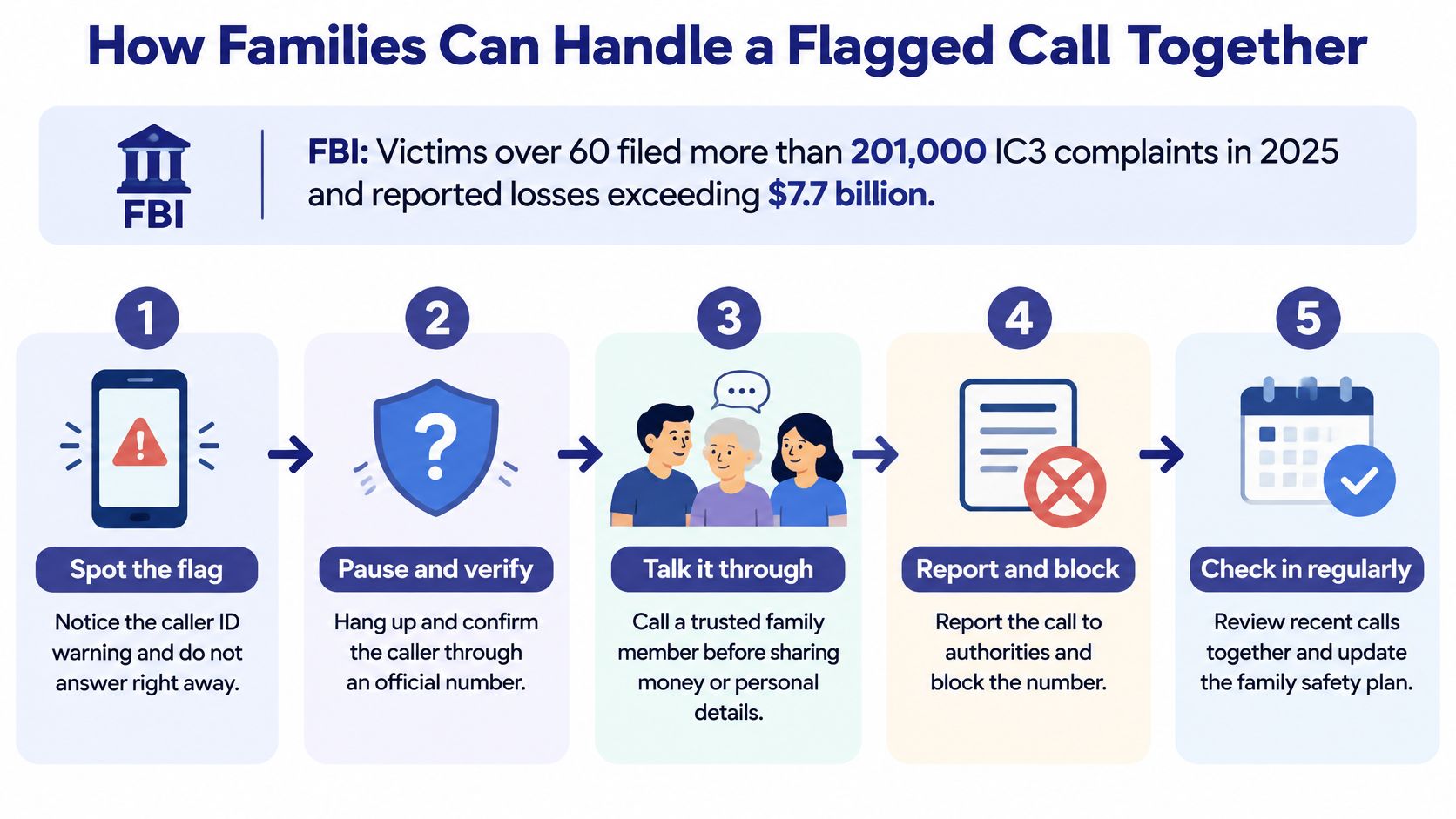
Older adults absorb the heaviest losses, and the numbers are not close. The FBI's summary of scams targeting older adults reports that victims over 60 filed more than 201,000 complaints with the Internet Crime Complaint Center in 2025 and reported losses exceeding $7.7 billion. Phishing and spoofing alone generated more than 48,000 complaints from that age group, over 24% of all complaints from seniors and the most common type of senior victimization in the summary.
The stakes are also higher per incident when a phone starts the fraud. The FTC's report on older consumers puts the median reported loss for fraud that began with a phone call at $3,000, compared with $599 for fraud that began on social media. A shared family routine is worth more than a memorized list of area codes.
- Pause and end the call. Don't confirm an address, a date of birth, or an account number to a caller who reached out first. The few seconds of silence after you hang up are free.
- Write it down. Caller name, claimed organization, the number shown, and what was requested. This becomes the record you compare against a real statement later.
- Verify through your own channel. Call the organization on the number from its official website, or the number printed on the back of the bank card in the drawer. Never a number the caller supplied.
- Bring in a second person before anything moves. Money transfers and account changes can wait for a daughter, a son, a neighbor, or a financial adviser to hear the story.
- Report once it has happened. Contact the bank immediately if money moved, then file with the FTC, or with the FBI's Internet Crime Complaint Center for internet-enabled fraud. Keep the call log and screenshots.
- Agree on a family question in advance. Something only a real relative would answer, used before any urgent request gets acted on. It works because it's decided calmly, before a stranger is on the line.
Whether your family needs a formal protection setup or just a shared habit, what family protection looks like in practice is a useful starting point for the conversation. A routine beats memory every time, especially on a bad day.
What to Do If You Already Shared Information or Paid
The call ended, and now you're the one holding the problem. Act in order and don't spend time on regret.
- Stop all contact with the caller. Don't answer if they call back, even with a refund offer or a threat. Both exist to keep you engaged.
- Change the password on any account tied to what you shared, and switch on two-factor authentication inside that account's own settings. If the code was for a bank, change the banking password first.
- Call the bank or card issuer now if money moved. Wire transfers, gift card payments, and crypto transfers get harder to recover by the hour. For gift cards, call the card issuer and report the card as used in a scam. For crypto, contact the exchange you used.
- Report the number to your carrier and mark it as spam on your phone, so the next person gets a warning sooner.
- File a report with the FTC, and with the FBI's Internet Crime Complaint Center if the fraud involved the internet. Keep screenshots, call logs, receipts, and any messages.
- If you granted remote access, disconnect that device from the internet, run a security scan, and have someone you trust check it before you log into banking again.
Quick reporting is the difference between a recoverable charge and a lost transfer. The written record matters just as much, because the family member or fraud investigator who helps you next week will need times, numbers, and amounts. A calm step-by-step recovery plan after being scammed is worth reading while the details are still fresh.
Confirm Every Request Before You Act
Whatever the screen says, one habit covers every case: confirm the request before you act on it. Not confirm the number. Not confirm the name. Confirm the thing being asked of you, through a channel you chose.
Three rules carry most of the weight. Verify before paying, using a number from a statement or an official website. Never share codes or passwords over the phone, since the caller who needs them has a reason to want them and a legitimate one to reach you another way. And treat urgency itself as a warning, because real institutions give you time to think.
Gini Help is one option for moving that screening earlier in the process. It's a mobile app that answers unknown callers, asks who is calling and why, and rings you through only when the call is real, which fits when unwanted calls and scam protection are the main concern. Every plan includes an allow list for trusted contacts and a block list for the rest, plus text and email scam scanning for the inbox you connect. You can watch a live demo of Gini blocking a real spam call in your browser before signing up.
The honest limit: screening reduces unwanted calls but cannot identify every scam or guarantee that every caller is safe. The verification habits above still do the work.
Download it from Google Play or the App Store, and find the rest at the Gini Help site.
Before you answer anything, labeled or not, run three questions. Who is calling? What do they want? Can I verify it through a number I already trust? If any answer is unclear, the call can wait.
Unknown callers stop being a gamble when something answers on your behalf first. Gini Help screens unknown calls, asks who is calling and why, and only rings you when a real person is on the line, so a spam risk label never becomes your only line of defense. Its Live Scam Detection keeps listening during calls you do take and warns you the moment someone starts asking for codes, account numbers, or immediate payment. Visit Gini Help to watch a real spam call get blocked in your browser, then start protecting your own line.