Scam Calls with Similar Phone Number: How to Spot Them
By Josh C.
The call lands at 4:12 on a Tuesday. The number on the screen carries your area code, and the first six digits match your own number, give or take a few. It could be the pharmacy. It could be the clinic confirming Thursday's appointment.
Your thumb is already moving before you've decided anything. That half second between the screen lighting up and your answer is where this fraud lives. Scammers build numbers that look like they belong on your street because familiarity is the cheapest trust signal there is.
Spot a Similar-Number Scam in Under a Minute
A call arrives showing your own area code and a number sharing your first six digits, a few digits off from your own. Nothing about that display proves a thing, but it feels like a neighbor, a clinic, the pharmacy on the corner.
That six-digit overlap is the signature move. Displaying a false number with intent to defraud is unlawful under the Truth in Caller ID Act, as the FBI explains in its guidance on scams targeting older adults, and the digits on your screen may belong to an innocent person who never placed the call.
You don't need to diagnose the technique mid-ring. Five signals cover most of what you'll see, and each has one action attached.
| Signal | What It Usually Means | What to Do |
|---|---|---|
| Number matches your area code and first six digits | Neighbor spoofing is likely | Treat the match as a warning, do not trust it |
| Caller asks for a code, password, gift card or remote access | A scam, whatever the number | Hang up immediately |
| Same number or nearby numbers call repeatedly within days | Robocall campaign | Block or screen the calls |
| Caller claims to be a bank, agency or retailer | Impersonation | Call the number printed on your statement or official site |
| Call comes from a saved contact | Usually legitimate | Still verify any money request |
Rows one and two do most of the work. A number that mirrors your own six digits is the pattern itself, so similarity is a warning rather than a credential. And no legitimate bank, agency, or retailer needs a verification code, a password, a gift card number, or remote access to your computer, which means the request settles the question even when the display looks perfect.
Row three is the campaign behind the curtain. When the same number, or a cluster of numbers close to yours, keeps landing within days, you're looking at an operation cycling through a block of numbers rather than a person trying to reach you.
Rows four and five are where careful people get caught. Impersonation of a bank, an agency, or a retailer is the most common script, and it only works if you accept the number as identification. A saved contact is the one case worth trusting by default, but money requests get verified even then, because phones and accounts do get stolen.
The rule that covers every row: a familiar number earns no trust until you've confirmed the caller through a channel you found yourself.
How Neighbor Spoofing Tricks You Into Answering
Caller ID behaves like a name tag at a conference. Anyone can print one, write any employer on it, and clip it to a lanyard. The badge doesn't verify the person wearing it. Your screen doesn't verify the caller either.
One picture makes the mechanism plain.
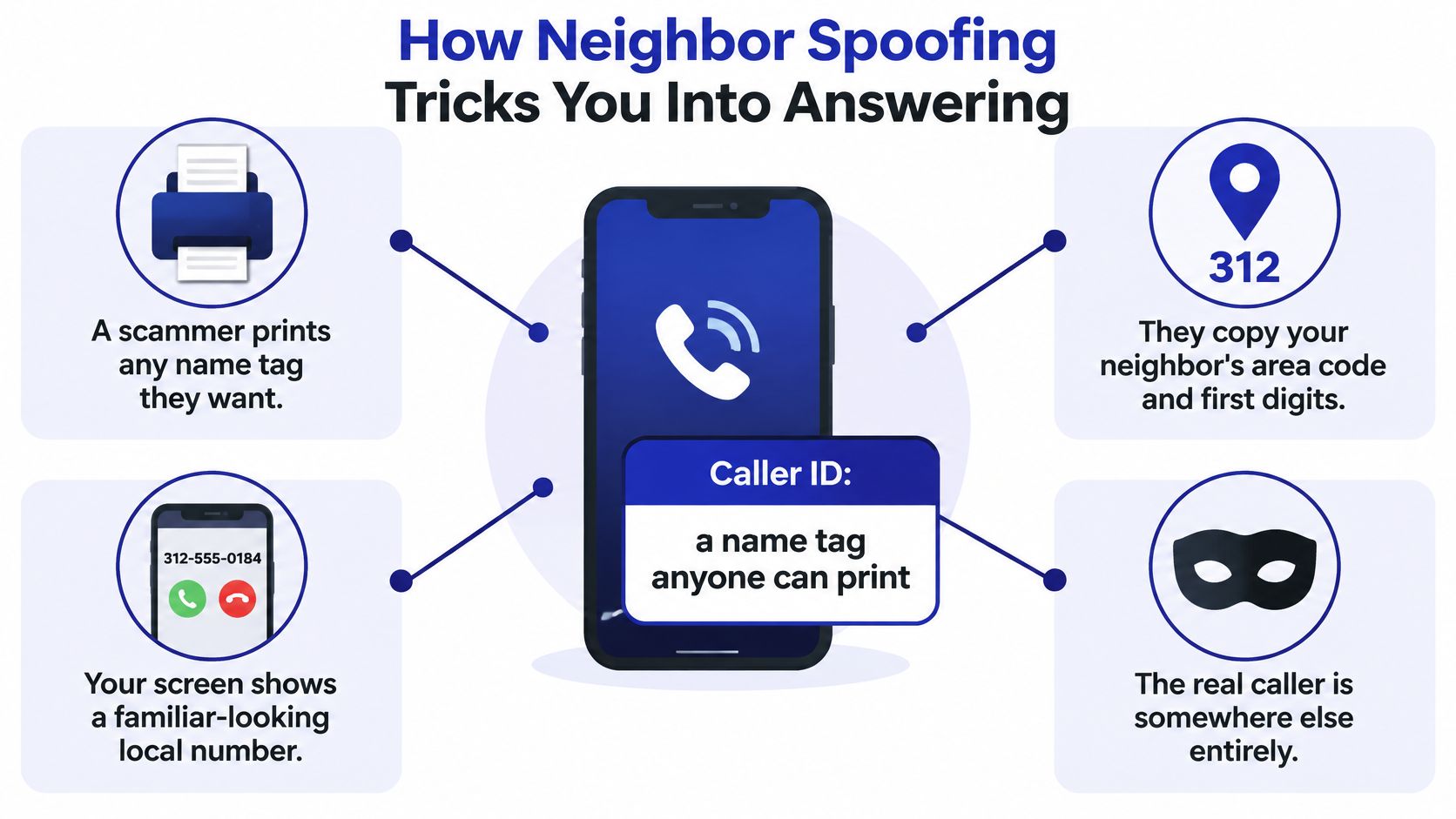
Neighbor spoofing is the deliberate version of the badge trick. A scammer displays a number matching your area code and telephone exchange, the first six digits of your own number, so the call reads as local instead of foreign. The U.S. Government Accountability Office's analysis of FCC and FTC complaint data treats that six-digit similarity as the defining feature, which separates it from ordinary spoofing that borrows any number at all.
The scale arrived fast
Data from a call-blocking provider showed neighbor-spoofed robocalls rising from 2% of calls in January 2016 to 23% in December 2018. Over 2015 to 2018, FTC complaints using the pattern grew from 67,845 to 945,714, according to the same GAO analysis. That's the difference between an occasional nuisance and a standing business model.
Why the decision happens before you think
The answer isn't gullibility. A familiar prefix reads as safe because most familiar prefixes really are safe, and that shortcut is exactly what the call purchases. An FCC consumer advisory committee recommendation on caller ID authentication reported that more than 80% of scam callers manipulate caller ID to show a number that looks familiar, and cited evidence that approximately one in three scam calls was answered because the displayed number appeared familiar.
One answer is all the operation needs. The script arrives next: a fraud department, a Medicare benefits line, a delivery that needs a small fee. The number already did its job, so the conversation starts with your guard down.
The pattern is easier to recognize once you've watched it happen. This short walkthrough shows a spoofed local number arriving on a phone.
Similarity is a warning sign, not proof of identity.
Why Caller ID and Blocklists Fall Short
Two layers sit between a scammer and your phone, and neither one tells you who is speaking.
The first is the number lookup that flags a call as spam. The second is carrier authentication. STIR/SHAKEN lets the originating provider sign the call's caller-ID information and the terminating provider verify that signature, which is more effective than an unsigned label. What it authenticates is the carrier's assertion about the number, not the human on the line. Independent academic analysis cited in an FCC document on caller ID authentication found that only about 15 to 24 percent of calls received by terminating networks had valid signatures in the cited public data, and signatures can fall away when a call crosses non-IP networks.
So treat the source of a call as one signal among several, and check three things yourself:
- Does the stated identity fit the number's context? A "bank fraud agent" calling from a mobile prefix that belongs to a plumbing company is a mismatch worth noticing.
- Is the conversation coercive or secretive? Instructions to stay on the line, to keep quiet, or to move fast are markers of a script, not a service.
- Is the request unusual for you? If you've never been asked to pay a fee by gift card or to install remote-access software, the first time shouldn't arrive by phone.
Databases age badly too. In one customer account over three months, 1,367 different numbers called and only 163 of them called twice, which leaves a blocklist chasing numbers that won't be reused.
It helps to know what your phone's caller ID display actually represents before you build a routine on top of it. If you want the technical picture of how signing and verification work, Dograh's STIR/SHAKEN caller ID guide walks through the framework in detail. For a high-risk household, the more effective setting is routing unknown or weakly authenticated calls into a screen before the handset rings, so the social-engineering conversation never begins.
What to Do When a Familiar Number Calls
The number on your screen is the least reliable part of the call. What you say after you pick up is entirely yours to control, and a short routine keeps you reachable without handing anything over.
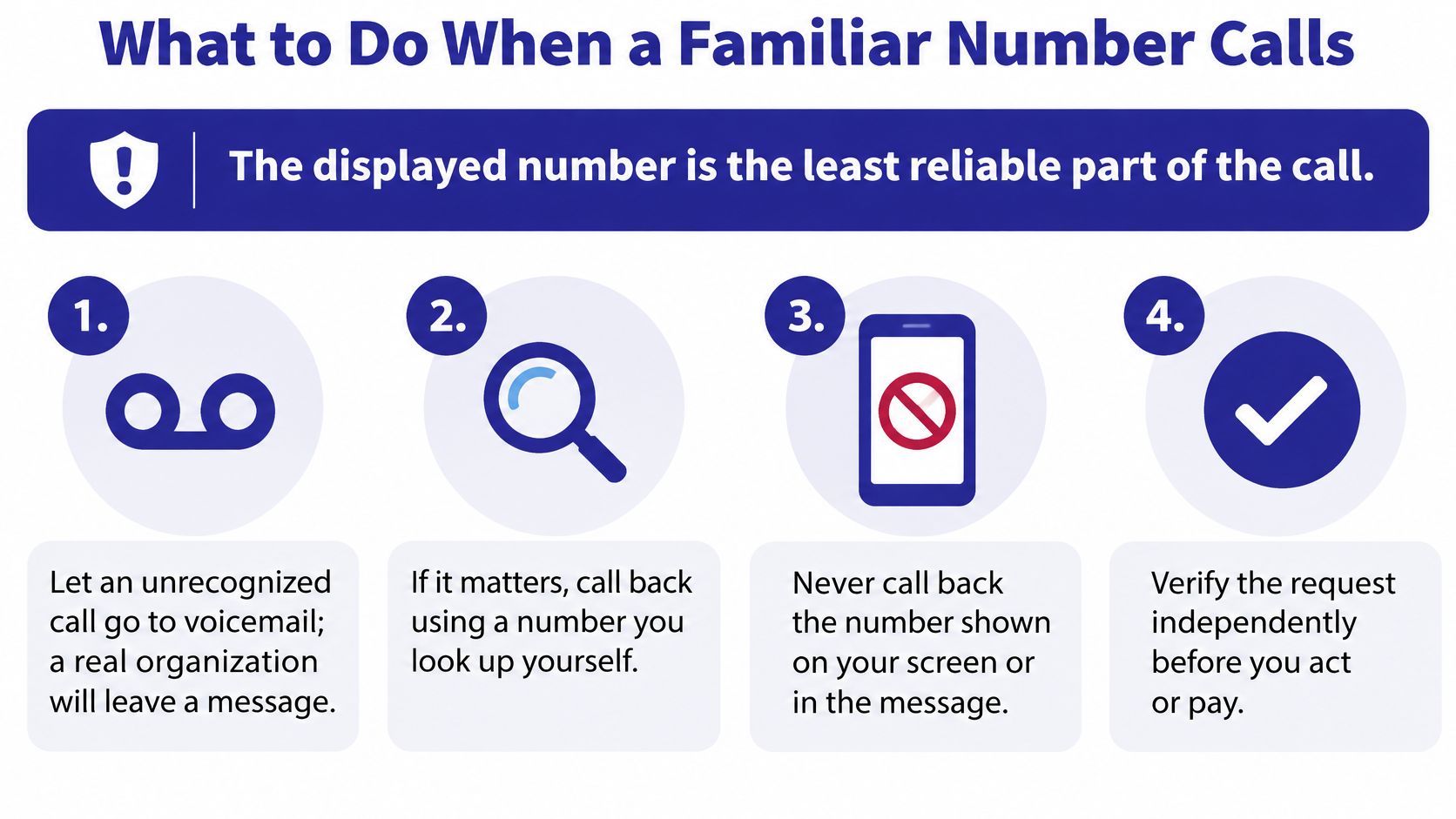
The line that ends most of these calls: I'll call the company back on the number printed on my statement. Thanks for letting me know.
Seven steps, in order
- Let the first ring go. An unrecognized call can finish in voicemail at no cost to you. A real clinic, bank, or contractor will leave the reason and a callback number, and listening to a recording beats answering live.
- Answer with nothing to give. If you do pick up, ask who is calling, which organization they're with, and what the call concerns. Don't confirm your name, address, date of birth, or account numbers while you decide, because those details are what make the next call convincing.
- Listen for pressure. Urgency, secrecy, a request for a verification code, a gift card, a wire transfer, or remote access to your device. Consumer guidance from the FCC's caller ID spoofing page is blunt about this: don't trust a name or number an impersonator supplies, hang up, and verify through a channel you found yourself.
- End it politely. Give a reason that closes the conversation without argument, such as needing to check your records first. You're not being rude. You're refusing to let a stranger set the terms of your banking.
- Find the number yourself. Use the one on your statement, the back of your card, the prescription label, or the organization's website typed in by hand. A number read out by a caller is part of the script, even when it sounds official.
- Don't redial the screen. A callback to a spoofed number can reach a stranger or the same operation, and neither settles whether the call was real.
- Report it and tell one person. Report the call to the FTC through its fraud reporting site and to your carrier's spam line, then mention it to a family member. Reporting helps the next person's phone label that number, and the family conversation is how a routine becomes a habit.
After step five you know something the caller was counting on you not knowing: whether the organization was trying to reach you. That answer usually takes a minute or two and costs nothing but patience.
If You Already Answered or Shared Details
If you've already answered, read out a code, or handed over card details, the useful question isn't what you should have done. It's what limits the damage in the next hour. There's a walkthrough for handling a scam call you've already taken on the conversation itself, and the steps below cover the aftermath. Skip the ones that don't apply.
- A code or password left your mouth. Change that password now, not tomorrow, and switch on two-step verification for the account it protects. A code read aloud is usually the second factor for a login the caller is running at that moment.
- Card or bank details were shared. Call the number printed on your card or statement, never one the caller supplied, and ask for the account to be reviewed. A new card number is often the right outcome, and asking costs nothing.
- Someone had remote access to your device. Disconnect it from the internet, run a security scan, and have a technician look at it before you use it for banking again. Remote-access tools stay installed until somebody removes them.
- Money left through a gift card or transfer. Contact the company that issued the card or your bank immediately, because fast reporting is the difference between a payment that can be chased and one that can't.
- Watch the following weeks. Read statements line by line, check your credit report, and consider a fraud alert or credit freeze if accounts were touched. Damage like a new account in your name tends to surface later, not on the day of the call.
- Report it and recruit one person. File with the FTC, tell your bank's fraud team, and tell a relative who can help you watch the accounts.
A calm sequence beats a panicked one. And if someone phones the next day offering to fix the problem, treat that as the second half of the scam. Verify with the number on your card, not the number on your screen.
Protecting Older Adults Without Missing Real Calls
The pharmacy calls from a new line, the specialist's office uses a hospital switchboard, and the contractor returns your call from a cellphone. Blocking every unknown number can keep those useful calls out, too. For an older adult who depends on local services, protection needs to leave a way for unfamiliar callers to explain themselves.
A familiar-looking number should prompt a check, not automatic trust.
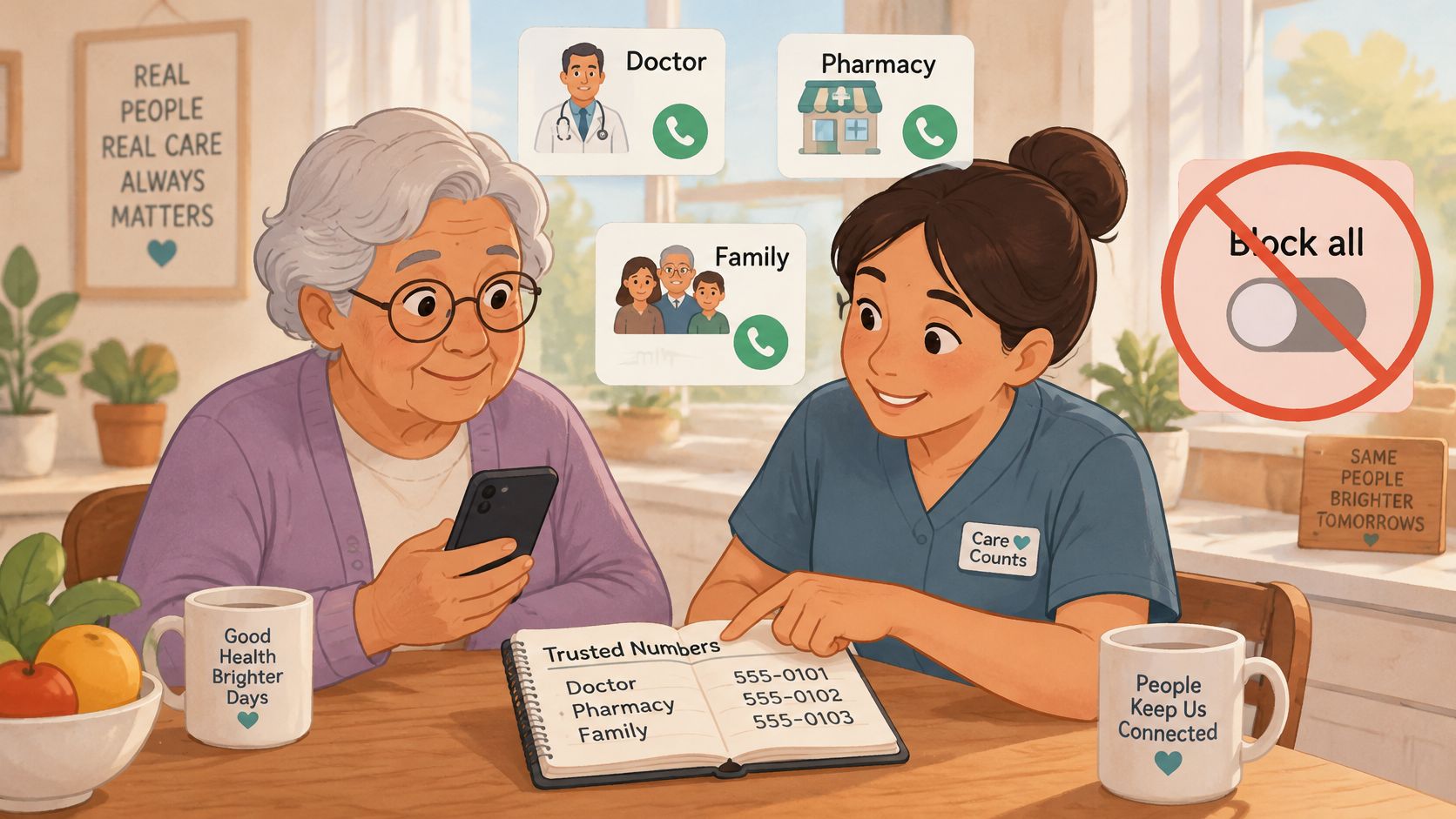
Build a routine together that separates hearing a caller's message from trusting their request. Let unknown callers say who they are and why they're calling. If someone claims to represent an institution and asks for sensitive information, end the conversation and call that institution using a prescription bottle, a statement, or its official website. The number on the screen is like a name on an envelope: it tells you what the sender wants you to see, not whether the contents are trustworthy.
The FTC's report on older adults found median reported losses of $3,000 for phone fraud versus $599 for fraud that originated on social media. That makes a calm callback routine worth practicing before a caller creates pressure.
Imposter scams can use text, phone, email, social media, search results and other channels. A call mentioning a text or email doesn't make either message genuine. Treat them as parts of the same request, rather than independent proof. If a message tells you to dial a number, use your own trusted contact information instead.
The rule to agree on out loud: no money, no codes, and no account numbers over the phone, no matter how familiar the number looks.
Call screening can handle the first conversation by asking unknown callers who they are and why they're calling, while letting legitimate calls continue according to the setup. It cannot catch every scam. Keep the callback rule even when a call passes screening.
Save the clinic, pharmacy, and two relatives under clear names. Rehearse a simple exit line together: I'll call them back on the number I already have. Make pausing an agreed household habit, so the person answering doesn't have to invent a response under pressure. The aim is to keep useful calls reachable while giving every sensitive request a separate check.
Comparing Tools That Screen Unknown Callers
Four approaches do different jobs, and most households end up mixing two of them.
| Approach | What It Checks | Main Limit |
|---|---|---|
| Blocklist of known spam numbers | The caller number against a database | Spammers rotate through new numbers |
| Carrier caller-ID authentication | Whether the carrier signed the number | Covers only part of the traffic and does not prove the speaker |
| AI answers and screens unknown callers | The caller's stated reason and the conversation | Cannot catch every scam, so verify money requests |
| Live call analysis | Warning cues during an answered call | Works only on calls the reader answers |
Pick the setup that matches the risk
If you miss legitimate calls from numbers you haven't saved, a blocklist alone is the wrong tool. Choose screening, which makes the caller state a reason before your phone rings, because it protects access at the same time it filters noise.
If the person you're protecting answers almost everything, add live call analysis. A warning that arrives mid-conversation works better than a warning that arrives after the payment, since it interrupts the script while the caller is still talking.
If someone is at high risk, combine screening with the verification habit from the steps above. Screening decides which calls reach the phone. Verification decides what happens once a call turns into a request.
A comparison of how call screening services differ in setup and coverage can save a week of trial and error, particularly when you're configuring someone else's phone remotely.
No setting makes a phone safe on its own. Screening changes how many scam calls reach you. Verification decides what happens when one does.
Confirm the Request Before You Act
Every tool above changes the odds. None of them changes the rule. Before you act on a request involving money, passwords, or urgency, confirm it through a channel you chose.
A screened call still ends in a decision you make.
Many phone scams begin as an email. A message about an invoice, a delivery, or an account problem invites you to call a number, and whoever answers already knows what the message said. Email security advice from Networking2000 explains how those messages are built to start exactly that conversation, which is why the same caution belongs in your inbox and on your phone.
Gini Help is a mobile app that screens unknown callers, helps users spot scams, and shows how each call was handled. Some scams can still get through, and screening can't identify every scam or guarantee that every caller is safe, so a request for money or codes still needs a call to a number you looked up yourself. The app is available on Google Play and the App Store.
Two actions for this week: turn on screening for unknown callers, and walk one family member through the verify-first routine until they can repeat it back to you.
Gini Help answers the calls you'd rather not answer, asks who's calling and why, and rings your phone only when a real person is on the line, so a familiar-looking number never gets to open the conversation on its own terms. It screens texts and email alongside the phone, which means the message behind a suspicious call gets checked too. Visit Gini Help to see how it works and set it up on the phone that matters most in your household.