Text Message Spam Laws: A Practical Guide for 2026
By Josh C.
Your phone buzzes. It says your toll bill is overdue. A minute later, another text says a package couldn't be delivered. Then your pharmacy sends a refill reminder, your bank sends a fraud alert, and a store you bought from last year offers a weekend sale. Many treat all of that as one messy pile called “spam.”
Legally, it isn't one pile.
Different text message spam laws sort those messages into different buckets. Some texts are allowed if you gave permission. Some are allowed because they're transactional. Some are illegal the moment they're sent. And in 2026, that answer changes depending on where you are, who sent the text, how they collected your number, and whether you already tried to opt out.
That's where people get tripped up. They hear “TCPA” once, assume every unwanted text is automatically unlawful, or assume replying STOP solves everything. Neither is quite right. The legal rules are real, the penalties are steep, and the practical details matter more than ever because the rules have shifted recently in the U.S. and are diverging sharply across other countries.
Why Text Message Spam Laws Matter More Than Ever
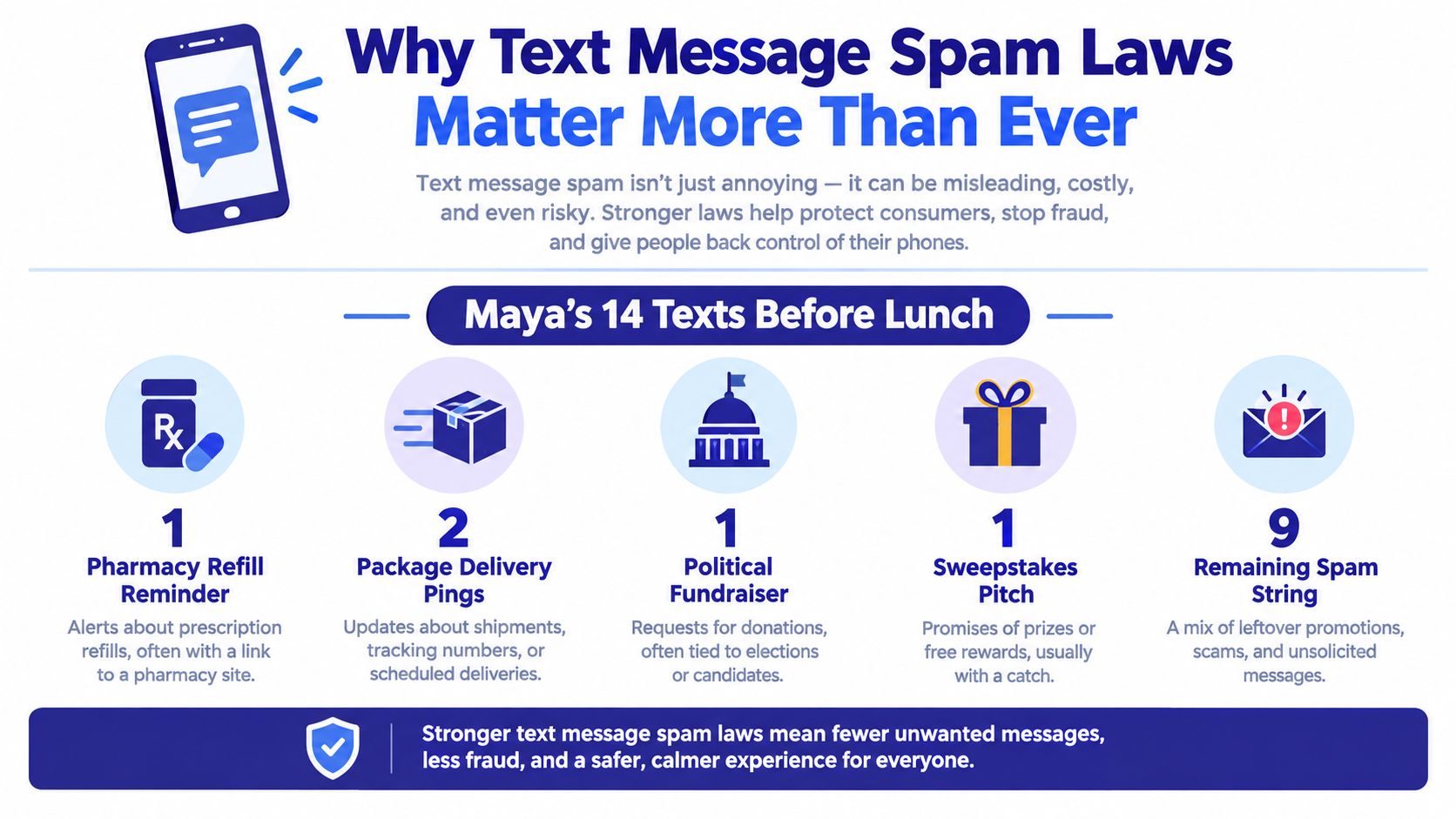
At 9:00 a.m., Maya gets a real pharmacy reminder. By 9:02, a fake toll notice lands in the same thread list. Before noon, a store promotion, a political fundraising text, and a delivery update follow. The legal problem is not just that her phone keeps buzzing. It is that each text may be playing by a different rulebook, and in 2026 that rulebook has changed in ways many senders and consumers have not caught up with.
Why the law starts with consent
Text message law is built around a practical idea. Your phone is a private channel, closer to a tap on the shoulder than a billboard. Because of that, the first legal question is usually whether the sender had permission before sending a marketing text.
That sounds simple until you look at a real inbox.
A bank fraud alert and a coupon text may arrive the same way, but the law does not treat them the same way. A refill reminder may be allowed because it relates to an existing service. A sweepstakes pitch usually stands or falls on consent. An opt-out reply matters too, but it is not a substitute for permission that should have existed at the start.
The Federal Communications Commission tightened this framework in its 2012 rules requiring prior express written consent for certain autodialed telemarketing texts to wireless numbers, as explained in the FCC's 2012 TCPA order.
Why 2026 feels less settled than people expect
A lot of articles still explain text spam law as if the rules froze years ago. They did not.
In 2026, three shifts matter right now. First, the old idea that one checkbox can authorize a flood of unrelated sellers has been hit hard by the vacated one-to-one consent rule, which changed how businesses and lead generators think about permission. Second, new revocation rules are putting more weight on how clearly a consumer can say "stop" and how quickly that request must be honored. Third, other countries are not lining up with the U.S. model, so a texting practice that looks acceptable in one country can create problems in another.
That is why the same message can move from lawful to risky based on details that seem small at first. How the number was collected matters. Whether the text is really informational or partly promotional matters. Whether the recipient already tried to opt out matters. Where the sender operates matters.
Why regulators still care
Consumers are still getting hit with large volumes of scam and nuisance texts, and regulators know it. Analysts in Google's Android 2025 text-based scams report found recurring scam patterns across user-reported SMS and RCS messages, which helps explain why enforcement pressure has not faded.
For consumers, that means an ordinary inbox can mix legitimate service messages with fraud attempts that are designed to look almost identical.
For businesses, it means casual texting habits are a poor fit for the current rules. A signup flow that looked acceptable a year ago may now deserve a second look. A STOP request that sits too long can create trouble fast. And a campaign copied from a foreign market may not match U.S. consent rules at all.
How the TCPA Shapes Every SMS You Receive
Your phone buzzes twice in a minute. One text says your package will arrive by 8 p.m. The next says you can save 15% on your next order if you buy tonight. They may come from the same brand, but the TCPA does not treat them the same way.
That difference is the part many people never see. The law works less like a blanket ban on annoying texts and more like a sorting system. It asks what job the message is doing. Is it completing a transaction, passing along useful information, or trying to sell you something?
For marketing texts, the basic federal rule is still prior express written consent. That consent must be clear, conspicuous, and separate from a purchase requirement, as explained in this TCPA and CAN-SPAM overview for SMS marketing.
Three buckets that matter
| Message Type | Example | Consent Required | Opt-Out Required |
|---|---|---|---|
| Marketing | “Get 20% off today only” | Prior express written consent | Yes |
| Transactional | “Your package is out for delivery” | Usually tied to the underlying transaction, not marketing consent | Usually yes in practice if messaging continues |
| Informational | “School closed due to weather” | Lower restrictions than promotional texting | Best practice is to offer a clear stop path when possible |
The hard cases sit in the middle. A pure delivery alert usually stays in the transactional bucket. Add a coupon to that same alert, and the message can shift into marketing. One extra sentence can change the legal rule that applies.
Where the line gets missed in practice
A fraud alert from your bank usually functions as an account or security message. An appointment reminder from a dentist usually functions as an operational message. A text that says “new arrivals just dropped” is plainly advertising. A text from that same dentist offering discounted whitening for referrals is also advertising, even if you already gave the office your number for scheduling.
The key question is simple: what is this text trying to do?
That is why familiar sender relationships do not solve the problem by themselves. Knowing a brand, buying from it before, or giving it your number for customer service does not automatically authorize promotional texting.
For a practical walkthrough from the business side, the CartBoss SMS compliance guide shows how message purpose changes the consent standard. If you want context on how high-volume junk texting is often automated, this explanation of how text message spam bots work helps clarify why inboxes can fill up so fast.
Why the 2025 to 2026 changes affect today's inbox
The TCPA categories did not disappear in 2026, but the pressure points changed. One major shift is that the one-to-one consent rule businesses had been preparing for was vacated in early 2025 and later removed by the FCC. Another shift matters more to day-to-day texting: opt-out rights now have sharper teeth.
Under the FCC's 2024 revocation order, effective in 2025, businesses generally must treat any reasonable stop request as valid and honor it within 10 business days across channels, as the FCC explains in its Rules and Regulations Implementing the Telephone Consumer Protection Act of 1991, Report and Order and Further Notice of Proposed Rulemaking. In plain English, “STOP” still works, but so can ordinary language like “please don't text me again” if a reasonable sender would understand it as a revocation.
So what changes in your inbox this month? Less depends on a narrow lead form theory. More depends on message classification, clean consent records, and whether a sender stops after you revoke permission. That is why two texts from the same company can still live under different legal rules, and why a message that looked acceptable last year can create risk now.
What Counts as Valid Consent in 2026
You enter your phone number to get a discount code. A week later, texts start arriving from a brand you recognize, then from another brand you do not. Whether those messages are legal often turns on one boring but decisive question: what exactly did you agree to, and can the sender prove it?
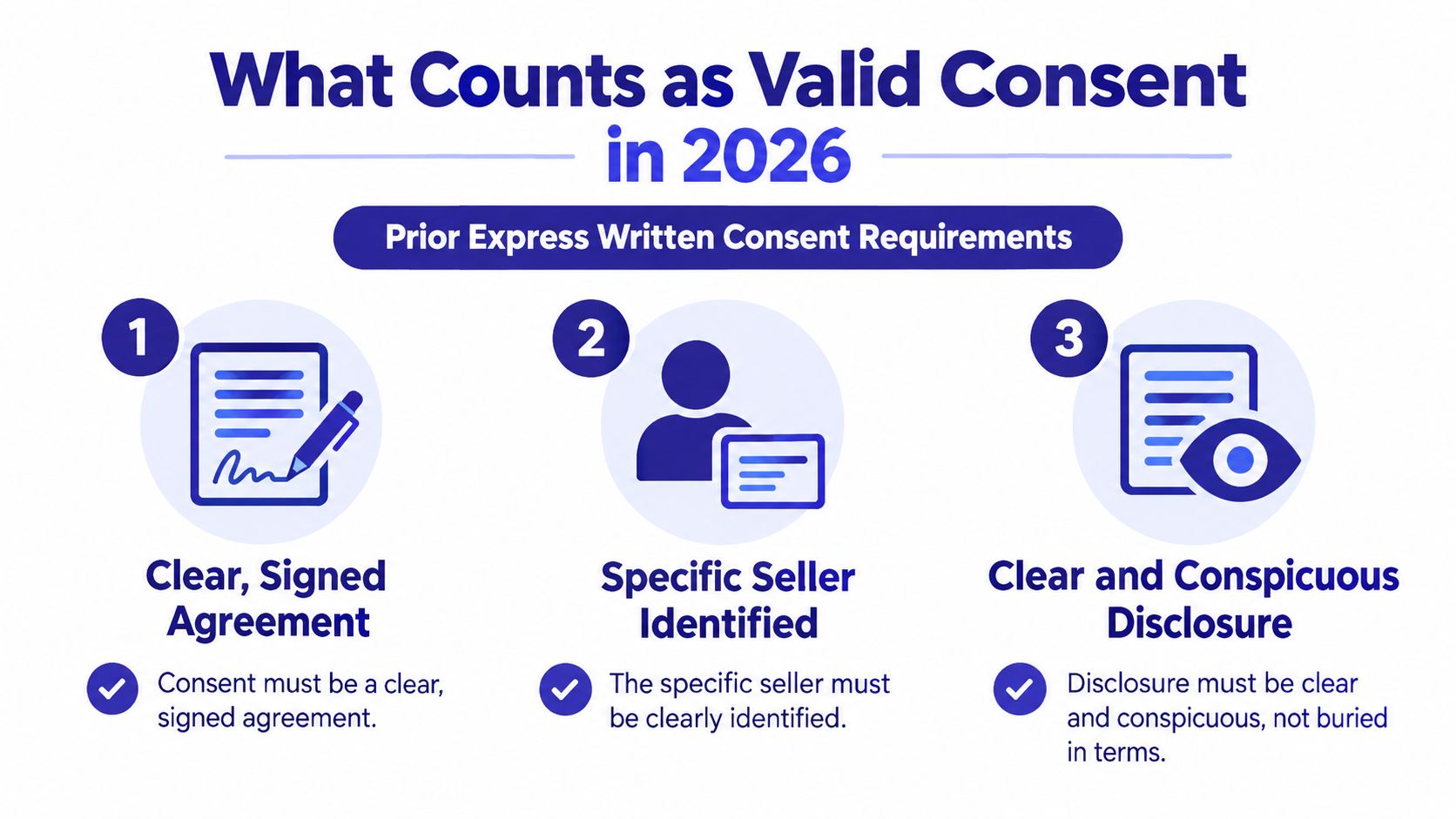
In 2026, valid consent for marketing texts still has four basic parts. The permission has to be clear, tied to a real disclosure, connected to the actual sender, and saved in a record the business can produce later. If any one of those pieces is missing, the consent trail starts to wobble.
What valid consent usually looks like
A cleaner opt-in flow usually includes:
- A separate checkbox: The person actively checks a box agreeing to receive marketing texts.
- A named sender: The form says who will send the messages.
- A clear disclosure: The form says the texts are promotional, may be sent with automation, and are not required to buy something.
- A saved record: The business keeps the timestamp, phone number, and the exact form language shown at signup.
The weak versions are easy to spot once you know what to look for. A pre-checked box. Tiny consent text buried under a button. “Partners may contact you” language that never tells you which company will text. A retailer that collected your number for shipping updates, then starts sending weekend sales alerts as if that earlier transaction covered marketing too.
The one-to-one rule is gone, but vague consent is still risky
This is the part that confuses people in 2026. The strict one-to-one consent rule that many lead generation companies were preparing for did not stick. As noted earlier, it was vacated in 2025 and later removed by the FCC.
That does not mean broad, fuzzy consent is suddenly safe.
A consent record still needs to make sense to a real person reading it later. If someone signed up on a comparison site, the question is simple: would they have understood which business might text them? If the answer is murky, the sender has a problem even without a formal one-to-one rule. The legal shift changed the technical structure businesses were bracing for. It did not bless mystery-brand texting.
A practical way to read the 2026 rule change is this: the law moved away from one specific form design, but it still cares about honest notice and traceable permission.
If a consumer could not reasonably tell who might text them at signup, the consent record is already weak.
Revoking consent is easier now than many companies planned for
The other live change is what happens after consent is withdrawn. Under the FCC's 2024 revocation order, effective in 2025, a consumer can revoke consent through any reasonable method, and sellers generally have up to 10 business days to stop, as the FCC explains in its Rules and Regulations Implementing the Telephone Consumer Protection Act of 1991, Report and Order and Further Notice of Proposed Rulemaking.
“STOP” still counts. So do plain-language messages like “please stop texting me,” “remove me from marketing,” or even a support email that clearly asks for the texts to end. The rule works a lot like canceling a subscription. The company does not get to insist that only one magic word works if your message clearly says you want out.
That change matters in a consumer's inbox this month because legality now depends less on clever form architecture alone and more on day-to-day behavior after the first opt-in. A company can have a decent signup form and still create risk by ignoring a reasonable opt-out, failing to sync suppression lists, or treating SMS, email, and customer support as separate silos.
For teams that send promotional texts, the safer approach is operational, not just legal. This guide on how to optimize SMS for DTC merchants is useful because it treats consent language, message cadence, and unsubscribe handling as one system, which is how regulators and plaintiffs' lawyers will look at it too.
How Text Spam Rules Differ Around the World
A text that is legal in one country can trigger complaints or enforcement risk in another. That is the practical problem for any brand, platform, or affiliate program sending across borders in 2026.
The shared theme is familiar: get consent, identify the sender, and give people a real way to stop the messages. The hard part is that each country builds those ideas differently. The U.S. has been reworking the consent and opt-out side of the rulebook after the one-to-one consent shift and the FCC's newer revocation rules. Other countries put more weight on sender registration, carrier controls, or anti-scam labeling. Same category of problem. Different legal machinery.
Four systems, four different pressure points
Australia is a useful contrast because the rule is stated plainly. Under Australia's Spam Act 2003, commercial electronic messages, including SMS, MMS, email, and instant messaging, generally require consent and must include accurate sender identification plus a working unsubscribe method, according to the Australian Spam Act 2003.
India's system focuses more heavily on telecom controls and complaint handling. The Telecom Regulatory Authority of India finalized the Telecom Commercial Communications Customer Preference (Third Amendment) Regulations, 2026 on September 18, 2026. Those changes restrict call-management apps from filtering, tagging, or blocking calls from TRAI-designated commercial number series, and they add a pricing mechanism for automated bulk calls plus an appeal path for consumers whose spam complaints were closed incorrectly, as reported in Medianama's TRAI coverage.
The U.K. and Australia also show how fast anti-scam rules can shift outside the classic consent model. Australia's ACMA moved to make unregistered branded SMS display as “Unverified” from 1 July 2026. In the U.K., the regulator said new mobile-messaging scam rules are scheduled to phase in in January and July 2027, according to the regulator's announcement, as described in ISPreview's overview of the new U.K. rules and related market shifts.
That matters because inbox legality is no longer just a yes-or-no consent question. In some places, the sender's identity, registration status, or network classification changes what the recipient sees before they even read the message.
Side-by-side comparison
| Jurisdiction | What regulators focus on most | How opt-out works in practice | Distinct 2026 takeaway |
|---|---|---|---|
| United States | Consent for marketing texts, plus fast handling of revocation requests | Businesses generally must honor reasonable opt-out methods within 10 business days | A valid opt-in is only part of the risk picture. Day-to-day suppression handling now matters a lot |
| UK | Direct marketing consent rules plus scam-prevention controls | Depends on the applicable regime and enforcement posture | Mobile messaging rules are still changing, with further measures scheduled for 2027 |
| Australia | Consent, clear sender identification, and a working unsubscribe tool | Unsubscribe must function and be available in the message | Branding and sender verification affect trust and message treatment |
| India | Registered sender controls, network oversight, and complaint-driven action | Consumer complaints and regulator processes play a larger role | Telecom infrastructure rules shape what commercial traffic is allowed and how it is challenged |
A good way to picture the difference is airport security. Every airport checks identity and bags, but the line, screening tools, and secondary checks vary by country. SMS law works the same way. The broad goal is similar, but compliance burden sits in the local details.
For cross-border senders, one global template is rarely enough. A signup flow that looks acceptable under current U.S. practice may still fail elsewhere if the sender ID is wrong, the unsubscribe path does not match local expectations, or the telecom layer requires registration before the text is even trusted.
Penalties, Lawsuits, and Real Enforcement Cases
A single promotional text can look harmless on a dashboard. Send that same text to thousands of people without valid consent, or keep texting after someone clearly opted out, and the math changes fast.
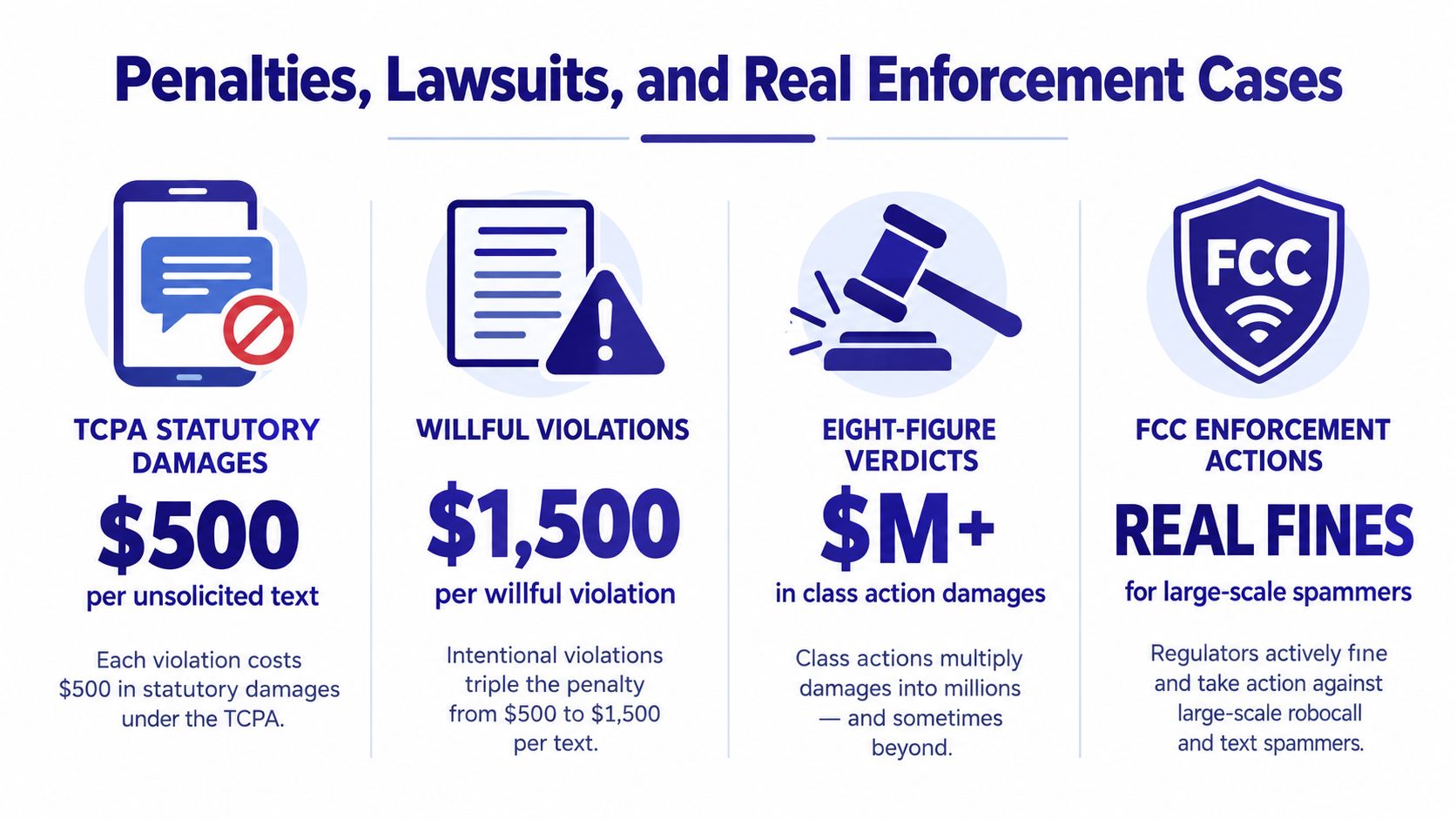
Under the TCPA, private lawsuits often focus on statutory damages of $500 per unlawful message and up to $1,500 for willful or knowing violations. That is why a low-cost SMS campaign can turn into expensive litigation so quickly, as summarized in this SMS opt-in regulations overview.
Why message volume changes everything
Texting liability works like a parking meter running in the background. The first mistake may look small. Repeating it across a whole contact list is what creates real exposure.
That is why plaintiffs, regulators, and carrier-facing investigators care so much about records. If a business cannot show who opted in, what disclosure they saw, when they gave permission, and when they later revoked it, each disputed text can become its own problem. In 2026, that recordkeeping issue matters even more because the consent rules are shifting in ways that leave less room for sloppy assumptions.
The practical lesson is simple. Cheap delivery does not mean cheap risk.
The lawsuits are changing with the rules
The legal fight in 2026 is not just about whether a company had consent once. It is also about whether that consent was still valid after the one-to-one consent rule was vacated, whether revocation was honored through a reasonable method, and which part of the TCPA a plaintiff is suing under.
That last point causes real confusion. A person might assume, "I am on the Do Not Call list, so every marketing text is automatically illegal." U.S. courts have not spoken with one voice on that issue. Recent court coverage describes a split: one 2026 Seventh Circuit ruling said TCPA Do-Not-Call rules do not cover texts, while another 2026 federal decision treated unwanted marketing texts as calls under the TCPA. Nixon Peabody explains that conflict in Seventh Circuit holds TCPA Do-Not-Call rules don't cover texts.
So the legal answer often depends on the theory being used. Was the claim about consent? Revocation? Automated marketing? Do Not Call rules? State consumer law? Those are different doors into the same house, and one locked door does not mean the whole case disappears.
Real enforcement risk is wider than a private lawsuit
Private class actions get attention because the dollar figures scale fast. They are not the only risk. FCC enforcement, state attorney general actions, carrier blocking, and brand damage can all hit at the same time.
That matters for businesses sending texts this month. A company can win one argument about consent wording and still have a problem if it ignored stop requests, used a signup flow that no longer fits current rules, or sent messages in countries with stricter local requirements than the U.S. standard. The 2026 compliance question is less "Did we collect a phone number?" and more "Can we prove this exact text was allowed, here, on this date, and did we stop when the person told us to stop?"
Here's a quick explainer before the video:
Reporting Spam and Building a Compliance Checklist
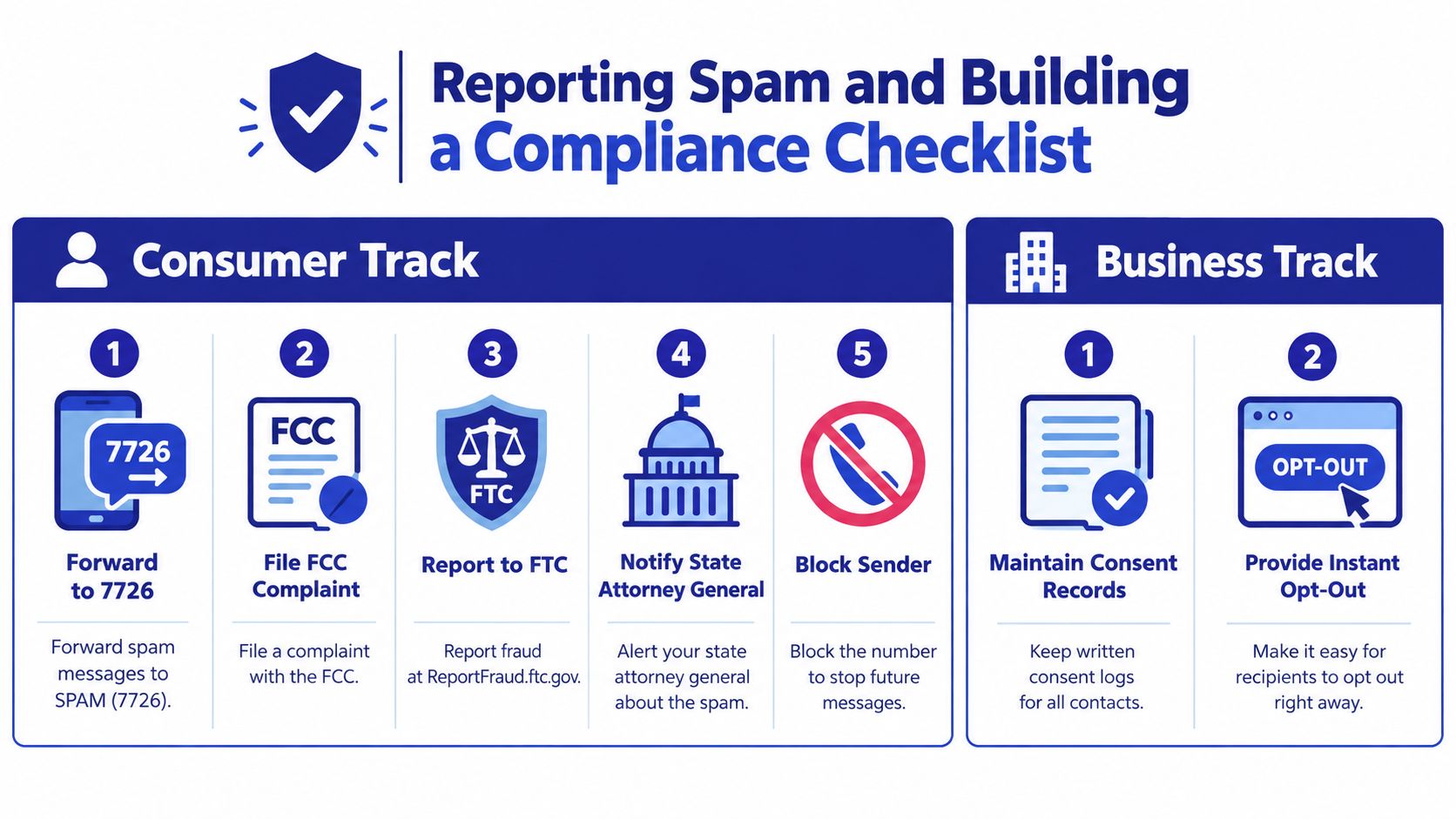
If you're a consumer, the goal is to stop the next message and create a record. If you're a business, the goal is to prove permission and act fast when that permission ends. Those are related problems, but they need different checklists.
If you received a suspicious or unwanted text
Start with the basics:
- Forward it to 7726: Most major carriers use that shortcode for spam reporting.
- Block the sender: That won't solve everything, but it stops repeat messages from that number.
- File a complaint: Use the FCC complaint process if the text looks unlawful or persistent.
- Report fraud: If the text is a scam or phishing attempt, report it through the FTC at ReportFraud.ftc.gov.
- Tell your state attorney general: This matters when state consumer-protection laws may also apply.
If you use an iPhone and want a practical reporting walkthrough, Gini Help has a useful guide on how to report spam text on iPhone.
This is also the place where a filtering tool can help. One option is the Gini Help app, which screens calls, texts, and emails and can analyze unknown text messages for spam patterns before you deal with them. If you want to try it, download Gini Help on Google Play or get Gini Help for iPhone on the App Store.
If you send marketing texts
Use a tighter checklist than you think you need.
- Keep consent logs: Save the form version, timestamp, phone number, and disclosure language.
- Audit opt-in language: Make sure your sender identity and text purpose are clear.
- Honor revocation quickly: Reasonable opt-out requests must be processed within 10 business days under the federal rule discussed earlier.
- Build keyword handling: STOP is the obvious one, but your team should also catch plain-language revocations sent to support channels.
- Separate transaction from promotion: Don't slip offers into service alerts unless your consent record supports marketing.
- Assign ownership: Marketing, legal, support, and engineering each need defined responsibility.
Good SMS compliance usually looks boring. Clean records, plain disclosures, simple stop paths, and no creativity around consent.
Common Questions About Text Message Spam Laws
Does the National Do Not Call Registry block texts
Not cleanly. In 2026, courts have disagreed about whether TCPA Do-Not-Call rules cover texts, so blanket advice is risky. Treat the registry as part of the picture, not the whole answer.
How can I tell a scam from legal marketing
Start with consent and content. Legal marketing usually comes from a sender you recognize, ties back to a real signup, and offers a way to stop future messages. Scam texts often push urgency, links, payment demands, or account threats. Gini Help's guide to SMS phishing protection is a good practical companion if you want to spot those patterns faster.
Is replying STOP always binding
Usually, it's the clearest signal you can send, but it isn't the only one businesses must honor. Federal revocation rules now recognize opt-out requests made by any reasonable method, so plain-language requests can matter too.
If a company follows federal law, is that enough
Not always. State consumer-protection statutes, mini-TCPA laws, unfair-practices claims, and carrier rules can still create exposure. Federal compliance is the floor, not a universal safe harbor.
What happens if a business is sold or merged
That's where old consent records get stress-tested. The key question is whether the original permission still clearly covers the sender now using the number and the type of messages being sent. If the identity shift is material, the safer move is to refresh consent rather than assume it carries over cleanly.
Gini Help is built for exactly this messy reality: texts that might be marketing, phishing, spoofed delivery alerts, or something in between. If you want one place to screen suspicious calls, texts, and emails before they become a bigger problem, visit Gini Help.