Fake Utilities Bill: Warning Signs and Safe Checks
By Josh C.
A text message arrives at 6:40 on a Tuesday evening. It says your power account is past due, a technician has been scheduled to disconnect service today, and you can settle the balance in the next 30 minutes by calling the number below or scanning the code. The account number looks familiar. The logo looks right. The whole thing looks like a bill.
Except nothing about it needs to look like a bill. The document is only bait. What the sender wants is control of the payment route, whether that's a phone number they answer, a page they built, or a code that sends your money to a counter that isn't the utility's.
Understanding a fake utilities bill means understanding that route, and knowing how to test it in three minutes without using a single contact detail the message hands you.
How Fake Utility Bills Work Today
A fake utility bill turns a familiar monthly expense into a payment trap. Scammers pose as an electricity, gas, water, or other service provider, then try to send your money somewhere the legitimate provider cannot collect it.
The Federal Trade Commission's 2023 Consumer Sentinel data book recorded 853,935 reports involving imposter scams that year. Of those who reported, 21 percent lost money, and reported losses approached $2.7 billion.
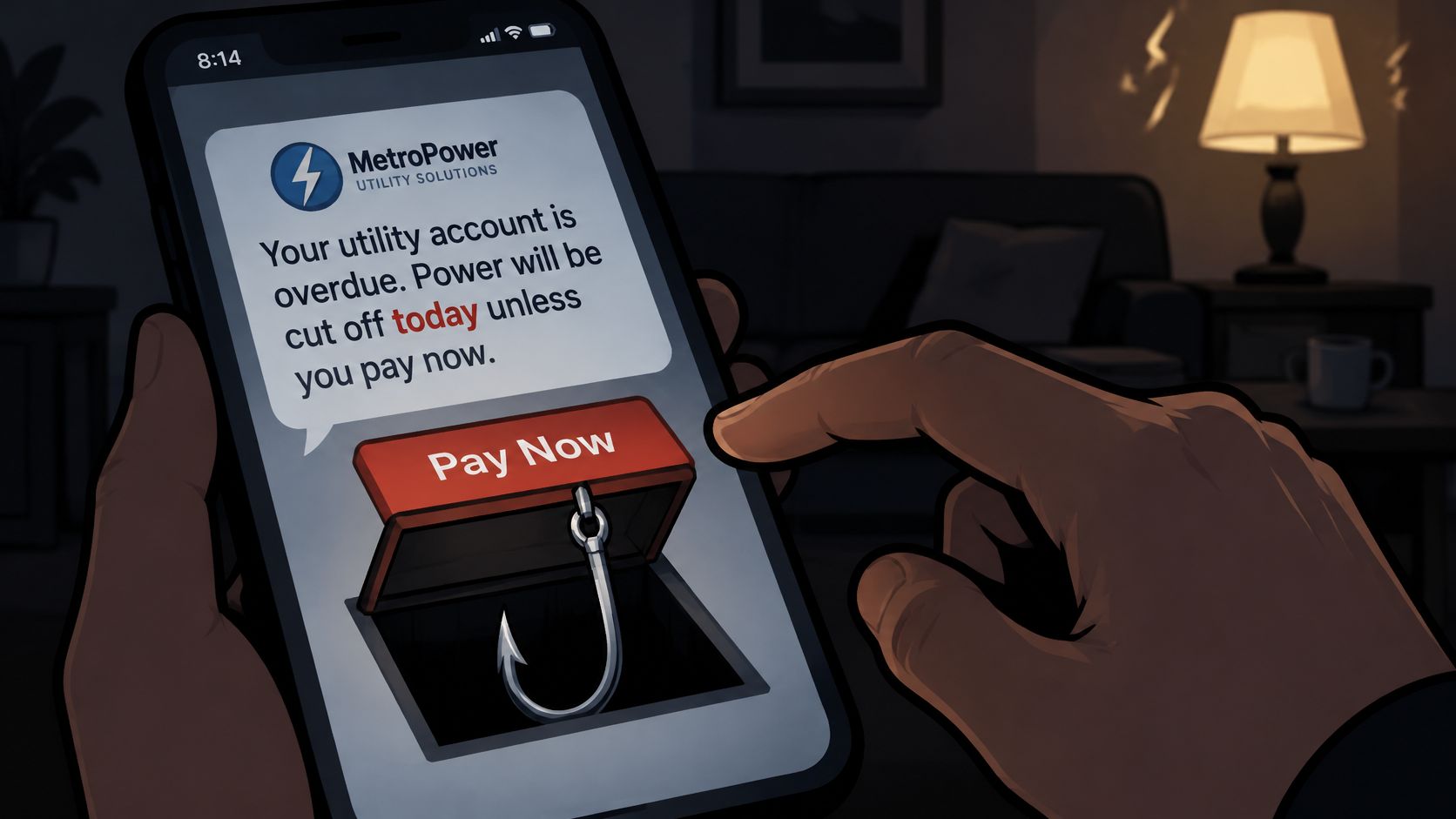
The FTC's review of its Impersonation Rule reported nearly $3 billion in imposter-scam losses in 2024, almost three times the reported 2020 level. Utility impersonation is one part of that broader category.
The approach often follows a simple sequence: borrow a provider's identity, create urgency, then steer the customer toward a payment destination controlled by the scammer. The counterfeit may arrive as a call, text, email, or paper notice. A familiar logo can make it look like ordinary billing correspondence, much like a counterfeit receipt can look convincing while directing payment to the wrong till.
The deadline does the persuading. A threat of same-day shutoff, a dispatched crew, or a growing fee pushes the recipient to act before checking where the payment will go. That is the trap: the bill's appearance is only the wrapper; the payment route is what determines who receives the money.
Red Flags That Expose a Fake Utility Bill
Run an unexpected bill through a filter before you treat it as a payment problem. One flag is a reason to slow down. Two or more make it very likely the message is counterfeit, and there's nothing left to gain by reading it carefully.
These are the signals worth checking first.
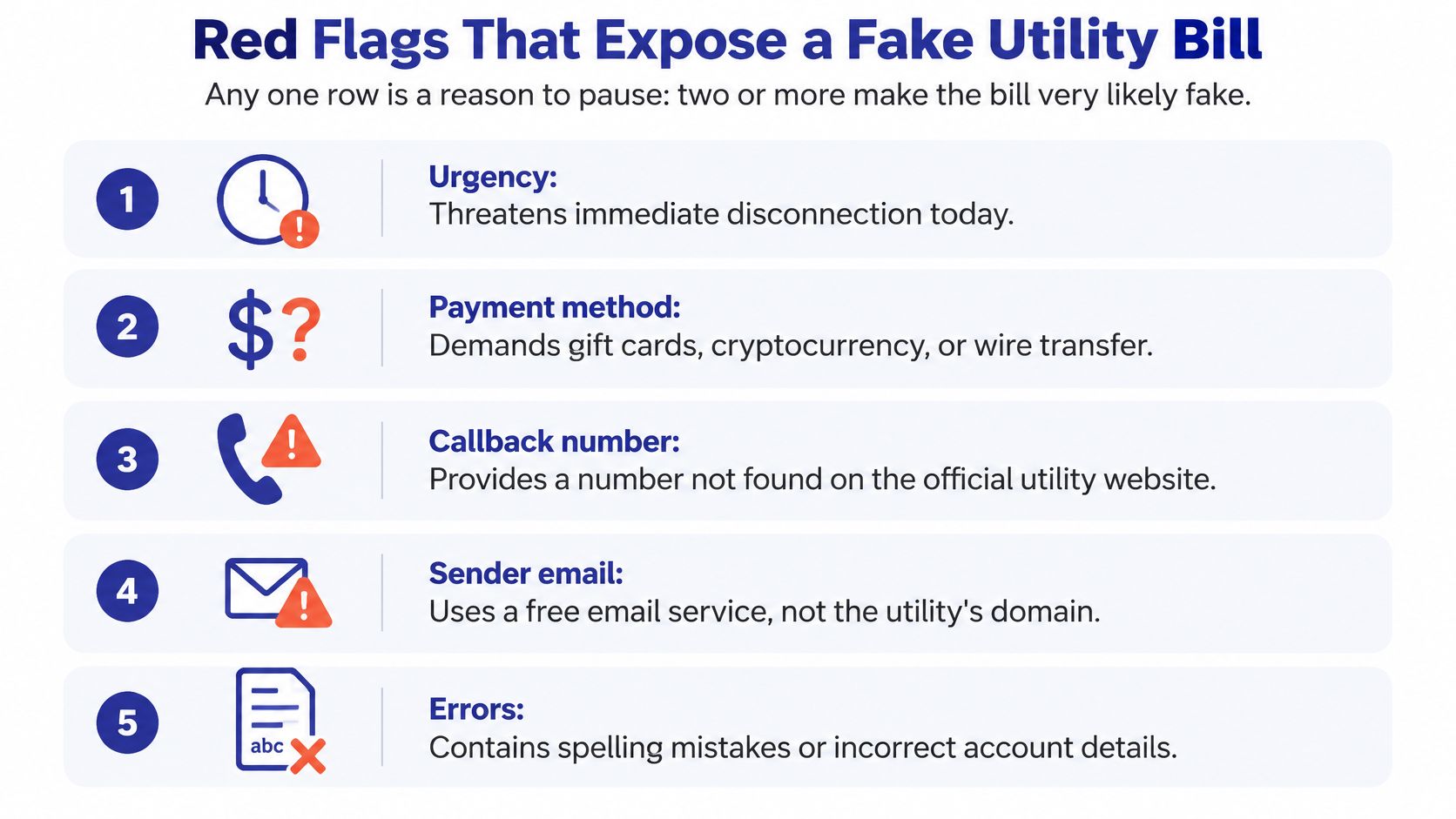
| Red flag | What it signals | What to do |
|---|---|---|
| Same-day disconnection threat | Pressure to act before checking | Hang up and check the balance through the provider's own portal |
| Unexpected call, text or email about an overdue balance | Unsolicited contact from an unverified sender | Ignore links and callback numbers in the message |
| Caller ID shows the utility's name | Caller ID can be spoofed | Call the number printed on a previous bill, not the one given |
| Account number or balance doesn't match your records | Counterfeit or misdirected bill | Compare with your own account in the official app or portal |
| Request to pay again after a payment was made | Earlier payment went to the wrong destination | Check receipts and the account ledger before paying anything |
| Payment page reached through a search result or ad | Lookalike website | Type the official address yourself or use a bookmarked portal |
A perfect logo proves nothing. Branding is the easiest element to copy and the least useful thing to inspect. A scammer can lift a logo, a font and a letterhead from the utility's own website in minutes and paste them into a PDF that prints cleanly.
Caller ID is a display, not a credential. The name on your screen comes from data the caller supplies, so a call showing the utility's name tells you nothing about who dialed. That's why the safe move is to hang up and dial the number printed on a bill you already have.
The row many overlook is the request to pay twice. If you've already sent money and a second message insists the balance is still open, that isn't a billing error to settle with another payment. It usually means the first payment never arrived where you intended.
Two minutes of watching fixes the pattern faster than reading it twice, and this walkthrough shows how quickly a fake bill turns into a payment demand.
Treat one flag as a prompt and any pair as a stop sign. The check that settles the question takes less time than re-reading the message.
How to Verify a Utility Bill Step by Step
The only check that works is one you run yourself, outside the message. Scammers own the number they gave you, the link they sent and the code they printed. They don't own the records inside your utility's billing system, and that's where the answer lives.
Follow these six steps in order.
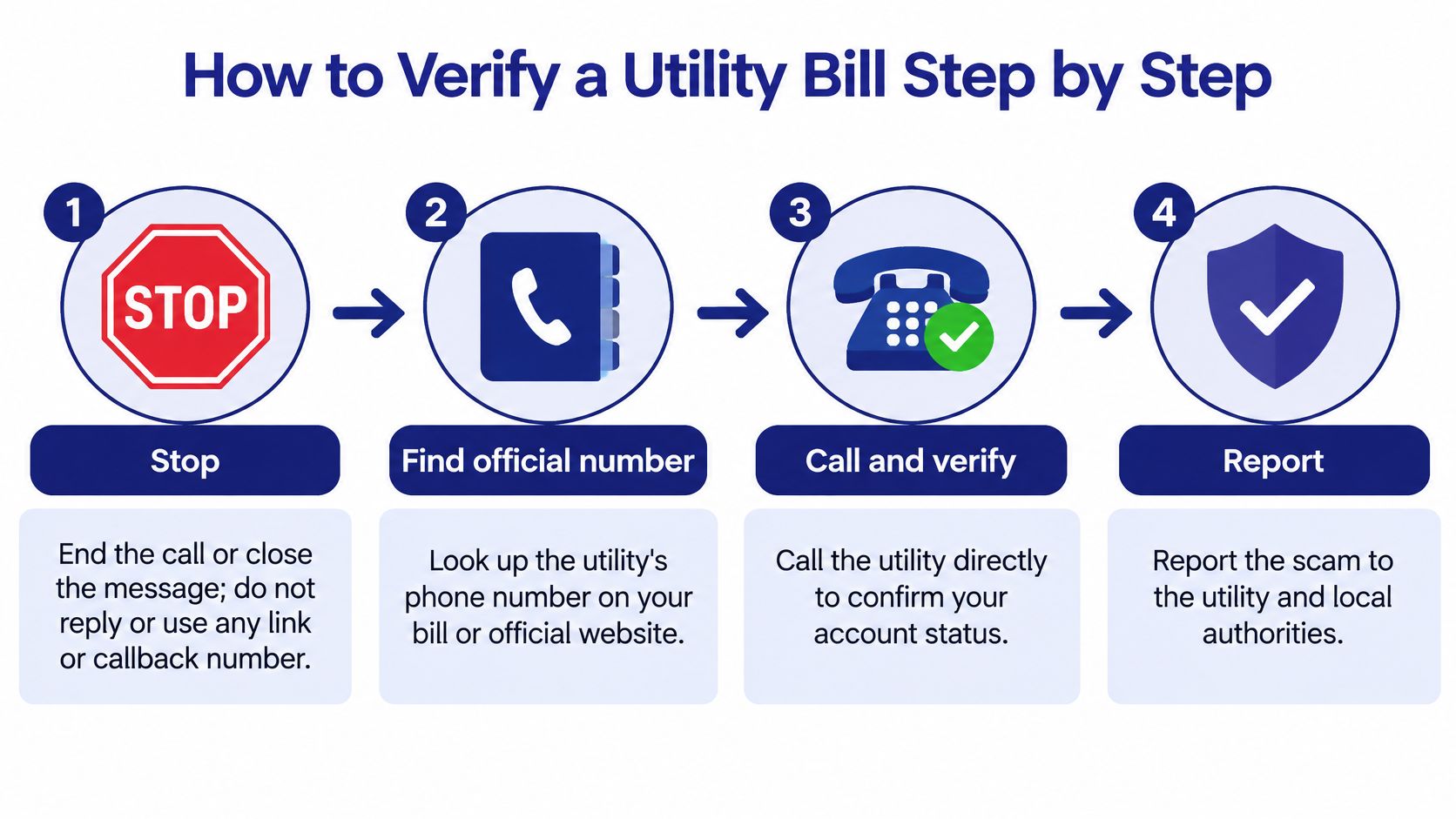
- Stop the interaction. End the call or close the message and don't reply. Everything in it, including a customer service number, a payment link or a barcode, was supplied by the person trying to take your money.
- Get the utility's number from a source that predates the message. A paper bill from last month, a statement already sitting in your email, or the address typed into the browser yourself. This is the step people skip, and it's the one the scam is engineered to prevent.
- Open your account and compare three things. Balance, due date, account number. When the message says $412.60 and the portal shows $98.40, or a zero balance, you have your answer without calling anyone.
- Ask the utility whether a shutoff is scheduled. A representative can see the order on your account. The FTC's guidance on utility impostors is direct: genuine utilities do not require immediate payment to avoid same-day disconnection, and they don't limit customers to gift cards, cryptocurrency, payment apps or wire transfers.
- Pay only through the verified route. If the balance does match, use the portal, the app or a method printed on a bill you checked yourself. Don't accept a receipt from a channel the utility doesn't recognize.
- If anything doesn't match, stop and keep the evidence. Screenshot the message, save the number, photograph the code, note the date and time. Those details carry a dispute, a report and a conversation with the utility.
The rule that covers everything else: if a caller asks for money, passwords or urgent action, check the request independently before you act.
Why the account record beats everything else
Three features together are more diagnostic than any one alone: you didn't initiate the contact, the deadline is today, and the only accepted payment is one that can't be reversed. Each of those happens in ordinary life. All three in the same message is not a coincidence.
Screening tools cut the volume of these messages and still won't catch every one, so a request involving money or urgency gets an independent check regardless. The same habit covers the wider family of fraud, including the phishing links that arrive disguised as billing notices, which use identical pressure and identical fake portals.
Payment Methods and QR Codes to Distrust
Sort payment methods by a single question: if this goes wrong, can I get the money back? The answer decides how much proof you need before anything leaves your account.
| Payment method | Reversibility | Legitimate utility asks for it |
|---|---|---|
| Credit card | Stronger dispute rights | Yes, through official channels |
| Debit card | Limited dispute options | Usually yes, through official channels |
| Wire transfer | Difficult to reverse | No |
| Gift card | Difficult to reverse | No |
| Cash-reload card | Difficult to reverse | No |
| Payment app | Difficult to reverse | No |
| Cryptocurrency | Effectively irreversible | No |
| Barcode or QR code paid at a retailer | Difficult to reverse | No |
The FTC's alert on barcode payment demands lists what utility scammers ask for: wire transfers, gift cards, cash-reload cards, payment apps, cryptocurrency and scannable barcodes or QR codes, all chosen because they're difficult to reverse. In a 2024 warning the agency described callers who sent a barcode by text or email and told people to pay at retailers such as Walgreens, CVS or Walmart to avoid shutoff or additional fees.
A real utility gives you options. One that accepts payment only tonight, only by gift card, only through a code, is telling you something.
The QR code problem
Scanning a code is not the harmless half-step it feels like. In 2025, San Diego Gas & Electric warned customers about codes directing them to pay alleged overdue balances at retail locations through Green Dot, and said it does not demand immediate payment and does not accept Bitcoin, Zelle or Green Dot for utility bills. The damage can start before any money moves, because malicious codes can lead to phishing sites that collect login or card details and can download malware.
How to check a payment destination
Type the utility's address yourself or open a bookmark you saved before any of this happened. The FTC has documented impersonators running payment pages and advertisements that appeared to belong to well-known companies, including utilities; some consumers paid added fees, while other payments never reached the company at all and surfaced later as collection notices, late fees or shutoff warnings.
Compare the account number and balance after paying, and treat a surprise convenience fee or a receipt missing from the provider's ledger as a warning rather than a rounding error. When you have to pay and you're unsure, a credit card leaves you a dispute route that a gift card or a wire doesn't.
What to Do If You Already Paid
Payment is the middle of the incident, not the end. The first few hours decide how much comes back, and the order of your calls matters more than the number of them.
| Payment used | Contact first | Immediate action |
|---|---|---|
| Credit card | Card issuer | Dispute the charge and request reversal |
| Debit card or bank transfer | Your bank | Report fraud and ask about recall of the funds |
| Payment app | App provider | Report the transfer and request reversal |
| Barcode or QR code at a retailer | Retailer or receipt issuer | Keep the receipt and report the transaction ID |
| Gift card | Card issuer or retailer | Report the card number immediately and keep the packaging |
| Cryptocurrency | Exchange or wallet provider | Report the transfer and preserve transaction IDs |
Then call the utility. The fraudulent payment almost certainly never reached the account, so the balance is still open and a shutoff may still be scheduled. A representative can confirm that no payment was received and note the account, which is what prevents a legitimate disconnection while your dispute runs.
The amounts are smaller than the headlines suggest, which is part of why the scam works. PG&E customers reported nearly 24,000 targeting incidents in 2025, with more than $301,000 in fraudulent payments and an average reported loss of $590, according to reporting on the utility's impersonation warning. A few hundred dollars is recoverable. The same amount paid and never disputed is not.
What to keep, and what to report
- The original message. Screenshot it with the sender details visible, before you block anything.
- The number and the code. The callback number, the barcode or QR code, and any reference number quoted to you.
- Receipts and transaction IDs. Every confirmation the retailer, app or bank gave you.
- A written log. Who you spoke to, when, and what they said, with times.
Report the incident to the FTC and to your state consumer protection office; both create a record you can attach to a bank dispute. If this has already happened to you, these steps to take after being scammed walk through the recovery sequence in the order that preserves the most money.
Protecting an Older Relative's Utility Account
Caregivers usually get pulled in through the account holder, not through their own phone. The scam leans on ordinary habits, a bill paid on time every month and a familiar company name, and asks for a decision before anyone can consult the family.
Set the routine up before a call ever comes.
- Confirm you're an authorized contact on the account. Do it in writing or through the utility's own process, never by phone with the person who called.
- Speak for the account holder only after that authorization is in place, so the utility knows who is calling and why.
- Keep logins and one-time codes private. No legitimate utility employee will ask for a code read aloud over the phone.
- Turn on bill and payment alerts in the official app or portal, so a change shows up as a notification instead of a surprise call.
- Agree a family rule in advance, so nobody improvises under pressure.
Family rule: no payment decision made under a shutoff threat, ever, until a relative calls back on a number already on file.
- Record who called, when and what they asked, and keep the message or the bill.
If the account holder can no longer manage bills but still makes their own decisions, a guardianship is the heaviest tool available and usually the wrong first move. The guide to Texas options short of full guardianship from the Law Office of Bryan Fagan, PLLC covers the lighter legal routes. For the broader conversation about protecting an older adult across phone, email and text, this senior fraud prevention guidance is a sensible next read.
The person who verifies the account should be you, on a number you looked up, not the caller who created the deadline.
Screen Suspicious Bills Before You Pay
The verification steps work on any bill. The difficulty is timing: an unexpected text at dinner is hard to check in the moment, and that moment is exactly what the scam is built for. A screening layer buys the seconds it takes to remember the steps.
Gini Help works from the message side rather than the document side. Text filtering moves scam texts into a separate folder, so fake delivery alerts, prize scams and phishing links are caught before you see them. Email protection flags suspicious senders, fake links and urgent payment requests, and explains the risk in plain language instead of leaving you to interpret a warning. Live Scam Detection adds a risk warning during a call you answer, which is the pause a shutoff threat is designed to remove.
Live Scam Detection depends on the plan you select and the setup it requires. No tool catches every scam, and some still get through, so a request involving money or urgency needs an independent check either way.
The app is available on Google Play at Gini Help for Android and on the App Store at Gini Help for iPhone. Install it as an extra layer, not a replacement for the three-minute check.
The next time a bill arrives with a deadline attached, do the check in this order: open the utility's own portal, compare the balance, and pay nothing until it matches.
Gini Help screens the calls, texts and emails that carry these fake bills, using AI to assess a caller in real time and flag urgent payment requests in plain language before they reach your bank account. If you'd rather have a layer of protection sitting between a shutoff threat and your money, visit Gini Help to see which plan suits your household.